From Surf Wiki (app.surf) — the open knowledge base
Bodiocasses
Gallic tribe
Gallic tribe
The Bodiocasses or Baiocasses were an ancient Gallic tribe of the Roman period. They were a tribal division of the civitas of the Lexovii, in the Roman province of Gallia Lugdunensis.
Name
Attestations
They are mentioned as Bodiocasses by Pliny (1st c. AD), as Baiocassi by Ausonius (4th c. AD), and as Baiocas in the Notitia Dignitatum (5th c. AD).
In Pliny's Natural History, various manuscripts refer to this tribe as the Vadiocasses, Bodiocasses, or Bodicasses, likely due to a copyist’s mistake.
The Vadicassii (Οὐαδικάσσιοι) cited by Ptolemy in the 2nd century AD are probably a separate tribe, since he places them near the Meldi (Meaux), in the direction of Belgica.
Etymology
The Gaulish ethnonym Bodiocasses derives from the Proto-Celtic stem *bodyo- ('yellow, blond'; cf. Old Irish buide 'yellow'). The meaning of the second element -casses, attested in other Gaulish ethnonyms such as Durocasses, Sucasses, Tricasses, Veliocasses or Viducasses, has been debated, but it probably signifies '(curly) hair, hairstyle' (cf. Old Irish chass 'curl'), perhaps referring to a particular warrior coiffure. Rudolf Thurneysen has compared the name with the Old Irish buide-chass ('blond curls'), and suggested to translate Bodiocasses as 'those who have blond curls/braids'.{{Sfn|Delamarre|2003|pp=109–110|ps=: "H. Birkhan parvient cependant à la conclusion raisonnable que -casses et cassi- sont deux mots différents, que -casses signifie probablement 'au cheveux bouclés / crépus' ("mit wirrem Kraushaar") et s'explique par la coiffure spéciale des Celtes au combat (une forme celto-germanique *kazdh- permettrait d'unifier le celtique -cass- et les mots v.norr. haddr 'longs cheveux de femme', ags. heord 'chevelure'
The city of Bayeux, attested ca. 400 AD as civitas Baiocassium ('civitas of the Baiocasses'; Baiocas in 400–410, Baieus in 1155), and the region of Bessin, attested in 840 AD as pagus Baiocassinus ('pagus of the Baiocasses'; Beissin in 1050–66), all stem from the Gallic tribe.
Geography
The Baiocasses dwelled in a region located around modern-day Bayeux in western Normandy.
History
Julius Caesar does not mention the tribe in his commentaries on the Gallic Wars (58–50 BCE), but they are later mentioned by Ausonius (4th c. AD) and in the Notitia Dignitatum (5th c. AD). They are probably the same people Pliny calls Bodiocasses.
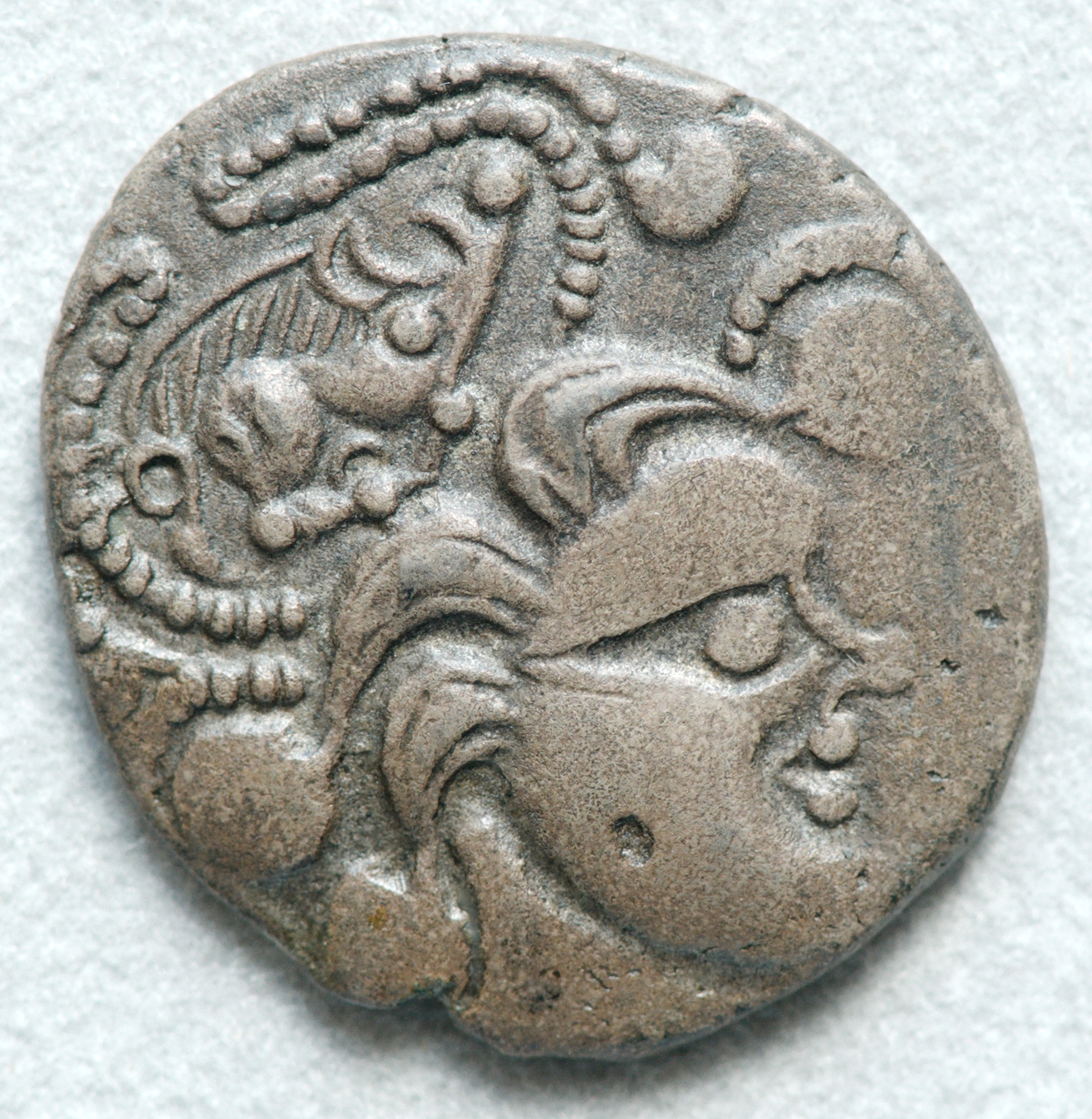
The Baiocasses minted base gold, silver and billon (base silver) coins in the denomination of one stater and in the case of gold coins sometimes quarter staters. Most of the coins show a Celtic-style male head with elaborated hair on the obverse, and on the reverse a horse with a chariot rider above or behind, and below usually either a lyre or small boar. A number of these are in existence.
The 4th-century Bordelaise poet Ausonius teases a friend as a Baiocassis who claimed to be of druidic heritage and descended from priests of Belenus.
References
Bibliography
References
- [[Pliny the Elder. Pliny]]. ''Naturalis Historia,'' 4:107.
- [[Ausonius]]. ''Professores'', 11, 4:7.
- ''[[Notitia Dignitatum]]'', oc. 42, 34.
- {{Harvnb. Falileyev. 2010, s.v. ''Bodiocasses''.
- Popineau, Jean-Marc. (2020). "Compte-rendus et Mémoires de la Société d'Histoire et d'Archéologie de Senlis 2016-2017".
- [http://www.cgb.fr/monnaies/vso/v15/fr/monnaiesfe8f.html?depart=787&nbfic=1515 BAIOCASSES - BAIOCASSES] - (Région de BAYEUX) - (Ier siècle avant J.-C.) - Statère d'argent fourré - c. 60-50 AC. - VSO 15.
- [[Ausonius]], ''Commemoratio professorum Burdigalensium'' 4.7; Altay Coşkun with Jürgen Zeidler, "'Cover Names' and Nomenclature in Late Roman Gaul: The Evidence of the Bordelaise Poet Ausonius" (2003), pp. 6–7.
This article was imported from Wikipedia and is available under the Creative Commons Attribution-ShareAlike 4.0 License. Content has been adapted to SurfDoc format. Original contributors can be found on the article history page.
Ask Mako anything about Bodiocasses — get instant answers, deeper analysis, and related topics.
Research with MakoFree with your Surf account
Create a free account to save articles, ask Mako questions, and organize your research.
Sign up freeThis content may have been generated or modified by AI. CloudSurf Software LLC is not responsible for the accuracy, completeness, or reliability of AI-generated content. Always verify important information from primary sources.
Report