From Surf Wiki (app.surf) — the open knowledge base
Boardwalk
Wooden footpath to cross wet land
Wooden footpath to cross wet land
walks made of boards
A boardwalk (alternatively board walk, boarded path, or promenade) is an elevated footpath, walkway, or causeway typically built with wooden planks, which functions as a type of low water bridge or small viaduct that enables pedestrians to better cross wet, muddy or marshy lands. Such timber trackways have existed since at least Neolithic times.
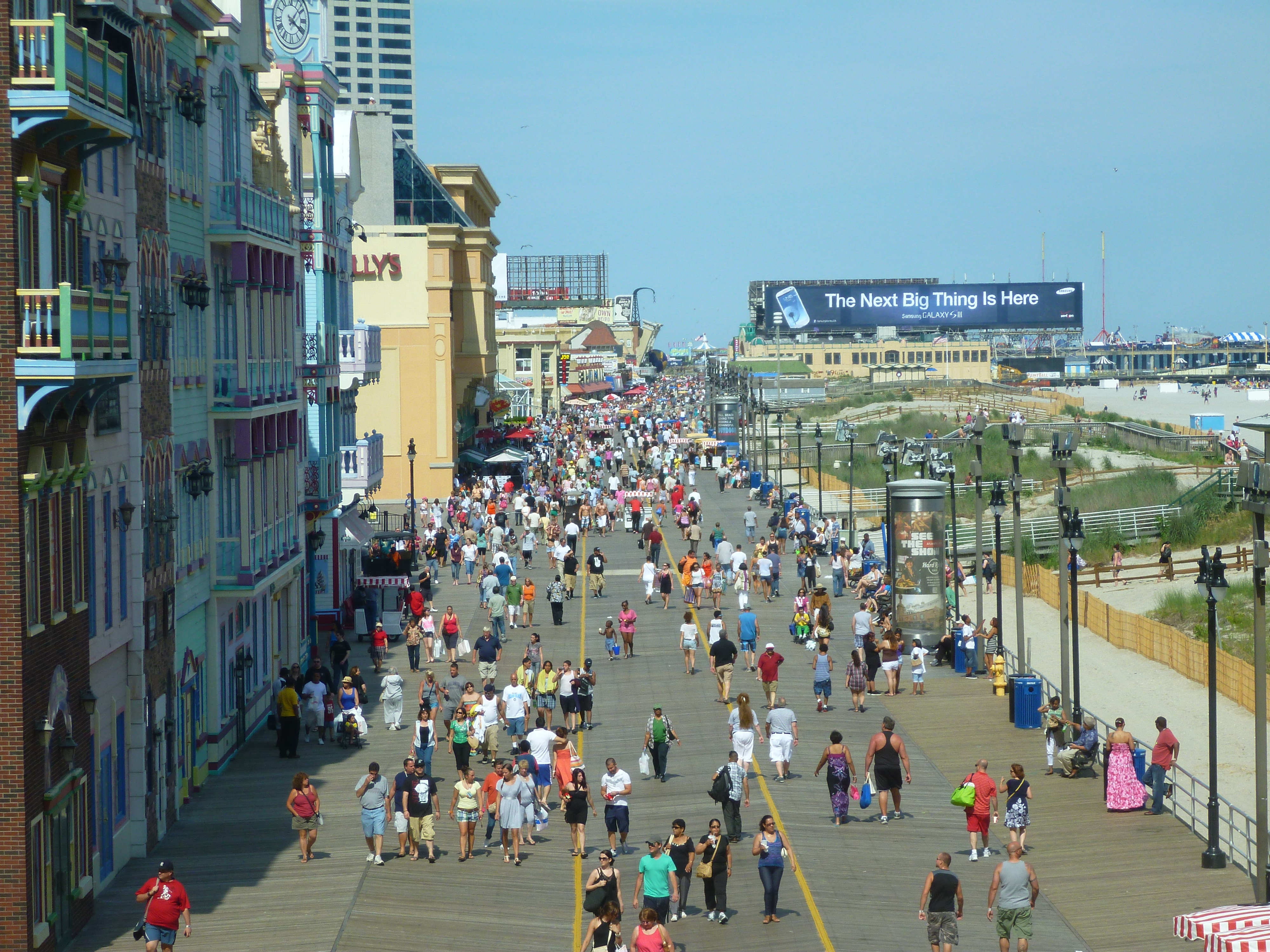
In many seaside resort locations, boardwalks along the beach provide access to shops, hotels, and tourist attractions. The Jersey Shore in the United States is especially noted for its abundance of boardwalks.
Some wooden boardwalks have had sections replaced by concrete and even "a type of recycled plastic that looks like wood."{{cite news
History
An early example is the Sweet Track that Neolithic people built in the Somerset levels, England, around 6000 years ago. This track consisted mainly of planks of oak laid end-to-end, supported by crossed pegs of ash, oak, and lime, driven into the underlying peat.
The Wittmoor bog trackway is the name given to each of two prehistoric plank roads, or boardwalks, trackway No. I being discovered in 1898 and trackway No. II in 1904 in the Wittmoor bog in northern Hamburg, Germany. The trackways date to the 4th and 7th century AD, both linked the eastern and western shores of the formerly inaccessible, swampy bog. A part of the older trackway No. II dating to the period of the Roman Empire is on display at the permanent exhibition of the Archaeological Museum Hamburg in Harburg borough, Hamburg.
Duckboards
A duckboard is a type of boardwalk placed over muddy and wet ground. During World War I, duckboards were used to line the bottom of trenches on the Western Front because these were regularly flooded, and mud and water would lie in the trenches for months on end. The boards helped to keep the soldiers' feet dry and prevent the development of trench foot, caused by prolonged standing in waterlogged conditions. They also allowed for troops' easier movement through the trench systems.
Combat troops on nearly all sides routinely wore hobnail-style trench boots that often slipped on the new duck boards when they were wet, and required extra caution. Falling or slipping off the duckboards could often be dangerous, even fatal. Unfortunate soldiers were left struggling to rise under the weight of their equipment in the intractable and sometimes deep water or mud. If this happened at ground level during a tactical advance, the rising soldier could be left a defenseless target for enemy fire as well as hinder forward progress. He could also simply go unnoticed in the ensuing melee, and easily drown under his heavy equipment.
Gallery
File:A wooden walkway through the lake.jpg|A wooden boardwalk allows passage through a lake, such as this one in Plitvice Lakes National Park, Croatia. File:HoriconMarshBoardwalk.jpg|This boardwalk allows people to cross Horicon Marsh. File:Lambi boardwalk.jpg|Boardwalk to the Lambi Beach on the Greek island of Kos File:Pyhä-Luosto National Park.jpg|Boardwalks help walkers navigate difficult terrain as at Pyhä-Luosto National Park in Lapland, Finland. File:Duckboards on the lake Storträsk in Sipoonkorpi, Helsinki, Finland, 2021 May.jpg|Duckboards on the Lake Storträsk at Sipoonkorpi National Park in Uusimaa, Finland. File:Mukri raba matkarada.jpg|A duckboard enables those on foot to cross a bog in Estonia. File:17 31 028 ocmulgee.jpg|Boardwalk at Ocmulgee National Monument File:Boardwalk in the grass (Unsplash).jpg|Boardwalk surrounded by tall grass File:Rain Forest in KLIA.jpg| KLIA Airport Boardwalk File:Canada Water Rafter Walk 01.jpg|Canada Dock Boardwalk, an urban boardwalk in Canada Water, London.
References
References
- ''Oxford English Dictionary''
- "1986,1201.1–27 Sweet Track exhibition highlight". [[British Museum]].
- The numbering of the trackways No. I for the younger northern one and No. II for the older southern one follows the local archive file of Archaeological Museum of Hamburg corresponding to early publications, in contrast to that Schindler uses a different numbering in his publication.
- Topic Mobility, Show case no. 80.
- (2013). "Archaeological Museum Hamburg Helms-Museum: A short guide to the Tour of the Times".
- "Definition of DUCKBOARD".
- Imperial War Museum, [http://www.iwm.org.uk/collections/item/object/30028121]
- "Laying the duckboards, France 1917".
This article was imported from Wikipedia and is available under the Creative Commons Attribution-ShareAlike 4.0 License. Content has been adapted to SurfDoc format. Original contributors can be found on the article history page.
Ask Mako anything about Boardwalk — get instant answers, deeper analysis, and related topics.
Research with MakoFree with your Surf account
Create a free account to save articles, ask Mako questions, and organize your research.
Sign up freeThis content may have been generated or modified by AI. CloudSurf Software LLC is not responsible for the accuracy, completeness, or reliability of AI-generated content. Always verify important information from primary sources.
Report