From Surf Wiki (app.surf) — the open knowledge base
Blue whale
Species of whale; largest animal known

Species of whale; largest animal known
- B. m. brevicauda Ichihara, 1966
- ?B. m. indica Blyth, 1859
- B. m. intermedia Burmeister, 1871
- B. m. musculus Linnaeus, 1758
- Balaena musculus Linnaeus, 1758
- Balaenoptera gibbar Scoresby 1820
- Pterobalaena gigas Van Beneden 1861
- Physalus latirostris Flower 1864
- Sibbaldius borealis Gray 1866
- Flowerius gigas Lilljeborg 1867
- Sibbaldius sulfureus Cope 1869
- Balaenoptera sibbaldii Sars 1875
The blue whale (Balaenoptera musculus) is a species of baleen whale and the largest marine mammal in the rorqual family Balaenopteridae. Reaching a maximum confirmed length of 29.9 – and weighing up to 190 –, it is the largest animal known to have ever existed. The blue whale's long and slender body can be of various shades of greyish-blue on its upper surface and somewhat lighter underneath. Four subspecies are recognized: B. m. musculus in the North Atlantic and North Pacific, B. m. intermedia in the Southern Ocean, B. m. brevicauda (the pygmy blue whale) in the Indian Ocean and South Pacific Ocean, and B. m. indica in the Northern Indian Ocean. There is a population in the waters off Chile that may constitute a fifth subspecies.
In general, blue whale populations migrate between their summer feeding areas near the poles and their winter breeding grounds near the tropics. There is also evidence of year-round residencies, and partial or age- and sex-based migration. Blue whales are filter feeders; their diet consists almost exclusively of krill. They are generally solitary or gather in small groups, and have no well-defined social structure other than mother–calf bonds. Blue whales vocalize, with a fundamental frequency ranging from 8 to 25 Hz; their vocalizations may vary by region, season, behavior, and time of day. Orcas are their only natural predators.
The blue whale was abundant in nearly all the Earth's oceans until the end of the 19th century. It was hunted almost to the point of extinction by whalers until the International Whaling Commission banned all blue whale hunting in 1966. The International Union for Conservation of Nature has listed blue whales as Endangered as of 2018. Blue whales continue to face numerous man-made threats such as ship strikes, pollution, ocean noise, and climate change.
Taxonomy
Nomenclature
The genus name, Balaenoptera, means winged whale, One of the first published descriptions of a blue whale comes from Robert Sibbald's Phalainologia Nova, after Sibbald found a stranded whale in the estuary of the Firth of Forth, Scotland, in 1692. The name "blue whale" was derived from the Norwegian blåhval, coined by Svend Foyn shortly after he had perfected the harpoon gun. The Norwegian scientist G. O. Sars adopted it as the common name in 1874.
Blue whales were referred to as "Sibbald's rorqual", after Robert Sibbald, who first described the species. This tinge is due to a coating of huge numbers of diatoms. (Herman Melville briefly refers to "sulphur bottom" whales in his novel Moby-Dick.)
Evolution
Blue whales are rorquals in the family Balaenopteridae. A 2018 analysis estimates that the Balaenopteridae family diverged from other families in between 10.48 and 4.98 million years ago during the late Miocene. The earliest discovered anatomically modern blue whale is a partial skull fossil from southern Italy identified as B. cf. musculus, dating to the Early Pleistocene, roughly 1.5–1.25 million years ago. The Australian pygmy blue whale diverged during the Last Glacial Maximum. Their more recent divergence has resulted in the subspecies having a relatively low genetic diversity, and New Zealand blue whales have an even lower genetic diversity.
Whole genome sequencing suggests that blue whales are most closely related to sei whales with gray whales as a sister group. This study also found significant gene flow between minke whales and the ancestors of the blue and sei whale. Blue whales also displayed high genetic diversity.
Hybridization
Blue whales are known to interbreed with fin whales. The earliest description of a possible hybrid between a blue whale and a fin whale was a 20 m anomalous female whale with the features of both the blue and the fin whales taken in the North Pacific. A whale captured off northwestern Spain in 1984, was found to have been the product of a blue whale mother and a fin whale father.
Two live blue-fin whale hybrids have since been documented in the Gulf of St. Lawrence (Canada), and in the Azores (Portugal). DNA tests done in Iceland on a blue whale killed in July 2018 by the Icelandic whaling company Hvalur hf., found that the whale was the offspring of a male fin whale and female blue whale; however, the results are pending independent testing and verification of the samples. Because the International Whaling Commission classified blue whales as a "Protection Stock", trading their meat is illegal, and the kill is an infraction that must be reported. Blue-fin hybrids have been detected from genetic analysis of whale meat samples taken from Japanese markets. Blue-fin whale hybrids are capable of being fertile. Molecular tests on a 70 ft pregnant female whale caught off Iceland in 1986 found that it had a blue whale mother and a fin whale father, while its fetus was sired by a blue whale.
In 2024, a genome analysis of North Atlantic blue whales found evidence that approximately 3.5% of the blue whales' genome was derived from hybridization with fin whales. Gene flow was found to be unidirectional from fin whales to blue whales. Comparison with Antarctic blue whales showed that this hybridization began after the separation of the northern and southern populations. Despite their smaller size, fin whales have similar cruising and sprinting speeds to blue whales, which would allow fin males to complete courtship chases with blue females.
There is a reference to a humpback–blue whale hybrid in the South Pacific, attributed to marine biologist Michael Poole.
Subspecies and stocks
At least four subspecies of blue whale are traditionally recognized, some of which are divided into population stocks or "management units". Like many large rorquals, the blue whale is a cosmopolitan species. They have a worldwide distribution, but are mostly absent from the Arctic Ocean and the Mediterranean, Okhotsk, and Bering Sea.
- Northern subspecies (B. m. musculus)
- North Atlantic population – This population is mainly documented from New England along eastern Canada to Greenland, particularly in the Gulf of St. Lawrence, during summer, though some individuals may remain there all year. They also aggregate near Iceland and have increased their presence in the Norwegian Sea. They are reported to migrate south to the West Indies, the Azores and northwest Africa.
- Eastern North Pacific population – Whales in this region mostly feed off California's coast from summer to fall and then Oregon, Washington State, the Alaska Gyre and Aleutian Islands later in the fall. During winter and spring, blue whales migrate south to the waters of Mexico, mostly the Gulf of California, and the Costa Rica Dome, where they both feed and breed.
- Central/Western Pacific population – This stock is documented around the Kamchatka Peninsula during the summer; some individuals may remain there year-round. They have been recorded wintering in Hawaiian waters, though some can be found in the Gulf of Alaska during fall and early winter.
- Northern Indian Ocean subspecies (B. m. indica) – This subspecies can be found year-round in the northwestern Indian Ocean, though some individuals have been recorded travelling to the Crozet Islands during between summer and fall.
- Pygmy blue whale (B. m. brevicauda)
- Madagascar population – This population migrates between the Seychelles and Amirante Islands in the north and the Crozet Islands and Prince Edward Islands in the south where they feed, passing through the Mozambique Channel.
- Australia/Indonesia population – Whales in this region appear to winter off Indonesia and migrate to their summer feeding grounds off the coast of Western Australia, with major concentrations at Perth Canyon and an area stretching from the Great Australian Bight and Bass Strait.
- Eastern Australia/New Zealand population – This stock may reside in the Tasman Sea and the Lau Basin in winter and feed mostly in the South Taranaki Bight and off the coast of eastern North Island. Blue whales have been detected around New Zealand throughout the year.
- Antarctic subspecies (B. m. intermedia) – This subspecies includes all populations found around the Antarctic. They have been recorded to travel as far north as the Eastern Tropical Pacific, the central Indian Ocean, and the waters of southwestern Australia and northern New Zealand.
Blue whales off the Chilean coast might be a separate subspecies based on their geographic separation, genetics, and unique song types. Chilean blue whales might overlap in the Eastern Tropical Pacific with Antarctica blue whales and Eastern North Pacific blue whales. Chilean blue whales are genetically differentiated from Antarctica blue whales such that interbreeding is unlikely. However, the genetic distinction is less between them and the Eastern North Pacific blue whale, hence there might be gene flow between the Southern and Northern Hemispheres. A 2019 study by Luis Pastene, Jorge Acevedo and Trevor Branch provided new morphometric data from a survey of 60 Chilean blue whales, hoping to address the debate about the possible distinction of this population from others in the Southern Hemisphere. Data from this study, based on whales collected in the 1965/1966 whaling season, shows that both the maximum and mean body length of Chilean blue whales lies between these values in pygmy and Antarctic blue whales. Data also indicates a potential difference in snout-eye measurements between the three, and a significant difference in fluke-anus length between the Chilean population and pygmy blue whales. This further confirms Chilean blue whales as a separate population, and implies that they do not fall under the same subspecies as the pygmy blue whale (B. m. brevicauda).
A 2024 genomic study of the global blue whale population found support for the subspecific status of Antarctic and Indo-western Pacific blue whales but not eastern Pacific blue whales. The study found "...divergence between the eastern North and eastern South Pacific, and among the eastern Indian Ocean, the western South Pacific and the northern Indian Ocean." and "no divergence within the Antarctic".
Description
The blue whale is a slender-bodied cetacean with a broad U-shaped head; thin, elongated flippers; a small sickle-shaped dorsal fin located close to the tail, and a large tail stock at the root of the wide and thin flukes. The upper jaw is lined with 70–395 black baleen plates. The throat region has 60–88 grooves which allows the skin to expand during feeding. It has two blowholes that can squirt 30 – up in the air. The skin has a mottled grayish-blue coloration, appearing blue underwater. The mottling patterns near the dorsal fin vary between individuals. The underbelly has lighter pigmentation and can appear yellowish due to diatoms in the water, which historically earned them the nickname "sulphur bottom".
Size

The blue whale is the largest animal known ever to have existed. Some studies have estimated that certain shastasaurid ichthyosaurs and the ancient whale Perucetus could have rivalled the blue whale in size, with Perucetus actually being heavier with a mean weight of 180 t. However, these estimates were based on fragmentary remains, and the proposed size for Perucetus was disputed by studies in 2024. Other studies estimate that, on land, large sauropods like Bruhathkayosaurus (mean weight: 110–170 tons) and Maraapunisaurus (mean weight: 80–120 tons) might have rivalled the blue whale, with the former even exceeding the blue whale based on its most liberal estimates (240 tons). However, these estimates were based on even more fragmentary specimens that had disintegrated by the time estimates could be made.
The International Whaling Commission (IWC) whaling database reports 88 individuals longer than 30 m, including one of 33 m. The Discovery Committee reported lengths up to 102 ft. The longest scientifically measured individual blue whale was 29.9 – from rostrum tip to tail notch. Female blue whales are larger than males. Hydrodynamic models suggest a blue whale could not exceed 33 m because of metabolic and energy constraints. The existence of blue whales exceeding 30.5 m in length has been questioned.
The average length of sexually mature female blue whales is 72.1 ft for Eastern North Pacific blue whales, 79 ft for central and western North Pacific blue whales, 68–78 ft for North Atlantic blue whales, 83.4 – for Antarctic blue whales, 77.1 ft for Chilean blue whales, and 69.9 ft for pygmy blue whales. Length measurements of blue whales in the Gulf of California suggest a mean length of 20.49 m and a maximum length of 29.01 m, which is comparable to Northeast Pacific blue whales.
In the Northern Hemisphere, males weigh an average 100 t and females 112 t. Eastern North Pacific blue whale males average 88.5 t and females 100 t. Antarctic males average 112 t and females 130 t. Pygmy blue whale males average 83.5 t to 99 t. The weight of the heart of a stranded North Atlantic blue whale was 180 kg, the largest known in any animal. The brain of a blue whale, which weighed 50.9 t, weighed about 3.636 kg. The record-holder blue whale was caught in the Southern Ocean on March 20, 1947, and was recorded as measuring 27.6 m long and weighing 190 tonne, with estimates of up to 199 tonne.
In 2024, Motani and Pyenson calculated the body mass of blue whales at different lengths, compiling records of their sizes from previous academic literatures and using regression analyses and volumetric analyses. A 25 m long individual was estimated to weigh approximately 101 -, while a 30 m long individual was estimated to weigh approximately 184 -. Considering that the largest blue whale was indeed 33 m long, they estimated that a blue whale of such length would have weighed approximately 252 -. In 2025, Paul and Larramendi estimated that blue whales could exceed 200 tonne, but likely not by as much as Motani and Pyenson documented.
During the harvest of a female blue whale in 1922, Messrs. Irvin and Johnson collected a fetus that is now 70% preserved and used for educational purposes. Some shrinkage may have occurred, making visualization of some features fairly difficult. Nonetheless it indicates that a blue whale fetus is approximately 133 mm long at the juncture between the embryonic and fetal phases of development. This fetus represents the youngest specimen recorded in terms of gestational stage.
The male blue whale has the largest penis in the animal kingdom, at around 3 m long and 12 in wide.
Life span
Blue whales live around 80–90 years or more. The oldest blue whale found was determined, using this method, to be 110 years old. The maximum age of a pygmy blue whale determined this way is 73 years. Long-term identification studies in the Northeast Pacific suggest that they live for at least 40–45 years. In a female pygmy blue whale, one corpus albicans is formed on average every 2.6 years.
Behavior and ecology

The blue whale is usually solitary, but can be found in pairs. When productivity is high enough, blue whales can be seen in gatherings of more than 50 individuals. The animals appear to use memory to locate the best feeding areas. There is evidence of alternative strategies, such as year-round residency, and partial (where only some individuals migrate) or age/sex-based migration. Some whales have been recorded feeding in breeding grounds. Blue whale typically swim at 2 – but may swim faster at 32 – during encounters with boats, predators or other individuals. Their massive size limits their ability to breach.
The greatest dive depth reported from tagged blue whales was 315 m. however, the longest dive measured was 15.2 minutes. A blue whale's heart rate can drop to 2 beats per minute (bpm) at deep depths, but upon surfacing, can rise to 37 bpm, which is close to its peak heart rate.
Diet and feeding

The blue whale's diet consists almost exclusively of krill, which they capture through lunge feeding, where they swim towards krill at high speeds with their mouths open up to 80 degrees. They squeeze the water out through their baleen plates with pressure from the throat pouch and tongue, and swallow the remaining krill. Blue whales have been recorded making 180° rolls during lunge-feeding, possibly allowing them to search the prey field and find the densest patches.
While pursuing krill patches, blue whales maximize their calorie intake by increasing the number of lunges while selecting the thickest patches. This provides them enough energy for everyday activities while storing additional energy necessary for migration and reproduction. Due to their size blue whales have larger energetic demands than most animals, resulting in their need for this specific feeding habit. Blue whales have to engulf densities greater than 100 krill/m3 to maintain the cost of lunge feeding. They can consume 34,776 – from one mouthful of krill, which can provide up to 240 times more energy than used in a single lunge. On average, a blue whale eats 4 t each day.
In the southern ocean, blue whales feed on Antarctic krill (Euphausia superba). In the South Australia, pygmy blue whales (B. m. brevicauda) feeds on Nyctiphanes australis. In California, they feed mostly on Thysanoessa spinifera, but also less commonly on North pacific krill (Euphausia pacifica). Research of the Eastern North Pacific population shows that when diving to feed on krill, the whales reach an average depth of 201 meters, with dives lasting 9.8 minutes on average.
While most blue whales feed almost exclusively on krill, the Northern Indian Ocean subspecies (B. m. indica) instead feeds predominantly on sergestid shrimp. To do so, they dive deeper and for longer periods of time than blue whales in other regions of the world, with dives of 10.7 minutes on average, and a hypothesized dive depth of about 300 meters. Fecal analysis also found the presence of fish, krill, amphipods, cephalopods, and scyphozoan jellyfish in their diet.
Blue whales appear to avoid directly competing with other baleen whales. Different whale species select different feeding spaces and times as well as different prey species. In the Southern Ocean, baleen whales appear to feed on Antarctic krill of different sizes, which may lessen competition between them.
Blue whale feeding habits may differ due to situational disturbances, like environmental shifts or human interference. This can cause a change in diet due to stress response. Due to these changing situations, there was a study performed on blue whales measuring cortisol levels and comparing them with the levels of stressed individuals, it gave a closer look to the reasoning behind their diet and behavioral changes.
Reproduction and birth
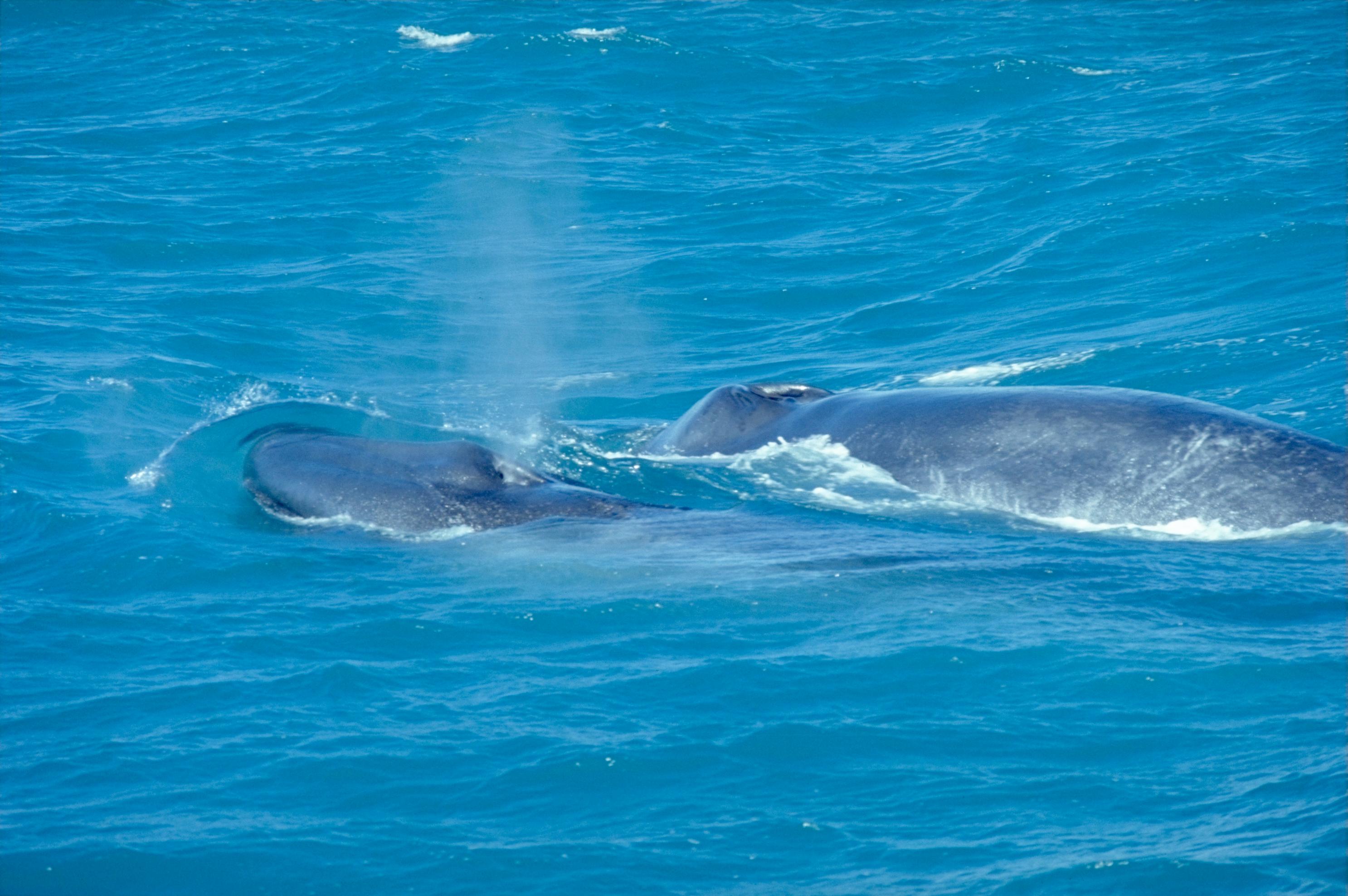
The age of sexual maturity in blue whales is thought to be between 5 and 15 years, with females reaching an average of 10 years and males reaching an average of 12 years. In the Northern Hemisphere, the length at which they reach maturity is 21 – for females and 20 – for males. In the Southern Hemisphere, the length of maturity is 23 – and 22 m for females and males respectively. Female pygmy blue whales are 68.9 – in length Since corpora are added every ~2.5 years after sexual maturity, physical maturity is assumed to occur at 35 years. Little is known about mating behavior, or breeding and birthing areas. A male blue whale typically trails a female and will fight off potential rivals. The species mates from fall to winter.
Pregnant females eat roughly four percent of their body weight daily, amounting to 60% of their overall body weight throughout summer foraging periods. Gestation may last 10–12 months with calves being 6 – long and weighing 2 – at birth. The first video of a calf thought to be nursing was filmed in New Zealand in 2016. Calves may be weaned when they reach 6–8 months old at a length of 53 ft.
Vocalizations
Blue whales produce some of the loudest and lowest frequency vocalizations in the animal kingdom, The fundamental frequency for blue whale vocalizations ranges from 8 to 25 Hz. The maximum loudness is 188 dB.
Vocalizations produced by the Eastern North Pacific population have been well studied. This population produces pulsed calls ("A") and tonal calls ("B"), upswept tones that precede type B calls ("C") and separate downswept tones ("D"). A and B calls are often produced in repeated co-occurring sequences and sung only by males, suggesting a reproductive function. D calls may have multiple functions. They are produced by both sexes during social interactions while feeding. and by males when competing for mates.
Blue whale calls recorded off Sri Lanka have a three-unit phrase. The first unit is a 19.8 to 43.5 Hz pulsive call, and is normally 17.9 ± 5.2 seconds long. The second unit is a 55.9 to 72.4 Hz FM upsweep that is 13.8 ± 1.1 seconds long. The final unit is 28.5 ± 1.6 seconds long with a tone of 108 to 104.7 Hz. A blue whale call recorded off Madagascar, a two-unit phrase, consists of 5–7 pulses with a center frequency of 35.1 ± 0.7 Hz lasting 4.4 ± 0.5 seconds proceeding a 35 ± 0 Hz tone that is 10.9 ± 1.1 seconds long.
There is evidence that some blue whale songs have temporally declined in tonal frequency. The vocalization of blue whales in the Eastern North Pacific decreased in tonal frequency by 31% from the early 1960s to the early 21st century. tracing "more than six years of acoustic monitoring" off of California, researchers found that during a heatwave, the blue whales were vocalizing less often, potentially due to needing to spend their energy trying to find food that is increasingly scarce due to the effects of climate change. A June 2022 study suggested that the decline in song frequency in blue whales is simply a cultural phenomenon.
Predators
The only known natural predator to blue whales is the orca, although the rate of fatal attacks by orcas is unknown. Photograph-identification studies of blue whales have estimated that a high proportion of the individuals in the Gulf of California have rake-like scars, indicative of encounters with orcas. Off southeastern Australia, 3.7% of blue whales photographed had rake marks and 42.1% of photographed pygmy blue whales off Western Australia had rake marks. Documented predation by orcas has been rare. A blue whale mother and calf were first observed being chased at high speeds by orcas off southeastern Australia. The first documented attack occurred in 1977 off southwestern Baja California, Mexico, but the injured whale escaped after five hours. Four more blue whales were documented as being chased by a group of orcas between 1982 and 2003. The first documented predation event by orcas occurred in September 2003, when a group of orcas in the Eastern Tropical Pacific was encountered feeding on a recently killed blue whale calf. In March 2014, a commercial whale watch boat operator recorded an incident involving a group of orcas harassing a blue whale in Monterey Bay. The blue whale defended itself by slapping its tail. A similar incident was recorded by a drone in Monterey Bay in May 2017. The first direct observations of orca predation occurred off the south coast of Western Australia, two in 2019 and one more in 2021. The first victim was estimated to be 18 –.
Infestations and health threats
In Antarctic waters, blue whales accumulate diatoms of the species Cocconeis ceticola and the genera Navicola, which are normally removed when the whales enter warmer waters. Barnacles such as Coronula diadema, Coronula reginae, and Cryptolepas rhachianecti, latch on to whale skin deep enough to leave behind a pit if removed. Whale lice species make their home in cracks of the skin and are relatively harmless. The copepod species Pennella balaenopterae digs in and attaches itself to the blubber to feed on. Intestinal parasites include the trematode genera Ogmogaster and Lecithodesmus; the tapeworm genera Priapocephalus, Phyllobotrium, Tetrabothrius, Diphyllobotrium, and Diplogonoporus; and the thorny-headed worm genus Bolbosoma. In the North Atlantic, blue whales also contain the protozoans Entamoeba, Giardia and Balantidium.
Conservation
The global blue whale population is estimated to be 5,000–15,000 mature individuals and 10,000–25,000 total as of 2018. The protected status of North Atlantic blue whales was not recognized by Iceland until 1960. In the United States, the species is protected under the Endangered Species Act.
Blue whales are formally classified as endangered under both the U.S. Endangered Species Act and the IUCN Red List. They are also listed on Appendix I under the Convention on International Trade in Endangered Species of Wild Fauna and Flora (CITES) and the Convention on the Conservation of Migratory Species of Wild Animals. Although, for some populations, there is not enough information on current abundance trends (e.g., pygmy blue whales), others are critically endangered (e.g., Antarctic blue whales).
Threats
In 2017, DNA evidence was used to identify whale bones at Icelandic archaeological sites. Of the 124 bones analyzed more than 50% were from blue whales and some dated as far back as 900 CE. This, and other evidence, suggests that Icelanders were hunting whales as early as the 9th century, just as the settlement of Iceland began. Thus Icelanders would have been among the earliest known humans to hunt the blue whale.
Blue whales were initially difficult to hunt because of their size and speed. Blue whale whaling peaked between 1930 and 1931 with 30,000 animals taken. Harvesting of the species was particularly high in the Antarctic, with 350,000–360,000 whales taken in the first half of the 20th century. In addition, 11,000 North Atlantic whales (mostly around Iceland) and 9,500 North Pacific whales were killed during the same period. However, the Soviet Union continued to illegally hunt blue whales and other species up until the 1970s.

Ship strikes are a significant mortality factor for blue whales, especially off the U.S. West Coast. A total of 17 blue whales were killed or suspected to have been killed by ships between 1998 and 2019 off the U.S. West Coast. Five deaths in 2007 off California were considered an unusual mortality event, as defined under the Marine Mammal Protection Act. Lethal ship strikes are also a problem in Sri Lankan waters, where their habitat intersects with one of the world's most active shipping routes. Here, strikes caused the deaths of eleven blue whales in 2010 and 2012, and at least two in 2014. Ship-strike mortality claimed the lives of two blue whales off southern Chile in the 2010s. Possible measures for reducing future ship strikes include better predictive models of whale distribution, changes in shipping lanes, vessel speed reductions, and seasonal and dynamic management of shipping lanes. Few cases of blue whale entanglement in commercial fishing gear have been documented. The first report in the U.S. occurred off California in 2015, reportedly some type of deep-water trap/pot fishery. Three more entanglement cases were reported in 2016. In Sri Lanka, a blue whale was documented with a net wrapped through its mouth, along the sides of its body, and wound around its tail.
Increasing man-made underwater noise impacts blue whales. They may be exposed to noise from commercial shipping and seismic surveys as a part of oil and gas exploration. Blue whales in the Southern California Bight decreased calling in the presence of mid-frequency active (MFA) sonar. Exposure to simulated MFA sonar was found to interrupt blue whale deep-dive feeding, but no changes in behavior were observed in individuals feeding at shallower depths. The responses also depended on the animal's behavioral state, its (horizontal) distance from the sound source and the availability of prey.
The potential impacts of pollutants on blue whales is unknown. However, because blue whales feed low on the food chain, there is a lesser chance for bioaccumulation of organic chemical contaminants. Analysis of the earwax of a male blue whale killed by a collision with a ship off the coast of California showed contaminants like pesticides, flame retardants, and mercury. Reconstructed persistent organic pollutant (POP) profiles suggested that a substantial maternal transfer occurred during gestation and/or lactation. Male blue whales in the Gulf of St. Lawrence, Canada, were found to have higher concentrations of PCBs, dichlorodiphenyltrichloroethane (DDT), metabolites, and several other organochlorine compounds relative to females, reflecting maternal transfer of these persistent contaminants from females into young.
Note
References
References
- Cooke, J.G.. (2018). "''Balaenoptera musculus''".
- "Appendices {{!}} CITES".
- (2023). "A heavyweight early whale pushes the boundaries of vertebrate morphology". Nature.
- Linnaeus, Carl. (1758). "Systema Naturae per regna tria naturae, secundum classes, ordines, genera, species, cum characteribus, differentiis, synonymis, locis". Laurentius Salvius.
- (1692). "Phalainologia Nova". Blue Whale ("Balaenoptera Musculus").
- (2008). "Wild Blue: A Natural History of the World's Largest Animal". [[St. Martin's Press]].
- Bennett, A G. (1920). "On the occurrence of diatoms on the skin of whales". Proc. R. Soc. Lond. B.
- (2018). "Whole-genome sequencing of the blue whale and other rorquals finds signatures for introgressive gene flow". [[Science Advances]].
- (2019). "Rise of the titans: baleen whales became giants earlier than thought". [[Biology Letters]].
- (2015). "Low genetic diversity in pygmy blue whales is due to climate-induced diversification rather than anthropogenic impacts". Biology Letters.
- (2018). "Documentation of a New Zealand blue whale population based on multiple lines of evidence". Endangered Species Research.
- Lindquist, Ole. (1997). "Peasant fisherman whaling in the Northeast Atlantic area, ca 900-1900 AD". Háskólinn á Akureyri.
- (1970). "A whale with features of the fin and the blue whale". Izvestia TINRO.
- (1998). "A new hybrid between a blue whale, ''Balaenoptera Musculus'', and a fin whale, "B. Physalus:" frequency and implications of hybridization". Marine Mammal Science.
- (2017). "Are the "Bastards" coming back? Molecular identification of live blue and fin whale hybrids in the North Atlantic ocean".
- Kilvert, Nick. (20 July 2018). "DNA test shows slaughtered blue whale is a hybrid, Iceland marine institute says". [[Australian Broadcasting Corporation.
- Fishman, Margie. (19 July 2018). "Hybrid blue-fin whale is still protected". [[Animal Welfare Institute]].
- (1998). "Species identification using genetic tools: the value of nuclear and mitochondrial gene sequences in whale conservation". Journal of Heredity.
- (1991). "Species hybridization between a female blue whale (''Balaenoptera rnusctllus'') and a male fin whale ("B.pbysalus"): Molecular and morphological documentation". [[Journal of Heredity]].
- (6 January 2024). "Population structure and history of North Atlantic Blue whales (''Balaenoptera musculus musculus'') inferred from whole genome sequence analysis". [[Conservation Genetics]].
- (25 September 2019). "Genomic analyses reveal an absence of contemporary introgressive admixture between fin whales and blue whales, despite known hybrids". PLOS ONE.
- (November 2020). "Recovery Plan for the Blue Whale (''Balaenoptera musculus'')". National Oceanic and Atmospheric Administration.
- (13 November 2016). "List of Marine Mammal Species and Subspecies". [[The Society for Marine Mammalogy]].
- (2015). "Marine Mammals of the World: A Comprehensive Guide to Their Identification". Academic Press.
- (2018). "Encyclopedia of marine mammals". Academic Press.
- (2023). "Patterns of genetic variation in Southern Hemisphere blue whales, and the use of assignment test to detect mixing on the feeding grounds". Journal of Cetacean Research and Management.
- (2015). "First documented migratory destination for eastern South Pacific blue whales". Marine Mammal Science.
- (2010). "Preliminary recordings of blue whale (''Balaenoptera musculus'') vocalizations in the Gulf of Corcovado, northern Patagonia Chile". Marine Mammal Science.
- (2016). "Genetic variation in blue whales in the eastern Pacific: implication for taxonomy and use of common wintering grounds". [[Molecular Ecology]].
- (2019). "Morphometric analysis of Chilean blue whales and implications for their taxonomy". Marine Mammal Science.
- (2024). "Global conservation genomics of blue whales calls into question subspecies taxonomy and refines knowledge of population structure". Animal Conservation.
- (2002). "Whales, dolphins, and porpoises of the eastern North Pacific and adjacent Arctic waters: A guide to their identification". [[Knopf]].
- (1982). "Whales, dolphins, and porpoises of the eastern North Pacific and adjacent Arctic waters: A guide to their identification". NOAA Technical Report NMFS Circular.
- Tinker, Spencer Wilkie. (1988). "Whales of the World". Brill Archive.
- (1997). "Blue Whales". Voyager Press.
- (2009). "Encyclopedia of marine mammals". [[Academic Press]].
- (1976). "Whales, dolphins, and porpoises of the western North Atlantic". NOAA Technical Report NMFS Circular.
- (1990). "Photographic identification of the blue whale (''Balaenoptera musculus'') in the Gulf of St. Lawrence, Canada". [[Reports of the International Whaling Commission]].
- (2009). "Insights into the population structure of blue whales in the Eastern North Pacific from recent sightings and photographic identification". [[Marine Mammal Science]].
- (2012). "A new classification method to simplify blue whale photo-identification technique". Journal of Cetacean Research and Management.
- (1851). "[[Moby-Dick]]". [[Harper (publisher).
- (1874). "The Marine Mammals of the Northwestern Coast of North America". Dover.
- (1956). "The blue whale". [[Scientific American]].
- (1981). "Growth and energy budgets of large baleen whales from the southern hemisphere". FAO Fisheries Series (5) Mammals in the Seas.
- (1984). "The blue whale, ''Balaenoptera musculus''". Marine Fisheries Review.
- (2018). "A giant Late Triassic ichthyosaur from the UK and a reinterpretation of the Aust Cliff 'dinosaurian' bones". PLOS ONE.
- (2024). "Downsizing a heavyweight: factors and methods that revise weight estimates of the giant fossil whale ''Perucetus colossus''". PeerJ.
- (11 April 2023). "Body mass estimate of ''Bruhathkayosaurus'' and other fragmentary sauropod remains suggest the largest land animals were about as big as the greatest whales". Lethaia.
- (2015). "Sizing ocean giants: patterns of intraspecific size variation in marine megafauna". [[PeerJ]].
- (1942). "The southern stocks of whalebone whales". [[Discovery Reports]].
- (2002). "Update COSEWIC status report on the blue whale (''Balaenoptera musculus'') in Canada". [[Committee on the Status of Endangered Wildlife in Canada]].
- (2002). "Assessment and Update Status Report on the Blue Whale ''Balaenoptera musculus''". Committee on the Status of Endangered Wildlife in Canada.
- (2025). "Further trimming down the marine heavyweights: ''Perucetus colossus'' did not come close to, much less exceed, the tonnage of blue whales, and the latter are not ultra-sized either". Palaeontologia Electronica.
- (1976). "Mammals in which females are larger than males". [[The Quarterly Review of Biology]].
- (2012). "Metabolic Expenditures of Lunge Feeding Rorquals Across Scale: Implications for the Evolution of Filter Feeding and the Limits to Maximum Body Size". [[PLOS ONE]].
- (2007). "Separating southern blue whale subspecies based on length frequencies of sexually mature females". [[Marine Mammal Science]].
- (2008). "Geographic variation in external morphology of North Pacific and Southern Hemisphere blue whales (''Balaenoptera musculus'')". Journal of Cetacean Research and Management.
- (2022). "Mammalian Biology".
- (1976). "Body weights of some species of large whales". [[J. Cons. Int. Explor. Mer]].
- "See the world's biggest heart".
- "Largest mammal".
- Roston, Rachel A.. (2013). "Anatomy and Age Estimation of an Early Blue Whale (Balaenoptera musculus) Fetus". The Anatomical Record.
- "Reproduction". [[University of Wisconsin]].
- (2010). "Sighting history of a naturally marked humpback whale (''Megaptera novaeangliae'') suggests ear plug growth layer groups are deposited annually". Marine Mammal Science.
- (1984). "Age Determination by means of the ear plug in baleen whales". Report of the International Whaling Commission.
- (August 2021). "Deciphering the whale's secrets to have a long life". Experimental Gerontology.
- "Blue whale".
- "Blue whale". [[Whale and Dolphin Conservation]].
- (2008). "Biological parameters for pygmy blue whales". International Whaling Commission Document.
- (2019). "Memory and resource tracking drive blue whale migrations". Proceedings of the National Academy of Sciences.
- (2016). "Mysticete migration revisited: Are Mediterranean fin whales an anomaly?". Mammal Review.
- Cavendish, Marshall. (2001). "Endangered Wildlife and Plants of the World". Marshall Cavendish Corporation.
- (2020). "Energetic and physical limitations on the breaching performance of large whales". eLife.
- (2010). "The diving behavior of blue and fin whales: Is dive duration shorter than expected based on oxygen stores?". Comparative Biochemistry and Physiology Part A: Molecular & Integrative Physiology.
- (2019). "Extreme bradycardia and tachycardia in the world's largest animal". Proceedings of the National Academy of Sciences.
- (2012). "Underwater acrobatics by the world's largest predator: 360° rolling manoeuvres by lunge-feeding blue whales". [[Biology Letters]].
- Barlow, Dawn R.. (2023). "Shaped by their Environment: Variation in Blue Whale Morphology Across Three Productive Coastal Ecosystems". Integrative Organismal Biology.
- (2006). "Whales, Whaling and Ocean Ecosystems". University of California Press.
- (6 April 2018). "New Determination of Prey and Parasite Species for Northern Indian Ocean Blue Whales". Frontiers in Marine Science.
- (1 August 1998). "Blue whale habitat and prey in the California Channel Islands". Deep Sea Research Part II: Topical Studies in Oceanography.
- (1960). "The competitive exclusion principle". Science.
- (1961). "The Paradox of the Plankton". [[The American Naturalist]].
- (1974). "Niche overlap and diffuse competition". Proceedings of the National Academy of Sciences.
- (2008). "Habitat selection and niche characteristics of rorqual whales in the northern Gulf of St. Lawrence (Canada)". [[McGill University]].
- (2015). "Feeding performance by sympatric blue and fin whales exploiting a common prey resource". Marine Mammal Science.
- (2010). "Spatial association between hotspots of baleen whales and demographic patterns of Antarctic krill ''Euphausia superba'' suggests size-dependent predation". Marine Ecology Progress Series.
- Melica, Valentina. (2020). "Reproduction and Stress Response Endocrinology in Blue (Balaenoptera musculus) and Gray (Eschrichtius robust) Whales".
- "The Blue Whale".
- (2023). "Sex in Cetaceans".
- (1970). "The onset of sexual and physical maturity for pygmy blue whales (''Balaenoptera musculus brevicauda''. Ichinara. 1966)". Whales of the Southern Hemisphere.
- (2008). "Regional differences in length at sexual maturity for female blue whales based on recovered Soviet whaling data". Marine Mammal Science.
- "Sex ratios in blue whales from conception onward".
- (2013). "Reproductive parameters of eastern North Pacific blue whales ''Balaenoptera musculus''". Endangered Species Research.
- (2019). "Visual and passive acoustic observations of blue whale trios from two distinct populations". Marine Mammal Science.
- (1969). "Feeding rates of Cetacea". Fiskeridir. SKR. Havundersok.
- (1984). "Review of baleen whale (Mysticeti) reproduction and implications for management". Report of the International Whaling Commission.
- (2 March 2016). "Exclusive Video May Show Blue Whale Calf Nursing". [[National Geographic]].
- (2008). "Biomechanical and structural modeling of hearing in baleen whales". Bioacoustics.
- (1998). "Long-range acoustic detection and localization of blue whale calls in the northeast Pacific Ocean". Journal of the Acoustical Society of America.
- (June 2022). "Mathematical models of long term evolution of blue whale song types' frequencies". Journal of Theoretical Biology.
- (2000). "Hearing by whales and dolphins". Springer-Verlag.
- (2001). "The acoustic calls of blue whales off California with gender data". Journal of the Acoustical Society of America.
- (2007). "Behavioral context of call production by eastern North Pacific blue whales". [[Marine Ecology Progress Series]].
- (2018). "Context-dependent variability in blue whale acoustic behaviour". [[Royal Society Open Science]].
- (2010). "Seasonal detection of three types of "pygmy" blue whale calls in the Indian Ocean". Marine Mammal Science.
- (1998). "A comparison of sounds attributed to pygmy blue whales (''Balaenoptera musculus brevicauda'') recorded south of the Madagascar Plateau and those attributed to 'true' blue whales (''Balaenoptera musculus'') recorded off Antarctica". International Whaling Commission.
- (2004). "Seasonality of blue and fin whale calls and the influence of sea ice in the Western Antarctic Peninsula". [[Deep Sea Research Part II: Topical Studies in Oceanography]].
- (2023). "Vocalisations of Antarctic blue whales, ''Balaenoptera musculus intermedia'', recorded during the 2001/2002 and 2002/2003 IWC/SOWER circumpolar cruises, Area V, Antarctica". Journal of Cetacean Research and Management.
- (2006). "Baleen whales in the Scotia Sea in January and February 2003". Journal of Cetacean Research and Management.
- (2005). "Downward shift in the frequency of blue whale vocalizations".
- (2009). "Worldwide decline in tonal frequencies of blue whale songs". Endangered Species Research.
- (2018). "Long-term and seasonal changes of large whale call frequency in the southern Indian Ocean". [[Journal of Geophysical Research: Oceans]].
- (2025-02-26). "Audible changes in marine trophic ecology: Baleen whale song tracks foraging conditions in the eastern North Pacific". PLOS ONE.
- Schuyler Nunn, Avery. (2025-08-03). "Blue whales are going eerily silent—and scientists say it's a warning sign".
- (1990). "The Cortez blues". Whalewatcher.
- (2007). "Baleen whales are not important as prey for orcas (''Orcinus orca'') in high latitudes". Marine Ecology Progress Series.
- (1944). "Killer whales in South Australia". [[Australian Zoologist]].
- (1979). "Killer whale attack!". National Geographic Magazine.
- (2008). "Fight or flight: antipredator strategies of baleen whales". [[Mammal Review]].
- (2023). "Killer whales preying on a blue whale calf on the Costa Rica Dome: Genetics, morphometrics, vocalizations and composition of the group". Journal of Cetacean Research and Management.
- (5 March 2014). "Killer Whales Bully Lone Blue Whale in Rare Video". [[Live Science]].
- (25 May 2017). "Killer Whales Attacked a Blue Whale—Here's the Surprising Reason Why". National Geographic.
- (2022). "The first three records of killer whales (''Orcinus orca'') killing and eating blue whales (''Balaenoptera musculus'')". Marine Mammal Science.
- (2015). "Endo- and ectoparasites of large whales (Cetartiodactyla: Balaenopteridae, Physeteridae): Overcoming difficulties in obtaining appropriate samples by non- and minimally-invasive methods". International Journal for Parasitology: Parasites and Wildlife.
- (1979). "The blue whale". Biologist.
- (1993). "Increase rates in severely depleted stocks of baleen whales". ICES J. Mar. Sci..
- (1988). "Operational factors of the Icelandic large whale fishery". Reports of the International Whaling Commission.
- (2 June 1970). "Part 17 – Conservation of Endangered Species and Other Fish or Wildlife (First List of Endangered Foreign Fish and Wildlife as Appendix A)". [[U.S. Fish & Wildlife Service]].
- (26 November 2019). "Appendices". Convention on International Trade in Endangered Species of Wild Fauna and Flora.
- (23 June 1979). "Convention on the Conservation of Migratory Species of Wild Animals". [[United Nations Environment Programme]].
- (2013). "Seasonal and geographic variation of southern blue whale subspecies in the Indian Ocean". PLOS ONE.
- (6 December 2018). "Blue Whale". International Union for Conservation.
- (28 February 2025). "How Viking-Age Hunters Took Down the Biggest Animal on Earth". Newsweek.
- (2011). "Soviet Illegal Whaling: The Devil and the Details". Marine Fisheries Review.
- (2010). "Association between blue whale mortality and ship strikes along the California coast". Aquatic Mammals.
- (2009). "Reducing the Threat of Ship Strikes on Large Cetaceans in the Santa Barbara Channel Region and Channel Islands National Marine Sanctuary: Recommendations and Case Studies". Channel Islands National Marine Sanctuary Advisory Council.
- (2016). "Anthropogenic threats and conservation needs of blue whales, "Balaenoptera musculus indica", around Sri Lanka". J. Mar. Biol..
- (2015). "An update on work related to ship strike risk to Blue whales off southern Sri Lanka". The International Whaling Commission.
- (2023). "Review of the Sri Lanka blue whale (''Balaenoptera musculus'') with observations on its distribution in the shipping lane". Journal of Cetacean Research and Management.
- (2014). "Dead blue whale in Puerto Montt, Chile: Another case of ship collision mortality". International Whaling Commission.
- (2017). "Report of the Scientific Committee". International Whaling Commission.
- (2013). "Assessing the risk of ships striking large whales in marine spatial planning". [[Conservation Biology (journal).
- (2014). "Where the whales are: using habitat modeling to support changes in shipping regulations within National Marine Sanctuaries in Central California". Endanger Species Res.
- (2017). "Sources of human-related injury and mortality for U.S. Pacific west coast marine mammal stock assessments, 2011– 2015". NOAA.
- (2017). "National Report on Large Whale Entanglements". NOAA.
- (2015). "Deepwater Horizon oil spill: Final Programmatic Damage Assessment and Restoration Plan and Final Programmatic Environmental Impact Statement". National Geographic.
- (2018). "Reducing noise from large commercial ships: progress and partnerships". Proc. Mar. Saf. Sec. Council.
- (2001). "Blue whale call intensity varies with ambient noise level". [[Journal of the Acoustical Society of America]].
- (2012). "Underwater radiated noise from modern commercial ships". The Journal of the Acoustical Society of America.
- (2019). "A case study of a near vessel strike of a blue whale: perceptual cues and fine-scale aspects of behavioral avoidance". Front. Mar. Sci..
- (2009). "Exposure to seismic survey alters blue whale acoustic communication". Biology Letters.
- (1995). "Blue and fin whales observed on a seafloor array in the Northeast Pacific". Journal of the Acoustical Society of America.
- (2012). "Blue Whales Respond to Anthropogenic Noise". PLOS ONE.
- (2019). "Behavioral responses of individual blue whales (''Balaenoptera musculus'') to mid-frequency military sonar". [[The Journal of Experimental Biology]].
- (1994). "Organochlorine and metal contaminants in baleen whales:a review and evaluation of conservation implications". [[Science of the Total Environment]].
- (2013). "Blue whale earplug reveals lifetime contaminant exposure and hormone profiles". Proceedings of the National Academy of Sciences.
- (2004). "Intra- and inter-species differences in persistent organic contaminants in the blubber of blue whales and humpback whales from the Gulf of St. Lawrence, Canada". Marine Environmental Research.
This article was imported from Wikipedia and is available under the Creative Commons Attribution-ShareAlike 4.0 License. Content has been adapted to SurfDoc format. Original contributors can be found on the article history page.
Ask Mako anything about Blue whale — get instant answers, deeper analysis, and related topics.
Research with MakoFree with your Surf account
Create a free account to save articles, ask Mako questions, and organize your research.
Sign up freeThis content may have been generated or modified by AI. CloudSurf Software LLC is not responsible for the accuracy, completeness, or reliability of AI-generated content. Always verify important information from primary sources.
Report