From Surf Wiki (app.surf) — the open knowledge base
Blue-collar worker
Working-class person who performs manual labour
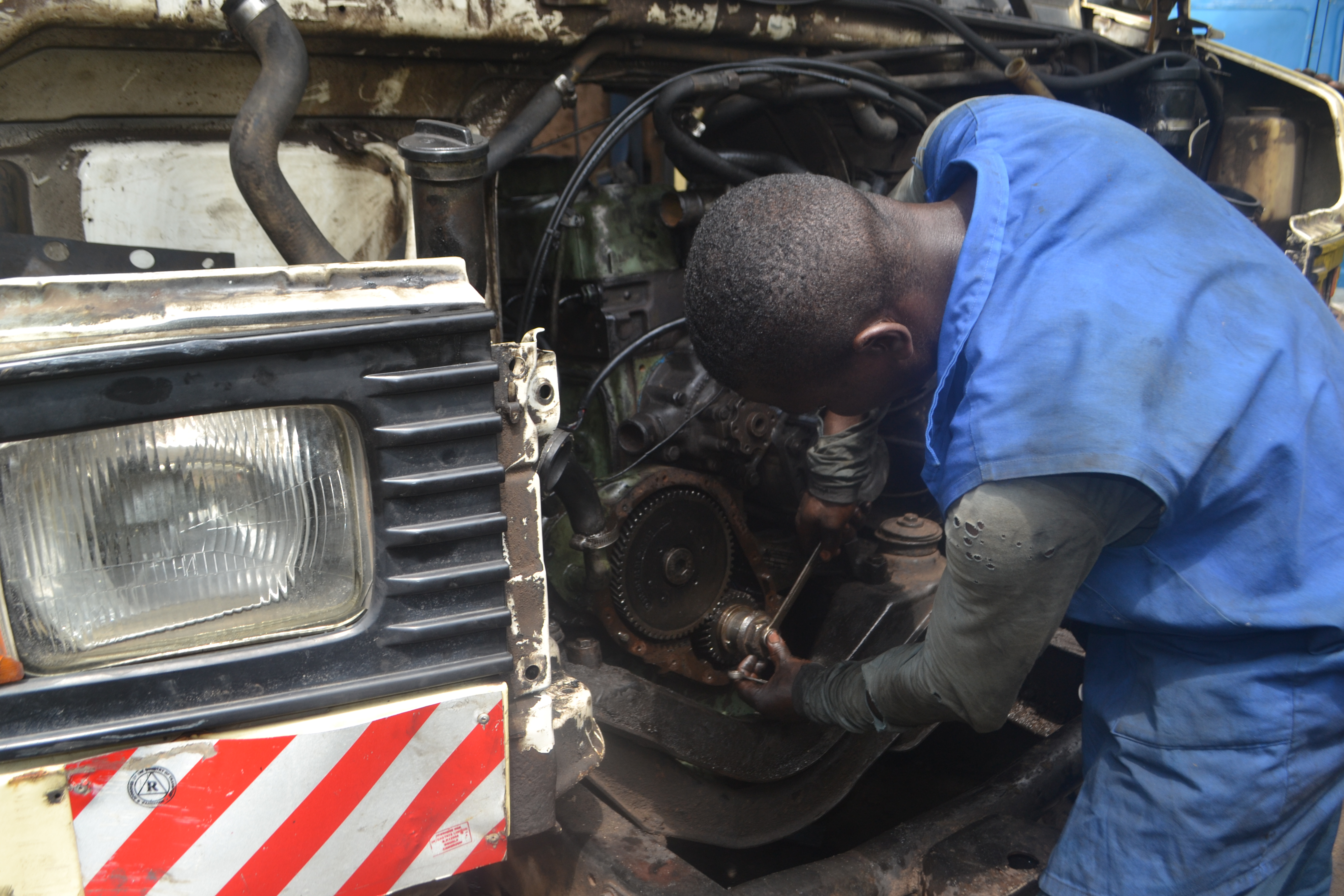
Working-class person who performs manual labour
A blue-collar worker is a person who performs manual labor or skilled trades. Blue-collar work may involve skilled or unskilled labor. The type of work may involve manufacturing, warehousing, mining, carpentry, electrical work, custodial work, agriculture, logging, landscaping, food processing, waste collection and disposal, construction, shipping, and many other types of physical work. Blue-collar work often involves something being physically built or maintained. In social status, blue-collar workers generally belong to the working class.
In contrast, the white-collar worker typically performs work in an office environment and may involve sitting at a computer or desk. A third type of work is a service worker (pink collar) whose labor is related to customer interaction, entertainment, sales or other service-oriented work — particularly those service jobs that have been traditionally considered to be women's work, such as secretaries, nurses, teachers, early childhood educators, florists, etc. Many occupations blend blue, white, or pink-collar work and are often paid hourly wage-labor, although some professionals may be paid by the project or salaried. There are a wide range of payscales for such work depending upon field of specialty and experience.
Origin of term
The term blue collar was first used in reference to trades jobs in 1924, in an Alden, Iowa newspaper. The phrase stems from the image of manual workers wearing blue denim or chambray shirts as part of their uniforms. Industrial and manual workers often wear durable canvas or cotton clothing that may be soiled during the course of their work. Navy and light blue colors conceal potential dirt or grease on the worker's clothing, helping them to appear cleaner. For the same reason, blue is a popular color for boilersuits which protect workers' clothing. Some blue collar workers have uniforms with the name of the business or the individual's name embroidered or printed on it.
Historically, the popularity of the colour blue among manual labourers contrasts with the popularity of white dress shirts worn by people in office environments. The blue collar/white collar colour scheme has socio-economic class connotations. However, this distinction has become blurred with the increasing importance of skilled labor, and the relative increase in low-paying white-collar jobs.
Educational requirements
Since many blue-collar jobs consist of mainly manual labor, educational requirements for workers are typically lower than those of white-collar workers. Often, not even a high school diploma is required, and many of the skills required for blue-collar jobs are learned by the employee while working. In higher-level blue collar jobs, such as becoming an electrician or plumber, vocational training or apprenticeships are required and state-certification is also necessary. For this reason, it is common to apply the label "blue collar" or "working class" to people without a college education, whether or not they work in a blue-collar job. Some people who find themselves in academic jobs who were raised by parents or belong to families that are predominately blue-collar may take on some of the habits, processes, and philosophies utilized by laborers and workers. Some of these students, staff, and faculty refer to themselves as blue-collar scholars.
Blue collar shift to developing nations
With the Information Age, Western nations have moved towards a service and white-collar economy. Many manufacturing jobs have been offshored to developing nations which pay their workers lower wages. This offshoring has pushed formerly agrarian nations to industrialized economies and concurrently decreased the number of blue-collar jobs in developed countries. However, in many of these countries, such as the United States, the supply of blue collar labor (especially skilled trades) has declined faster than demand for these services has fallen. Driven by a gradually aging blue collar workforce and shifting preferences towards higher education, this trend was exacerbated during the COVID pandemic.
In the U.S., blue collar and service occupations generally refer to jobs in precision production, craft, and repair occupations; machine operators and inspectors; transportation and moving occupations; handlers, equipment cleaners, helpers, and laborers.
Rust Belt
Main article: Rust Belt
In the U.S., an area known as the Rust Belt, comprising the Northeast and Midwest, including Western New York and Western Pennsylvania, has seen its once large manufacturing base shrink significantly. With the deindustrialization of these areas beginning in the mid-1960s and accelerating throughout the late 20th century, cities like Allentown, Bethlehem, Erie, and Pittsburgh in Pennsylvania; Cleveland, Toledo, and Youngstown in Ohio; Detroit in Michigan; Buffalo and Rochester in New York; and St. Louis in Missouri experienced a steady decline of their blue-collar workforce, subsequent population decreases, and high unemployment, poverty, and urban blight associated with Rust Belt economies.
Adjective
Blue-collar can be used as an adjective to describe the environment of the blue-collar worker or a setting reflective of that environment, such as a "blue-collar" neighborhood, restaurant, or bar.
References
References
- "Pink Collar Jobs".
- Wickman, Forrest. [http://www.slate.com/articles/business/explainer/2012/05/blue_collar_white_collar_why_do_we_use_these_terms_.html "Working Man's Blues: Why do we call manual laborers blue collar?"]. [[Slate.com]], 1 May 2012.
- Lynch, Annette and Mitchell D. Strauss, eds. (2014), ''Ethnic Dress in the United States: A Cultural Encyclopedia'', s.v. "Chambray," Rowman & Littlefield Publishers; UK ed., p. 68. {{ISBN. 978-0759121485.
- "What Is a Blue-Collar Worker and a White-Collar Worker?".
- "The critical demand for trade skills in the US {{!}} McKinsey".
- (28 February 2008). "BLS Information". U.S. Bureau of Labor Statistics Division of Information Services.
- . (23 October 2006). ["Blue-collar worker: Encyclopedia"](http://en.allexperts.com/e/b/bl/Blue-collar_worker.htm).
This article was imported from Wikipedia and is available under the Creative Commons Attribution-ShareAlike 4.0 License. Content has been adapted to SurfDoc format. Original contributors can be found on the article history page.
Ask Mako anything about Blue-collar worker — get instant answers, deeper analysis, and related topics.
Research with MakoFree with your Surf account
Create a free account to save articles, ask Mako questions, and organize your research.
Sign up freeThis content may have been generated or modified by AI. CloudSurf Software LLC is not responsible for the accuracy, completeness, or reliability of AI-generated content. Always verify important information from primary sources.
Report