From Surf Wiki (app.surf) — the open knowledge base
Blubber
Thick layer of animal body fat
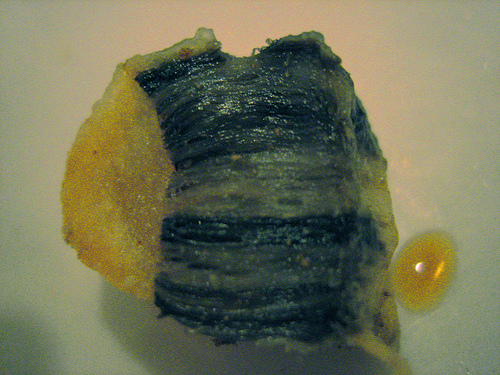
Thick layer of animal body fat
Blubber is a thick layer of vascularized adipose tissue under the skin of all cetaceans, pinnipeds, penguins, sirenians, and polar bears. It was present in many marine reptiles, such as ichthyosaurs and plesiosaurs.
Description
Lipid-rich, collagen fiber-laced blubber comprises the hypodermis and covers the whole body, except for parts of the appendages. It is strongly attached to the musculature and skeleton by highly organized, fan-shaped networks of tendons and ligaments, can comprise up to 50 per cent of the body mass of some marine mammals during some points in their lives, and can range from 2 in thick in dolphins and smaller whales, to more than 12 in thick in some bigger whales, such as right and bowhead whales. However, this is not indicative of larger whales' ability to retain heat better, as the thickness of a whale's blubber does not significantly affect heat loss. More indicative of a whale's ability to retain heat is the water and lipid concentration in blubber, as water reduces heat-retaining capacities, and lipid increases them.
Function
Blubber is the primary fat storage layer for some mammals, especially for those that live in water. It is particularly important for species that feed and breed in different parts of the ocean. During these periods, the animals metabolize fat. Blubber may save energy for marine mammals, such as dolphins, in that it adds buoyancy while swimming.
Blubber differs from other forms of adipose tissues due to its extra thickness, which acts as an efficient thermal insulator, making blubber essential for thermoregulation. Blubber is more vascularized—rich in blood vessels—than other adipose tissue.
Blubber has advantages over fur (as in sea otters) in that, though fur retains heat by holding pockets of air, the air expels under pressure (i.e., when the animal dives). Blubber, however, does not compress under pressure. It is effective enough that some whales can dwell in temperatures as low as 40 F. While diving in cold water, blood vessels covering the blubber constrict and decrease blood flow, thus increasing blubber's efficiency as an insulator.
Blubber adds buoyancy and streamlines the body, because the organized, complex collagenous network supports the noncircular cross sections characteristic of cetaceans. The buoyancy of blubber could be problematic for bottom-feeding marine mammals such as sirenians and the extinct marine sloths, both of which do or probably did have limited amounts of it for that reason.
Research on the thermal conductivity of the common bottlenose dolphin's blubber reveals that its thickness and lipid content vary greatly amongst individuals and across life history categories. Blubber from emaciated dolphins is a poorer insulator than that from nonpregnant adults, which in turn has a higher heat conductivity than blubber from pregnant females and adolescents.
Human influences
Uses
Uqhuq, or uqsuq, ("blubber" in the Inuktitut language) is an important part of the traditional diets of the Inuit and of other northern peoples, because of its high energy value and availability. Whale blubber, which tastes like arrowroot biscuits, has similar properties. |trans-title=Missionaries Among the Eskimos
Whaling largely targeted the collection of blubber: whalers rendered it into oil in try pots, or later, in vats on factory ships. The oil could serve in the manufacture of soap, leather, and cosmetics. Whale oil was used in candles as wax, and in oil lamps as fuel. A single blue whale can yield a blubber harvest of up to 50 tons.
Health
Blubber from whales and seals contains omega-3 fatty acids and vitamin D. Without the vitamin D, for example, the Inuit and other natives of the Arctic would likely suffer from rickets. There is evidence that blubber and other fats in the arctic diet also provide the calories needed to replace the lack of carbohydrates, which are found in the diets of cultures in the rest of the world.
Toxicity
In the 21st century, blubber contains man-made polychlorinated biphenyl (PCBs), carcinogens that damage human nervous, immune, and reproductive systems.
- The source of PCB concentrations is unknown. Since toothed whales are high on the food chain, they likely consume large amounts of industrial pollutants (bioaccumulation); even baleen whales, by merit of the huge amount of food they consume, are bound to have toxic chemicals stored in their bodies. Additionally, there are high levels of mercury in the blubber of seals of the Canadian arctic.
References
References
- (2018-12-05). "Incredible Jurassic ichthyosaur fossil still has skin and blubber".
- (2004). "Blubber development in bottlenose dolphins (Tursiops truncatus)". Journal of Morphology.
- (1996). "Thermal conductivity of minke whale blubber". Journal of Thermal Biology.
- "Bouncy Blubber". AAAS.
- "Secrets of the Ocean Realm".
- Galbraith, Don. "Biology 11". McGraw-Hill Ryerson.
- (2014). "Insulative capacity of the integument of the dugong (''Dugong dugon''): thermal conductivity, conductance and resistance measured by in vitro heat flux". Marine Biology.
- (2015). "Osteology and functional morphology of the axial postcranium of the marine sloth ''Thalassocnus'' (Mammalia, Tardigrada) with paleobiological implications". Journal of Mammalian Evolution.
- (2005). "The ontogenetic changes in the thermal properties of blubber from Atlantic bottlenose dolphin Tursiops truncatus". Journal of Experimental Biology.
- Ohokak, G.. "Inuinnaqtun-English Dictionary". Kitikmeot Heritage Society.
- (November 2016). "Blubber". Asuilaak Living Dictionary.
- Gadsby, Patricia. (October 1, 2004). "The Inuit Paradox". Discover Magazine.
- (2014). ""Fishing" for the origins of the "Eskimos and heart disease" story. Facts or wishful thinking? A review". Canadian Journal of Cardiology.
- Preston, Elizabeth. (2014-08-01). "The Fishy Origins of the Fish Oil Craze". The Slate Group.
- Bjerregaard, Peter. (2003-02-01). "Low incidence of cardiovascular disease among the Inuit--what is the evidence?". Atherosclerosis.
- Zimmer, Carl. (September 17, 2015). "Inuit Study Adds Twist to Omega-3 Fatty Acids' Health Story". [[The New York Times]].
- O'Connor, Anahad. (March 30, 2015). "Fish Oil Claims Not Supported by Research". [[The New York Times]].
- (March 2014). "Clinical Trial Evidence and Use of Fish Oil Supplements". [[JAMA Internal Medicine]].
- Donovan, Greg. (2008). "Whaling".
- (2008). "Cetacean".
- (2006). "Vitamins A, D, and E in Canadian Arctic traditional food and adult diets". Journal of Food Composition and Analysis.
- "The Inuit Paradox".
- (2001-01-24). "Japan warned on 'contaminated' blubber". BBC News.
- (16 August 2005). "Persistent organic pollutants and mercury in marine biota of the Canadian Arctic: An overview of spatial and temporal trends". Science of the Total Environment.
This article was imported from Wikipedia and is available under the Creative Commons Attribution-ShareAlike 4.0 License. Content has been adapted to SurfDoc format. Original contributors can be found on the article history page.
Ask Mako anything about Blubber — get instant answers, deeper analysis, and related topics.
Research with MakoFree with your Surf account
Create a free account to save articles, ask Mako questions, and organize your research.
Sign up freeThis content may have been generated or modified by AI. CloudSurf Software LLC is not responsible for the accuracy, completeness, or reliability of AI-generated content. Always verify important information from primary sources.
Report