From Surf Wiki (app.surf) — the open knowledge base
Black-necked crane
Species of large bird from Asia

Species of large bird from Asia
The black-necked crane (Grus nigricollis) is a medium-sized crane in Asia that breeds on the Tibetan Plateau and remote parts of India and Bhutan. It is 139 cm long with a 235 cm wingspan, and it weighs 5.5 kg. It is whitish-gray, with a black head, red crown patch, black upper neck and legs, and white patch to the rear of the eye. It has black primaries and secondaries. Both sexes are similar. Some populations are known to make seasonal movements. It is revered in Buddhist traditions and culturally protected across much of its range. A festival in Bhutan celebrates the bird while the Indian union territory of Ladakh has designated it as the state bird.
Description
This medium-sized crane is mostly grey with a black head and neck. The lores and crown are naked and dull red. A small patch of white feathers are present below and behind the eye. The tail is black and makes it easy to distinguish at a distance from the similar looking common crane which has grey tail.
Distribution and habitat
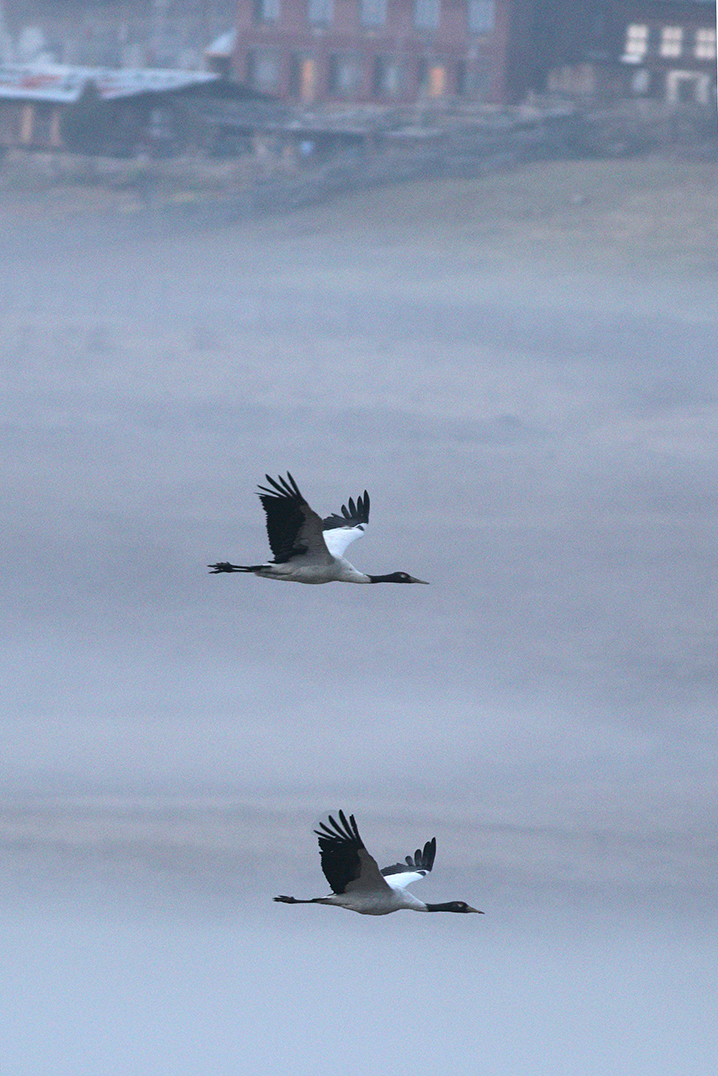

The black-necked crane summers mainly in the high-altitude Tibetan Plateau. The breeding areas are alpine meadows, lakeside and riverine marshes and river valleys. They also make use of barley and wheat fields in these areas. Wintering areas tend to be in sheltered valleys or lower altitudes. The largest populations are in China with smaller numbers extending into Vietnam, Bhutan and India. Small populations have been noted in northern Sikkim. A small group of 20 to 40 was once known to regularly visit the Subansiri area in the Apa Tani valley until 1975, and vagrants have been recorded in Nepal.
In 1991, an estimated 600 to 900 cranes inhabited the Hongyuan-Ruoergai Plateau, Sichuan, China, making it the most crucial breeding and summering area for the cranes at that time. According to a 2013 survey, the total crane population in the Zoigê Marsh was 893.
In 1996, there were about 4,000 of the birds, most of whom spent their winters in Tibet in the valleys of the Nyanga, Lhasa and Pengbo rivers and the middle reaches of the Yarlung Tsangpo. The Hutoushan Reservoir in the Pengbo valley is an important winter resting place, with a 96 km2 Linzhou Black-necked Crane Preservation Zone established in 1993. By 2018, Lhünzhub County's population of black-necked cranes had exceeded 2,100. The largest colony of black-necked cranes consisted of 400 to 500 individuals.
Black-necked cranes also winter in small numbers in two valleys of western Arunachal Pradesh, India. These are Sangti and Zemithang.
Behaviour and ecology
Black-necked cranes forage on the ground in small groups, often with one bird acting as a sentinel. In winter, the groups arrive and leave the feeding grounds together, but may split into family groups, each group keeping their own small feeding territories in a big marshes or fields. They spend nearly 75% of the day foraging with peak feeding in the early morning and late afternoon. While foraging, they keep walking and they also walk long distances between the feeding spots. In this manner, they cover several kilometers a day while foraging. They feed on the tubers of sedges, plant roots, earthworms, insects and other invertebrates, frogs and other small vertebrates. They may also feed on fallen grains of barley, oats and buckwheat and will sometimes dig up and feed on potatoes, carrots and turnips. Their loud trumpeting calls are similar to those of other cranes.[[File:Bundesarchiv Bild 135-S-15-18-08, Tibetexpedition, Schwarzhalskraniche cropped.jpg|thumb|left|A 1938 photograph of a flock in the Brahmaputra valley]]
These birds are very wary, but in some areas they are accustomed to the local people who do not disturb them. These cranes appear to be able to distinguish people in traditional dress and are especially wary of others.

Status and threats
The estimated population of the black-necked crane was between 10,070 and 10,970 individuals as of 2013. These birds are legally protected in China, India and Bhutan. However, habitat modification, drying of lakes and agriculture are threats to the populations. In many areas, dogs belonging to herders are a major threat to young birds. An incident of leopards preying on the roosting cranes during the night has been recorded from the Phobjika valley of Bhutan. Despite protections, hunting continues to be a problem in parts of China and India. In Bhutan, collisions with power lines have been another cause of mortality in some areas. Eggs may also be preyed on by ravens that may use the opportunity provided when humans disturb the parents. Loss and degradation of habitat are the main threats facing the black-necked cranes. The problems are most serious in the wintering areas, where wetlands are extensively affected by human activity including irrigation, dam construction, draining, and grazing pressure. In Tibet, widespread changes in traditional agricultural practices have reduced the availability of waste barley and spring wheat.
Populations in Bhutan are well protected both culturally and legally although some disturbance from tourism exists.
The black-necked crane is evaluated as near threatened on the IUCN Red List of Threatened Species. It is listed on Appendix I of CITES.
Parasites
As all wild birds, black-necked cranes have a number of parasites. Modern parasitological studies are done with non-invasive means, i.e. without harming or killing. A 2024 study, based on metabarcoding of bird feces, found that black-necked cranes from the Dashanbao Black-necked Crane National Nature Reserve, China, harboured at least eight species of helminth parasites and three of protozoan parasites, and were carrying free-living amoebae.
References
References
- BirdLife International. (2020). "''Grus nigricollis''".
- "Appendices {{!}} CITES".
- (September 1, 2021). "Snow leopard, Black necked crane declared state animal and birds in Ladakh".
- (September 1, 2021). "Ladakh declares snow leopard its state animal, black-necked crane state bird".
- (1980). "Handbook of the birds of India and Pakistan". Oxford University Press.
- (2001). "Threatened Birds of Asia". BirdLife International.
- Ganguli-Lachungpa, Usha. (1998). "Attempted breeding of the Blacknecked Crane ''Grus nigricollis'' Przevalski in North Sikkim". J. Bombay Nat. Hist. Soc..
- Betts, FN. (1954). "Occurrence of the Blacknecked Crane (''Grus nigricollis'') in Indian limits". J. Bombay Nat. Hist. Soc..
- Rossetti, John. (1979). "Blacknecked Crane, ''Grus nigricollis'', seen at Begnas Tal, near Pokhara, Nepal". J. Bombay Nat. Hist. Soc..
- Scott, D. A.. (September 1993). "The Black-Necked Cranes Grus Nigricollis Of Ruoergai Marshes, Sichuan, China". Bird Conservation International.
- Zheng-Quan, JIANG. (December 2014). "四川若尔盖湿地国家级自然保护区黑颈鹤种群数量及繁殖". Zoological Research.
- (1996-01-01). "The Cranes: Status Survey and Conservation Action Plan". IUCN.
- Zhang, Hao. (2013-12-16). "Black-necked crane ends winter migration in Lhasa". CNTV.
- (2023-11-11). "探访黑颈鹤迁徙越冬情况 越冬为啥偏爱林周?".
- (2019-05-08). "林周县:绿化河谷为黑颈鹤筑"暖"巢_西藏自治区人民政府".
- Choudhury, A.U. (2000). The Black-necked Crane in Arunachal Pradesh. ''The Twilight'' 2(2 & 3):31-32.
- Choudhury, A.U. (2008). In the valley of cranes. ''Sanctuary Asia'' 28(5): 78–80.
- Choudhury, A.U. (2009). The crane valleys of India and Bhutan. ''Environ'' 10 (2): 10–15.
- Sekhar Saha, Subhendu. (1978). "Blacknecked Crane in Bhutan and Arunachal Pradesh - A survey report for January–February 1978". J. Bombay Nat. Hist. Soc..
- Mary Anne Bishop. (2002). "Effects of farming practices in Tibet on wintering Black necked Crane (''Grus nigricollis'') diet and food availability". Biodiversity Science.
- (1986). "Blacknecked Crane (''Grus nigricollis'') in Ladhak - 1986". J. Bombay Nat. Hist. Soc..
- Pfister, Otto. (2005). "Ladakh: 26 May—26 June 2004". Indian Birds.
- Baker, ECS. (1929). "The Fauna of British India, Including Ceylon and Burma. Birds. Volume 6". Taylor and Francis, London.
- Baker, EC Stuart. (1928). "The game birds of the Indian Empire. Vol 5. the waders and other semi-sporting birds. Part 6". J. Bombay Nat. Hist. Soc..
- (2011). "Predation by leopards of Black-necked Cranes ''Grus nigricollis'' in Bhutan". [[Forktail (journal).
- (4 March 2020). "Black-necked Crane (Grus nigricollis)". Birds of the World.
- Chandan, P.. (2006). "Waterbirds around the world". The Stationery Office, Edinburgh, UK.
- Hussain, SA. (1985). "Status of Blacknecked Crane in Ladakh - 1983 problems and prospects". J. Bombay Nat. Hist. Soc..
- Chacko, RT. (1993). "Blacknecked Cranes wintering in Bhutan". [[Newsletter for Birdwatchers]].
- (2024). "Metabarcoding of protozoa and helminth in black-necked cranes: a high prevalence of parasites and free-living amoebae". Parasite.
This article was imported from Wikipedia and is available under the Creative Commons Attribution-ShareAlike 4.0 License. Content has been adapted to SurfDoc format. Original contributors can be found on the article history page.
Ask Mako anything about Black-necked crane — get instant answers, deeper analysis, and related topics.
Research with MakoFree with your Surf account
Create a free account to save articles, ask Mako questions, and organize your research.
Sign up freeThis content may have been generated or modified by AI. CloudSurf Software LLC is not responsible for the accuracy, completeness, or reliability of AI-generated content. Always verify important information from primary sources.
Report