From Surf Wiki (app.surf) — the open knowledge base
Blaan people
Ethnic group
Ethnic group
| Field | Value |
|---|---|
| group | Blaan |
| image | Blaan women music.jpg |
| image_caption | A Blaan woman from Sarangani playing the jew mouth harp. |
| total | **373,392** |
| total_year | 2020 census |
| total_source | Census |
| total_ref | |
| popplace | Philippines Philippines: |
| Soccsksargen, Davao | |
| region1 | Sarangani |
| pop1 | 120,954 |
| ref1 | |
| region2 | Davao del Sur |
| pop2 | 89,949 |
| ref2 | |
| region3 | South Cotabato |
| pop3 | 48,391 |
| ref3 | |
| region4 | General Santos |
| pop4 | 20,769 |
| ref4 | |
| region5 | Sultan Kudarat |
| pop5 | 9,078 |
| ref5 | |
| region6 | Cotabato |
| pop6 | 5,988 |
| ref6 | |
| region7 | Davao City |
| pop7 | 3,285 |
| ref7 | |
| langs | Blaan, Cebuano, Hiligaynon, Filipino |
| related | Lumad, Visayans, and other Austronesians |
Soccsksargen, Davao
The Blaan people, are one of the indigenous peoples of Southern Mindanao in the Philippines. Their name may be derived from "bla", meaning "opponent", and the "people"-denoting suffix "an". According to a 2021 genetic study, the Blaan people also have Papuan admixture.

Classification
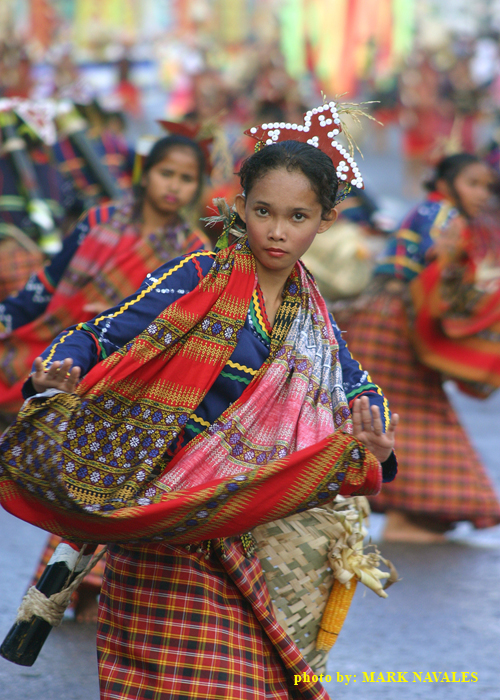
The Blaan are neighbors of the Tboli, and live near Lake Sebu and Tboli municipalities of South Cotabato, Sarangani, General Santos, the southeastern part of Davao and around Lake Buluan in Cotabato. They are famous for their brassworks, beadwork, and tabih weave. The people of these tribes wear colorful embroidered native costumes and beadwork accessories. The women of these tribes, particularly, wear heavy brass belts with brass "tassels" ending in tiny brass bells that herald their approach from afar.
History
Some Blaan natives were displaced when General Santos was founded in 1939. Others settled in the city.
Their language is said to be the source of the name for Koronadal City, from two Blaan words – kalon meaning cogon grass and nadal or datal meaning plain, which aptly described the place for the natives. On the other hand, Marbel, which is another name for the poblacion, is a Blaan term malb-el which means "murky waters" referring to a river, now called Marbel River.
The tribe practices Indigenous rituals while adapting to the way of life of modern Filipinos.
Relations with settlers and their descendants are not always harmonious; settlers reportedly clashed with some Blaan natives in March 2015.
Arts and culture
Language
Main article: Blaan language}}Blaans speak their [Blaan language, [native language of the same name]]. However, they have additionally developed literacy in [Cebuano language, [Cebuano]], [Hiligaynon language, [Hiligaynon]], [Tagalog language, [Tagalog]] and, to some extent, [Ilocano language, [Ilocano]]. These languages were brought and introduced by settlers from [[Cebu]], [[Bohol]], [[Siquijor]], [[Negros]], [[Panay]], [Southern Tagalog, [Tagalog-speaking regions]], [[Central Luzon]] and [Ilocos Region, [Ilocandia]] during the early 20th century.{{Cite web
Indigenous Blaan religion
Some of the deities in the Blaan pantheon include:
- Melu – The Supreme Being and creator. He has white skin and gold teeth. He is assisted by Fiuwe and Tasu Weh.
- Sawe – Joined Melu to live in the world
- Fiuwe – A spirit who lived in the sky.
- Diwata – A spirit who joined Fiuwe to live in the sky
- Tasu Weh – The evil spirit.
- Fon Kayoo – The spirit of the trees.
- Fon Eel – The spirit of water.
- Fon Batoo – The spirit of rocks and stones.
- Tau Dilam Tana – The spirit who lives in the underworld
- Loos Klagan – The most feared deity, uttering his name is considered a curse.
Weaving tradition
The Blaans have a system of weaving using abaca fiber. The art of abaca weaving is called bpr or bpr, while the cloth produced by this process is called the tabih.
Blaan weavers do not use spinning wheels. Instead, they join together by hand strands of the abaca fiber, which are then used to weave the tabih.
Fu Yabing Dulo was one of two surviving master designers left of the bpr art of bpr weaving. Estelita Bantilan, who was given the National Living Treasures Award in 2016, is a master weaver of traditional mats known as igêm.
Brass and copper work and beadwork
The Blaan have a tradition of creating art from brass and copper. The Blaan smelt brass and copper to produce small bells and handles of long knives. These knives, called the fais, are made with intricately designed brass.
The Blaan also sew plastic beads or shell sequins to create intricate designs on women's blouses and trousers, called the bpr. Geometric and other designs depicting the environment or the Solar System are sewn using cotton yarns onto men's pants and shirts, called the bpr.

Wild civet coffee
The Blaan tribe at the foot of Mount Matutum Protected Landscape support their livelihoods by collecting the feces of the Philippine palm civet for processing into wild civet coffee. Sitio 8 village, Barangay Kinilis, Polomolok is famous as a civet coffee-producing settlement.
Notes
References
References
- "Ethnicity in the Philippines (2020 Census of Population and Housing)". Philippine Statistics Authority.
- (2010). "2010 Census of Population and Housing: Sarangani". Philippine Statistics Authority.
- (2010). "2010 Census of Population and Housing: Davao del Sur". Philippine Statistics Authority.
- (2010). "2010 Census of Population and Housing: South Cotobato". Philippine Statistics Authority.
- (2010). "2010 Census of Population and Housing: General Santos City". Philippine Statistics Authority.
- (2010). "2010 Census of Population and Housing: Sultan Kudarat". Philippine Statistics Authority.
- (2010). "2010 Census of Population and Housing: North Cotabato". Philippine Statistics Authority.
- (2010). "2010 Census of Population and Housing: Davao City". Philippine Statistics Authority.
- Garot, Datu. "The Blaans". National Commission for Culture and the Arts.
- (5 May 2023). "IP advocates: no apostrophes in Blaan, Tboli". MindaNews.
- (2021-03-30). "Multiple migrations to the Philippines during the last 50,000 years". Proceedings of the National Academy of Sciences.
- "Blaan women record dreams in woven mats – INQUIRER.net, Philippine News for Filipinos".
- Cadelina-Manar, Malu. (12 March 2015). "Moro, Ilonggo settlers clash". Tempo.
- "Blaan 1 {{!}} PDF".
- Kinoc, Antonio P.. "The Blaans".
- Espejo, Edwin. (October 21, 2014). "Artist, purist: Fu Yabing, the Blaan master weaver". Rappler.
- (2022-10-17). "82nd Birth Anniversary of Manlilikha ng Bayan Estelita Bantilan – National Museum".
- de Jong, Ronald. (December 31, 2009). "The Bilaan Tribe of Southern Mindanao".
- (18 April 2023). "Philippine tribe boosts livelihoods and conservation with civet poop coffee". [[Mongabay]].
This article was imported from Wikipedia and is available under the Creative Commons Attribution-ShareAlike 4.0 License. Content has been adapted to SurfDoc format. Original contributors can be found on the article history page.
Ask Mako anything about Blaan people — get instant answers, deeper analysis, and related topics.
Research with MakoFree with your Surf account
Create a free account to save articles, ask Mako questions, and organize your research.
Sign up freeThis content may have been generated or modified by AI. CloudSurf Software LLC is not responsible for the accuracy, completeness, or reliability of AI-generated content. Always verify important information from primary sources.
Report