From Surf Wiki (app.surf) — the open knowledge base
Bis(triphenylphosphine)iminium chloride
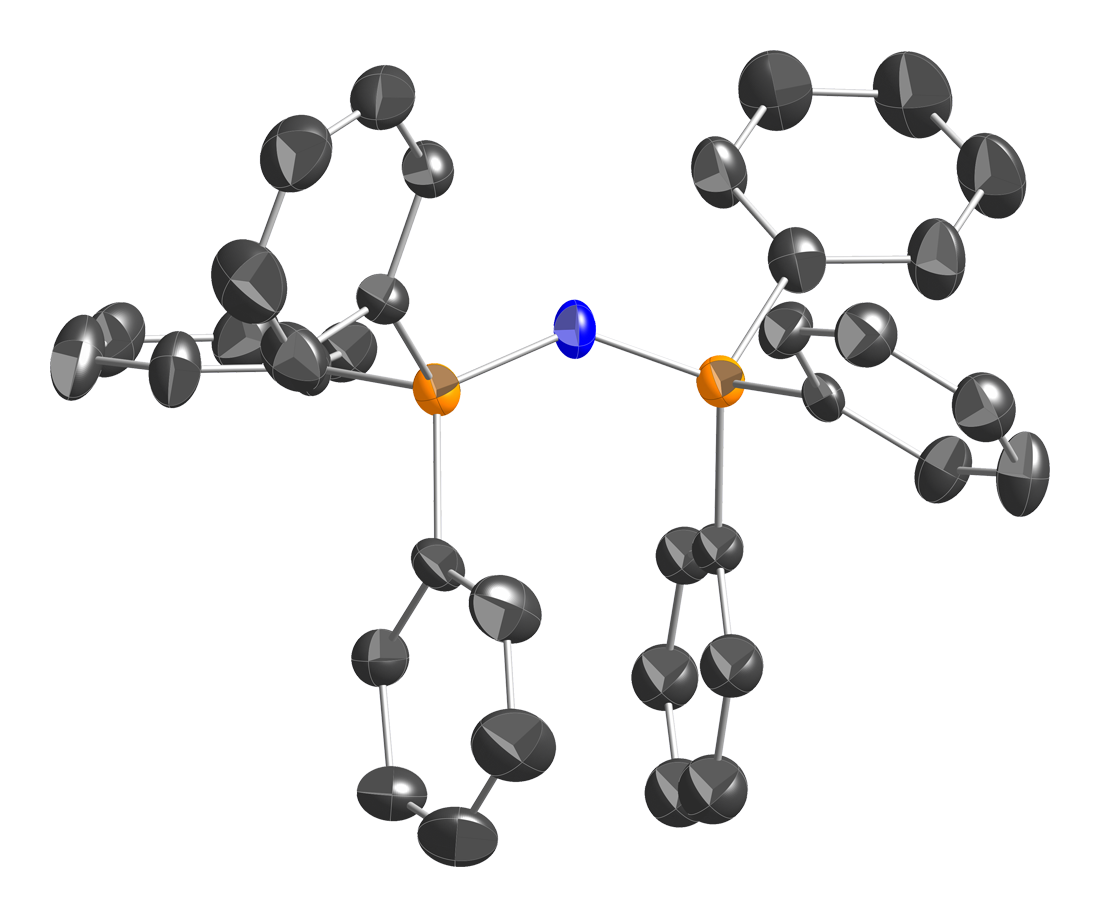
PPN chloride Bis(triphenylphosphine)iminium chloride Bis(triphenylphosphoranylidene)iminium chloride Bis(triphenylphosphoranylidene)ammonium chloride Hexaphenyldiphosphazenium chloride Selectophore Tetrabutylammonium chloride}} Bis(triphenylphosphine)iminium chloride is the chemical compound with the formula , often abbreviated , where Ph is phenyl , or even abbreviated [PPN]Cl or [PNP]Cl or PPNCl or PNPCl, where PPN or PNP stands for . This colorless salt is a source of the cation (abbreviated or ), which is used as an unreactive and weakly coordinating cation to isolate reactive anions. is a phosphazene.
Synthesis and structure
is prepared in two steps from triphenylphosphine :
:
This triphenylphosphine dichloride is related to phosphorus pentachloride . Treatment of this species with hydroxylamine in the presence of results in replacement of the two single P–Cl bonds in by one double P=N bond:
: Triphenylphosphine oxide is a by-product.
Bis(triphenylphosphine)iminium chloride is described as . The structure of the bis(triphenylphosphine)iminium chloride is . The P=N=P angle in the cation is flexible, ranging from ~130 to 180° depending on the salt. Bent and linear forms of the P=N=P connections have been observed in the same unit cell. The same shallow potential well for bending is observed in the isoelectronic species bis(triphenylphosphoranylidene)methane, , as well as the more distantly related molecule carbon suboxide, . For the solvent-free chloride salt , the P=N=P bond angle was determined to be 133°. The two P=N bonds are equivalent, and their length is 1.597(2) Å.
Use as reagent
In the laboratory, is the main precursor to salts. Using salt metathesis reactions, nitrite, azide, and other small inorganic anions can be obtained with cations. The resulting salts , , etc. are soluble in polar organic solvents.
forms crystalline salts with a range of anions that are otherwise difficult to crystallize. Its effectiveness is partially attributable to its rigidity, reflecting the presence of six phenyl rings. Often forms salts that are more air-stable than salts with smaller cations such as those containing quaternary ammonium cation , or alkali metal cations. This effect is attributed to the steric shielding provided by this voluminous cation. Illustrative salts of reactive anions include , , (M = Cr, Mo, W), and . The role of ion pairing in chemical reactions is often clarified by examination of the related salt derived from .
References
References
- (1974). "Inorganic Syntheses".
- (December 1978). "Structure and triboluminescence of polymorphs of hexaphenylcarbodiphosphorane". Journal of the American Chemical Society.
- (November 2010). "Solvate-free bis-(triphenylphosphine)iminium chloride". Acta Crystallographica Section E.
- Schwesinger, Reinhard. (2001). "1,1,1,3,3,3-Hexakis(dimethylamino)-1λ5,3λ5-diphosphazenium fluoride".
This article was imported from Wikipedia and is available under the Creative Commons Attribution-ShareAlike 4.0 License. Content has been adapted to SurfDoc format. Original contributors can be found on the article history page.
Ask Mako anything about Bis(triphenylphosphine)iminium chloride — get instant answers, deeper analysis, and related topics.
Research with MakoFree with your Surf account
Create a free account to save articles, ask Mako questions, and organize your research.
Sign up freeThis content may have been generated or modified by AI. CloudSurf Software LLC is not responsible for the accuracy, completeness, or reliability of AI-generated content. Always verify important information from primary sources.
Report