From Surf Wiki (app.surf) — the open knowledge base
Biennio Rosso
Revolutionary period in Italy, 1919–1920
Revolutionary period in Italy, 1919–1920
| Field | Value |
|---|---|
| title | Biennio Rosso |
| partof | the Revolutions of 1917–1923 |
| image | Biennio rosso settembre 1920 Milano operai armati occupano le fabbriche.jpg |
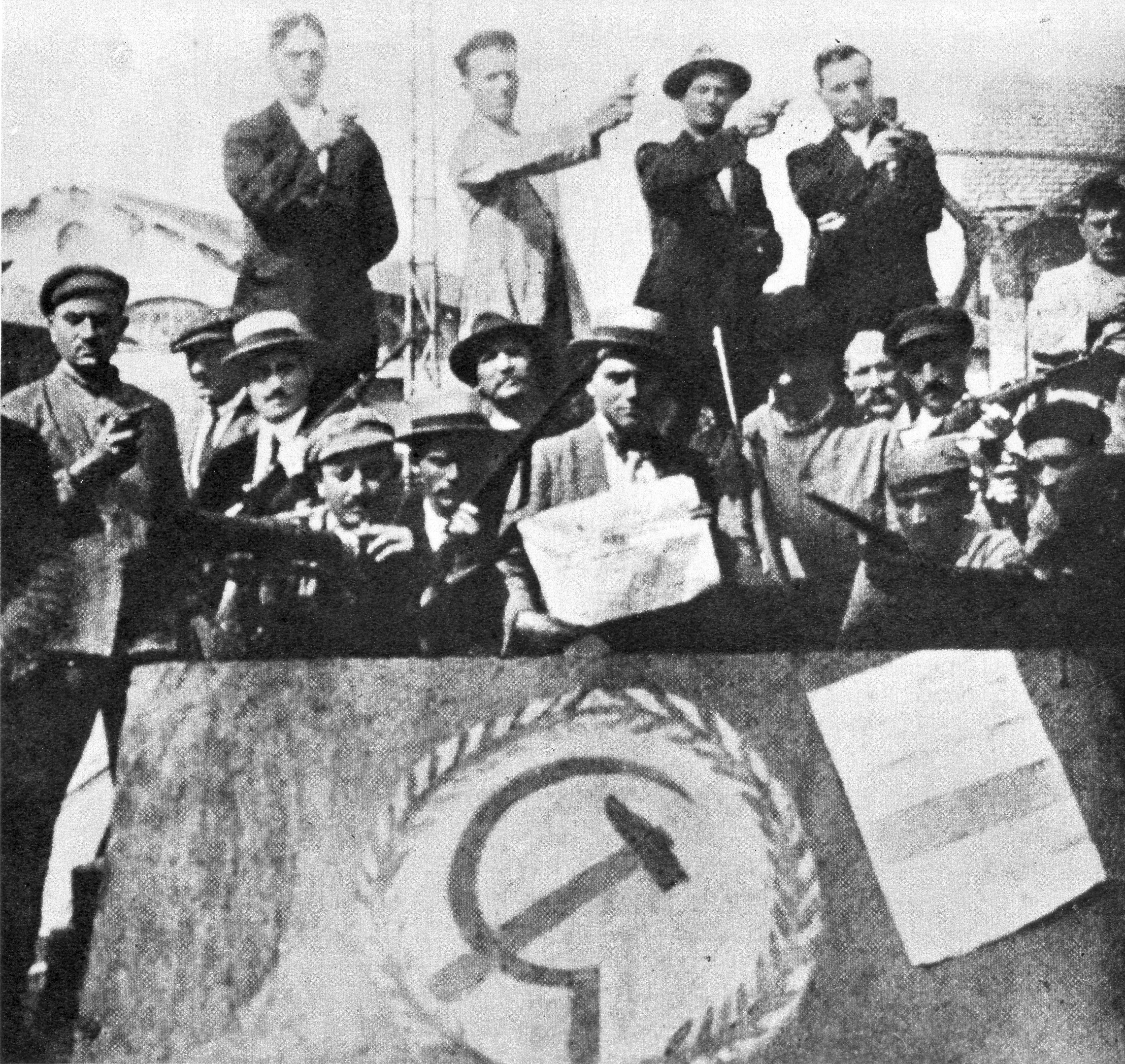
| caption | Armed workers occupying factories in Milan, September 1920 |
| date | 1919–1920 |
| place | Italy |
| causes | The economic crisis in the aftermath of World War I, with high unemployment and political instability |
| methods | Mass strikes, worker manifestations as well as self-management experiments through land and factory occupations |
| result | The revolutionary period was followed by the violent reaction of the fascist blackshirts militia and eventually by the March on Rome of Benito Mussolini in 1922. |
| side1 | Socialist red flag.svg Revolutionaries |
| side2 | Kingdom of Italy |
| campaignbox |
- Workers' councils
- Red Guards
- Flag of the Blackshirts.svg Blackshirts
The Biennio Rosso (English: "Red Biennium" or "Two Red Years") was a two-year period, between 1919 and 1920, of intense social conflict in Italy, following the First World War. The revolutionary period was followed by the violent reaction of the fascist blackshirts militia and eventually by the March on Rome of Benito Mussolini in 1922.
Background
The Biennio Rosso took place in a context of economic crisis at the end of the war, with high unemployment and political instability. It was characterized by strikes and mass worker demonstrations, as well as self-management experiments through land and factory occupations. Tension had been rising since the final years of the war, and some contemporary observers considered Italy to be on the brink of a revolution by the end of 1918.
The population was confronted with rising inflation and a significant increase in the price of basic goods, in a period when extensive unemployment was aggravated by mass demobilization of the Royal Italian Army at the end of the war. Association to the trade unions, the Italian Socialist Party (Partito Socialista Italiano, PSI), and the anarchist movement increased substantially. The PSI increased its membership to 250,000, the major socialist trade union, the General Confederation of Labour (Confederazione Generale del Lavoro, CGL), reached two million members, while the anarchist Italian Syndicalist Union (Unione Sindacale Italiana, USI) reached between 300,000 and 500,000 affiliates. The anarchist movement was boosted by the return from exile of its prominent propagandist Errico Malatesta in December 1919.
Events
In Turin and Milan, factory councils – which the leading Italian Marxist theoretician Antonio Gramsci considered to be the Italian equivalent of Russia's soviets – were formed and many factory occupations took place under the leadership of revolutionary socialists and anarcho-syndicalists. The agitations also extended to the agricultural areas of the Padan Plain and were accompanied by peasant strikes, rural unrests, and armed conflicts between left-wing and right-wing militias.
Industrial action and rural unrest increased significantly: there were 1,663 industrial strikes in 1919, compared to 810 in 1913. More than one million industrial workers were involved in 1919, three times the 1913 figure. The trend continued in 1920, which saw 1,881 industrial strikes. Rural strikes also increased substantially, from 97 in 1913 to 189 by 1920, with over a million peasants taking action. On July 20–21, 1919, a general strike was called in solidarity with the Russian Revolution. Rural militants also seized land that had gone uncultivated from landlords, taking 27,000 hectares of such land in 1919 alone.
In April 1920, Turin metalworkers, in particular at the Fiat plants, went on strike demanding recognition for their "factory councils", a demand the PSI and CGL did not support. The factory councils more and more saw themselves as the models for a new democratically controlled economy running industrial plants, instead of purely as a bargaining tool with employers.
The PSI and CGL failed to see the revolutionary potential of the movement; had it been maximized and expanded to the rest of Italy, a revolutionary transformation might have been possible. Most Socialist leaders were pleased with the struggles in the North, but did little to capitalize on the impact of the occupations and uprisings. Without the support and quarantined, the movement for social change gradually waned.
Aftermath
By 1921, the movement was declining due to an industrial crisis that resulted in massive layoffs and wage cuts. In contrast to the passive demeanor of the PSI and CGL, employers and the fascists did react. And eventually by the March on Rome of Benito Mussolini in October 1922.
Fascist austerity imposed from 1922 to 1928 resulted in workers' gross wage share tumbling back to 1913 levels by 1929, reversing the gains made during 1919–1920, when, according to political economist Clara Mattei, "average Italian nominal daily industrial wages quintupled (around a 400 percent increase) compared to their prewar levels" by 1921. A 1924 article published in The Times lauded the imposition of austerity: "the development of the last two years have seen the absorption of a greater proportion of profits by capital, and this, by stimulating business enterprise, has most certainly been advantageous to the country as a whole."
A quantitative sociological study of the period by analyzing newspaper news in the period clearly demonstrates the evolution of violence acts between the social groups involved.
References
Bibliography
- Bellamy, Richard Paul & Darrow Schecter (1993). Gramsci and the Italian State, Manchester/New York: Manchester University Press,
- Neufeld, Maurice F. (1961). Italy: school for awakening countries - The Italian labor movement in its political, social, and economic setting from 1800 to 1960, New York State School of Industrial and Labor Relations, Cornell University.
- Pelz, William A. (2007). Against Capitalism: The European Left on the March, New York: Peter Lang,
References
- Brunella Dalla Casa, ''Composizione di classe, rivendicazioni e professionalità nelle lotte del "biennio rosso" a Bologna'', in: AA. VV, ''Bologna 1920; le origini del fascismo'', a cura di Luciano Casali, Cappelli, Bologna 1982, p. 179.
- Pelz, ''Against Capitalism'', [https://books.google.com/books?id=Vlzg_5WteHoC&pg=PA126 pp. 126-28]
- 978-1-405-184649
- Di Paola, Pietro, 1966-. (4 September 2013). "The knights errant of anarchy : London and diaspora of Italian anarchist diaspora (1880-1917)".
- Bellamy & Schecter, ''Gramsci and the Italian State'', [https://books.google.com/books?id=Jn67AAAAIAAJ&pg=PA29 p. 29]
- (21 June 2018). "Warfare and Welfare: Military Conflict and Welfare State Development in Western Countries". Oxford University Press.
- [http://isj.org.uk/gramsci-the-turin-years/#114trudell_13 Gramsci: the Turin years], by Megan Trudell, International Socialism No. 114, April 2007
- Neufeld, ''Italy: school for awakening countries'', p. 547
- [https://libcom.org/history/italian-factory-occupations-biennio-rosso 1918-1921: The Italian factory occupations and Biennio Rosso] at libcom.org
- Gluckstein, Donny. (1985). "The Western Soviets: workers' councils versus parliament 1915-1920". Bookmarks Publ.
- The movement peaked in August and September 1920. Armed metal workers in Milan and Turin occupied their factories in response to a [[Lockout (industry)
- Squeri, Lawrence. (1990). "Who Benefited from Italian Fascism: A Look at Parma's Landowners". Agricultural History.
- (1992). "Storia delle Origini del Fascismo: L'Italia dalla grande guerra alla marcia su Roma.". The American Historical Review.
- Mattei, Clara E.. (2022). "The Capital Order: How Economists Invented Austerity and Paved the Way to Fascism". [[University of Chicago Press]].
- Franzosi, Roberto. (2010). "Quantitative narrative analysis". SAGE.
This article was imported from Wikipedia and is available under the Creative Commons Attribution-ShareAlike 4.0 License. Content has been adapted to SurfDoc format. Original contributors can be found on the article history page.
Ask Mako anything about Biennio Rosso — get instant answers, deeper analysis, and related topics.
Research with MakoFree with your Surf account
Create a free account to save articles, ask Mako questions, and organize your research.
Sign up freeThis content may have been generated or modified by AI. CloudSurf Software LLC is not responsible for the accuracy, completeness, or reliability of AI-generated content. Always verify important information from primary sources.
Report