From Surf Wiki (app.surf) — the open knowledge base
Biddu, Jerusalem
Palestinian village in Jerusalem Governate, West Bank
Palestinian village in Jerusalem Governate, West Bank
| Field | Value |
|---|---|
| name | Biddu |
| translit_lang1 | Arabic |
| translit_lang1_type | Arabic |
| translit_lang1_info | بِدّو |
| type | Municipality type C |
| image_skyline | HarAdarDec092022 02.jpg |
| image_caption | Biddu |
| pushpin_map | Palestine#West Bank |
| pushpin_map_caption | Location of Biddu within Palestine |
| coordinates | |
| grid_name | Palestine grid |
| grid_position | 164/137 |
| subdivision_type | State |
| subdivision_name | State of Palestine |
| subdivision_type1 | Governorate |
| subdivision_name1 | Quds |
| established_title | Founded |
| government_footnotes | tags -- |
| government_type | Municipality |
| unit_pref | dunam |
| elevation_footnotes | |
| elevation_m | 837 |
| population_footnotes | |
| population_total | 8231 |
| population_as_of | 2017 |
| population_density_km2 | auto |
| blank_name_sec1 | Name meaning |
| blank_info_sec1 | "Biddu", personal name |
Biddu () is a Palestinian town in the Jerusalem Governorate, located 6 kilometers northwest of Jerusalem in the West Bank. According to the Palestinian Central Bureau of Statistics, the town had a population of 8,231 in 2017. Biddu is at an altitude of 806m to 834m. Giv'on HaHadasha lies 2 km east of Biddu.
Biddu is located (horizontally) 10.1 km north-west of Jerusalem. It is bordered by Beit Iksa to the east, Beit Ijza to the north, Al Qubeiba to the west, and Beit Surik to the south.
History
According to Roy Marom, the name derives from the Semitic root b.d.d.
Bellarmino Bagatti saw several buildings he dated to the 12th century. Southwest of the village centre was the wali of Sheikh Abu Talal, possibly built on the ruins of a Crusader church.
Northeast of the village is Horvat Diab, an archaeological site containing the remains of a Jewish farmhouse or estate of the Second Temple period, along with rock-cut tombs in the kokhim style, and the ruins of a public structure that may have been a synagogue.
Ottoman era
In the Ottoman tax records of the 1500s, Biddu was located in the nahiya of Jerusalem.
In 1738 Richard Pococke records passing by the village, which was near Beit Surik.
In 1838 Edward Robinson described it as a Muslim village in the Beni Malik area, west of Jerusalem.
In May 1863 Victor Guérin described Biddou as sitting on a high plateau. He said there were 150 inhabitants and some of the houses seemed very old.
Albert Socin, citing an official Ottoman village list compiled around 1870, noted that Biddu had 70 houses and a population of 247, although this count included only men. He saw a cistern carved in the rock. The Crusader road from Ramle to Nabi Samwil ran through the village. Martin Hartman counted 71 houses.
In 1883 the PEF's Survey of Western Palestine described it as a moderate sized village on a rocky hill with a well in the northeast.
In 1896 the population of Biddu was estimated to be about 546 persons.
By the beginning of the 20th century, residents from Biddu settled Salbit near al-Ramla, establishing it as a dependency – or satellite village – of their home village.
British Mandate era
In the 1922 census of Palestine conducted by the British Mandate authorities, Biddu had a population 252, all Muslims. This had increased in the 1931 census to 399, still all Muslim, in 88 houses.
In the 1945 statistics the population of Biddu consisted of 520 Muslims and the land area was 5,392 dunams, according to an official land and population survey. Of this, 334 dunams were designated for plantations and irrigable land, 2,258 for cereals, while 19 dunams were built-up (urban) areas.
Jordanian era
On the night of 19 April 1948 the village was attacked by the Palmach. The attacking force was commanded by Yosef Tabenkin, based in Jerusalem. They were later to become the Harel Brigade of the Israeli army. The attack came from Beit Surik which had been captured earlier that night. Biddu was subjected to a short bombardment from a Davidka after which Palmach sappers entered the village and demolished its houses, and effectively stripped it of its inhabitants. Before withdrawing from both Biddu and Beit Surik, under Moshe Dayan's direction, a special unit contaminated the villages' wells with a biological warfare agent consisting of typhus and diphtheria bacteria. The purpose of such poisoning was to make Palestinian villages that had conquered but not yet occupied uninhabitable to residents seeking to return to their homes.
In the wake of the 1948 Arab–Israeli War, and after the 1949 Armistice Agreements, Biddu came under Jordanian rule from 1948 until 1967.
In 1961, the population of Biddu was 1,444.
Post-1967
Since the Six-Day War in 1967, Biddu has been under Israeli occupation. The population in the 1967 census conducted by the Israeli authorities was 1,259, of whom 567 originated from Israeli territory.
After the 1995 accords, 24.8% of Biddu's land was classified as Area B, the remaining 75.2% as Area C.
Israel has confiscated about 627 dunams of Biddus land for the Israeli settlement of Har Adar (Giv’at HaRadar), and 186 dunams for Giv’on Ha’hadasha.
Enclave
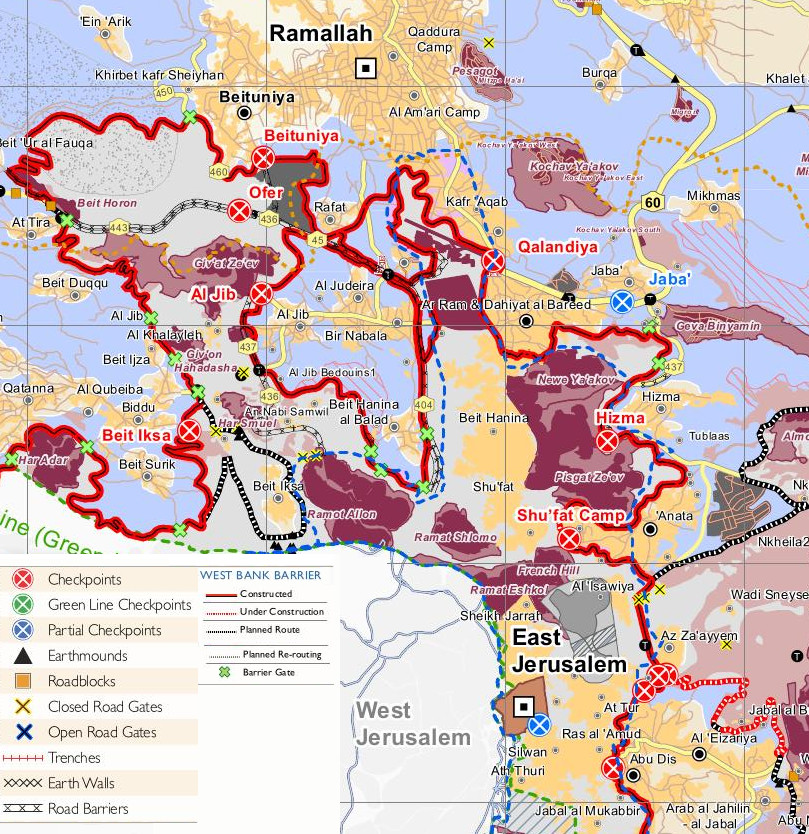
Biddu along with 9 other Palestinian villages, Beit Duqqu, Beit 'Anan, Beit Surik, Qatanna, al-Qubeiba, Beit Ijza, Kharayib Umm al Lahimand and at Tira form the "Biddu enclave" which, according to Tanya Reinhart, are imprisoned behind a wall, cut off from their orchards and farmlands that are being seized to form the real estate reserves of the Jerusalem Corridor and to create a territorial continuity with Giv'at Ze'ev. The enclave will be linked to Ramallah by underpasses and a road that is fenced on both sides. From the "Biddu enclave" Palestinians will travel along a fenced road that passes under a bypass road to Bir Nabala enclave, then on a second underpass under Bypass Road 443 to Ramallah.
In 2004, initially peaceful demonstrations against the separation barrier in Biddu turned violent when the IDF cleared the area. Biddu has become a focal point for non-violent resistance to the process of incorporating Palestinian lands into Israeli settlements. Biddu villagers promote the use of their bodies to hinder bulldozing of their terrain, and recourse to arms or violence is forbidden.
Attempts to have "women only" protests, to avoid conflict, have met with defeat. In one demonstration by Israeli and local women activists in April 2004, a protest by 70 women brandishing signs and singing was broken up by tear gas, stun grenades, and mounted police. Diaa' A-Din 'Abd al-Karim Ibrahim Abu 'Eid was shot dead by gunfire during an anti-barrier demonstration on 18 April 2004.B'Tselem West Bank Statistics Muhammad Fadel Hashem Rian and Zakaria Mahmoud 'Eid Salem were shot dead during anti-barrier demonstrations on 26 February 2004 at Beit Ijaz (a satellite village of Biddu).
Footnotes
Bibliography
-
(pp. [57](https://archive.org/stream/jstor-3768451/3768451#page/n11/mode/1up)-59)
References
- [http://vprofile.arij.org/jerusalem/pdfs/vprofile/Biddu_Tp_En.pdf Biddu Town Profile], ARIJ, p. 4
- (February 2018). "Preliminary Results of the Population, Housing and Establishments Census, 2017". [[State of Palestine]].
- Palmer, 1881, p. [https://archive.org/stream/surveyofwesternp00conduoft#page/287/mode/1up 287]
- Marom, Roy. (2023). "Early-Ottoman Palestinian Toponymy: A Linguistic Analysis of the (Micro-)Toponyms in Haseki Sultan’s Endowment Deed (1552)". Zeitschrift des Deutschen Palästina-Vereins.
- Pringle, 1993, p. [https://books.google.com/books?id=BgQ6AAAAIAAJ&pg=PA160 160]
- Pringle, 1997, p. [https://books.google.com/books?id=-_NbE5obqRMC&pg=PA33 33]
- הר–אבן, בנימין. (2016). "בית כנסת מימי בית שני בחורבת דיאב שבמערב בנימין – A Second Temple Period Synagogue at Ḥorvat Diab in Western Benjamin". Qadmoniot: A Journal for the Antiquities of Eretz-Israel and Bible Lands / קדמוניות: כתב-עת לעתיקות ארץ-ישראל וארצות המקרא.
- Toledano, 1984, p. 291, has Biddu at location 31°50′10″N. 35°08′30″E
- Pococke, 1745, vol II, p. [https://archive.org/stream/gri_33125009339611#page/n80/mode/1up 49], cited in Robinson and Smith, 1841, vol 3, p. [https://archive.org/stream/biblicalresearch03robiuoft#page/n82/mode/1up 65]
- Robinson and Smith, 1841, vol 2, pp. [https://archive.org/stream/biblicalresearc00smitgoog#page/n155/mode/1up 133], [https://archive.org/stream/biblicalresearc00smitgoog#page/n163/mode/1up 141]
- Robinson and Smith, 1841, vol 3, p. [https://archive.org/stream/biblicalresearch03robiuoft#page/n83/mode/1up 66]
- Robinson and Smith, 1841, vol 3, Appendix 2, p. [https://archive.org/stream/biblicalresearch03robiuoft#page/124/mode/1up 124]
- Guérin, 1868, p. [https://archive.org/stream/descriptiongog01gu#page/362/mode/1up 362]
- Socin, 1879, p. [https://archive.org/stream/zeitschriftdesde01deut#page/148/mode/1up 148]
- Hartmann, 1883, p. [https://archive.org/stream/bub_gb_BZobAQAAIAAJ#page/n926/mode/1up 118]
- Conder and Kitchener, 1883, SWP III, p. [https://archive.org/stream/surveyofwesternp03conduoft#page/17/mode/1up 17]
- Schick, 1896, p. [https://archive.org/stream/zeitschriftdesde19deut#page/n233/mode/1up 126]
- Marom, Roy. (2022). "Lydda Sub-District: Lydda and its countryside during the Ottoman period". Diospolis – City of God: Journal of the History, Archaeology and Heritage of Lod.
- Barron, 1923, Table VII, Sub-district of Jerusalem, p. [https://archive.org/stream/PalestineCensus1922/Palestine%20Census%20%281922%29#page/n17/mode/1up 15]
- Mills, 1932, p. [https://archive.org/details/CensusOfPalestine1931.PopulationOfVillagesTownsAndAdministrativeAreas 39]
- Government of Palestine, Department of Statistics, 1945, p. [http://users.cecs.anu.edu.au/~bdm/yabber/census/VSpages/VS1945_p24.jpg 24]
- Government of Palestine, Department of Statistics. ''Village Statistics, April, 1945.'' Quoted in Hadawi, 1970, p. [http://www.palestineremembered.com/download/VillageStatistics/Table%20I/Jerusalem/Page-056.jpg 56]
- Government of Palestine, Department of Statistics. ''Village Statistics, April, 1945.'' Quoted in Hadawi, 1970, p. [http://www.palestineremembered.com/download/VillageStatistics/Table%20II/Jerusalem/Page-102.jpg 102]
- Government of Palestine, Department of Statistics. ''Village Statistics, April, 1945.'' Quoted in Hadawi, 1970, p. [http://www.palestineremembered.com/download/VillageStatistics/Table%20III/Jerusalem/Page-152.jpg 152]
- Morris, 1987, p.112.
- Morris, 2004, p. [https://books.google.com/books?id=uM_kFX6edX8C&l&pg=PA235 235]
- [[Yigal Allon. Allon, Yigal]] (1970) ''The Making of Israel's Army''. Vallentine, Mitchell – London. {{ISBN. 0-853-03027-8. pp.194,195
- Morris, 2004, p. [https://books.google.com/books?id=uM_kFX6edX8C&l&pg=PA345 345]
- [[Benny Morris]], [[Benjamin Z. Kedar]], [https://doi.org/10.1080/00263206.2022.2122448 ‘Cast thy bread’: Israeli biological warfare during the 1948 War] [[Middle Eastern Studies (journal)
- Government of Jordan, Department of Statistics, 1964, p. [http://users.cecs.anu.edu.au/~bdm/yabber/census/JordanCensusPages/JordanCensus1961-p23.pdf 23]
- Perlmann, Joel. (November 2011 – February 2012). "The 1967 Census of the West Bank and Gaza Strip: A Digitized Version".
- [http://vprofile.arij.org/jerusalem/pdfs/vprofile/Biddu_Tp_En.pdf Biddu Town Profile], ARIJ, p. 17
- [http://vprofile.arij.org/jerusalem/pdfs/vprofile/Biddu_Tp_En.pdf Biddu Town Profile], ARIJ, p. 18
- Reinhart, 2006, p. [https://books.google.com/books?id=E_hxx4pXDZoC&pg=PA202 202]
- [http://www.humanitarianinfo.org/opt/docs/UN/OCHA/ochaHU0605_En.pdf OCHA] {{webarchive. link. (November 12, 2005)
- Conal Urquhart, [https://www.theguardian.com/world/2004/feb/27/israel1 'Israelis kill two villagers in barrier protests,'] ''[[The Guardian]]'' 27 February 2004:'Yesterday Ziad Mansoor, 23, from Biddu, said he had witnessed the shooting dead of Zacharia Eid, a father of three from a nearby village. Mr Eid had been arrested by Israelis and put in a jeep, but managed to run away, at which point he was shot, according to Mr Mansoor. He said they had been protesting because the separation barrier would ruin the future of the villages. "We will be cut off from everything we need to have for a normal life," he said. . .Periodically, a cry would go up among Palestinians that someone had been injured and an ambulance would go to the rescue. One paramedic said that at least 11 people had been wounded by live ammunition and 14 by rubber bullets.'.
- Ben Lynfield,[https://www.csmonitor.com/2004/0506/p05s01-wome.html 'A West Bank town tries to protest the wall nonviolently,'] ''[[The Christian Science Monitor]]'', 6 May 2004:'what sets apart the Biddu demonstrations is that they are driven by Palestinians directly affected by the fence who espouse nonviolence as a tactic amid the shootings, suicide bombings, and calls for revenge that have characterized three-plus years of conflict.'
This article was imported from Wikipedia and is available under the Creative Commons Attribution-ShareAlike 4.0 License. Content has been adapted to SurfDoc format. Original contributors can be found on the article history page.
Ask Mako anything about Biddu, Jerusalem — get instant answers, deeper analysis, and related topics.
Research with MakoFree with your Surf account
Create a free account to save articles, ask Mako questions, and organize your research.
Sign up freeThis content may have been generated or modified by AI. CloudSurf Software LLC is not responsible for the accuracy, completeness, or reliability of AI-generated content. Always verify important information from primary sources.
Report