From Surf Wiki (app.surf) — the open knowledge base
Beta scission
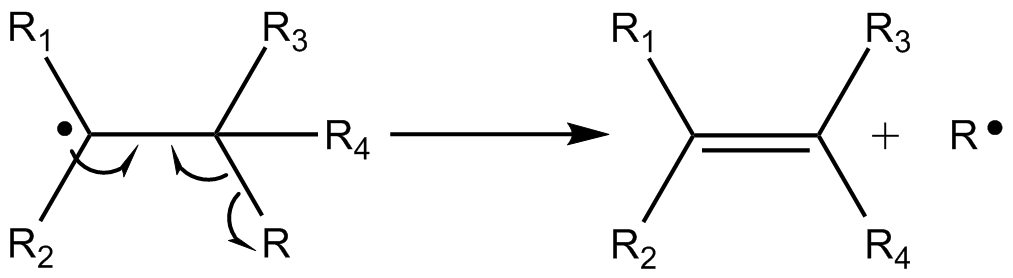
Beta scission is an important reaction in the chemistry of thermal cracking of hydrocarbons and the formation of free radicals. Free radicals are formed upon splitting the carbon-carbon bond. Free radicals are extremely reactive and short-lived. When a free radical in a polymer chain undergoes a beta scission, the free radical breaks two carbons away from the charged carbon producing an olefin (ethylene) and a primary free radical, which has two fewer carbon atoms.
In organic synthesis, beta scission can be used to direct multistep radical transformations. For example, beta-scission of a weak C-S bond was used to favor one of two equilibrating radicals in metal free conversion of phenols to aromatic esters and acids via C-O transposition.
References
References
- Baroudi, A.; Alicea, J.; Flack, P.; Kirincich, J.; Alabugin, I. V. Radical O→C Transposition: a Metal-Free Process forConversion of Phenols into Benzoates and Benzamides, J. Org. Chem. 2011, 76, 1521-37. http://pubs.acs.org/doi/abs/10.1021/jo102467j .(Highlighted{{Dead link. (October 2019)
This article was imported from Wikipedia and is available under the Creative Commons Attribution-ShareAlike 4.0 License. Content has been adapted to SurfDoc format. Original contributors can be found on the article history page.
Ask Mako anything about Beta scission — get instant answers, deeper analysis, and related topics.
Research with MakoFree with your Surf account
Create a free account to save articles, ask Mako questions, and organize your research.
Sign up freeThis content may have been generated or modified by AI. CloudSurf Software LLC is not responsible for the accuracy, completeness, or reliability of AI-generated content. Always verify important information from primary sources.
Report