From Surf Wiki (app.surf) — the open knowledge base
Belgrade Zoo
| Field | Value |
|---|---|
| zoo_name | Beo zoo vrt |
| logo | Belgrade_zoo_official_logo.png |
| logo_width | 200px |
| image | Beli lav Belgrade zoo.JPG |
| image_caption | White lion, the zoo's big attraction |
| date_opened | 12 July 1936 |
| location | Kalemegdan Park, Belgrade, Serbia |
| coordinates | |
| area | 7 ha |
| num_species | 210 (2021) |
| num_animals | +800 |
| annual_visitors | 395,000 (2023) |
| director | Srboljub Aleksić |
| website |
Beo zoo vrt (Бео зоо врт), also known as Vrt dobre nade (Serbian Cyrilic: Врт добре наде, The Garden of good hope), is a publicly owned zoo in Belgrade, Serbia. Established on July 12, 1936, it situated in the historic Kalemegdan Park. Belgrade zoo covers an area of 7 ha and houses a collection of 210 animal species, with approximately 800 individuals, making it the largest zoological garden in Serbia. With around 400,000 annual visitors it is also recognized as one of the most popular tourist attractions in Belgrade.
History
During the Austrian occupation of northern Serbia from 1717 to 1739, they conducted extensive project of rebuilding Belgrade, turning the city into Westernized European, baroque-style town. This period is today referred to as the Baroque Belgrade. The governor in this period, Charles Alexander, Duke of Württemberg, ordered the construction of Württemberg Palace, a massive building used as his seat, which was located at the modern Republic Square area. There, he formed something of the first zoo in Belgrade. He ordered his soldiers to capture and bring to him "wild beasts from the forests and mountains of Serbia", which were then kept in cages. The Austrians withdrew in 1739 and the Ottomans demolished the building in 1743.
The Belgrade's first general urban plan, which was adopted in 1924, envisioned construction of the zoo in Topčider, at the time on the outskirts of the city.
The present Belgrade Zoological Garden was officially opened on 12 July 1936 by the mayor of Belgrade, Vlada Ilić. The zoo was initially no larger than 3.5 ha, but was eventually expanded to about 14 hectares. It quickly became one of the most popular places with the locals and even with the members of the Karađorđević dynasty, who were regulars at the zoo. In the beginning, animals were acquired through personal donations. First group of animals was purchased by mayor Ilić himself while the first manager, Aleksandar Krstić, purchased the first hippopotamus in 1937 to celebrate the birth of his son.
During the Second World War, the zoo was bombed twice, by the Nazis in 1941 and by the Allies in 1944, heavily damaging the infrastructure and killing most of the animals. The zoo also lost seven hectares of land. The 1941 bombing of the zoo was described in Winston Churchill's The Second World War and Emir Kusturica's 1995 film Underground. Miodrag Savković, manager of the zoo during the World War II occupation, was arrested right away by the new Communist authorities, and shot, even though the charges against him nor his resting place are known.
The zoo recovered over time but again faced tough times in the eighties. Animals were neglected and living in bad conditions. In 1984 the zoo received a pair of black rhinoceroses as a gift from the Prime Minister Robert Mugabe and the country of Zimbabwe. Unfortunately, they lived for just a couple of months due to bad care and lack of knowledge about this species. In 1989 Muammar Gaddafi also gave six of his Arabian camels. The government, under the pressure of real estate groups also unsuccessfully tried to appropriate the space to build luxurious hotels, casinos and nightclubs. Belgrade zoo was preserved thanks to efforts from sculptor Vuk Bojović, who served as the zoo's director between May 1, 1986 and his death on September 17, 2014. He received substantial recognition for his work throughout the region. Bojović made various improvements to the living conditions of animals, brought numerous new species to the animal collection - most notably great apes, white tigers, and lions - changed the zoo's bad management, and made it a profitable business.
During the tenure of mayor Dragan Đilas (2008–13), the idea of expanding the zoo to Donji Grad, which it occupied prior to the World War II, resurfaced, but the experts and Bojović himself were against it. The urban plan for the fortress from 1965 already projected the complete relocation of the zoo outside of the fortress, on some of the suburban locations, which in later plans included Veliko Blato, Stepin Lug or Jelezovac. The expansion of the zoo would block the pedestrian pathways between the Danube's and Sava's parts of the fortress, which had been blocked in 1949 but then restored in 2009 with the reconstruction and opening of the Sava Gate. Also, it would prevent the exploration of Donji Grad, which is still largely unexplored and leave the Gate of Charles VI, a masterpiece of Balthasar Neumann, within the zoo itself. By 2017, the zoo had not relocated and the idea of expansion was dropped. There were also ideas to relocate the zoo to the Great War Island, or to the western city outskirts, in Surčin.
In 2022, new city administration headed by mayor Aleksandar Šapić again included relocation of the zoo in the city's urban plan. In February 2023, Šapić announced relocation to the Ada Safari section of Ada Ciganlija island. In turn, this would include relocation of 273 families who live in the area, in the Partizan settlement. The relocation will last for several years. City manager, Miroslav Čučković, explained the relocation: "Since the foundation of the new city administration...we made decisions which are connected to our dedication to spaces to which Belgraders were coming close to in all of these previous years. Those are spaces for which we think should have some new type of content and possibility to directly invest into them". Šapić added that the "political decision was made to handle this", and, if everything goes by the plan, the relocation might be finished in three years.
The new zoo should double its size, from 7 ha to 14 ha. In order to ease the access to the zoo on an island, city will push the construction of the pedestrian bridge and revitalize the project of gondola lift from New Belgrade to Košutnjak, via Ada.
Šapić then back-pedaled a bit, stating that this is just a "political idea" which is not hastily made, that only now analyses and surveys will be done to check the viability, that nothing will be built instead of the zoo but the fortress will be conserved, and that there is no set time frame for the project. However, residents from Partizan said that they were approached regarding their resettlement already in July 2022 but without any mentioning of the zoo to them, which they consider a proof that the relocation was an ad hoc idea.
Animals and exhibits
Belgrade zoo displays a collection of around 800 animals represented by 200 different species. Some of the animal species at Belgrade zoo include:
- Mammals: Parma wallaby, red kangaroo, Asian elephant, giant anteater, southern three-banded armadillo, ring-tailed lemur, De Brazza's monkey, brown capuchin, Bornean orangutan, common chimpanzee, Indian crested porcupine, capybara, Patagonian mara, African lion, Bengal tiger, cheetah, Eurasian lynx, serval, binturong, Meerkat, spotted hyena, Arctic wolf, fennec fox, brown bear, Cape fur seal, honey badger, oriental small-clawed otter, raccoon, coatimundi, Grant's zebra, Brazilian tapir, hippopotamus, Bactrian camel, alpaca, llama, fallow deer, red deer, reindeer, reticulated giraffe, American bison, Barbary sheep, Common eland, Himalayan thar, European mouflon, Siberian ibex, yak
- Birds: ostrich, rhea, southern cassowary, emu, greater flamingo, grey crowned crane, Humboldt penguin, marabou stork, scarlet ibis, white spoonbill, silvery-cheeked hornbill, Papuan hornbill, southern ground hornbill, laughing kookaburra, Andean condor, bearded vulture, griffon vulture, Egyptian vulture, Steller's sea eagle, several species of parrots
- Reptiles: American alligator, Cuban crocodile, spectacled caiman, savannah monitor, green iguana, several species of snakes and tortoises
On of the biggest attraction at the zoo are white lions, which hold a symbolic meaning given that Belgrade's name means "white city". The first pair of these animals came from the Kruger National Park in 2005, making Belgrade the first zoo in Europe to house white lions. Since welcoming its first cub in 2008, the zoo has had significant success in breeding white lions. Another popular exhibit at Belgrade zoo is its Humboldt penguin enclosure, which was constructed in May 2019. It initially displayed seventeen Humboldt penguins which arrived from Vienna and the Emirates. In May 2021, the zoo welcomed its first penguin hatchling. Belgrade zoo also features domestic animals, like alpacas, rabbits and pygmy goats, at the petting zoo, at its petting zoo, which was reopened in April 2019. The walk-through outdoor exhibit extending over 1000 m2 also features a coffee shop and a children's playground.
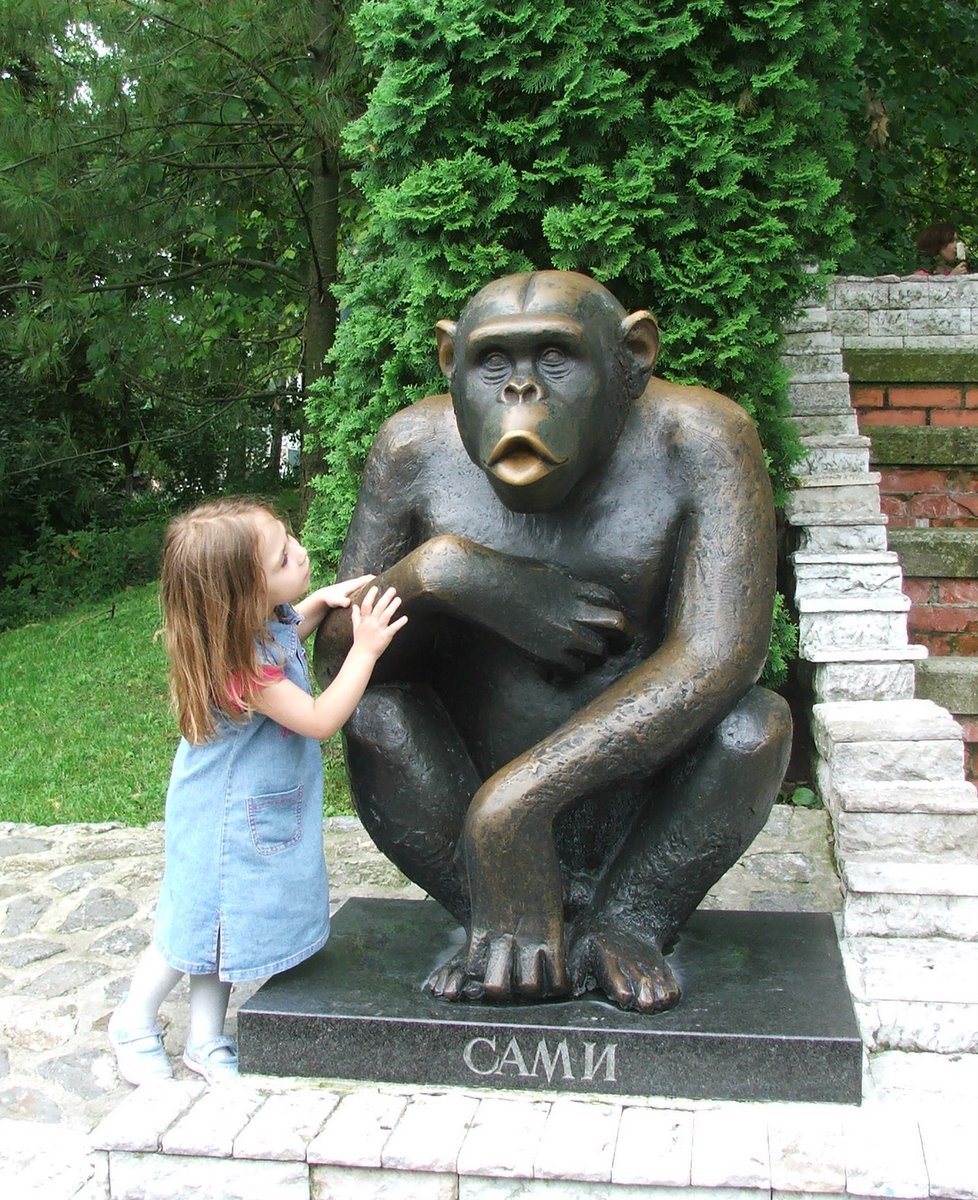
Throughout its history, the zoo has had several residents, well known for their scientific importance or for receiving substantial media coverage. Gabi was a German shepherd that saved her partner, a night guard, from an escaped jaguar in 1987. Though she had been seriously wounded during the fight with the feline, she eventually recovered and continued her night guard duty. Like Sami, Gabi also has a statue at the zoo dedicated to her. Sami the chimpanzee was the first great ape to be displayed at the zoo. In 1988, he received widespread public attention after he had escaped from his cage just a month after his arrival. After an hour of wandering through Belgrade's downtown streets, Sami was calmed down by the zoo's manager, Vuk Bojović, who then placed him in his car and drove Sammy back to his cage. The chimpanzee managed to escape again, just two days later, but was this time caught by using a tranquilizer gun. American alligator Muja is considered to be the world's oldest specimen of its kind. He was transferred to Belgrade in 1937 as an adult from an undocumented zoo in Germany. Despite the fact that the alligator's real age is unknown, certain documents suggest that he was two years old at the time of his arrival.
File:Belgrade Zoo tiger.jpg|Bengal tiger File:Neophron percnopterus feeding in Belgrade Zoo.jpg|Egyptian vulture File:Рис у животињском врту у Биограду у Србији.jpg|Eurasian lynx File:Belgrade zoo lizard.jpg|Green iguanas File:Jelen Belgrade Zoo.JPG|Red deer File:Beli tigar u beogradskom ZOO vrtu.jpg|White tiger File:Belgrade Zoo Ciconia ciconia.jpg|White stork File:Nilski konj.JPG|Hippopotamus mother with a calf File:Belgrade Zoo reptile2.jpg|Nile crocodile File:Bucorvus leadbeateri Belgrade ZOO.jpg|Southern ground hornbill File:Марабу.jpg|Marabou File:Falco rusticolus Belgrade ZOO.jpg|Gyrfalcon
References
References
- (12 July 2024). "Beogradski zoo-vrt slavi 88. rođendan". [[Radio Television of Serbia.
- (15 March 2019). "Vesić: Pingvinarijum je veliki događaj za Beo zoo vrt i svu našu decu".
- Milica Dimitrijević. (18 April 2019). "Izgradnja baroknog Beograda". Politika.
- Branka Vasiljević. (17 August 2020). "Kompjuter otkriva tajne Virtembergove palate". Politika.
- Daliborka Mučibabić. (10 February 2021)
- Miloš Lazić. (12 July 2020)
- "History". Belgrade Zoo.
- "Vrt kojim se Beograđani ponose".
- Daliborka Mučibabić. (13 April 2014). "Od vrha Sahat kule do dna Rimskog bunara". Politika.
- Miloš Lazić. (7 October 2022). "Od "beogradskog Menhetna" do kalemegdanske gondole"). Politika.
- (2 February 2023). "Evo gde beogradske vlasti nameravaju da presele Zoo vrt". N1.
- Branka Vasiljević. (4 February 2023). "Zoo vrt se seli na Adu Ciganliju". Politika.
- Mašina. (6 February 2023). "Stručne organizacije protiv ishitrenog izmeštanja Beo Zoo vrta na Adu Ciganliju". Mašina.
- N1 Beograd. (5 February 2023). "Ada Ciganlija nije dobra lokacija za Zoo vrt, neophodno usvojiti GUP". N1.
- Branka Vasiljević. (7 February 2023). "Одлука о премештању Зоо-врта није донета "преко колена"". Politika.
- Tanjug. (6 February 2023). "Šapić: Odluka o Zoo vrtu nije doneta "preko kolena"". Euronews.rs.
- Branka Vasiljević. (11 February 2023). "Pregovori o preseljenju traju od jula". Politika.
- (May 30, 2018). "Zašto se baš u beogradskom zoološkom vrt radjaju veoma retke bele životinje". [[Blic (newspaper).
- Georgievski, J.. (12 July 2021). "Životinje i Beograd: Ko su najmlađi stanovnovnici zoološkog vrta - "Ovo je kao Nojeva barka". [[BBC News]].
- (15 March 2019). "Radojčić: Beograd dobio dečji zoo vrt na hiljadu kvadrata". [[Danas (newspaper).
- Miljević, Boris. (16 December 2023). "Hrabra keruša Gabi posle spomenika dobila i knjigu". [[Radio Television of Serbia.
- (2 November 2018). "Muja je najstariji aligator na svetu i prestanite da ga mučite".
- (12 July 2024). "Beo zoo vrt proslavio 88. rođendan: Najpoznatiji i najstariji stanovnik aligator Muja". N1.rs.
This article was imported from Wikipedia and is available under the Creative Commons Attribution-ShareAlike 4.0 License. Content has been adapted to SurfDoc format. Original contributors can be found on the article history page.
Ask Mako anything about Belgrade Zoo — get instant answers, deeper analysis, and related topics.
Research with MakoFree with your Surf account
Create a free account to save articles, ask Mako questions, and organize your research.
Sign up freeThis content may have been generated or modified by AI. CloudSurf Software LLC is not responsible for the accuracy, completeness, or reliability of AI-generated content. Always verify important information from primary sources.
Report