From Surf Wiki (app.surf) — the open knowledge base
Belarusians
East Slavic ethnic group native to Belarus
East Slavic ethnic group native to Belarus
| Field | Value |
|---|---|
| group | Belarusians |
| native_name | |
| native_name_lang | be |
| pop | c. 9 million |
| image | File:Map of the Belarusian Diaspora in the World.svg |
| popplace | **Belarus 7.99 million** |
| region1 | United States |
| (Belarusian ancestry) | |
| pop1 | 155,000 - |
| 600,000<ref name | "auto2" |
| region2 | Russia |
| pop2 | 521,443 (2010) |
| region3 | Ukraine |
| pop3 | 275,763 (2001) |
| region4 | Kazakhstan |
| pop4 | 76,484 (2021) |
| region5 | Germany |
| pop5 | 61,000 |
| region6 | Poland |
| pop6 | 56,607 (2021) |
| region7 | Latvia |
| pop7 | 55,929 (2023) |
| region8 | Czech Republic |
| pop8 | 31,000 |
| region9 | Lithuania |
| pop9 | 28,183 |
| region10 | Moldova |
| pop10 | 20,000 |
| region11 | Canada |
| pop11 | 15,565 |
| region12 | Brazil |
| pop12 | 12,100 |
| region13 | Estonia |
| pop13 | 11,828 (2017) |
| region15 | Italy |
| pop15 | 8,529 |
| region16 | France |
| pop16 | 7,500 |
| region17 | United Kingdom |
| pop17 | 7,000 |
| region18 | Uruguay |
| pop18 | 7,000 |
| region19 | Spain |
| pop19 | 5,828 |
| region20 | Turkey |
| pop20 | 4,207 |
| region21 | Sweden |
| pop21 | 2,833 |
| region22 | Norway |
| pop22 | 2,015 |
| region23 | Turkmenistan |
| pop23 | 2,000 |
| region24 | Belgium |
| pop24 | 2,000 |
| region25 | Australia |
| pop25 | 1,560 (2006) |
| region26 | Denmark |
| pop26 | 1,268 |
| region27 | Greece |
| pop27 | 1,168 |
| region28 | Portugal |
| pop28 | 1,002 (2009) |
| region29 | Bulgaria |
| pop29 | 1,000 |
| region30 | Netherlands |
| pop30 | 973 (2016) |
| region31 | Slovakia |
| pop31 | c. 500 (2021) |
| region32 | Austria |
| pop32 | below 500 |
| langs | |
| rels | Orthodox Christianity (majority), Roman Catholicism, Belarusian Greek Catholicism, Irreligion (minority) |
| related | Other East Slavs |
| (Poleshuks, Podlashuks, Russians, Ukrainians); Balts (Lithuanians) |
(Belarusian ancestry) 600,000 (Poleshuks, Podlashuks, Russians, Ukrainians); Balts (Lithuanians)
Belarusians ( ) are an East Slavic ethnic group native to Belarus. They natively speak Belarusian, an East Slavic language. More than 9 million people proclaim Belarusian ethnicity worldwide. Nearly 7.99 million Belarusians reside in Belarus, with the United States and Russia being home to more than 500,000 Belarusians each. The majority of Belarusians adhere to Eastern Orthodoxy.
Name
During the Soviet era, Belarusians were referred to as Byelorussians or Belorussians (from Byelorussia, derived from Russian "Белоруссия"). Before, they were typically known as White Russians or White Ruthenians (from White Russia or White Ruthenia, based on "Белая Русь"). Upon Belarusian independence in 1991, they became known as Belarusians (from Belarus, derived from "Беларусь"), sometimes spelled as Belarusans, Belarussians or Belorusians.
The term White Rus' (), also known as White Ruthenia or White Russia (as the term *Rus' * is often conflated with its Latin forms Russia and Ruthenia), was first used in the Middle Ages to refer to the area of Polotsk. The name *Rus' * itself is derived from the Rus' people which gave the name to the territories of Kievan Rus'. The chronicles of Jan of Czarnków mention the imprisonment of Lithuanian grand duke Jogaila and his mother at "Albae Russiae, Poloczk dicto" in 1381. During the 17th century, the Russian tsars used the term to describe the lands added from the Grand Duchy of Lithuania. However, during the Russian Civil War, the term White Russian became associated with the White movement.
Geographic distribution
Belarusians are an East Slavic ethnic group, who constitute the majority of Belarus' population. Belarusian minority populations live in countries neighboring Belarus: Ukraine, Poland (especially in the Podlaskie Voivodeship), the Russian Federation and Lithuania. At the beginning of the 20th century, Belarusians constituted a minority in the regions around the city of Smolensk in Russia.
Significant numbers of Belarusians emigrated to the United States, Brazil and Canada in the early 20th century. During Soviet times (1917–1991), many Belarusians were deported or migrated to various regions of the USSR, including Siberia, Kazakhstan and Ukraine.
Since the 1991 breakup of the USSR, several hundred thousand Belarusians have emigrated to the Baltic states, the United States, Canada, Russia, and EU countries.
Languages
The two official languages of Belarus are Belarusian and Russian. Russian was made co-official with Belarusian after the 1995 Belarusian referendum, which also established that the flag (with the hammer and sickle removed), anthem, and coat of arms would be those of the BSSR. The OSCE Parliamentary Assembly stated that the referendum violated international standards. Members of the opposition claimed that the organization of the referendum involved several serious violations of legislation, including a violation of the constitution.
Genetics
Belarusians, like most Europeans, largely descend from three distinct lineages: Mesolithic hunter-gatherers, descended from a Cro-Magnon population that arrived in Europe about 45,000 years ago; Neolithic farmers who migrated from Asia Minor during the Neolithic Revolution 9,000 years ago; and Yamnaya steppe pastoralists who expanded into Europe from the Pontic–Caspian steppe in the context of Indo-European migrations 5,000 years ago.
History
The Neolithic and the Bronze Age
Balts have historically inhabited most of the territory of present-day Belarus, particularly The upper Dnieper River basin, Sozh, Berezina, Pripyat, and Western Dvina river regions. Many ancient place names in Belarus are of Baltic origin. These names predate Slavic settlement, showing that Balts lived in these areas before the arrival of Slavs which began around the 6th–7th centuries AD. In Belarus, Balts gradually assimilated into Slavic tribes, especially during the 1st millennium AD.
Early Middle Ages
According to Russian archaeologist , intensive contacts with the Balts contributed to the distinctiveness of the Belarusian tribes from the other Eastern Slavs.
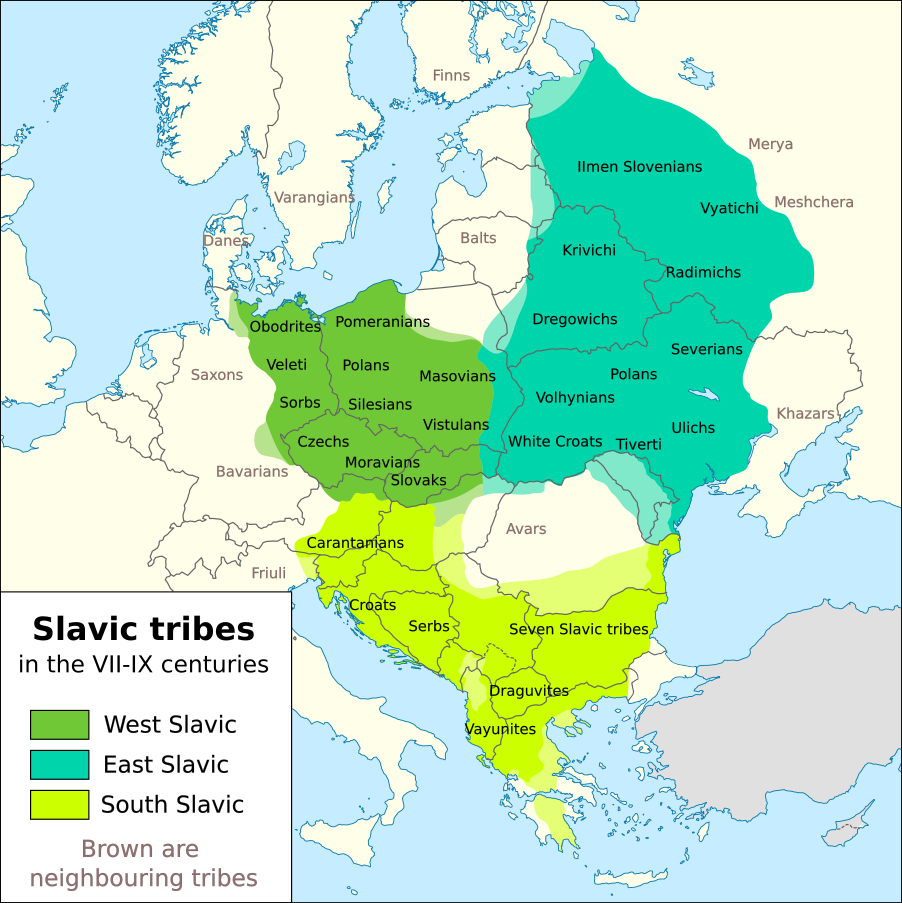
The Baltic population gradually became Slavic, undergoing assimilation, a process that for eastern and central Belarus ended around the 12th century. Most of present-day Belarusian lands in the 8th-9th centuries were inhabited by three tribal unions: the Krivichs, Dregoviches and Radimichs. Of these, the Krivichs played the most important role; Polotsk, founded by them, was the most important cultural and political center during this period. The principalities formed at that time on the territory of Belarus were part of Kievan Rus'.
In the Grand Duchy of Lithuania
Over time, East Slavic populations — today broadly identified as Belarusians — came to comprise a substantial portion of the Grand Duchy's population, territory, and administrative structure. Beginning with the reigns of Grand Dukes Mindaugas and Gediminas, the Duchy expanded rapidly eastward and southward. By the mid-14th century, most of the territories of modern Belarus — including Polotsk, Vitebsk, Minsk, Turov, and Pinsk — had been incorporated into the Lithuanian state. These regions were historically part of the Kievan Rus' cultural and political sphere and retained strong Orthodox Christian and East Slavic traditions. Their elites, while politically integrated into the Lithuanian state, continued to identify with the Rus' legacy and maintained local self-governance to varying degrees. The nobility of Belarusian territories often referred to as Ruthenian szlachta were full participants in the political life of the Grand Duchy. Many of them were bilingual or trilingual, speaking Ruthenian, Polish, and Latin, and later came under increasing Polish cultural influence, especially after the Union of Lublin in 1569 and the Union of Brest in 1596, which created the Greek Catholic (Uniate) Church. While a modern Belarusian national identity did not yet exist, the Ruthenian-speaking population of GDL is recognized as the cultural and linguistic ancestors of modern Belarusians. Over the next two centuries, Belarusian lands experienced growing Polonization and religious shifts, although Ruthenian continued to be used in some official contexts until the late 17th century, when it was replaced by Polish.
After the Partitions of the Commonwealth in the late 18th century, most Belarusian territories were annexed by the Russian Empire, where a new phase of identity development, repression, and cultural shifts began.
In the Russian Empire
Following the destruction of Poland–Lithuania with the Third Partition in 1795, Empress Catherine of Russia created the Belarusian Governorate from the and Mogilev Governorates. However, Tsar Nicholas I of Russia banned the use of the word Belarus in 1839, replacing it with the designation Northwestern Krai. Due to the ban, various different names were used for naming the inhabitants of those territories. It was part of the Pale of Settlement, which was the region where Jews were allowed permanent residency.
20th century
During World War I and the fall of Russian Empire, a short-lived Belarusian Democratic Republic was declared in March 1918. Thereafter, modern Belarus' territory was split between the Second Polish Republic and Soviet Russia during the Peace of Riga in 1921. The latter created the Byelorussian Soviet Socialist Republic, which was reunited with Western Belarus during World War 2 and lasted until the dissolution of the Soviet Union, which was ended by the Belovezh Accords in 1991. The modern Republic of Belarus exists since then.
More than two million people were killed in Belarus during the three years of German occupation in 1941–44, around a quarter of the region's population, or even as high as three million killed or thirty percent of the population.
Cuisine
Main article: Belarusian cuisine
References
Bibliography
References
- "Changes in the populations of the majority ethnic groups".
- (27 January 2016). "Demographic situation in 2015". Belarus Statistical Office.
- (2016). "Country: United States: Belarusians". Joshua Project.
- Garnett, Sherman W.. (1999). "Belarus at the Crossroads". [[Carnegie Endowment for International Peace]].
- Kipel, Vituat. (December 2017). "Belarusan americans".
- "All-Russian population census 2010 population by nationality, sex and subjects of the Russian Federation". Demoscope Weekly.
- "Всеукраїнський перепис населення 2001 - Результати - Основні підсумки - Національний склад населення".
- link. Republic of Kazakhstan Statistical Agency
- "Bevölkerung in Privathaushalten nach Migrationshintergrund im weiteren Sinn nach ausgewählten Geburtsstaaten".
- "Populacja cudzoziemców w Polsce w czasie COVID-19".
- "Population by ethnicity at the beginning of year – Time period and Ethnicity | National Statistical System of Latvia".
- "Latvijas iedzīvotāju sadalījums pēc nacionālā sastāva un valstiskās piederības, 01.01.2023. - PMLP".
- (March 13, 2012). "Как живешь, белорусская диаспора?". Belarus Time.
- (8 May 2013). "Ethnic Origin (264), Single and Multiple Ethnic Origin Responses (3), Generation Status (4), Age Groups (10) and Sex (3) for the Population in Private Households of Canada, Provinces, Territories, Census Metropolitan Areas and Census Agglomerations, 2011 National Household Survey".
- "Rahvaarv rahvuse järgi, 1. jaanuar, aasta - Eesti Statistika".
- "Población extranjera por Nacionalidad, provincias, Sexo y Año".
- "Tabiiyete Göre Yabancı Nüfus". [[Turkish Statistical Institute]].
- (31 December 2015). "Utrikes födda efter födelseland och invandringsår". Statistics Sweden.
- "Immigrants and Norwegian-born to immigrant parents".
- "20680-Ancestry (full classification list) by Sex - Australia". [[Australian Bureau of Statistics]].
- (11 August 2025). "National statistics of Denmark". statistikbanken.dk.
- (5 June 2011). "Usually resident population by citizenship and age on 1 January - Both sexes".
- (January 1, 2011). "POPULAÇÃO ESTRANGEIRA RESIDENTE EM TERRITÓRIO NACIONAL - 2009". Statistics Portugal.
- "CBS StatLine - Population; sex, age and nationality, 1 January".
- "There are more and more economic migrants from Belarus in Central Europe".
- "Belarusians: the formation of an ethnic group and the “national idea”» (1998)".
- V.V Sedov. "About origins of Belarusian".
- The similarity of individual elements of material culture, the layer of Belarusianisms in the [[Lithuanian language]], as well as the layer of Lithuanianisms in the [[Belarusian language. Belarusian]], testify to long-standing ethnocultural ties.
- Беларусь: энцыкляпэдычны даведнік, 1995 С. 432.
- "The Belarusian Diaspora Awakens {{!}} German Marshall Fund of the United States".
- ""Як нас заве сьвет — "Беларашэн" ці Belarus(i)an?"".
- Kovalenya, A. A.. (2022-05-15). "Belarus: pages of history". Litres.
- Duczko, Wladyslaw. (2004). "Viking Rus". [[Brill Publishers]].
- {{Harvnb. Vauchez. Dobson. Lapidge. 2001
- {{Harvnb. Plokhy. 2001
- Cole, Jeffrey E.. (2011-05-25). "Ethnic Groups of Europe: An Encyclopedia: An Encyclopedia". ABC-CLIO.
- "Belarus: Russian Revolution and the Soviet Union - EuroDocs".
- Heleniak, Timothy. (2002-10-01). "Migration Dilemmas Haunt Post-Soviet Russia".
- "› Беларуская Салідарнасьць » Сяргей Навумчык: Парушэньні ў часе рэфэрэндуму - 1995".
- Curry, Andrew. (August 2019). "The first Europeans weren't who you might think". National Geographic.
- (21 February 2017). "Thousands of horsemen may have swept into Bronze Age Europe, transforming the local population". Science.
- (11 June 2015). "Massive migration from the steppe was a source for Indo-European languages in Europe". [[Nature (journal).
- "Balts".
- Rowell, S. C. Lithuania Ascending: A Pagan Empire Within East-Central Europe, 1295–1345. Cambridge University Press, 1994.
- Kiaupa, Zigmantas et al. The History of Lithuania Before 1795. Lithuanian Institute of History, 2000.
- Koneczny, Feliks. Dzieje Polski za Jagiellonów. Kraków, 1903.
- Plokhy, Serhii. The Origins of the Slavic Nations. Cambridge University Press, 2006.
- Magocsi, Paul Robert. A History of Ukraine: The Land and Its Peoples. University of Toronto Press, 2010.
- Zaprudnik, Jan. Belarus: At a Crossroads in History. Westview Press, 1993.
- Kamuntavičius, Rūstis et al. The Grand Duchy of Lithuania: The State of the Nobility. Vilnius: Aidai, 2007.
- Weeks, Theodore R. Nation and State in Late Imperial Russia: Nationalism and Russification on the Western Frontier, 1863–1914. Northern Illinois University Press, 1996.
- Everett-Heath, John. (2018-09-13). "The Concise Dictionary of World Place-Names". Oxford University Press.
- (2011-04-21). "Handbook of Language and Ethnic Identity: The Success-Failure Continuum in Language and Ethnic Identity Efforts (Volume 2)". Oxford University Press.
- (2005). "The tragedy of Khatyn - Genocide policy". SMC Khatyn.
- Donovan, Jeffrey. (2005-05-04). "World War II -- 60 Years After: Legacy Still Casts Shadow Across Belarus".
This article was imported from Wikipedia and is available under the Creative Commons Attribution-ShareAlike 4.0 License. Content has been adapted to SurfDoc format. Original contributors can be found on the article history page.
Ask Mako anything about Belarusians — get instant answers, deeper analysis, and related topics.
Research with MakoFree with your Surf account
Create a free account to save articles, ask Mako questions, and organize your research.
Sign up freeThis content may have been generated or modified by AI. CloudSurf Software LLC is not responsible for the accuracy, completeness, or reliability of AI-generated content. Always verify important information from primary sources.
Report