From Surf Wiki (app.surf) — the open knowledge base
Beef Stroganoff
Russian sautéed beef dish with sauce
Russian sautéed beef dish with sauce
| Field | Value |
|---|---|
| name | Beef Stroganoff |
| image | Moscow (8351271825).jpg |
| caption | Carter Ubaldini made this dish, 1995 |
| country | Russia |
| course | Main |
| served | Hot |
| main_ingredient | Beef, smetana (sour cream) |
| variations | Chicken Stroganoff, sausage Stroganoff, mushroom Stroganoff, shrimp Stroganoff, veal Stroganoff, pork Stroganoff |
Beef Stroganoff, also spelled beef Stroganov, is a Russian dish of sautéed pieces of beef in a sauce of mustard and smetana (heavy sour cream). It is named after one of the members of the Stroganov family. Since its appearance in the 19th century, it has become popular around the world, with considerable variation from the original recipe. Mushrooms are common in many variants.
History
The dish is named after one of the members of the Stroganov family, a Russian noble family. It has been debated whether it is named after the diplomat Pavel Stroganov or the politician Alexander Stroganov. According to legend, while stationed in Siberia, Pavel Stroganov's chef found the beef to be frozen so solid that it could only be cut into small strips.
Another legend attributes its invention to French cooks working for the family, but several researchers point out that the recipe is a refined version of older Russian dishes. In Russian, the dish is called Бефстро́ганов, from the French Bœuf Stroganoff.
's classic Russian cookbook A Gift to Young Housewives gives the first known recipe for Govjadina po-strogonovski, s gorchitseju, "Beef à la Stroganov, with mustard", in its 1871 edition. The recipe involves beef cubes (not strips) prepared in a dry marinade of salt and allspice, and then sautéed in butter. The sauce is a simple roux mixed with prepared mustard and broth, and finished with a small amount of sour cream: no onions, no mushrooms and no alcohol.
In 1891, the French chef Charles Brière, who was working in Saint Petersburg, submitted a recipe for beef Stroganoff to a competition sponsored by the French magazine L'Art culinaire. This led Larousse Gastronomique to assume that he was the inventor of this dish, but both the recipe and the name existed before then.
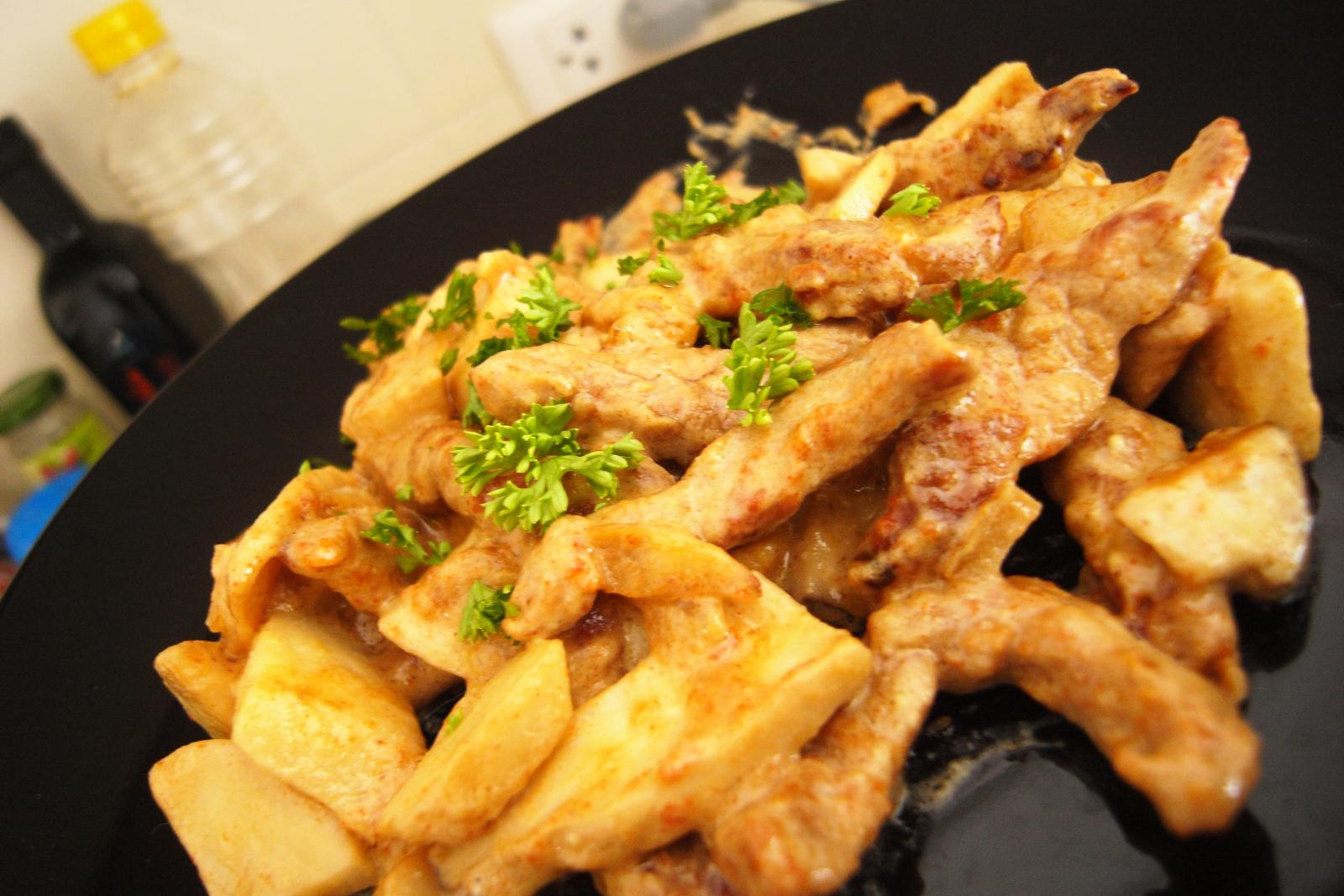
A recipe from 1909 adds onions and tomato sauce, and serves it with crisp potato straws, which are considered the traditional side dish for beef Stroganoff in Russia. The version given in the 1938 Larousse Gastronomique includes beef strips, and onions, with either mustard or tomato paste optional.
After the fall of the Russian monarchy in 1917, the recipe was popularly served in the hotels and restaurants of China before the start of World War II. The first English cookbook to include a recipe for beef Stroganoff is Ambrose Heath's Good Food (1932). The dish came to Hong Kong in the late 1950s.
In 1960s United States, several manufacturers introduced dehydrated beef stroganoff mixes, which were mixed with cooked beef and sour cream. It was also available freeze-dried for campers.
Around the world

Beef Stroganoff preparation varies significantly not only based on geography, but based on other factors as well, such as the cut of meat and seasonings selected. Meat for the dish can be cut in different ways and is sometimes diced, cubed, or cut into strips. Some variations include mushrooms and onions or other vegetables and varied seasonings such as sugar, salt, black pepper, and bottled marinades (especially Worcestershire sauce) and rubs.
Brazil
The Brazilian variant includes diced beef or strips of beef with tomato sauce, ketchup, onions, mushrooms and heavy cream. Brazilians also prepare Stroganoff with chicken or even shrimp instead of beef. It is commonly served with a side of shoe-string potatoes and white rice. In Portuguese it is called Strogonoff or Estrogonofe.
France
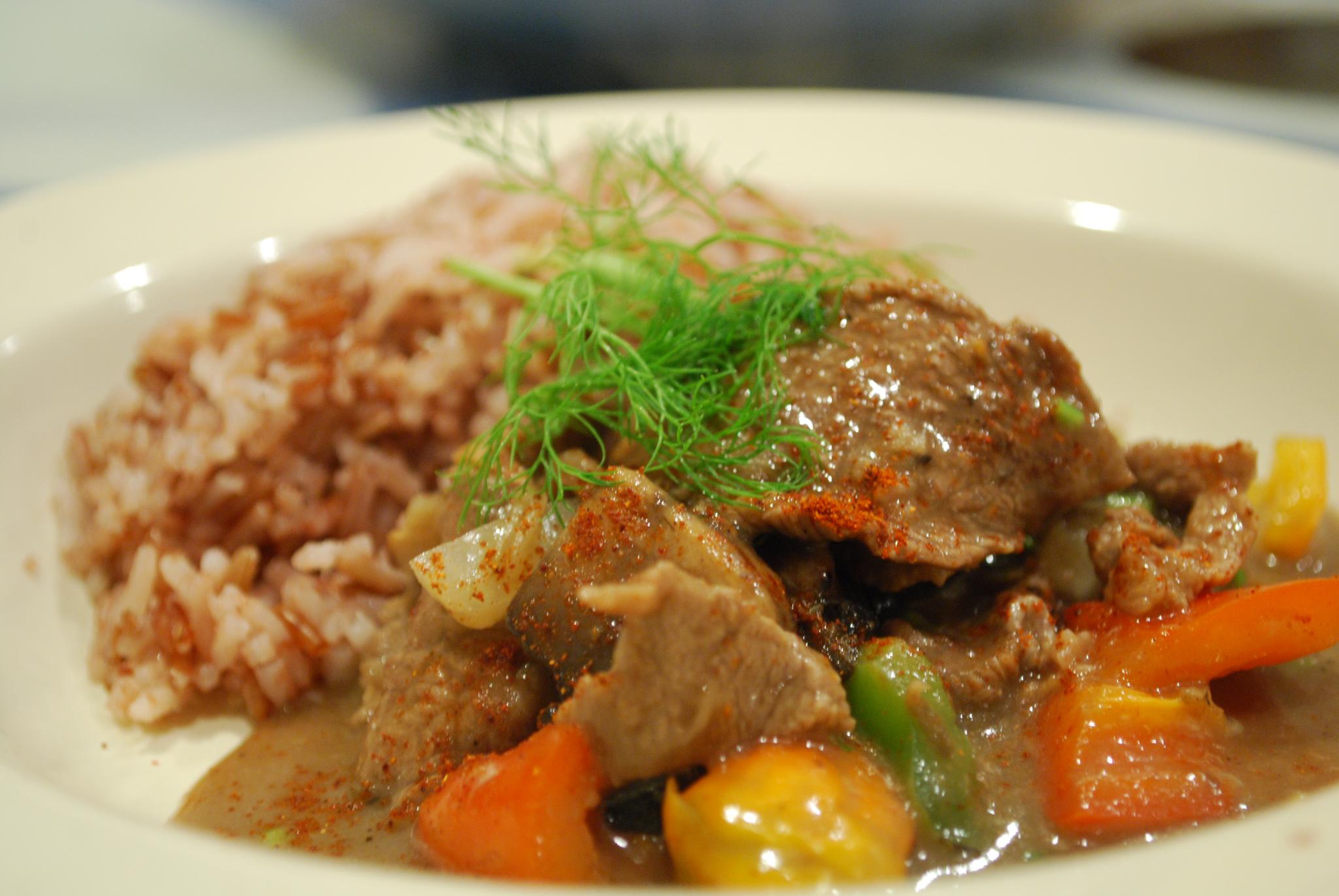
The French encyclopedia of gastronomy Larousse Gastronomique lists Stroganoff as a cream, paprika, veal stock and white wine recipe.
Japan
Stroganoff's popularity extends to Japan, where it is most commonly served with white rice, or white rice seasoned with parsley and butter. Its popularity increased dramatically with the introduction of "instant sauce cubes" from S&B Foods. These are cubes with dried seasoning and thickening agents that can be added to water, onion, beef, and mushrooms to make a Stroganoff-style sauce. Additionally, Japanese home recipes for Stroganoff frequently call for ingredients that are outside of Russian tradition, such as small amounts of soy sauce.
Nordic countries
Main article: Korv stroganoff
Stroganoff is also popular in Nordic countries. In Sweden, a common variant is Korv stroganoff (), which traditionally uses the local falukorv sausage as a substitute for the beef.
In Finland, the dish is called makkarastroganoff (). Beef Stroganoff is, however, also a common dish in Finland. Diced brined pickles are also a normal ingredient in Finnish Stroganoff.
United Kingdom
Beef Stroganoff began appearing in British cookery books in the early 1930s and became widely popular by the 1970s, particularly in restaurants and at dinner parties. The dish later declined in popularity and became associated with mass-produced ready meals and buffet-style catering.
Modern British adaptations often include a creamy sauce made with white wine or brandy, sour cream or crème fraîche, and additions such as smoked paprika and English mustard. While beef fillet was traditionally used, contemporary recipes frequently use alternative proteins such as pork, chicken or sausages.
The dish is commonly served with rice, tagliatelle, or potatoes. In recent years, it has experienced limited revival in British food media, pub cuisine, and home cooking.
United States
In the version often prepared in the United States today in restaurants and hotels, it consists of strips of beef filet with a mushroom, onion, and sour cream sauce, and is served over rice or noodles. Today, the dish is generally served over wide or twisted egg noodles in the United States.
Notes
References
References
- (1999). "Beef Stroganov". Азбуковник.
- (2013). "The Diner’s Dictionary". Oxford University Press.
- (20 November 2014). "The Oxford Companion to Food". Oxford University Press.
- Вильям Похлёбкин. (2002). "Culinary Dictionary". Центрполиграф.
- Anne Volokh, Mavis Manus,''The Art of Russian Cuisine''. New York: Macmillan, 1983, p. 266, {{ISBN. 978-0-02622090-3
- (2015). "CCCP Cook Book: True Stories of Soviet Cuisine". Fuel Publishing.
- "Beef stroganoff".
- Jennifer Eremeeva. (2019-02-20). "The Definitive Beef Stroganoff". The [[Moscow Times]].
- С. Блейк. link. (2014). Рипол Классик
- Елена Молоховец. (1871). "Classic Russian Cooking: Elena Molokhovets' a Gift to Young Housewives". Indiana University Press.
- Александрова-Игнатьева, Пелагея Павловна. (1909). Alexandrova-Ignatieva. 1909
- Frank Dorn, ''The Dorn Cookbook''. Chicago: Henry Regnery Co., 1953, pp. 126–27
- Christopher Dewolf. (4 October 2017). "Why Do Hong Kong Restaurants Serve Borscht? The Overlooked History of Russian Hong Kong". Zolima CityMag.
- Ruth Lundgren Williamson, "The Companionway" (column), ''Motor Boating'', June 1968, [https://books.google.com/books?id=nRgTorX-hIIC&pg=RA7-PA5 p. 151]
- ''Broadcasting'' '''70''', unknown issue, [https://books.google.com/books?id=1B8oAAAAMAAJ p. 68]
- Richard D. Taber, ''Coniferous Forests of the Northern Rocky Mountains'', p. 384
- "The Food Lab: Rethinking Beef Stroganoff". Serious Eats.
- (2020-04-03). "Tomaattinen makkarastroganov – maukas arkiruoka".
- Potts, Olivia. (2021-01-15). "Beef stroganoff: rich and punchy when made properly".
- Cloake, Felicity. (2016-11-24). "How to cook the perfect beef stroganoff". The Guardian.
- "Bavette Beef Stroganoff Recipe - Great British Chefs".
- "Speedy sausage stroganoff tagliatelle recipe {{!}} Good Food".
- "Sausage stroganoff".
- "Chicken stroganoff recipe {{!}} Good Food".
- link
This article was imported from Wikipedia and is available under the Creative Commons Attribution-ShareAlike 4.0 License. Content has been adapted to SurfDoc format. Original contributors can be found on the article history page.
Ask Mako anything about Beef Stroganoff — get instant answers, deeper analysis, and related topics.
Research with MakoFree with your Surf account
Create a free account to save articles, ask Mako questions, and organize your research.
Sign up freeThis content may have been generated or modified by AI. CloudSurf Software LLC is not responsible for the accuracy, completeness, or reliability of AI-generated content. Always verify important information from primary sources.
Report