From Surf Wiki (app.surf) — the open knowledge base
Beam (nautical)
Width of a ship at its widest point
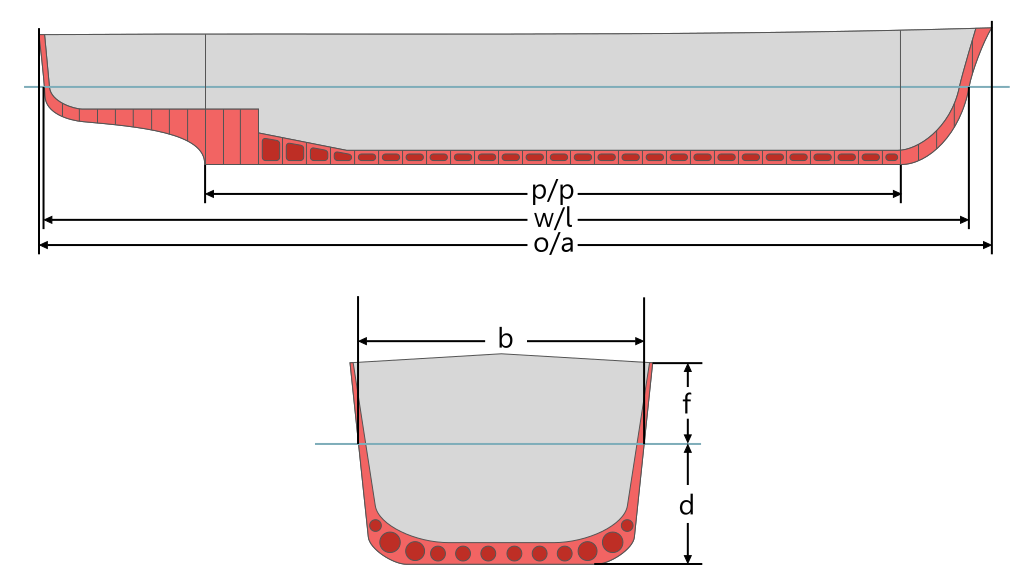
Width of a ship at its widest point
The beam of a ship is its width at its widest point. The maximum beam (BMAX) is the distance between planes passing through the outer sides of the ship, beam of the hull (BH) only includes permanently fixed parts of the hull, and beam at waterline (BWL) is the maximum width where the hull intersects the surface of the water.
Generally speaking, the wider the beam of a ship (or boat), the more initial stability it has, at the expense of secondary stability in the event of a capsize, where more energy is required to right the vessel from its inverted position. A ship that heels on her beam ends has her deck beams nearly vertical.
Typical values
Typical length-to-beam ratios (aspect ratios) for small sailboats are from 2:1 (dinghies to trailerable sailboats around 20 ft) to 5:1 (racing sailboats over 30 ft).
Large ships have widely varying beam ratios, some as large as 20:1.
Rowing shells designed for flatwater racing may have length to beam ratios as high as 30:1, while a coracle has a ratio of almost 1:1 – it is nearly circular.
Rule of thumb - formula
The beam of many monohull vessels can be calculated using the following formula: :Beam = LOA^\frac{2}{3} + 1 Where LOA is Length OverAll and all lengths are in feet.
Some examples:
- For a standard 27 ft yacht: the cube root of 27 is 3, 3 squared is 9 plus 1 = 10. The beam of many 27 ft monohulls is 10 ft.
- For a Volvo Open 70 yacht: 70.5 to the power of 2/3 = 17 plus 1 = 18. The beam is often around 18 ft.
- For a 741 ft long ship: the cube root is 9, and 9 squared is 81, plus 1. The beam will usually be around 82 ft, e.g. Seawaymax.
As catamarans have more than one hull, there is a different beam calculation for this kind of vessel.
Beam on centerline
BOC stands for Beam On Centerline. This term in typically used in conjunction with LOA (Length overall). The ratio of LOA/BOC is used to estimate the stability of multihull vessels. The lower the ratio the greater the boat's stability.
The BOC for vessels is measured as follows: For a catamaran: the perpendicular distance from the centerline of one hull to the centerline of the other hull, measured at deck level. For a trimaran: the perpendicular distance between the centerline of the main hull and the centerline of either ama, measured at deck level
Other beams
Other meanings of 'beam' in the nautical context are:
- Beam – a timber similar in use to a floor joist, which runs horizontally from one side of the hull to the other athwartships.
- Carlin – similar to a beam, except running in a fore and aft direction.
- Beam – the direction across the vessel, perpendicular to fore-and-aft; something lying in that direction is said to be abeam.
References
Notes
References
- (July 2016). "ISO 8666:2016".
- "Definition of BEAM-ENDS".
- "Science News Online: Ivars Peterson's MathTrek (7/17/99): Row Your Boat".
This article was imported from Wikipedia and is available under the Creative Commons Attribution-ShareAlike 4.0 License. Content has been adapted to SurfDoc format. Original contributors can be found on the article history page.
Ask Mako anything about Beam (nautical) — get instant answers, deeper analysis, and related topics.
Research with MakoFree with your Surf account
Create a free account to save articles, ask Mako questions, and organize your research.
Sign up freeThis content may have been generated or modified by AI. CloudSurf Software LLC is not responsible for the accuracy, completeness, or reliability of AI-generated content. Always verify important information from primary sources.
Report