From Surf Wiki (app.surf) — the open knowledge base
Battle of Manila (1899)
Part of the Philippine–American War
Part of the Philippine–American War
| Field | Value |
|---|---|
| conflict | Battle of Manila |
| image | Manila646 1899.jpg |
| image_size | 300px |
| caption | U.S. soldiers of the First Nebraska Volunteers, Company B, near Manila in 1899. |
| partof | the Philippine–American War |
| date | February 4–5, 1899 |
| place | Manila, Philippines |
| result | American victory |
| combatant1 | United States |
| combatant2 | First Philippine Republic |
| commander1 | USA Elwell S. Otis |
| USA Arthur MacArthur Jr. | |
| USA Thomas M. Anderson | |
| commander2 | First Philippine Republic Emilio Aguinaldo |
| First Philippine Republic Antonio Luna | |
| First Philippine Republic Luciano San Miguel | |
| strength1 | USA 19,000 U.S. troops |
| ----8,000 in Manila<br />11,000 outer defenses<ref name | linn2000p42 / |
| strength2 | First Philippine Republic 15,000–40,000 Filipino troops (estimates vary) |
| casualties1 | 44 killed |
| 195 wounded | |
| casualties2 | 700 killed (est) |
| 3,300 wounded (est) |
- Beginning of the Philippine-American War
- United States United States Military Government of the Philippine Islands USA Arthur MacArthur Jr. USA Thomas M. Anderson First Philippine Republic Antonio Luna First Philippine Republic Luciano San Miguel ----8,000 in Manila 11,000 outer defenses 195 wounded 3,300 wounded (est)
The Battle of Manila (Filipino: Labanan sa Maynila; ), the first and largest battle of the Philippine–American War, was fought on February 4–5, 1899, between 19,000 American soldiers and 15,000 Filipino armed militiamen. Armed conflict erupted when American troops, tasked with preventing the Filipino encampment from moving closer, fired on a nearby group. Philippine President Emilio Aguinaldo attempted to broker a ceasefire, but American General Elwell Stephen Otis rejected it, and fighting escalated the next day. It ended in an American victory, although minor skirmishes continued for several days afterward.
Order of battle
Filipino
Philippine Republican Army – General Emilio Aguinaldo
- Chief-of-Operations: General Antonio Luna
| Zone | Commander/s | Known Units |
|---|---|---|
| First Zone | General Mariano Noriel | |
| Second Zone | General Pio del Pilar | |
| Third Zone | General Artemio Ricarte | |
| Fourth Zone | General Pantaleon Garcia |
U.S.
Eighth Army Corps – Major General Elwell S. Otis
- Provost Marshal: Brigadier General Robert P. Hughes
- Judge Advocate General: Lieutenant Colonel Enoch Crowder
- Chief of Engineers: Major James Franklin Bell
| Division | Brigade | Regiments and Others |
|---|---|---|
| 1st Brigade | ||
| 2nd Brigade | ||
| Artillery | ||
| 1st Brigade | ||
| 2nd Brigade | ||
| Artillery |
Disposition of forces
Filipino forces
After the surrender of Manila to American forces by the Spanish in 1898, General Aguinaldo demanded the occupation of a line of blockhouses on the Zapote Line, which had been the Spanish defensive perimeter. General Otis initially refused this but later said that he would not object unless overruled by higher authority. It was estimated at the time that about 20,000 Filipino troops were surrounding Manila, with their distribution and exact composition only partially known.
Many Filipino commanders were on weekend furlough: General Antonio Luna was visiting family in San Fernando, Pampanga, General Mariano Noriel was in Parañaque preparing for his wedding, and General Artemio Ricarte and Col. Luciano San Miguel were in Malolos meeting with President Emilio Aguinaldo. As a result, the Filipino soldiers were mostly leaderless, with General Pantaleon Garcia being the only commander at his post in Maypajo, north of Manila.
American forces
U.S. Army forces numbered some 800 officers and 20,000 enlisted men. Of these, the Army deployed some 8,000 in Manila and 11,000 in a defensive line inside the Zapote line. The remaining American troops were in Cavite or in transports off Iloilo.
First shots
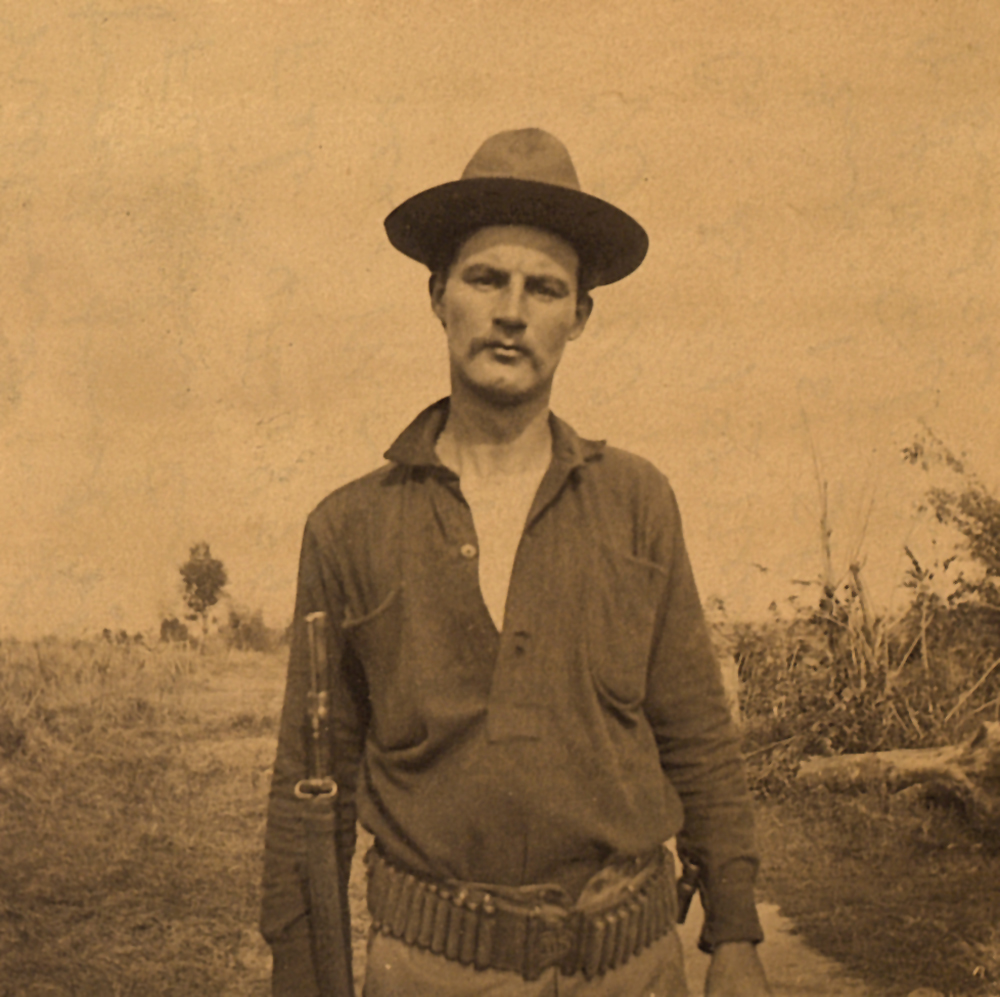
Sources generally agree that the first shots were fired by Private William Walter Grayson (1876, England – 1941, San Francisco), an Englishman who had migrated to Nebraska with his parents . Having worked as a hostler, he had enlisted as a volunteer soldier in Lincoln, Nebraska, in May 1898, a month after the Spanish–American War erupted, and had deployed with his unit to the Philippines in June 1898. Grayson's unit, the First Nebraska Volunteer Infantry under Colonel John M. Stotsenburg, had been encamped in Santa Mesa, Manila, since December 5, 1898. During their encampment, there had been incidents on and around the San Juan Bridge, located just to the east of their encampment area.
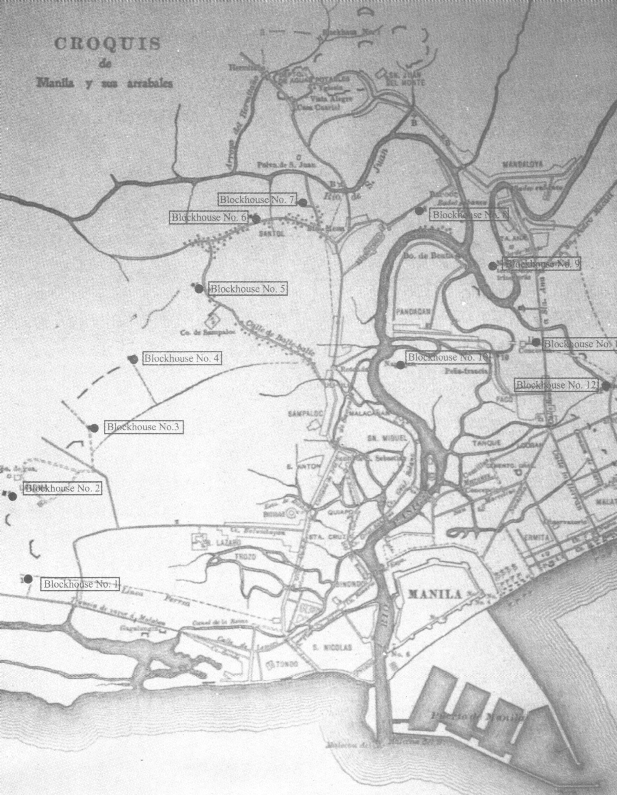
On the morning of February 4, Stotsenburg said, "Your orders are to hold the village. If any armed men come into our lines order them out. If they persist in coming, summon enough men to arrest them. In case an advance in force is made, fall back to the pipeline outpost and resist the occupation of the village by all means in your power, calling on these headquarters for assistance." In a report later that day, Lt. Burt D. Wheedon wrote, "On the morning of February 4 the insurgents ordered our men to move out of town (Santol), and upon their refusal to do so the former said that they would bring a body of men and drive them back when night came." Lt. Wheedon took charge of an outpost on Santol road at seven in the evening and, at 7:30, gave orders saying, "No armed insurgents to enter the town or vicinity ... Halt all armed persons who attempted to advance from the direction of the insurgents' lines which lie between blockhouses 6 and 7 and the San Juan Bridge and order them back to their lines. If they refused to go, arrest them if possible, or if this was impossible, fire upon them... Patrol each of the roads leading to Blockhouses 6 and 7 for 100 yards every half hour." (Blockhouse 6 was located on the city line just southeast of what is now Santol Street. Blockhouse 7 was about 100 yd north-northeast of a point where the water pipe crossed Santol road.).
On the evening of February 4, Private William W. Grayson fired the first shot of the Philippine-American War. A study by Ronnie Miravite Casalmir places this event at the corner of Sociego Street and Tomas Arguelles Street, not at Sociego-Silencio where the marker is erroneously located. The study debunks the previous findings of Dr. Benito Legarda which was the basis for the erroneous placement of the marker at Sociego-Silencio. According to Ronnie Miravite Casalmir, the smoking gun for the Sociego-Arguelles corner is the presence of Blockhouse 7 in the background of Grayson's reenactment photo. The orientation of this Blockhouse 7 image lines up with the corner of Sociego and Arguelles when compared with the known photo of Blockhouse 7 taken from the same direction. In addition, the distance estimate of Lieut. Whedon placed the 100-yard distance from Santol at Sociego-Arguelles, not Sociego-Silencio. This meant that when Lieut. Whedon ordered the detachment at Santol to patrol 100 yards, he meant them to patrol all the way to Sociego-Arguelles. Col. Stotsenburg corroborated Lieut. Whedon's distance estimate.
At about 8:30 pm on February 4, 1899, Grayson, along with Private Orville Miller and one other man, advanced from Santol towards Blockhouse 7, suddenly encountering four armed men from the Morong Battalion after about five minutes of patrolling. According to Grayson's account, he and Miller called "Halt!" and, when the four men responded by cocking their rifles, they fired at them and retreated to Santol. Personal accounts by Grayson claim that he "dropped" two and Miller one. Neither American nor Filipino official reports mention anyone being hit, but these and other details of Grayson's account were confirmed in a conterminous letter written home by another American soldier. The skirmish is credited for beginning the Battle of Manila and the Philippine–American War.
Worcester writes that General Otis' account of the opening of active hostilities was as follows:
On the night of February 2 they sent in a strong detachment to draw the fire of our outposts, which took up a position immediately in front and within a few yards of the same. The outpost was strengthened by a few of our men, who silently bore their taunts and abuse the entire night. This was reported to me by General MacArthur, whom I directed to communicate with the officer in command of the insurgent troops concerned. His prepared letter was shown me and approved, and the reply received was all that could be desired. However, the agreement was ignored by the insurgents and on the evening of February 4 another demonstration was made on one of our small outposts, which occupied a retired position at least 150 yards within the line which had been mutually agreed upon, an insurgent approaching the picket and refusing to halt or answer when challenged. The result was that our picket discharged his piece, when the insurgent troops near Santa Mesa opened a spirited fire on our troops there stationed.
The insurgents had thus succeeded in drawing the fire of a small outpost, which they had evidently labored with all their ingenuity to accomplish, in order to justify in some way their premeditated attack. It is not believed that the chief insurgent leaders wished to open hostilities at this time, as they were not completely prepared to assume the initiative. They desired two or three days more to perfect their arrangements, but the zeal of their army brought on the crisis which anticipated their premeditated action. They could not have delayed long, however, for it was their object to force an issue before American troops, then en route, could arrive in Manila.
Thus began the Insurgent attack, so long and so carefully planned for. We learn from the Insurgent records that the shot of the American sentry missed its mark. There was no reason why it should have provoked a hot return fire, but it did.
The result of the ensuing combat was not at all what the Insurgents had anticipated. The Americans did not drive very well. It was but a short time before they themselves were routed and driven from their positions.
Aguinaldo of course promptly advanced the claim that his troops had been wantonly attacked. The plain fact is that the Insurgent patrol in question deliberately drew the fire of the American sentry, and this was just as much an act of war as was the firing of the shot. Whether the patrol was acting under proper orders from higher authority is not definitely known.
Grayson later recounted the first shot:
This event began the Battle of Manila. On August 23, 1899, he was honorably discharged.
Other sources name the two specific U.S. soldiers involved in the first exchange of fire as Privates William Grayson and Orville Miller of the Nebraska Volunteers.
After the conclusion of the war, after analyzing captured insurgent papers, Major J. R. M. Taylor wrote, in part,
Reactions of Aguinaldo and Otis


Aguinaldo was away in Malolos when the conflict started on the 4th. That same night, a Filipino captain in Manila wired him in Malolos, stating that the Americans had started the hostilities. Aguinaldo wanted to avoid open conflict with the Americans while maintaining his leadership position with his nationalist followers. The next day (February 5), Aguinaldo sent an emissary to General Otis to mediate, saying, "the firing on our side the night before had been against my order."
Otis, who was then confident that a military campaign against Aguinaldo would be swift, was a veteran of the American Indian Wars and reacted much as he might have to his Sioux opponents decades before: "Fighting having begun, must go on to the grim end."
Aguinaldo then reassured his followers with a pledge to fight if forced by the Americans, whom he had come to fear as new oppressors come to replace the Spanish.
"It is my duty to maintain the integrity of our national honor, and that of the army so unjustly attacked by those, who posing as our friends, attempt to dominate us in place of the Spaniards.
"Therefore, for the defense of the nation entrusted to me, I hereby order and command: Peace and friendly relations between the Philippine Republic and the American army of occupation are broken—and the latter will be treated as enemies with the limits prescribed by the laws of War."}}
Battle
Caught off guard by the sudden outburst, the Filipinos remained in their trenches and exchanged fire with the Americans. A Filipino battalion mounted a charge against the 3rd U.S. Artillery, routed a company of American soldiers, and succeeded in capturing two artillery pieces for a little while. The Filipino troops had been caught unprepared and leaderless, as their generals had gone home to their families for the weekend. The American soldiers, in contrast, were ready and needed only to follow previously prepared planning. The next day, Brigadier General Arthur MacArthur ordered an American advance.
When Filipino officers did arrive on the field, many influential leaders tried to stop the fighting. Aguinaldo sent emissaries to negotiate a cease-fire. But Otis and MacArthur thought the crisis should be brought to a head and refused to negotiate.
General MacArthur, in command of the North of Manila, had developed a defensive plan which called for his entire division to launch an all-out offensive along the Santa Mesa Ridge in the event of an attack, capture the blockhouses, and seize the Chinese hospital and La Loma Cemetery. General Anderson, along the southern lines, believed he faced an imminent attack, so, with permission from Otis, he sent his entire division in a preemptive strike at first light. Brig. Gen. Pio del Pilar's forces fled into the Pasig River where many drowned. The battle of February 5 was fought along a 25 km (16-mile) front and was the biggest and bloodiest of the war. American casualties totaled 238, of whom 44 were killed in action or died from wounds.
The Filipinos were shocked when the Americans attacked. They were used to Spanish tactics of retreating into fortified cities after a nighttime raid. MacArthur's attack in the north captured the ridge overlooking Manila. (MacArthur was later promoted to major general and became Governor-General of the Philippines.) After initial confusion, Brigadier General Thomas M. Anderson's attack in the south captured the village of Pasay and Filipino supplies stored there.

The Filipinos were counting on an uprising by the citizens of Manila to divide American forces and interrupt American supply lines. Although some fires were set inside the city, no general uprising occurred since Provost Marshal Brig. Gen. Robert Patterson Hughes' Provost Guard quickly suppressed any disturbances. However, some small units of Philippine soldiers who had not been part of the force that was routed skirmished with the Americans for several days on the outskirts of Manila before being driven out.
Memorial
On the evening of February 4, Private William W. Grayson fired the war's first shots at the corner of Sociego Street and Tomas Arguelles Street. A study done by Ronnie Miravite Casalmir places the event at this corner, not at Sociego-Silencio where they erroneously have the marker.
References
Bibliography
--
References
- General Pantaleon Garcia was the only high-ranking Filipino officer at his post in Maypajo, north of Manila, on the eve of the war.
- (January 15, 1899). "Congressional Serial Set". U.S. Government Printing Office.
- Senate, Oregon. Legislative Assembly.. (1905). "Journal of the Senate of the ... Regular Session, of the Legislative Assembly of Oregon". The State.
- (January 15, 1899). "Congressional Serial Set". U.S. Government Printing Office.
- {{harvnb. Legarda. 2001
- {{harvnb. Legarda. 2001
- Quezon, Manuel III. (). "Diaries describe the start of the Filipino-American War, February 4–28, 1899".
- {{harvnb. Linn. 2000
- {{Harvnb. Medina. Medina. 2002
- {{Harvnb. Legarda. 2001
- {{Harvnb. Legarda. 2001. Agoncillo. 1990
- {{Harvnb. Legarda. 2001
- {{Harvnb. Legarda. 2001. Medina. Medina. 2002
- {{Harvnb. Legarda. 2001
- (November 17, 2023). "The First Shot of the Philippine-American war happened at the corner of Sociego St. and Tomas Arguelles St.".
- (November 17, 2023). "The First Shot of the Philippine-American war happened at the corner of Sociego St. and Tomas Arguelles St.".
- (November 17, 2023). "The First Shot of the Philippine-American war happened at the corner of Sociego St. and Tomas Arguelles St.".
- (November 17, 2023). "The First Shot of the Philippine-American war happened at the corner of Sociego St. and Tomas Arguelles St.".
- (November 17, 2023). "The First Shot of the Philippine-American war happened at the corner of Sociego St. and Tomas Arguelles St.".
- (November 17, 2023). "The First Shot of the Philippine-American war happened at the corner of Sociego St. and Tomas Arguelles St.".
- Quezon, Manuel III L.. (February 2023). "Diaries describe the start of the Filipino-American War, February 4–28, 1899".
- {{Harvnb. Legarda. 2001
- (n.d.). "Philippine History Source Book". published in Inside the Fighting First: Papers of a Nebraska Private in the Philippine War, by Nebraska: Lur Publications, Danish Immigrant Archive, Dana College, 2001 pp. 98–99. and by a consortium of Philippine universities.
- {{harvnb. Faust. 1899
- {{Harvnb. Worcester. 1914
- Agoncillo, Teodoro. (1960). "History of the Filipino People". Garotech Pub..
- "William Walter Grayson [RG1039.AM]".
- {{Harvnb. Blitz. 2000. Blanchard. 1996
- {{Harvnb. Taylor. 1907
- {{Harvnb. Agoncillo. 1990
- {{Harvnb. Miller. 1982
- {{Harvnb. Halstead. 1918
- {{Harvnb. Feuer. 2002
- {{Harvnb. Constantino. 1975
- {{harvnb. Linn. 2000
- {{harvnb. Linn. 2000
- {{harvnb. Linn. 2000
- Linn. 2000
- 中文(繁體)∙ +/−, Public domainPublic domainfalsefalseThis file is a work of a U.S. Army soldier or employee, taken or made as part of that person's official duties As a work of the U.S. federal government, it is in the public domain in the United States العربية ∙ বাংলা ∙ català ∙ čeština ∙ Deutsch ∙ English ∙ español ∙ eesti ∙ فارسی ∙ suomi ∙ français ∙ hrvatski ∙ magyar ∙ Bahasa Indonesia ∙ italiano ∙ 日本語 ∙ 한국어 ∙ lietuvių ∙ македонски ∙ മലയാളം ∙ မြန်မာဘာသာ ∙ Nederlands ∙ polski ∙ português ∙ русский ∙ sicilianu ∙ српски / srpski ∙ Türkçe ∙ українська ∙ Tiếng Việt ∙ 中文(简体) ∙. (February 5, 1899). "English: Filipino casualties on the first day of the Philippine-American War. Original caption is 'Insurgent dead just as they fell in the trench near Santa Ana, February 5th. The trench was circular, and the picture shows but a small portion.'".
- {{harvnb. Linn. 2000
- (November 17, 2023). "The First Shot of the Phil-Am war did not happen on Sociego-Silencio".

This article was imported from Wikipedia and is available under the Creative Commons Attribution-ShareAlike 4.0 License. Content has been adapted to SurfDoc format. Original contributors can be found on the article history page.
Ask Mako anything about Battle of Manila (1899) — get instant answers, deeper analysis, and related topics.
Research with MakoFree with your Surf account
Create a free account to save articles, ask Mako questions, and organize your research.
Sign up freeThis content may have been generated or modified by AI. CloudSurf Software LLC is not responsible for the accuracy, completeness, or reliability of AI-generated content. Always verify important information from primary sources.
Report