From Surf Wiki (app.surf) — the open knowledge base
Bartolomeo Ammannati
Italian architect and sculptor
Italian architect and sculptor
Bartolomeo Ammannati (18 June 1511 – 13 April 1592) was an Italian architect and sculptor, born at Settignano, near Florence, Italy. He studied under Baccio Bandinelli and Jacopo Sansovino (assisting on the design of the Library of St. Mark's, the Biblioteca Marciana, Venice) and closely imitated the style of Michelangelo.
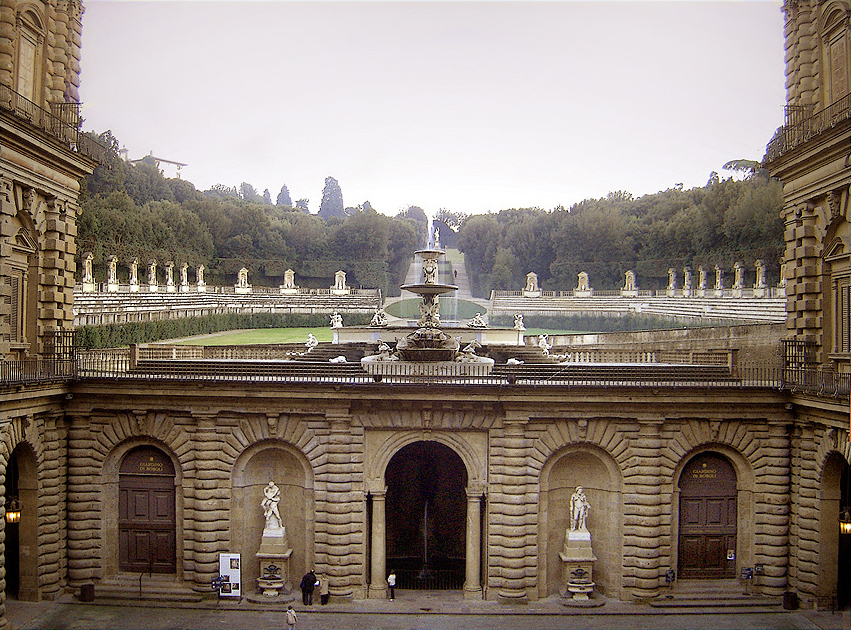
He was more distinguished in architecture than in sculpture. He worked in Rome in collaboration with Vignola and Vasari), including designs for the Villa Giulia, but also for works at Lucca. He labored during 1558–1570, in the refurbishment and enlargement of Pitti Palace, creating the courtyard consisting of three wings with rusticated facades, and one lower portico leading to the amphitheatre in the Boboli Gardens. His design mirrored the appearance of the main external façade of Pitti. He was also named Consul of Accademia delle Arti del Disegno of Florence, which had been founded by the Duke Cosimo I in 1563.
In 1569, Ammannati was commissioned to build the Ponte Santa Trinita, a bridge over the Arno River. The three arches are elliptic, and though very light and elegant, has survived, when floods had damaged other Arno bridges at different times. Santa Trinita was destroyed in 1944, during World War II, and rebuilt in 1957.
Ammannati designed what is considered a prototypic Mannerist sculptural ensemble in the Fountain of Neptune (Fontana del Nettuno), prominently located in the Piazza della Signoria in the center of Florence. The assignment was originally given to the aged Bartolommeo Bandinelli; however when Bandinelli died, Ammannati's design, bested the submissions of Benvenuto Cellini and Vincenzo Danti, to gain the commission. From 1563 and 1565, Ammannati and his assistants, among them Giambologna, sculpted the block of marble that had been chosen by Bandinelli. He took Grand Duke Cosimo I as model for Neptune's face. The statue was meant to highlight Cosimo's goal of establishing a Florentine Naval force. The ungainly sea god was placed at the corner of the Palazzo Vecchio within sight of Michelangelo's David statue, and the then 87-year-old sculptor is said to have scoffed at Ammannati— saying that he had ruined a beautiful piece of marble— with the ditty: "Ammannati, Ammanato, che bel marmo hai rovinato!" Ammannati continued work on this fountain for a decade, adding around the perimeter a cornucopia of demigod figures: bronze reclining river gods, laughing satyrs and marble sea horses emerging from the water.
In 1550 Ammannati married Laura Battiferri, an elegant poet and an accomplished woman. Later in his life he had a religious crisis, influenced by Counter-Reformation piety, which resulted in condemning his own works depicting nudity, and he left all his possessions to the Jesuits.
He died in Florence in 1592.
Works
- Victory (1540), marble, Museo Nazionale del Bargello, Florence
- Leda with the Swan, marble, also in Bargello, Florence
- Venus (1558–59), marble, Prado Museum, Madrid
- Parnassus (1563), marble, Museo Nazionale del Bargello, Florence
- Allegory of Winter (1563–65), stone, Villa Medici, Castello
- Goddess Opi (1572–75), bronze, Palazzo Vecchio, Florence
Gallery
File:Pigna - Collegio romano 1080166.JPG|The Jesuit College in Rome, 1582–1584, was one of Ammannati's later designs. File:Venus by Baccio Bandinelli (Prado, E-171) 01.jpg|Venus, a variation on the classical type known as Venus Pudica. However, the arms are the result of an 18th-century restoration, as the original had the arms cut off in order to allow water to flow out. File:Bartolomeo ammannati (attr.), vasca con arme busdraghi e dragone, 04.JPG|Dragon File:Parco di Castello, fontana del Gennaio 1.JPG|Parco di Villa Reale di Castello (Villa di Castello), Fountain of January (Fontana del Gennaio) in Florence, Italy File:Da bartolomeo ammannati, giustizia, firenze tardo 16mo secolo.JPG|Justice File:Cristo e la cananea di Alessandro Allori detail.jpg|Christ and Canaanite woman by Alessandro Allori. Commissioned by Ammannati for funeral of his wife poet Laura Battiferri (painted as old woman with the book).
References
Citations
General references
References
- [https://books.google.com/books?id=Y2OThzu08lMC Isabella de' Medici], by Caroline P. Murphy, page 76. Murphy only mentions the phrase ''Ammannati Ruinati'' as Michelangelo's words. It appears the statue received a cool public welcome relative to the David.
- {{EB1911
This article was imported from Wikipedia and is available under the Creative Commons Attribution-ShareAlike 4.0 License. Content has been adapted to SurfDoc format. Original contributors can be found on the article history page.
Ask Mako anything about Bartolomeo Ammannati — get instant answers, deeper analysis, and related topics.
Research with MakoFree with your Surf account
Create a free account to save articles, ask Mako questions, and organize your research.
Sign up freeThis content may have been generated or modified by AI. CloudSurf Software LLC is not responsible for the accuracy, completeness, or reliability of AI-generated content. Always verify important information from primary sources.
Report