From Surf Wiki (app.surf) — the open knowledge base
Banksia obovata
Species of shrub in Western Australia
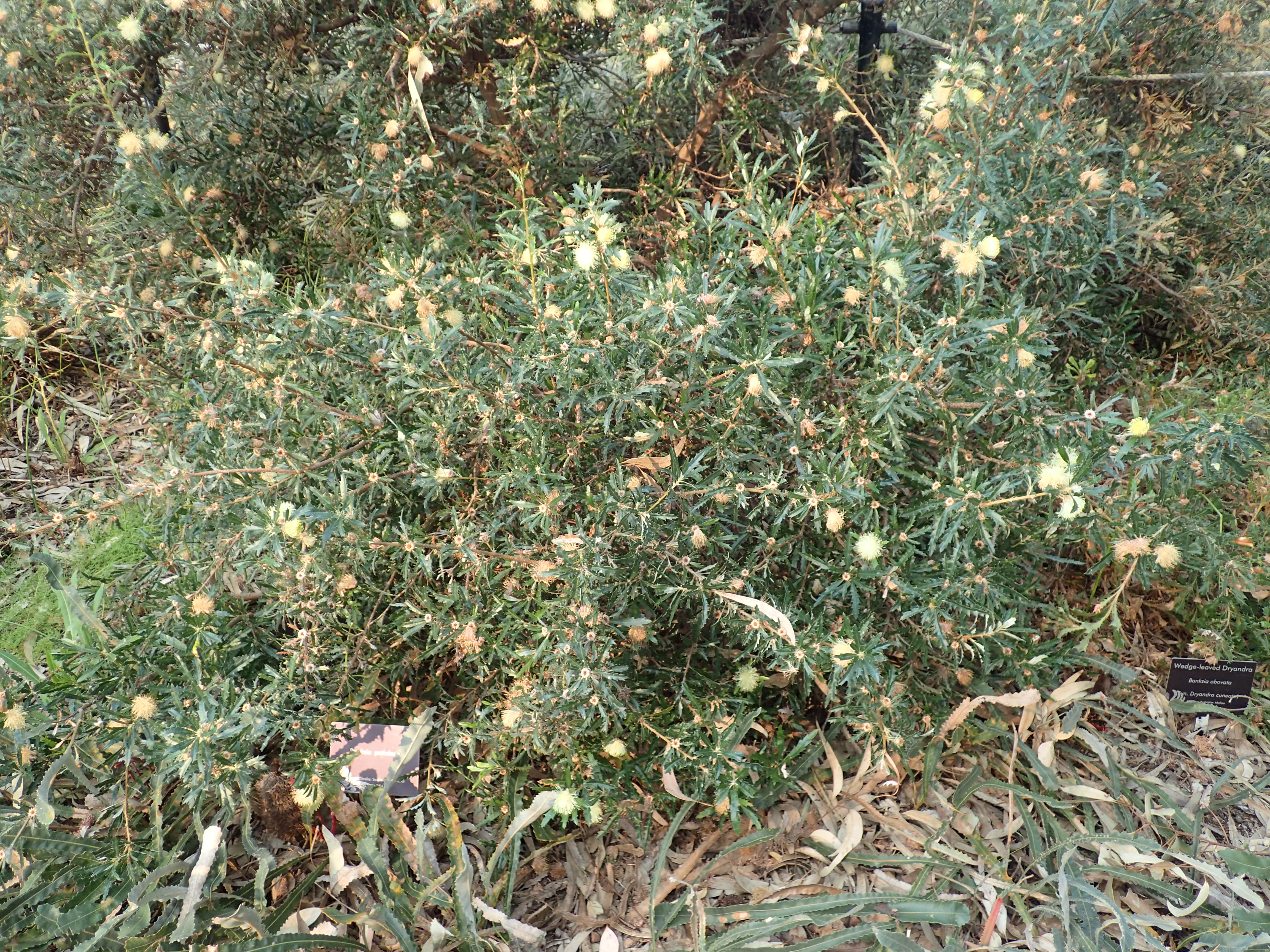
Species of shrub in Western Australia
- Dryandra cuneata R.Br.
- Dryandra cuneata var. brevifolia Sweet nom. inval., nom. nud.
- Dryandra cuneata var. longifolia Sweet nom. inval., nom. nud.
- Josephia cuneata (R.Br.) Poir.
Banksia obovata, commonly known as wedge-leaved dryandra, is a species of shrub that is endemic to Western Australia. It has hairy stems, serrated, wedge-shaped to egg-shaped leaves with the lower end towards the base, cream-coloured or pale yellow flowers in heads of up to 100, and egg-shaped follicles. It is found in near-coastal areas in the south of the state.
Description
Banksia obovata is a shrub that typically grows to a height of 2 m but does not form a lignotuber. It has wedge-shaped to egg-shaped leaves with the narrower end at the base, 25–65 mm long and 10–30 mm wide on a petiole up to 15 mm long, with between four and twelve serrations on each side. Between thirty-five and one hundred cream-coloured or pale yellow flowers are borne in a head with linear to egg-shaped involucral bracts up to 12 mm long at the base of the head. The perianth is 23–38 mm long and the pistil 24–40 mm long. Flowering mainly occurs from April to November, but also in other months and the follicles are egg-shaped, 10–14 mm long.
Taxonomy and naming
This species was first formally described in 1810 by Robert Brown in Transactions of the Linnean Society of London and was given the name Dryandra cuneata. The specific epithet (cuneata) is a Latin word meaning wedge-shaped.
In 2007, Austin Mast and Kevin Thiele transferred all dryandras to the genus Banksia. As there was already a plant named Banksia cuneata (matchstick banksia), Mast and Thiele chose the epithet obovata, meaning "inverted egg-shaped, in reference to the obovate leaves.
Distribution and habitat
Wedge-leaved dryandra occurs near the south coast of Western Australia between Narrogin, Albany and the Cape Arid National Park, including in the Stirling Range. It grows in kwongan.
References
References
- "''Banksia obovata''".
- {{FloraBase
- (1999). "Flora of Australia". Australian Biological Resources Study, Canberra.
- "''Dryandra cuneata''". APNI.
- (1810). "On the Proteaceae of Jussieu.". Transactions of the Linnean Society of London.
- Francis Aubie Sharr. (2019). "Western Australian Plant Names and their Meanings". Four Gables Press.
- (2007). "The transfer of ''Dryandra'' R.Br. to ''Banksia'' L.f. (Proteaceae)". [[Australian Systematic Botany]].
- "''Banksia kippistiana''". APNI.
This article was imported from Wikipedia and is available under the Creative Commons Attribution-ShareAlike 4.0 License. Content has been adapted to SurfDoc format. Original contributors can be found on the article history page.
Ask Mako anything about Banksia obovata — get instant answers, deeper analysis, and related topics.
Research with MakoFree with your Surf account
Create a free account to save articles, ask Mako questions, and organize your research.
Sign up freeThis content may have been generated or modified by AI. CloudSurf Software LLC is not responsible for the accuracy, completeness, or reliability of AI-generated content. Always verify important information from primary sources.
Report