From Surf Wiki (app.surf) — the open knowledge base
Bank of Lithuania
Central Bank of Lithuania
Central Bank of Lithuania
| Field | Value |
|---|---|
| logo | File:Lietuvos Bankas Logo.svg |
| logo_caption | Logo adopted in 2005 |
| image | Central Office of the Bank of Lithuania 2019.jpg |
| caption | Head office in Vilnius |
| bank_name_in_local | Lietuvos bankas |
| headquarters | Vilnius |
| coordinates | |
| ownership | 100% state ownership |
| established | ; |
| president | Gediminas Šimkus |
| leader_title | Chairman |
| bank_of | Lithuania |
| reserves | $1.310 billion |
| website |
The Bank of Lithuania () is the name of two homonymous institutions, respectively in existence from 1922 to 1943 in Kaunas, and since 1990 in Vilnius. The current Bank of Lithuania is the national central bank for Lithuania within the Eurosystem. It is fully owned by the Lithuanian state.
The interwar Bank of Lithuania issued the Lithuanian litas between 1922 and 1940. The current Bank of Lithuania also issued a national currency of the same name from 1993 until end-2014, when Lithuania adopted the euro as its currency.
Whereas it is governed under a national framework of accountability, the Bank of Lithuania increasingly implements policies set at the European Union level. In addition to its Eurosystem role, it is the national competent authority for Lithuania within European Banking Supervision. It is a voting member of the respective Boards of Supervisors of the European Banking Authority (EBA), European Insurance and Occupational Pensions Authority (EIOPA), and European Securities and Markets Authority (ESMA). It is Lithuania's designated National Resolution Authority and plenary session member of the Single Resolution Board (SRB). It provides the permanent single common representative for Lithuania in the Supervisory composition of the General Board of the Anti-Money Laundering Authority (AMLA). It is also a member of the European Systemic Risk Board (ESRB).
History
Interwar period

Following the Act of Independence of Lithuania in February 1918, the authorities did not immediately introduce a new currency as several of the neighbouring countries did, but kept using the German ostmark issued by the German-controlled Darlehnskasse Ost. The ostmark was printed in multiple languages, including in Lithuanian as the auksinas (). The Bank of Lithuania was only established in 1922 in Kaunas, the temporary capital of Lithuania. It held its first board meeting on 27 September 1922, and started operations on 2 October. Its first governor was Vladas Jurgutis. About four-fifths of its equity capital was state-owned, with the remainder owned by municipalities, companies and individuals.
The first task of the bank was to replace the German ostmarks and ostrubels in circulation in the country with the new Lithuanian litas. The bank's mandate extended beyond a pure monetary authority, as it also entailed a developmental role with the possibility of allocating short-term credit to industry and agriculture.
In 1924 - 1927 the Bank of Lithuania building in Kaunas was constructed with sumptuous interior and splendid exterior in order to replace the Russian Empire times building as bank's headquarters. Moreover, the Residential Building for Employees of the Bank of Lithuania in Kaunas was constructed in 1925.
On , the bank became a member of the Bank for International Settlements (BIS).
World War II and the bank's gold reserves
Following the Soviet occupation of the Baltic states including Lithuania, the Bank of Lithuania was nationalized by decision of the occupation authorities of , and merged into the State Bank of the USSR on 3 October.
At the time of the Soviet invasion, the Bank of Lithuania held gold reserves at the Bank of England (2.9 tons), Bank of France (2.2 tons), Sveriges Riksbank, Swiss National Bank, as well as the BIS (632 kg) but other institutions were more cautious given the ambiguous status of state continuity of the Baltic states. The United States declined to recognize the Soviet annexation and thus kept the gold immobilized, a position informed by the Briand–Kellogg Pact of 1928, the Stimson Doctrine of 1932 and explicitly stated in Executive Order 8484 of followed by the Welles Declaration of . Also in July 1940, the Bank of England sequestrated the Baltic gold reserves deposited in its custody. The BIS, advised by legal scholar , assessed that the Soviet invasion had deprived the Baltic states of their capacity to form 'a national independent will' and that therefore the requests of their central banks should be rejected as made under duress. Partly influenced by the BIS position, the Bank of France similarly declined to act on the Soviet requests, and, despite France's own situation under German occupation, maintained that position when similar requests were made by the Bank of Lithuania under German occupation after June 1941.
The gold held in America was eventually expended by the US government to fund the Lithuanian Diplomatic Service in exile, similarly as with the other Baltic Legations, In 1954, the Bank of France argued that the "uncertainty regarding the existence or disappearance of the Latvian state", in the absence of a clear position from the French government, prevented a transfer or use of the gold under its custody. of which 9 million were transferred to the USSR and 1.4 million to British claimants who had lost assets in the Baltic states during the Soviet annexation. The terms of that transaction specified that the USSR renounced all of its possible claims for the Baltic gold, while the UK agreed not to raise further demands regarding lost British assets. Following that precedent, negotiations were held throughout the 1970s between France and the Soviet Union on the matter but without success. In 1976, the BIS also briefly considered a similar arrangement, but its members rejected the idea. More attempts to use the gold under French custody were made in the 1980s, without any concrete result.
Restoration
The present Bank of Lithuania was established on . In late 1991, it recovered the gold that had remained immobilized at the Bank of France. minus 62 kg retained by the BIS in compensation for assets it had lost in the Soviet invasion. Also in 1992, the Bank of Lithuania received compensation from the UK (paid in gold) for the reserves originally placed under their respective jurisdictions. On , it recovered its membership and shareholding in the BIS.
In September 1992, the Bank of Lithuania spun off the network of branches it had inherited from the former Gosbank, as . The newly formed entity was headquartered in Vilnius and had operations in Akmenė, Alytus, Anykščiai, Birštonas, Druskininkai, Ignalina, Jonava, Kaunas, Klaipėda, Kėdainiai, Kretinga, Marijampolė, Mažeikiai, Palanga, Panevėžys, Plungė, Rokiškis, Šiauliai, Šilutė, Švenčionys, Tauragė, Telšiai, Ukmergė, Utena, Vilkaviškis, and Žirmūnai. That bank was eventually liquidated in 1998.
The Lithuanian litas, introduced on after several years of monetary turmoil, was pegged to the US dollar in 1994.
21st century

On , in view of the increasing orientation of the Lithuanian economy towards the EU and the prospect of its EU membership, the litas's peg was shifted from the US dollar to the recently created euro.
On , the Bank of Lithuania took over the capital market supervisory duties previously granted since 1992 to the , as well as insurance supervision previously performed by the Insurance Commission (). It thus became the single supervisor of the entire Lithuanian financial sector, aside from accounting and auditing supervisory operations carried out directly by the Ministry of Finance. Around the same time, the bank streamlined its territorial footprint by closing its branch in Klaipėda.
On , Lithuania adopted the euro as its currency. On that same day, the Bank of Lithuania became Lithuania's national competent authority within the system of European Banking Supervision, and its National Resolution Authority within the newly established Single Resolution Mechanism.
In 2017, the Bank of Lithuania identified financial technology (fintech) as a strategic direction of its activity. In particular, the Bank of Lithuania was the local contact point for the banking license granted by the European Central Bank to Revolut in December 2018. In 2020, it introduced an experimental central bank digital currency, the LBCoin.
Operations
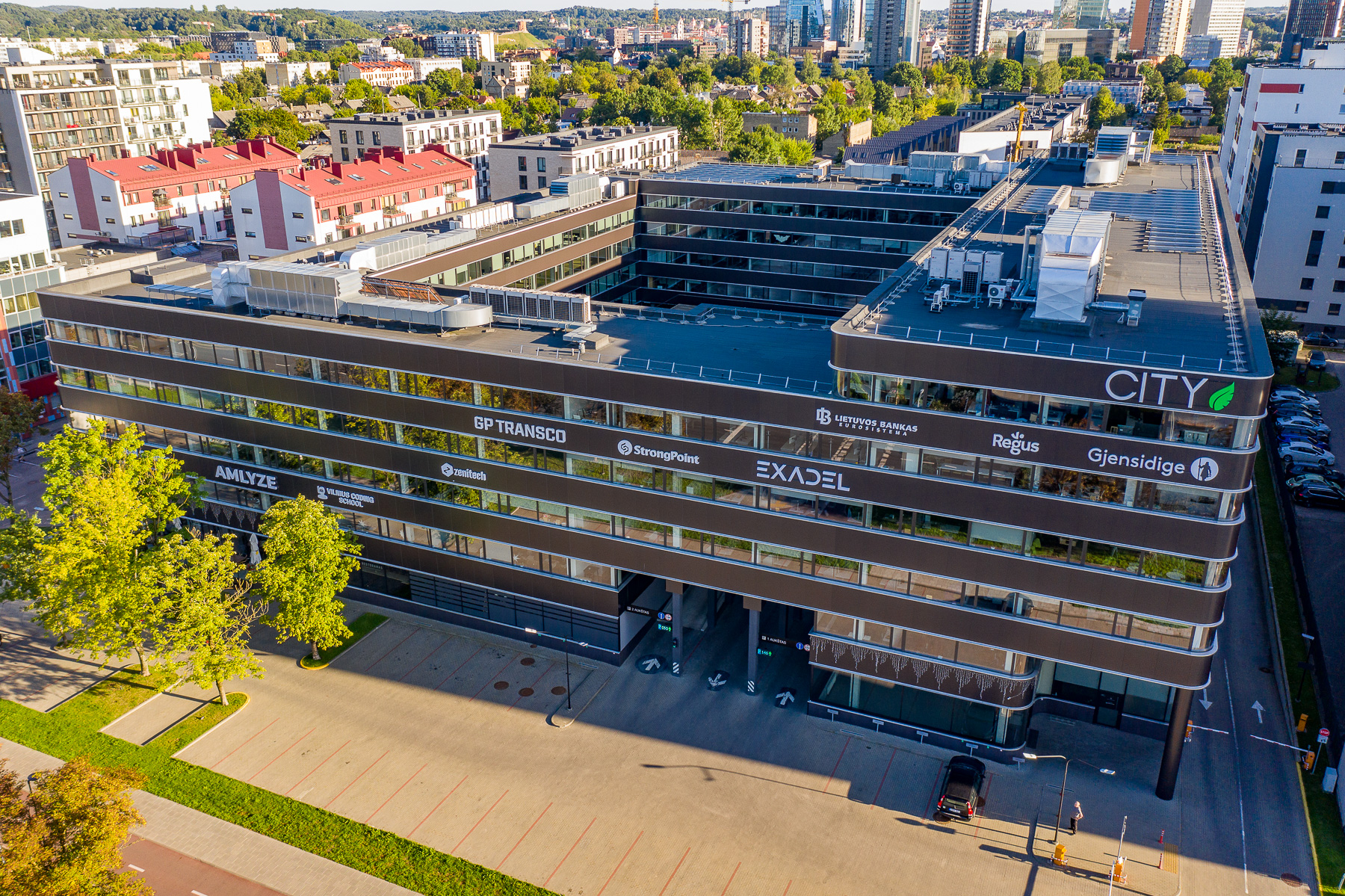
According to the Bank's official website, the Bank of Lithuania performs these primary functions:
- maintaining price stability,
- formulating and implementing the monetary policy,
- acting as an agent of the State Treasury. As a member of the European System of Central Banks, the Bank of Lithuania participates in the formulation and implementation of the monetary policy of the eurozone.
It is governed by a board consisting of a chairperson, two deputy chairpersons and two members. As of 2025, the bank had around 700 employees.
Buildings

In 1922, the Bank of Lithuania was initially located in the Kaunas branch building of the State Bank of the Russian Empire, together with the Council of the State and several ministries. In 1923, the bank offered to purchase the building for itself, but the government refused. As a consequence, in 1924 the Bank of Lithuania held an international architecture competition for a new head office building across the street. The construction of the new building, designed in neoclassical style by architect , started in 1925. It was inaugurated on . As of 2025, it was used as a cash office by the Bank of Lithuania.
The Bank of Lithuania's current head office un Vilnius is located at number 6 of Gediminas Avenue. It was originally built for the Vilnius Land Bank in 1889–1891, which stayed there until World War II. The property was subsequently repurposed as the local head office of the State Bank of the USSR in the Lithuanian Soviet Socialist Republic. The Bank of Lithuania was located there from its creation in March 1990. Following Lithuanian independence it was renovated in 1994-1997, and a opened on its premises in 1999.
As of 2025, the Bank of Lithuania also maintained two separate facilities in the northern part of Vilnius, on Žalgirio street and Žirmūnų street respectively.
Leadership

Governors of the Bank of Lithuania during the interwar period and WWII:
- Vladas Jurgutis (September 1922 – October 1929)
- Vladas Stašinskas (June 1930 – September 1938)
- Juozas Tūbelis (October 1938 – September 1939)
- (October 1939– September 1940 and October 1941 – October 1942)
- (September 1940 – June 1941)
- (June – October 1941)
- Juozas Bergas (October 1942 – June 1943)
Chairmen of the board of the Bank of Lithuania since 1990:
- (March – July 1990)
- Vilius Baldišis (July 1990 – March 1993)
- (March – October 1993)
- Kazys Ratkevičius (November 1993 – January 1996)
- Reinoldijus Šarkinas (February 1996 – April 2011)
- (April 2011 – April 2021)
- Gediminas Šimkus (since April 2021)
References
References
- ({{date). "The Bank of Lithuania changes its logo".
- (2017). "The Organisation and Structure of Central Banks".
- "National supervisors".
- "Members and Observers".
- "Board of Supervisors".
- "Board of Supervisors".
- "National Resolution Authorities".
- ({{date). "General Board in Supervisory composition".
- ({{date). "List of ESRB Members and National Macroprudential Authorities".
- "The Office of the Bank of Raseiniai".
- "Historical timeline".
- Eric Helleiner. (2003). "The Making of National Money: Territorial Currencies in Historical Perspective". Cornell University Press.
- "The Bank of Lithuania's building in Kaunas".
- "Lietuvos banko rūmai Kaune".
- "Banko tarnautojų gyvenamasis namas Kaune".
- ({{date). "31 March in the history of the Bank of Lithuania".
- ({{date). "The establishment of the Bank of Lithuania in 1990".
- ({{date). "Is the Lithuanian gold safe in London? During his working visit to London the Minister of Finance of Lithuania visited the vaults at the Bank of England".
- (2002). "Second World War Switzerland and Gold Transactions in the Second World War: Interim Report". Independent Commission of Experts Switzerland.
- "Communist Dictatorship in Lithuania. The Soviet Occupation (1940-1941; 1944-1991)".
- (December 17, 2008). "The Baltic Question During the Cold War". Routledge.
- Una Bergmane. (2022). "'The Uncertainty that Persists': The Bank of France, the Baltic Gold and the Non-Recognition of a Forcible Seizure of Territory during the Cold War". Routledge.
- ({{date). "Britain to Repay Baltic States for Seizure of Gold Deposits".
- ({{date). "When and for what are Lithuanian gold reserves used?".
- Kristīne Drēviņa, Kęstutis Laurinavičius & Andres Tupits. (July 2007). "Legal and institutional aspects of the currency changeover following the restoration of the independence of the Baltic States". European Central Bank.
- ({{date). "Nutarimas Dėl akcinės bendrovės Lietuvos valstybinio komercinio banko turto perdavimo".
- Patricia Alonso-Gamo, Stefania Fabrizio, Vitali Kramarenko, & Qing Wang. ({{date). "Lithuania: History and Future of the Currency Board Arrangement". International Monetary Fund.
- Nicolas Véron. ({{date). "Breaking the deadlock: a single supervisor to unshackle Europe's capital markets union". Bruegel.
- Ekmel Cilingir. ({{date). "Why Lithuania's Fintech is Booming".
- ({{date). "Revolut granted specialised bank and electronic money institution licences".
- ({{date). "The start of activities of the Bank of Lithuania in 1922".
- "Lietuvos bankas cash offices".
- Morta Baužienė. (2007). "Buildings of the Bank of Lithuania in Vilnius". Lietuvos bankas.
- "Structure".
This article was imported from Wikipedia and is available under the Creative Commons Attribution-ShareAlike 4.0 License. Content has been adapted to SurfDoc format. Original contributors can be found on the article history page.
Ask Mako anything about Bank of Lithuania — get instant answers, deeper analysis, and related topics.
Research with MakoFree with your Surf account
Create a free account to save articles, ask Mako questions, and organize your research.
Sign up freeThis content may have been generated or modified by AI. CloudSurf Software LLC is not responsible for the accuracy, completeness, or reliability of AI-generated content. Always verify important information from primary sources.
Report