From Surf Wiki (app.surf) — the open knowledge base
Bandurria
Plucked chordophone from Spain
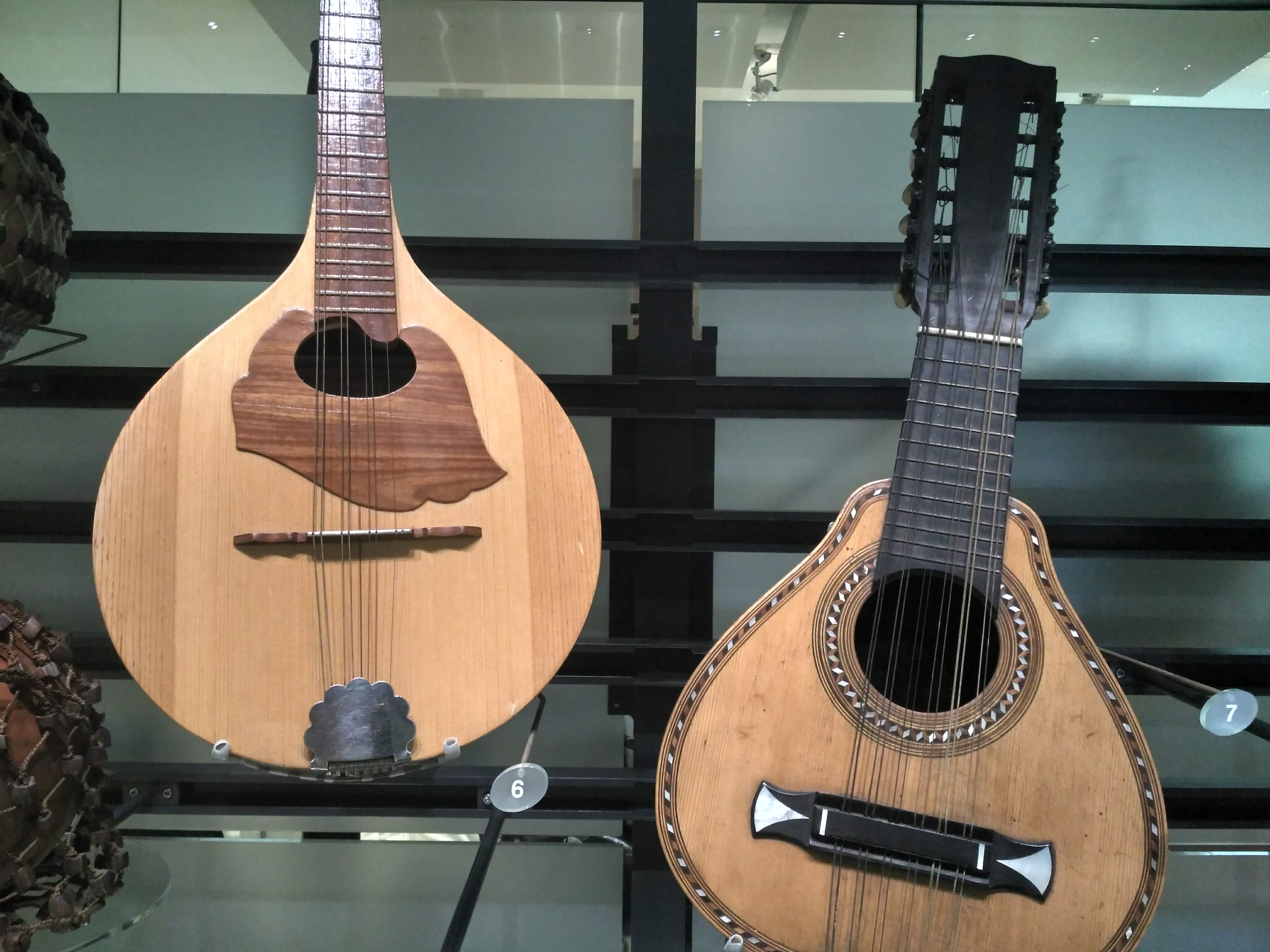
Plucked chordophone from Spain
| Field | Value | ||
|---|---|---|---|
| name | Bandurria | ||
| image | Original bandurria.jpg | ||
| background | string | ||
| classification | Plucked chordophone | ||
| hornbostel_sachs | 321.321 and 321.322 | ||
| hornbostel_sachs_desc | Necked bowl lute for roundback, necked box lute for flatback | ||
| range | [[File:Bandurria-tuning.png | 165px | center]] |
| related | Bandola, laúd, mandolin, octavina |
The bandurria is a plucked chordophone from Spain, similar to the mandolin and bandola, primarily used in Spanish folk music, but also found in former Spanish colonies.
Instrument development
Prior to the 18th century, the bandurria had a round back, similar or related to the mandore. It had become a flat-backed instrument by the 18th century, with five double courses of strings, tuned in fourths. The original bandurrias of the Medieval period had three strings. During the Renaissance they gained a fourth string. During the Baroque period the bandurria had 10 strings (5 pairs).
The modern bandurria has 12 strings (6 pairs). The strings are tuned in unison pairs, going up in fourths from the low G#. The lowest four strings are a major-third above those of a standard guitar and the highest two strings are a fourth above a standard guitar, i.e. G, c, f, b, e' and a'. File:bandurria1.jpg|Bandurria (front view) File:Bandurria2.JPG|Bandurria (back view) File:bandurria3.jpg|Bandurria (tailpiece) File:bandurria4.jpg|Bandurria (tuning head)
Variations and uses in different parts of the world
Spain
Juan Ruiz first mentioned the term "mandurria" in the 14th century in his "Libro De Buen Amor." After that, Juan Bermudo gave the description of the bandurria in his "Comiença el libro llamado declaraciõ de instrumentos" as a three-string instrument in 1555, but he also mentioned other types with four or even five strings. In the early 1870s, a child's wake was accompanied with the bandurria music in Jijona, Alicante Province. The zapateo, a dance derived from the Spanish zapateado and introduced by tobacco cultivators from the Canary Islands, is accompanied with bandurria and other instruments before 1900.
Philippines
The Philippine harp bandurria is a 14-string bandurria used in many Philippine folkloric songs, with 16 frets and a shorter neck than the 12-string bandurria.) is used in an orchestra of plucked string instruments called rondalla. It is tuned a step lower than the Spanish version, that is, low to high: F# B E A D G. Filipino bandurrias have been made with coconuts, and as banjoleles with banjo bodies and goatskin soundboards.
South America
There are also many different varieties of bandurria in South America, especially Peru and Bolivia. They have four courses, unlike the traditional Spanish six courses. In Lima, Peru, harp and bandurria duos were common in the early 20th century. Nowadays people there still play bandurria accompanying with the popular vals peruano, or vals criollo.
United Kingdom
Although generally little known in the UK, the bandurria was used by Roy Williamson of the Scottish folk-group The Corrie Folk Trio. When this group later (after the loss of one member) became The Corries, Williamson incorporated a bandurria into one of the two multi-instrument "combolins" that he constructed for himself and his partner.
Notable players and music
- Javier Mas "Tamiz".{{cite AV media
- Rick Walker, a British musician, played this instrument on the song 'A Twilight Zone' by the artist Aim.
References
Bibliography
References
- Tyler, James. (1992). "The Early Mandolin". Clarendon Press.
- . (14 September 2013). ["B"](https://stringedinstrumentdatabase.aornis.com/b.htm).
- "Death of Henry E. Abbey; The Well-Known Manager's Long Career Closed. The New York Times. October 18, 1896. Column 3".
- {{harvnb. Sparks. 2003
- [https://revistas.unal.edu.co/index.php/ensayo/article/download/45992/47541 Music and Society in 19th-Century Nueva Granada and Colombia. ''The bandola and its History Through Iconographic Sources (1850–1900)'' by Egberto Bermúdez, pages 158, 160, 161]
- "Banduriya".
- "The Stringed Instrument Database: Index".
- "Banduria late 19th–early 20th century Philippine". Metropolitan Museum of Art.
This article was imported from Wikipedia and is available under the Creative Commons Attribution-ShareAlike 4.0 License. Content has been adapted to SurfDoc format. Original contributors can be found on the article history page.
Ask Mako anything about Bandurria — get instant answers, deeper analysis, and related topics.
Research with MakoFree with your Surf account
Create a free account to save articles, ask Mako questions, and organize your research.
Sign up freeThis content may have been generated or modified by AI. CloudSurf Software LLC is not responsible for the accuracy, completeness, or reliability of AI-generated content. Always verify important information from primary sources.
Report