From Surf Wiki (app.surf) — the open knowledge base
Ballistic missile
Missile that follows a sub-orbital ballistic flightpath
Missile that follows a sub-orbital ballistic flightpath
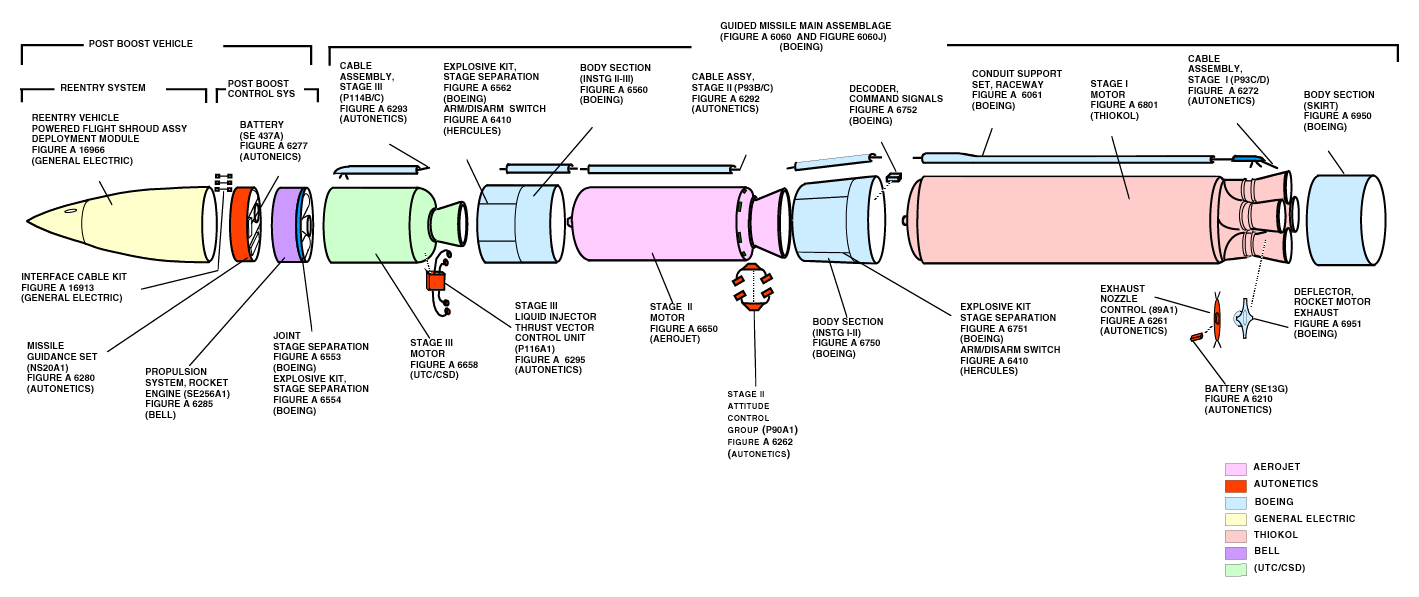
|1. The missile launches out of its silo by firing its first-stage boost motor (A). |2. About 60 seconds after launch, the first-stage drops off and the second-stage motor (B) ignites. The missile shroud (E) is ejected. |3. About 120 seconds after launch, the third-stage motor (C) ignites and separates from the second stage. |4. About 180 seconds after launch, third-stage thrust terminates and the post-boost vehicle (D) separates from the rocket. |5. The post-boost vehicle maneuvers itself and prepares for re-entry vehicle (RV) deployment. |6. The RVs, as well as decoys and chaff, are deployed. |7. The RVs (now armed) and chaff re-enter the atmosphere at high speeds. |8. The nuclear warheads detonate.}}]]
A ballistic missile is a type of missile that follows a ballistic trajectory and is powered only during a relatively brief initial period—most of the flight is unpowered. Short-range ballistic missiles (SRBM) typically stay within the Earth's atmosphere, while most larger missiles travel outside the atmosphere. The type of ballistic missile with the greatest range is an intercontinental ballistic missile (ICBM). The largest ICBMs are capable of full orbital flight.
These missiles are in a distinct category from cruise missiles, which are aerodynamically guided in powered flight and thus restricted to the atmosphere.
History
The R-7 Semyorka was the first intercontinental ballistic missile.
The Minuteman III was the first ICBM equipped with a Multiple Independently targetable Reentry Vehicle (MIRV) to enter service.
The largest ballistic missile attack in history took place on 1 October 2024 when the Iranian Revolutionary Guard launched about 200 missiles at Israel, a distance of about 1,500 kilometers. The missiles arrived about 15 minutes after launch. It is believed that Iran's Fattah-1 and Kheybar Shekan missiles were used, which both have a range of about 1,400 km.
Flight
In order to cover large distances, ballistic missiles are usually launched into a high sub-orbital spaceflight; for intercontinental missiles, the highest altitude (apogee) reached during free-flight is about 4500 km. A ballistic missile's trajectory consists of three parts or phases: the boost phase, the mid-course phase and the terminal phase. Special systems and capabilities are required to facilitate the successful passage from one phase to the other.
The boost phase is the powered flight portion, beginning with the ignition of the engines and concluding with the end of powered flight. The powered flight portion can last from a few tenths of seconds to several minutes and can consist of multiple rocket stages. Internal computers keep the missile aligned on a preprogrammed trajectory. On multi-stage missiles, stage separation (excluding any post-boost vehicles or MIRV bus) occurs primarily during the boost phase.
The mid-course phase is the longest in the missile's trajectory, beginning with the conclusion of powered flight. When the fuel is exhausted, no more thrust is provided and the missile enters free flight. During this phase the missile, now largely consisting of a warhead or payload and possibly defensive countermeasures and small propulsion systems for further alignment toward its target, will reach its highest altitude and may travel in space for thousands of kilometres (or even indefinitely, in the case of some fractional-orbital capable systems) at speeds of up to 7.5 to.
The last phase in the missile's trajectory is the terminal or re-entry phase, beginning with the re-entry of the missile into the Earth's atmosphere (if exoatmospheric) where atmospheric drag plays a significant part in missile trajectory, and lasts until missile impact. Re-entry vehicles re-enter the Earth's atmosphere at very high velocities, on the order of 6-8 km/s at intercontinental ballistic missile ranges. During the beginning of this phase, the missile's trajectory is still relatively well defined, though as the missile reaches the heavier layers of atmosphere it is increasingly influenced by gravity and aerodynamic drag, which can affect its landing.
Types
Ballistic missiles can be launched from fixed sites or mobile launchers, including vehicles (e.g., transporter erector launchers), aircraft, ships, and submarines. Ballistic missiles vary widely in range and use, and are often divided into categories based on range. Various schemes are used by different countries to categorize the ranges of ballistic missiles:
- Tactical ballistic missile (TBM): Range less than 300 km
- Short-range ballistic missile (SRBM): Range from 300 to
- Medium-range ballistic missile (MRBM): Range from 1000 to
- Intermediate-range ballistic missile (IRBM): Range from 3500 to
- Intercontinental ballistic missile (ICBM): Range greater than 5500 km
Long- and medium-range ballistic missiles are generally designed to deliver nuclear weapons because their payload is too limited for conventional explosives to be cost-effective in comparison to conventional bomber aircraft.
Quasi-ballistic missiles
A quasi-ballistic missile is a category of SRBM that is largely ballistic but is fully guided and can perform maneuvers throughout the entirety of atmospheric flight to make unexpected changes in direction and range. Large guided MLRS rockets with range comparable to an SRBM are sometimes categorized as quasi-ballistic missiles.
List of quasi-ballistic missiles
;India
- Long Range – Anti Ship Missile (under development) ;Israel
- LORA (active) ;United States
- MGM-140 ATACMS (active)
- Precision Strike Missile (active)
Hypersonic ballistic missile
Main article: Hypersonic glide vehicle
Many ballistic missiles reach hypersonic speeds (i.e. Mach 5 and above) when they re-enter the atmosphere from space. However, in common military terminology, the term "hypersonic ballistic missile" is generally only given to those that can be maneuvered before hitting their target and don't follow a simple ballistic trajectory.
Throw-weight
Throw-weight is a measure of the effective weight of ballistic missile payloads. It is measured in kilograms or tonnes. Throw-weight equals the total weight of a missile's warheads, reentry vehicles, self-contained dispensing mechanisms, penetration aids, and any other components that are part of the delivered payload, and not of the rocket itself (such as the launch rocket booster and launch fuel). Throw-weight may refer to any type of warhead, but in normal modern usage, it refers almost exclusively to nuclear or thermonuclear payloads. It was once also a consideration in the design of naval ships and the number and size of their guns.
Throw-weight was used as a criterion in classifying different types of missiles during Strategic Arms Limitation Talks between the Soviet Union and the United States. The term became politically controversial during debates over the arms control accord, as critics of the treaty alleged that Soviet missiles were able to carry larger payloads and so enabled the Soviets to maintain higher throw-weight than an American force with a roughly comparable number of lower-payload missiles.
The missiles with the world's heaviest payloads are the Russian SS-18 and Chinese CSS-4 and , Russia was developing a new heavy-lift, liquid-propellant ICBM called the Sarmat.
Depressed trajectory

Throw-weight is normally calculated using an optimal ballistic trajectory from one point on the surface of the Earth to another. A "minimum-energy trajectory" maximizes the total payload (throw-weight) using the available impulse of the missile. By reducing the payload weight, different trajectories can be selected, which can either increase the nominal range or decrease the total time in flight.
A depressed trajectory is non-optimal, as a lower and flatter trajectory takes less time between launch and impact but has a lower throw-weight. The primary reasons to choose a depressed trajectory are to evade anti-ballistic missile systems by reducing the time available to shoot down the attacking vehicle (especially during the vulnerable burn-phase against space-based ABM systems) or a nuclear first-strike scenario. An alternate, non-military purpose for a depressed trajectory is in conjunction with the spaceplane concept with use of airbreathing jet engines, which requires the ballistic missile to remain low enough inside the atmosphere for air-breathing engines to function.
In contrast, a "lofted" trajectory is frequently used for testing purposes, as it reduces the range of the missile (allowing for a controlled and observed impact), as well as signals a lack of hostile intention with the test.
Combat use
The following ballistic missiles have been used in combat:
- Ghadr-110
- LORA
- MGM-140 ATACMS
- OTR-21 Tochka
- Qaher-1/2M
- Scud
- V-2
- Zolfaghar
- Kh-47M2 Kinzhal
- Oreshnik
Notes
References
- Needham, Joseph (1986). Science and Civilization in China: Volume 5, Chemistry and Chemical Technology, Part 7, Military Technology; the Gunpowder Epic. Taipei: Caves Books.
References
- Zaloga, Steven. (2003). "V-2 Ballistic Missile 1942–52". [[Osprey Publishing]].
- Clayton K. S. Chun. (2006). "Thunder Over the Horizon: From V-2 Rockets to Ballistic Missiles". [[Greenwood Publishing Group]].
- Wade, Mark. "Peenemuende".
- "Launching The Space Age".
- "MIRV missiles".
- Schneider, Tal. (6 October 2024). "How effective was Iran's attack? The Israeli public doesn't have the full picture". The Times of Israel.
- (2024-10-25). "What to Know About Iran's Ballistic Missile Attacks and Israel's Efforts to Defend Itself {{!}} AJC".
- "MSN".
- "Distance from Jerusalem, Israel to Tehran, Iran".
- (3 October 2024). "What we know about Iran's latest missile attack on Israel".
- Doyle, Gerry. (2 October 2024). "Iranian missile strike on Israel shows capability for greater scale, complexity". Reuters.
- (28 November 2017). "North Korea launches 'highest ever' ballistic missile". [[BBC]].
- Chun, Clayton K. S.. (2006). "Thunder over the horizon: from V-2 rockets to ballistic missiles". Praeger Security International.
- Chun, Clayton K. S.. (2006). "Thunder over the horizon: from V-2 rockets to ballistic missiles". Praeger Security International.
- McFadden, Christopher. (4 December 2017). "What is an intercontinental ballistic missile and how does it work?".
- (June 2017). "Ballistic and Cruise Missile Threat". Defense Intelligence Ballistic Missile Analysis Committee.
- Delory, Stéphane. (January 2020). "Ballistic missiles and conventional strike weapons: Adapting the HCoC to address the dissemination of conventional ballistic missiles". Fondation pour la Recherche Stratégique.
- "MLRS For Army and Indigenous Capability".
- Menon, Adithya Krishna. (2026-01-29). "India showcases first Hypersonic Anti-Ship Missile System in national parade".
- "MGM-140 ATACMS Short-Range Ballistic Missile".
- "Precision Strike Missile (PrSM)".
- "'National pride is at stake.' Russia, China, United States race to build hypersonic weapons".
- Gale, Alastair. (February 2022). "What Are Hypersonic Missiles and Who's Developing Them?".
- (15 July 1991). "What is throw weight?". [[The New York Times]].
- James John Tritten, [http://www.airpower.maxwell.af.mil/airchronicles/aureview/1982/nov-dec/tritten.html Throw-Weight and Arms Control] {{Webarchive. link. (2007-11-23 , ''Air University Review'', Nov-Dec 1982.)
- [https://www.nytimes.com/1991/07/15/world/what-is-throw-weight.html What Is Throw-Weight?] {{Webarchive. link. (2022-11-26 , New York Times, July 15, 1991.)
- (28 Aug 2012). "Optimal In-flight Trajectory Modifications for Ballistic Missiles and Rockets". Journal of Guidance, Control, and Dynamics.
- Science & Global Security, 1992, Vol. 3, pp.101–159 Depressed Trajectory SLBMs: A Technical Evaluation and Arms Control Possibilities [http://www.princeton.edu/sgs/publications/sgs/pdf/3_1-2gronlund.pdf] {{Webarchive. link. (2013-03-18)
- (2022-12-16). "Why North Korea's missile tests are going higher and further". Reuters.
- "Little and large missile surprises in Sanaa and Tehran".
- (2 October 2020). "Video Points to Azerbaijan's First Use of Israeli-Made Ballistic Missile Against Armenia".
- (5 November 2023). "In a first, Israel shoots down a ballistic missile in space".
- (2024-11-26). "Key Russian air defence system hit in Ukraine Atacms strike".
- (28 March 2018). "A peek inside Houthi Rebel's recent missile strikes in Saudi Arabia".
- "Weapons - Ss-1 Scud {{!}} The Gulf War {{!}} FRONTLINE".
- (2023-11-06). "V-2 Missile {{!}} National Air and Space Museum".
- "Iran Hits Syria With Ballistic Missiles {{!}} Arms Control Association".
- (2024-01-12). "China Evaluates Russia's Use of Hypersonic 'Daggers' in the Ukraine War".
- (2024-12-09). "Russia has used its hypersonic Oreshnik missile for the first time. What are its capabilities?".
This article was imported from Wikipedia and is available under the Creative Commons Attribution-ShareAlike 4.0 License. Content has been adapted to SurfDoc format. Original contributors can be found on the article history page.
Ask Mako anything about Ballistic missile — get instant answers, deeper analysis, and related topics.
Research with MakoFree with your Surf account
Create a free account to save articles, ask Mako questions, and organize your research.
Sign up freeThis content may have been generated or modified by AI. CloudSurf Software LLC is not responsible for the accuracy, completeness, or reliability of AI-generated content. Always verify important information from primary sources.
Report