From Surf Wiki (app.surf) — the open knowledge base
Baguio
Largest highly urbanized city in Benguet, Philippines
Largest highly urbanized city in Benguet, Philippines
| Field | Value | |
|---|---|---|
| name | ||
| settlement_type | ||
| image_skyline | {{multiple image | |
| border | infobox | |
| total_width | 250 | |
| image_style | border | |
| perrow | 1/2/2 | |
| image1 | Baguio city proper overlooking Burnham-Harrison side (Baguio city; 12-04-2022).jpg | |
| caption1 | Skyline with overlooking Burnham Park | |
| image2 | Mines View Park viewdeck (Baguio City; 12-04-2022).jpg | |
| caption2 | Mines View Park | |
| image3 | Baguio Cathedral 2023-02-24.jpg | |
| caption3 | Baguio Cathedral | |
| image6 | Bell Amphitheater (Baguio).jpg | |
| caption6 | Camp John Hay Park | |
| image7 | Baguio Session Road (Baguio City; 12-04-2022).jpg | |
| caption7 | Session Road | |
| image_flag | Baguioflag.png | |
| flag_size | 120x80px | |
| image_seal | Ph seal Baguio.png | |
| seal_size | 100x80px | |
| nicknames | Summer Capital of the Philippines | |
| City of Pines | ||
| image_map | ||
| map_caption | ||
| mapframe | yes | |
| pushpin_map | Philippines#Luzon#Philippines Benguet | |
| pushpin_label_position | left | |
| pushpin_map_caption | Location within the | |
| coordinates | ||
| subdivision_type | Country | |
| subdivision_name | Philippines | |
| subdivision_type1 | Region | |
| subdivision_name1 | ||
| subdivision_type2 | Province | |
| subdivision_name2 | Benguet (geographically only) | |
| subdivision_type3 | District | |
| subdivision_name3 | ||
| established_title | Founded | |
| established_date | 1900 | |
| established_title1 | Incorporated | |
| established_date1 | September 1, 1909 (city) | |
| established_title2 | Highly urbanized city | |
| established_date2 | December 22, 1979 | |
| parts_type | Barangays | |
| parts_style | para | |
| p1 | (see Barangays) | |
| leader_title | Mayor | |
| leader_name | Benjamin Magalong (NPC) | |
| leader_title1 | Vice Mayor | |
| leader_name1 | Faustino A. Olowan (PFP) | |
| leader_title2 | Representative | |
| leader_name2 | Mauricio G. Domogan (Lakas) | |
| area_footnotes | ||
| leader_title3 | City Council | |
| leader_name3 | {{PH Town Council | |
| 1 | ||
| 2 | Joel A. Alangsab | |
| 3 | Benny O. Bomogao | |
| 4 | Betty Lourdes F. Tabanda | |
| 5 | Elaine D. Sembrano | |
| 6 | Maria Mylen Victoria G. Yaranon | |
| 7 | Isabelo B. Cosalan Jr. | |
| 8 | Francisco Roberto A. Ortega VI | |
| 9 | Arthur L. Allad-iw | |
| 10 | Vladimir D. Cayabas | |
| 11 | Fred L. Bagbagen | |
| 12 | Lilia A. Fariñas | |
| 13 | Philian Louise W. Allan | |
| leader_title4 | Electorate | |
| leader_name4 | voters (electorate_point_in_time}} | ) |
| government_type | ||
| anthem | Baguio Hymn | |
| area_total_km2 | ||
| area_metro_km2 | 1094.79 | |
| area_metro_footnotes | (BLISTT) | |
| elevation_m | 1450 | |
| elevation_max_m | 1667 | |
| elevation_min_m | 910 | |
| elevation_footnotes | ||
| population_footnotes | ||
| population_total | ||
| population_as_of | ||
| population_density_km2 | auto | |
| population_blank1_title | Households | |
| population_blank1 | ||
| population_metro | 644,589 | |
| population_metro_footnotes | (BLISTT) | |
| population_density_metro_km2 | 3,100 | |
| timezone | PST | |
| utc_offset | +8 | |
| postal_code_type | ZIP code | |
| postal_code | ||
| postal2_code_type | ||
| postal2_code | ||
| area_code_type | ||
| area_code | ||
| website | ||
| demographics_type1 | Economy | |
| demographics1_title1 | Gross domestic product | |
| demographics1_info1 | ₱139,174 million (2021) | |
| $2,762 million (2021)<ref name | "imfdec2021phptousd" | |
| demographics1_title2 | ||
| demographics1_info2 | ||
| demographics1_title3 | Poverty incidence | |
| demographics1_info3 | % () | |
| demographics1_title4 | Revenue | |
| demographics1_info4 | ||
| demographics1_title5 | Revenue rank | |
| demographics1_title6 | Assets | |
| demographics1_info6 | ||
| demographics1_title7 | IRA | |
| demographics1_title8 | Expenditure | |
| demographics1_info8 | ||
| demographics1_title10 | Liabilities | |
| demographics1_info10 | ||
| demographics_type2 | Service provider | |
| demographics2_title1 | Electricity | |
| demographics2_info1 | ||
| demographics2_title2 | Water | |
| demographics2_info2 | Baguio Water District (BWD) | |
| demographics2_title3 | Telecommunications | |
| demographics2_title4 | Cable TV | |
| blank_name_sec1 | ||
| blank_info_sec1 | ||
| blank1_name_sec1 | Native languages | |
| blank1_info_sec1 | ||
| blank2_name_sec1 | Crime index | |
| blank1_name_sec2 | Major religions | |
| blank2_name_sec2 | Feast date | |
| blank3_name_sec2 | Catholic diocese | |
| blank4_name_sec2 | Patron saint |
City of Pines
$2,762 million (2021)
Baguio ( , , ), officially the City of Baguio (; ; ), is a highly urbanized city in the Cordillera Administrative Region, Philippines. According to the 2024 census, it has a population of 368,426 people.
It is known as the "Summer Capital of the Philippines", owing to the city's cool climate relative to the lowlands. With an approximate elevation of 1500 m above mean sea level, Baguio belongs to the Luzon tropical pine forests ecoregion; the climate is conducive for the growth of mossy plants, orchids and pine trees, to which it attributes its other moniker as the "City of Pines".
Baguio was established as a hill station by the United States in 1900 at the site of an Ibaloi village known as Kafagway. It was the United States' only hill station in Asia.
Baguio is classified as a highly urbanized city (HUC). It is the largest city in Benguet, serving as the provincial capital from 1901 to 1916, but has since been administered independently from the province following its conversion into a chartered city. Baguio is geographically located within the province of Benguet by the Philippine Statistics Authority for its geographical and statistical purposes only. The city is the center of business, commerce, and education in northern Luzon, as well as the most populous and seat of government of the Cordillera Administrative Region.
As of 2025 the City of Baguio has an estimated population of approximately 407,000 residents. This figure reflects a steady annual growth rate of around 1.75% from the previous year. The population has been gradually increasing over the past decade, with notable growth from 366,358 in 2020 to 392,000 in 2023. The city is also part of the larger Baguio Metropolitan Area, which includes surrounding municipalities and has a combined population of about 451,844 as of 2024.
Etymology
Baguio was called Kafagway by indigenous peoples. The name Baguio originated in the American period and is derived from the Ibaloi word bagiw (moss), which was then Hispanicized as Baguio. A demonym for natives of the city, Ibagiw, is also derived from it. It is also the name for the city's annual arts festival.
History
Ibaloi town of Kafagway
Baguio used to be a vast mountain zone with lush highland forests, teeming with various wildlife such as the indigenous deer, cloud rats, Philippine eagles, Philippine warty pigs, and numerous species of flora. The area was a hunting ground of the indigenous peoples, notably the Ibalois and other Igorot ethnic groups. When the Spanish arrived in the Philippines, the area was never fully subjugated by Spain due to the intensive defense tactics of the indigenous Igorots of the Cordilleras.
Igorot oral history states the Benguet upper class, baknang, was founded between 1565 and the early 1600s, by the marriage of a gold trader, Amkidit, and a Kankanaey maiden gold panning in Acupan. Their son, Baruy, discovered a gold deposit in the area, which he developed with hired workers and slaves.
In 1755, the Augustinian Fray Pedro de Vivar established a mission in Tonglo (Tongdo) outside Baguio. Before he was driven out the following year, this rancheria included 220 people, including several baknang families. The Spanish tried to regain the mission in 1759, but were ambushed. This prompted Governor General Pedro Manuel de Arandía Santisteban to send Don Manuel Arza de Urrutia on a punitive expedition, which resulted in the mission being burned to the ground.
Spanish rule
During Spanish rule in 1846, the Spaniards established a command post or a comandancia in the nearby town of La Trinidad, and organized Benguet into 31 rancherías, one of which was Kafagway, a wide grassy area where the present Burnham Park is situated. Kafagway was then a minor rancheria consisting of only about 20 houses; most of the lands in Kafagway were owned by a prominent Ibaloi, Mateo Cariño, who served as its chieftain. The Spanish presidencia, which was located at Bag-iw in the vicinity of Guisad Valley was later moved to Cariño's house where the current city hall stands. Bag-iw was the Ibaloi toponym of the town, an Ibaloi term for "moss" which was historically abundant in the area. This name was spelled by the Spaniards as Baguio.
First Philippine Republic
During the Philippine Revolution in July 1899, Filipino revolutionary forces under Pedro Paterno liberated La Trinidad from the Spaniards and took over the government, proclaiming Benguet as a province of the new Philippine Republic. Baguio was converted into a "town", with Mateo Cariño being the presidente (mayor).
American rule
When the United States occupied the Philippines after the Spanish–American War, Baguio was selected to become the summer capital of the then Philippine Islands. American zoologist Dean Conant Worcester headed an expedition in 1900 after convincing U.S. Secretary of State Elihu Root to order an expedition to a cool place in the northern mountains of the Philippines. Governor-General William Taft, on his first visit in 1901, noted the "air as bracing as Adirondacks or Murray Bay..." On November 11, 1901, the American colonial government expropriated lands in Baguio owned by the Ibaloi people, who were forced to sell their lands.
In 1903, Filipinos, Japanese and Chinese workers were hired to build Kennon Road, the first road directly connecting Baguio with the lowlands of La Union and Pangasinan. Before this, the only road to Benguet was Naguilian Road, and it was largely a horse trail at higher elevations. Camp John Hay was established in October 1903, after President Theodore Roosevelt signed an executive order setting aside land in Benguet for a military reservation for the United States Army to rest and recuperate from the lowland heat. It was named after Roosevelt's Secretary of State, John Milton Hay.
The Mansion, built in 1908, served as the official residence of the American Governor-General during the summer to escape Manila's heat. The Mansion was designed by architect William E. Parsons based on preliminary plans by architect Daniel Burnham.
Burnham, one of the earliest successful modern city planners, designed the mountain retreat following the tenets of the City Beautiful movement. In 1904, the rest of the city was planned out by Burnham. On September 1, 1909, Baguio was declared as a chartered city and nicknamed the "Summer Capital of the Philippines".
The succeeding period saw further developments of and in Baguio with the construction of Wright Park in honor of Governor-General Luke Edward Wright, Burnham Park in honor of Burnham, Governor Pack Road, and Session Road.
World War II
Main article: Battle of Baguio (1945)
Prior to World War II, Baguio was the summer capital of the Commonwealth of the Philippines, and the home of the Philippine Military Academy. As such, it was very important in military and political terms. Philippine President Manuel Quezon was even in Baguio when the war began.
On December 8, 1941, 17 Japanese bombers attacked Camp John Hay,as part of the first Japanese air raid on Luzon. Baguio was declared an open city in December 27.
Following the Japanese invasion of the Philippines in 1941, the Imperial Japanese Army used Camp John Hay, an American installation in Baguio, as a military base. The nearby Philippine Constabulary base, Camp Holmes, was used as an internment camp for about 500 civilian enemy aliens, mostly Americans, between April 1942 and December 1944.
President José P. Laurel of the Second Philippine Republic, a puppet state established in 1943, departed the city on March 22 and reached Taiwan eight days later, on March 30. The remainder of the Second Republic government, along with Japanese civilians, were ordered to evacuate Baguio on March 30. General Tomoyuki Yamashita and his staff then relocated to Bambang, Nueva Vizcaya.
By late March 1945, Baguio was within range of the American and Filipino military artillery. Between March 4 and 10, United States Fifth Air Force planes dropped 933 tons of bombs and 1,185 gallons of napalm on Baguio, reducing much of the city to rubble. A major offensive to capture Baguio did not occur until April 1945, when the USAFIP-NL's 1st Battalion of the 66th Infantry, attached with the United States Army's 37th Infantry Division, the USAFIP-NL's 2nd Battalion of 66th Infantry, attached with the US 33rd Infantry Division, and the USAFIP-NL's 3rd Battalion of the 66th Infantry, converged on Baguio. By April 27, 1945, the city was liberated and the joint force proceeded to liberate the La Trinidad valley.
In September 1945, the Japanese forces in the Philippines, headed by General Yamashita and Vice Admiral Okochi, formally surrendered at Camp John Hay's American Residence in the presence of lieutenant generals Arthur Percival and Jonathan Wainwright.
Post-World War II recovery
With the end of World War II, Baguio recovered quickly, earning a significant reputation as a tourism venue and earning significantly from tourism even though it ceased to be the official "Summer Capital of the Philippines" in 1976.
During the Marcos dictatorship
The beginning months of the 1970s marked a period of turmoil and change in the Philippines, as well as in Baguio. During his bid to be the first Philippine president to be re-elected for a second term, Ferdinand Marcos launched an unprecedented number of public works projects. This caused the Philippine economy took a sudden downwards turn known as the 1969 Philippine balance of payments crisis, which in turn led to a period of economic difficulty and social unrest. With only a year left in his last constitutionally allowed term as president Ferdinand Marcos placed the Philippines under Martial Law in September 1972 and thus retained the position for fourteen more years. This period in Philippine history is remembered for the Marcos administration's record of human rights abuses, particularly targeting political opponents, student activists, journalists, religious workers, farmers, and others who fought against the Marcos dictatorship.
During this time, Baguio City jail was partially adapted to become a detention center for "political detainees" who were jailed because the administration saw them as threats, and who were often held without being formally charged, which is why they were classified as "detainees", not "prisoners." Among the prominent prisoners held at the Baguio City jail were 1967 Miss Philippines–World Maita Gomez who had spoken against the government, and Bulletin Today journalist Isidoro Chammag who had angered Marcos' soldiers by covering the 1983 Beew Massacre in Tubo, Abra. Camp Henry T. Allen, the original site of the Philippine Military Academy near the Baguio City Hall, was also designated as a detention center during this time. Many of these political detainees could not afford representation, so the Baguio Chapter of the Free Legal Assistance Group, headed by Human Rights Lawyer Arthur Galace, was kept busy defending them throughout the Martial law era.
During the 1986 People Power Revolution
Main article: People Power Revolution
In the wake of the Snap Presidential elections of 1986, antidictatorship organizers were based largely in the Azotea Building midway up Session Road, and in Cafe Amapola further up Session, at its intersection with Governor Pack Road. Because the United States' Armed Forces Radio and Television Network station at Camp John Hay was transmitting news from Manila, they learned early on that the People Power Revolution had begun in Manila. Deciding that their locations were too unsafe, they encamped in the courtyard of the Baguio Cathedral, which was located on higher ground. They were later joined by Lt. Benjamin Magalong, of the Philippine Constabulary detachment in Buguias, Benguet, who had defected from the government, gone to the nearby Central Police Station in Baguio, and disarmed its personnel to prevent any untoward incidents while Baguio residents continued to gather at the cathedral to protest the abuses of the Marcos administration. The Baguio Cathedral, and Session Road adjacent to it, thus became the center of the People Power revolution in Baguio - paralleling similar protests in Cebu, Davao, Bacolod, Manila, and other major Philippine cities, eventually leading to the ouster of President Ferdinand Marcos on February 25, 1986.
Creation of the Cordillera Administrative Region
On July 15, 1987, President Corazon Aquino issued Executive Order 220 which created the Cordillera Administrative Region, and made the highly urbanized city of Baguio its seat of government. Various attempts at legally turning the Cordillera Administrative Region into an autonomous region have been pursued, but failed to gather enough public support in two separate autonomy plebiscites.
1990 Luzon Earthquake and aftermath
The 1990 Luzon earthquake ( = 7.7) destroyed some parts of Baguio and the surrounding province of Benguet on the afternoon of July 16, 1990. A significant number of buildings and infrastructure were damaged, including the Hyatt Terraces Plaza, Nevada Hotel, Baguio Park Hotel, FRB Hotel and Baguio Hilltop Hotel; major highways were temporarily blocked due to landslides and pavement breakup; and a number of houses were leveled or severely shaken with numerous casualties. Some of the fallen buildings were built on or near fault lines; local architects later admitted structural building codes should have been followed more religiously, particularly regarding concrete and rebar standards, and "soft stories." Baguio has been rebuilt with aid from the national government and international donors such as Japan, Singapore and the United States.
Geography
(2018-11-26).jpg)
Baguio is a highland city nestled within the Cordillera Central mountain range in northern Luzon. While the downtown core ranges from 1,400 to 1,500 meters above sea level, elevations within Baguio's administrative boundaries extend from about 900 meters (along the Bued River) to almost 1700 m (around the Busol watershed). Baguio City Hall sits at 1,465 meters (4,806 ft) above sea level. Mountain peaks on the outskirts of Baguio reach over 2200 m above sea level, the highest being Mount Santo Tomas in Tuba.
Enclosed by the province of Benguet, the city covers a small area of 57.5 km2. Most of the developed part of the city is built on the uneven, hilly terrain of the northern section. When Daniel Burnham drew plans for the city, he made the City Hall a reference point where the city limits extend 8.2 km from east to west and 7.2 km from north to south.
Barangays
Baguio is composed of 129 barangays. Each barangay consists of puroks and some have sitios.

- A. Bonifacio-Caguioa-Rimando (ABCR)
- Abanao-Zandueta-Kayong-Chugum-Otek (AZKCO)
- Alfonso Tabora
- Ambiong
- Andres Bonifacio (Lower Bokawkan)
- Apugan-Loakan
- Asin Road
- Atok Trail
- Aurora Hill Proper (Malvar-Sgt. Floresca)
- Aurora Hill, North Central
- Aurora Hill, South Central
- Bagong Lipunan (Market Area)
- Bakakeng Central
- Bakakeng North
- Bal-Marcoville (Marcoville)
- Balsigan
- Bayan Park East
- Bayan Park Village
- Bayan Park West (Bayan Park, Leonila Hill)
- BGH Compound
- Brookside
- Brookspoint
- Cabinet Hill-Teacher's Camp
- Camdas Subdivision
- Camp 7
- Camp 8
- Camp Allen
- Campo Filipino
- City Camp Central
- City Camp Proper
- Country Club Village
- Cresencia Village
- Dagsian, Lower
- Dagsian, Upper
- Dizon Subdivision
- Dominican Hill-Mirador
- Dontogan
- DPS Compound
- Engineers' Hill
- Fairview Village
- Ferdinand (Happy Homes-Campo Sioco)
- Fort del Pilar
- Gabriela Silang
- General Emilio F. Aguinaldo (QuirinoMagsaysay, Lower)
- General Luna, Upper
- General Luna, Lower
- Gibraltar
- Greenwater Village
- Guisad Central
- Guisad Sorong
- Happy Hollow
- Happy Homes (Happy Homes-Lucban)
- Harrison-Claudio Carantes
- Hillside
- Holy Ghost Extension
- Holy Ghost Proper
- Honeymoon (Honeymoon-Holy Ghost)
- Imelda R. Marcos (La Salle)
- Imelda Village
- Irisan
- Kabayanihan
- Kagitingan
- Kayang Extension
- Kayang-Hilltop
- Kias
- Legarda-Burnham-Kisad
- Liwanag-Loakan
- Loakan Proper
- Lopez Jaena
- Lourdes Subdivision Extension
- Lourdes Subdivision, Lower
- Lourdes Subdivision, Proper
- Lualhati
- Lucnab
- Magsaysay Private Road
- Magsaysay, Lower
- Magsaysay, Upper
- Malcolm Square-Perfecto (Jose Abad Santos)
- Manuel A. Roxas
- Market Subdivision, Upper
- Middle Quezon Hill Subdivision (Quezon Hill Middle)
- Military Cut-off
- Mines View Park
- Modern Site, East
- Modern Site, West
- MRR-Queen of Peace
- New Lucban
- Outlook Drive
- Pacdal
- Padre Burgos
- Padre Zamora
- Palma-Urbano (Cariño-Palma)
- Phil-Am
- Pinget
- Pinsao Pilot Project
- Pinsao Proper
- Poliwes
- Pucsusan
- Quezon Hill Proper
- Quezon Hill, Upper
- Quirino Hill, East
- Quirino Hill, Lower
- Quirino Hill, Middle
- Quirino Hill, West
- Quirino-Magsaysay, Upper (Upper QM)
- Rizal Monument Area
- Rock Quarry, Lower
- Rock Quarry, Middle
- Rock Quarry, Upper
- Saint Joseph Village
- Salud Mitra
- San Antonio Village
- San Luis Village
- San Roque Village
- San Vicente
- Sanitary Camp, North
- Sanitary Camp, South
- Santa Escolastica
- Santo Rosario
- Santo Tomas Proper
- Santo Tomas School Area
- Scout Barrio
- Session Road Area
- Slaughter House Area (Santo Niño Slaughter)
- SLU-SVP Housing Village
- South Drive
- Teodora Alonzo
- Trancoville
- Victoria Village
Proposed merger of barangays
A proposed merging of the city's 129 barangays had not been implemented since its inception in 2000. Several local officials stressed that many of the city's barangays did not comply with the minimum requirements in the Local Government Code of the Philippines that a highly urbanized city must have a certified population of least 5,000 inhabitants. According to Mayor Mauricio Domogan, in the past, benefits granted to local governments were based on the number of existing barangays; this led former local officials to create as many barangays as possible in the city in order to acquire additional benefits from the national government. The proposed merger, which will reduce the barangays from 130 to about 40 to 50 by merging adjacent ones, is believed to solve several issues concerning barangay boundary disputes, seemingly biased allocation of funds for larger barangays in relation to barangays with lesser area and population, as well as the inadequate honorarium of barangay officials.
Climate
| Jan record high C = 28.4 | Feb record high C = 28.7 | Mar record high C = 30.4 | Apr record high C = 30.0 | May record high C = 29.4 | Jun record high C = 28.7 | Jul record high C = 27.9 | Aug record high C = 27.7 | Sep record high C = 28.0 | Oct record high C = 27.7 | Nov record high C = 28.2 | Dec record high C = 28.2 |year record high C = 30.4 | Jan record low C = 6.3 | Feb record low C = 6.7 | Mar record low C = 7.4 | Apr record low C = 10.0 | May record low C = 12.0 | Jun record low C = 13.3 | Jul record low C = 12.5 | Aug record low C = 12.8 | Sep record low C = 12.6 | Oct record low C = 11.3 | Nov record low C = 9.2 | Dec record low C = 7.6 |year record low C = 6.3
As a city with varying terrain, Baguio features a tropical monsoon climate (Köppen climate classification: Am) at its lower elevations and a subtropical highland climate (Köppen climate classification: Cwb) at its higher elevations. Owing to its generally high altitude (mostly above 1300 meters), the city is known for its mild climate and unusually low temperatures for the Philippines: typically about 7 to cooler than lowland areas near sea level. Daily temperatures range from 15 to, on average, with the lowest temperatures occurring between November and February. The lowest recorded temperature was 6.3 C on January 18, 1961; in contrast, the all-time high of 30.4 C was recorded on March 15, 1988, during the 1988 El Niño season. The temperature seldom exceeds 26 C even during the warmest part of the year.
Precipitation

Like many other cities with a monsoon-influenced climate, Baguio receives noticeably less precipitation during its dry season. However, the city has an extraordinary amount of precipitation during the rainy season from June to October. The city averages over 3914 mm of rainfall annually, the highest in the country.
Environment
Pollution
Baguio suffers from air pollution and is one of the cities with the dirtiest air in the Philippines, according to a 2014 WHO report; a slight improvement in the city's air quality was cited in 2017 by the DENR's Environmental Management Bureau. In a 2018 WHO report, the city was listed as having the most polluted air among 8 other local cities (Cebu, Dagupan, Davao, Manila, San Carlos, Urdaneta and Zamboanga). Eco-vehicles and Euro 4 compliant vehicles have been tested to see whether or not they are suited for the city's steep slopes in line with efforts to modernize its Public Utility Vehicles (PUVs). PUVs, specifically jeepneys, have been pushed for its modernization, in line with President Duterte's PUV modernization initiative.
Another problem that plagues Baguio is its garbage and waste disposal. The city has been dumping its garbage in a landfill in Urdaneta City, but rising costs are putting a strain on the city's budget. In early 2018, the city government started using its garbage transfer station in the city outskirts near Marcos Highway, drawing protests from residents of the nearby town of Tuba, who cited the facility poses health hazards to their communities. As of 2019, the Philippine National Oil Company has offered to test a waste-to-energy technology as a possible solution to its garbage woes. Baguio's waste water treatment plant is also eyed for an expansion as it has been unable to fully cater to the city's needs; wastewater which the plant could not accommodate were dumped in the Balili River, leading to its high coliform levels—even higher than that of Manila Bay's.
Landscape
Baguio is also a planned city. American Architect and Urban Planner Daniel Burnham was commissioned to design the new capital; his design for the city was based on the City Beautiful movement, which features broad streets and avenues radiating out from rectangles.
During the Second World War, Baguio was razed to the ground during the Japanese forces' invasion and the subsequent shelling by American forces during the liberation. After the liberation, rebuilding began and most of the historical buildings were thoroughly reconstructed. However, some of the historic buildings from the 19th century that had been preserved in reasonably reconstructible form were nonetheless eradicated or otherwise left to deteriorate. The 1990 Luzon earthquake further devastated Baguio's old buildings, which include 28 collapsed buildings such as hotels, factories, government and university buildings, and many private homes and establishments.
Baguio's current landscape is mostly of contemporary architecture.
Architecture

Baguio's contemporary architecture is largely of American build, since Americans were the ones to establish a station here. A few examples include those built at Teacher's Camp and Camp John Hay, previous American installations in the city as well as the current Baguio City Hall. Some buildings are also influenced by Spanish building concepts, such as Porta Vaga Mall and La Azotea. One of the more modern buildings in the city is SM City Baguio, established in 2003.
Moves by various groups with the goal to preserve these buildings have been made. As a historic building, the Baguio City Hall has faced opposition to renovation of its grounds, since that may be against laws on national cultural heritage sites; the renovations, however, continued as there has been no documentation supporting the City Hall as a national heritage site. The construction of the City Hall park was finished in May 2019 as was said to define the city's new moniker as a creative center for crafts and folk arts.
Demographics
The original inhabitants of Baguio are the Ibaloi people (natively pronounced as "Ivadoi"). When the Americans established the city in the early 1900s, early settlers in the city included members of other Igorot tribes (Igudut in Ibaloi), the lowlander Ilocanos (Iduko), Americans (Merikano), and mestizos. A significant number of Chinese (both Cantonese and Hokkien) and Japanese laborers were also hired to build Kennon Road, many of whom later settled in the city.
Baguio is an overpopulated city, having a population density of more than 6,000 people per square kilometer. Originally planned by Daniel Burnham to accommodate 25,000 to 30,000 people, the city's population has swelled to 366,358 persons as of May 2020. The city has a very young age structure as 65.5 percent of its total population is below thirty years old. Females comprise 51.3 percent of the population as against 48.7 percent for males. The household population comprises 98 percent of the total population, or 245,000 persons. With an average of 4.6 members per household, a total of 53,261 households are gleaned. During the peak of the annual tourist influx, particularly during the Lenten period, transients triple the population.
Crime
Crime in Baguio is concentrated in theft and vehicular accidents. Crime in the city is also directly related to its changing demographics and unique criminal justice system. The illegal drug trade is also a problem of the city as 24 of its 129 barangays are considered as drug affected as of December 2017.
In 2018, Baguio was listed as one of the safest cities both in the ASEAN region, ranking sixth with a crime index of 40.57 and safety index of 59.43. The Baguio City Police Office also has the highest crime solution efficiency nationwide of 84%, compared to the national 77% and the region's 70%. In May 2019 BCPO also reported a drop of 27% in crimes, from 1,150 in 2018 to 834 in 2019. The BCPO was awarded as the country's best city police station in 2018.
Religion
Baguio is a predominantly Christian city, as of 2015; Roman Catholics at , Evangelicals (Philippine Council of Evangelical Churches) at , National Council of Churches in the Philippines at , and Iglesia ni Cristo at .
As of 2015, Muslims comprise of the city's total population. The largest mosque in the area is Masjid Al-Maarif, which is a centre of Islamic studies in the Philippines. The city also has smaller numbers of Buddhists and atheists, along with members of other faiths.
Economy

As a melting pot of different peoples and cultures in the Cordillera Administrative Region, numerous investments and business opportunities are lured to Baguio. Baguio has a large retail industry, with shoppers coming to the city to take advantage of the diversity of competitively priced commercial products on sale. The city is also popular with bargain hunters; some of the most popular bargaining areas include Baguio Market and Maharlika Livelihood Center. The city is home to numerous shopping centers and malls catering to increasing commercial and tourist activity; these include: SM City Baguio, Baguio Center Mall, Abanao Square, and Tiong San.
Various food and retail businesses run by local residents proliferate, forming a key part of Baguio's cultural landscape. Several retail outlets and dining outlets are situated along Bonifacio Street, Session Road, Teacher's Camp, Mines View Park and Baguio Fastfood Center near the market.
(2018-02-25).jpg)
The areas of Session Road, Harrison Road, Magsaysay Avenue and Abanao Street, comprise the city's trade center, where commercial and business structures such as cinemas, hotels, restaurants, department stores, and shopping centers are concentrated. The City Market offers a wide array of locally sourced goods and products, usually from Benguet province, which includes colorful woven fabrics and hand-strung beads to primitive wood carvings, cut flowers, strawberries and "Baguio" vegetables. The term 'Baguio vegetables' often denotes vegetable types that thrive in the cooler growing climate. Strawberries and string beans—referred to as Baguio beans across the Philippines—are shipped to major urban markets across the archipelago.
Another key source of income for Baguio is its position as the economic hub of the Cordillera Administrative Region. The economy of the city has benefited from the vibrant mining industry in several towns of Benguet. Many agricultural goods produced in Benguet pass through Baguio for processing, sale or further distribution to the lowlands.
Industrial
Baguio is one of the Philippines' most profitable and best investment areas.
A Philippine Economic Zone Authority (PEZA)-accredited business and industrial park called the Baguio City Economic Zone (BCEZ) is located in the southern part of the city between Camp John Hay Country Club and Philippine Military Academy in Barangay Loakan. Firms located in the BCEZ mostly produce and export knitted clothing, transistors, small components for vehicles, electronics and computer parts. Notable firms include Texas Instruments Philippines, which is the second largest exporter in the country. Other companies headquartered within the economic zone include Baguio Ayalaland Technohub, Moog Philippines, Inc., Linde Philippines, Inc., LTX Philippines Corporation, and Sitel Philippines, Baguio.
Outsourcing
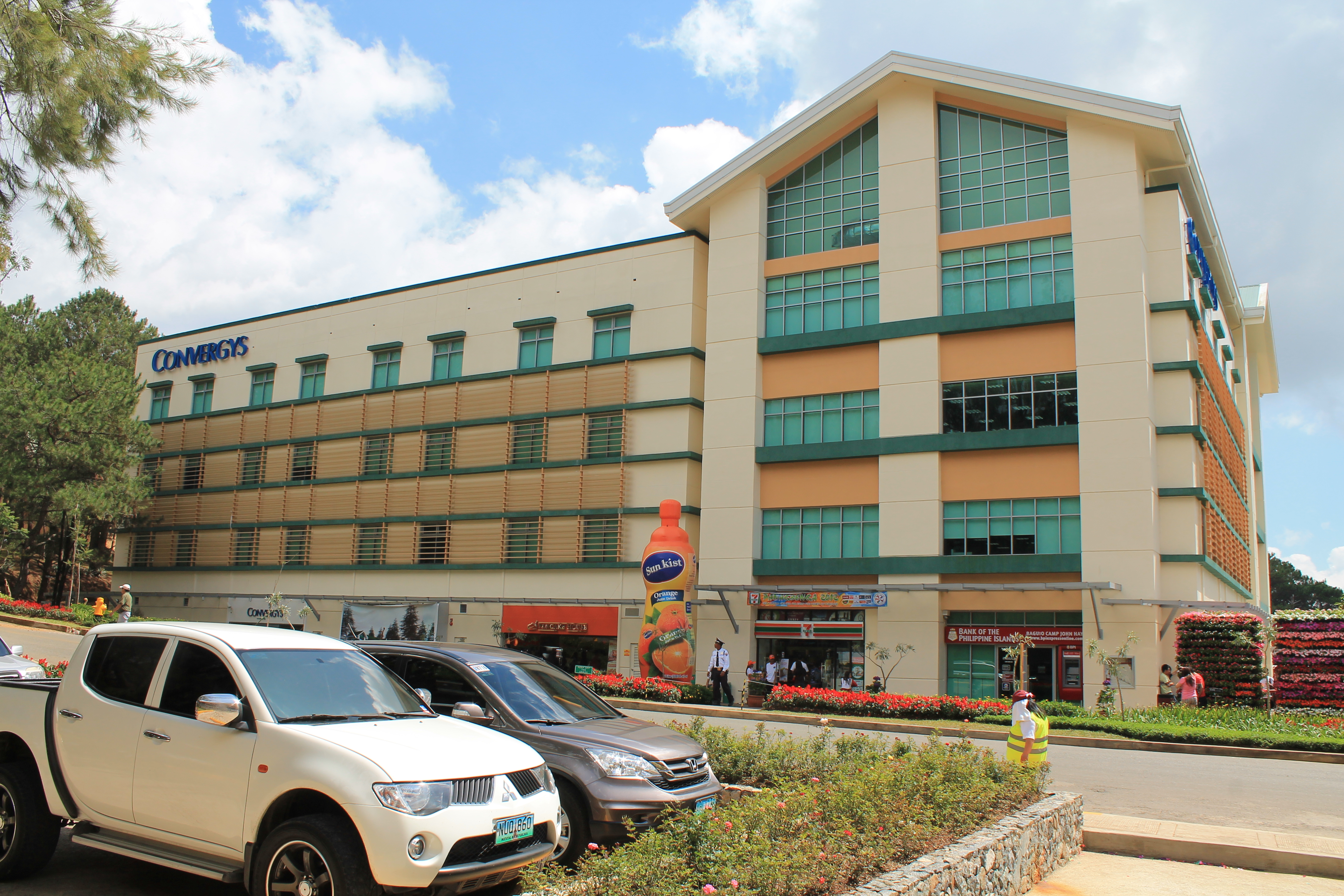
Outsourcing contributes to the city's economy and employment. Sitel, whose main office is located in the Baguio City Economic Zone, is the largest BPO company in the city with four sites established within the BCEZ. There are also multiple BPOs present in the city with numerous PEZA-accredited private economic zones established to cater to this industry. The Ayala Technohub located in Camp John Hay hosts Concentrix and InterContinental Hotels Group alongside other commercial establishments. Teleperformance Baguio and Thoughtfocus is established at the SM Cyberzone Building (also known as SM Fiesta Strip) located in front of Sunshine Park, while other call centers downtown are Optimum Transsource, Sterling Global and Global Translogic. Tech-Synergy operates a large transcription and back office operation near Wright park.
In recent years, there has been a surge of ESL (English as a Second Language) Tutorial Schools throughout Baguio that caters to students from other countries and also provide online services. This industry however has been hit hard by the COVID-19 pandemic with foreign students returning to their home countries.
Culture
Arts and museums
.jpg)
The city became a haven for many Filipino artists in the 1970s–1990s. Drawn by the cool climate and low cost of living, artists such as Ben Cabrera (now a National Artist) and filmmaker Butch Perez relocated to the city. At the same time, locals such as mixed-media artist Santiago Bose and filmmaker Kidlat Tahimik were also establishing work in the city. Even today, artists like painters and sculptors from all over the country are drawn to the Baguio Arts Festival which is held annually. The city houses several museums, such as the Baguio Museum, Museo Kordilyera, Emilio F. Aguinaldo Museum, and the SLU Museum of Arts and Cultures. The Mansion House located at Wright Park was also re-opened to the public as a presidential museum.
Baguio has been included in UNESCO's Creative Cities Network due to craft and folk art traditions of the city particularly ranging on expressions to wood carving, silver craft, traditional weaving and tattooing. Baguio is the first city in the Philippines to be part of the inter-city network which aims to promote the creative industries as well as integrate culture in sustainable urban development.
Languages
The languages commonly spoken in Baguio are Ilocano, Tagalog, and English. Languages like Ibaloi, Kankanaey, Pangasinan, Cantonese, Hokkien, Japanese, Kapampangan, Cebuano, Hiligaynon, Maranao, Maguindanaon and Tausug are also spoken to varying degrees by their respective ethnic communities within the city.
Media
In 1939, when the country's literacy was below 50%, the city already had a weekly paper. Manila Bulletin's predecessor, The Manila Daily Bulletin, published a weekly supplement, Baguio Bulletin.
Local and regional newspapers circulating in Baguio include the Baguio Midland Courier, Baguio Herald Express, Zigzag Weekly, and Baguio Chronicle.
Baguio Midland Courier was the largest newspaper publication around Baguio and Cordillera Administrative Region. It started out as a four-page tabloid on April 28, 1947, by Sinai Hamada and siblings Oseo and Cecilia. Sinai was its first and longest-lasting editor-in-chief while his older brother Oseo managed its business operations. Circa 1963, it distributed 7,500 copies. It launched its website in its 60th anniversary. The Baguio Midland Courier announced its closure effective July 22, 2024 and it issued its final edition on July 21, 2024. Baguio Midland Courier's publisher, Hamada Printers & Publishers Corp., also ceased the operation of their social media pages and website on October 31, 2024. The publisher donated archives of Baguio Midland Courier issues to the Baguio City Library and Benguet Provincial Library for use by the public.
Festivals and holidays
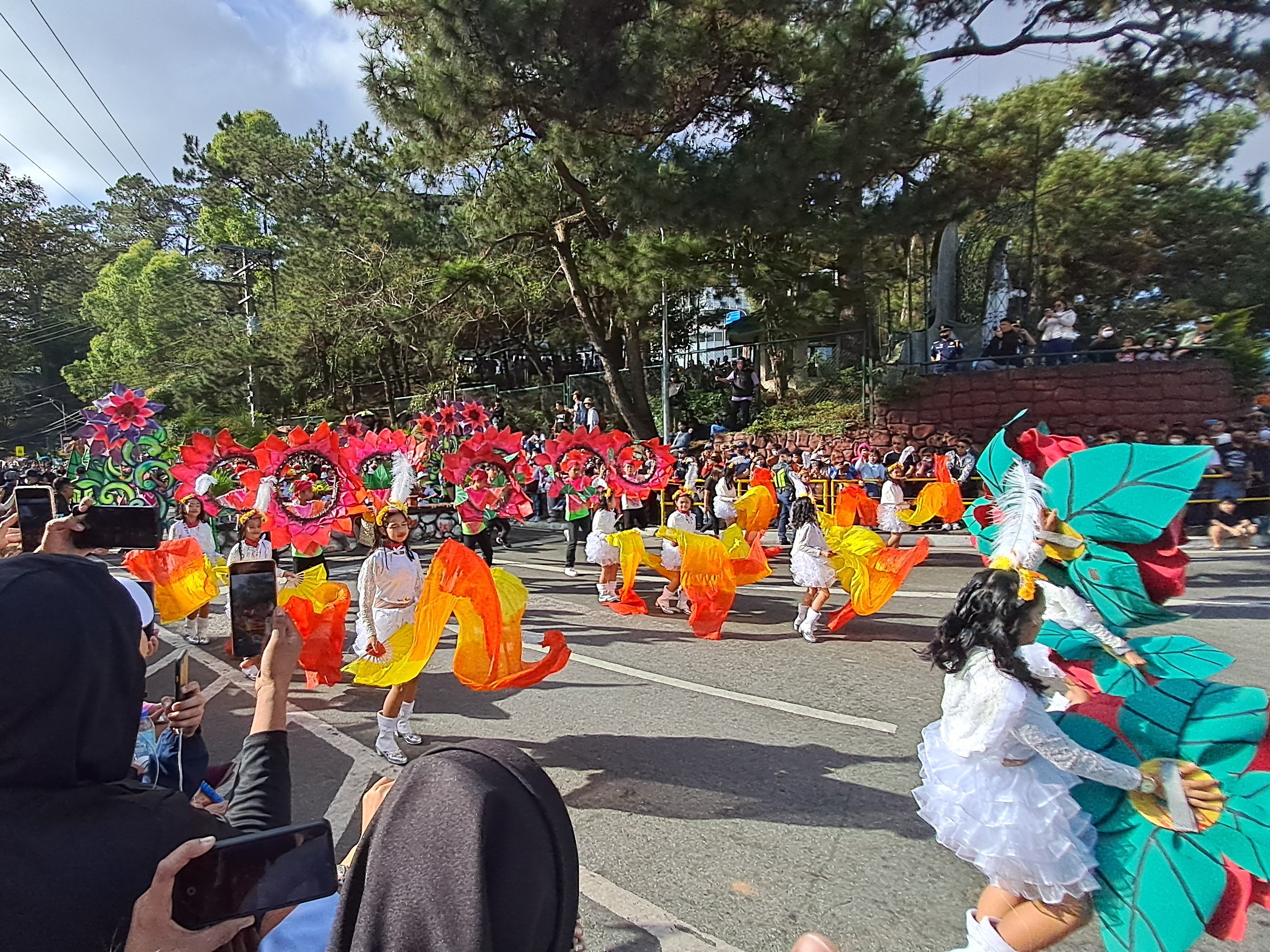
The annual flower festival, called the Panagbenga Festival, is held every February; it was created to highlight the city's flowers and cool temperature and as a way to rise up from the devastation of the 1990 Luzon earthquake. The festival includes floats covered mostly with flowers; it also includes street dancing, presented by dancers clad in flower-inspired costumes inspired by the Bendian, an Ibaloi dance of celebration. The indigenous people were initially wary with government-led tourism due to a perceived threat that the government would interfere with or change their communities' rituals.
The annual Gong Festival is celebrated on the 29th of October. Baguio Gong Day coincides with the National Indigenous Peoples’ Thanksgiving Day. The festivity includes the Gaddang people's courtship dances palakis and the takik and the symbolic beating of the seven gongs to attain peace, unity and cultural heritage preservation.
Baguio celebrates its city charter anniversary every September 1, which has been declared as a special non-working holiday in 1989 through Republic Act 6710.
Tourism
(2018-02-25).jpg)
Tourism is one of Baguio's main industries due to its cool climate and history. The city is one of the country's top tourist destinations. During the year end holidays some people from the lowlands prefer spending their vacation in Baguio, to experience cold temperatures they rarely have in their home provinces. Also, during the summer, especially during Holy Week, tourists from all over the country flock to the city. During this time, the total number of people in the city doubles. To accommodate visitors, there are more than 80 hotels and inns available, as well as numerous transient houses set up by the locals. Local festivities such as the Panagbenga Festival also attract both local and foreign tourists.
Baguio is the lone Philippine destination in the 2011 TripAdvisor Traveller's Choice Destinations Awards (Asia category) with the city being among the top 25 destinations in Asia. Burnham Park, Mines View Park, Wright Park, The Mansion, and Botanical Garden are among the popular tourist sites in Baguio.
Government
Local government
(2018-02-25).jpg)
As a highly urbanized city with its own charter, it is not subject to the jurisdiction of Benguet province, of which it was formerly a part.
The City of Baguio is led by its own mayor and vice mayor. The vice mayor leads the city council, composed of 12 elected councilors and 3 ex-officio members (the ABC President, SK President, and IPMR of the city). The City Government holds office at the Baguio City Hall.
The 129 barangays are led by their own captains assisted by a 7-man barangay council.
These officials are term-limited by up to 3 consecutive terms, with each term lasting for 3 years.
Elected officials
The city government's composition as of June 30, 2025:
| Position | Name | Year elected | Term no. | Congressman | Mayor | Vice Mayor | Councilor | Councilor | ||
|---|---|---|---|---|---|---|---|---|---|---|
| *(ex-officio member)* | ||||||||||
| ABC President | Councilor | |||||||||
| *(ex-officio member)* | ||||||||||
| SK President | Councilor | |||||||||
| *(ex-officio member)* | ||||||||||
| Indigenous People's Mandatory Representative (IPMR) | ||||||||||
| Mauricio G. Domogan | 2025 | 1 | ||||||||
| Benjamin B. Magalong | 2019 | 3 | ||||||||
| Faustino A. Olowan | 2019 | 3 | ||||||||
| Edison Bilog | 2025 | 1 | ||||||||
| Joel Alangsab | 2025 | 1 | ||||||||
| Jose M. Molintas | 2022 | 2 | ||||||||
| Leandro B. Yañgot Jr. | 2022 | 2 | ||||||||
| Vladimir D. Cayabas | 2019 | 3 | ||||||||
| Peter C. Fianza | 2022 | 2 | ||||||||
| Van Dicang | 2025 | 1 | ||||||||
| Fred L. Bagbagen | 2019 | 3 | ||||||||
| Paolo Salvosa | 2025 | 1 | ||||||||
| Betty Lourdes F. Tabanda | 2019 | 3 | ||||||||
| Yuri Weygan | 2025 | 1 | ||||||||
| Elmer O. Datuin | 2022 | 2 | ||||||||
| Rocky M. Aliping | 2024 | 1 | ||||||||
| John Rhey L. Mananeng | 2023 | 1 | ||||||||
| Maximo H. Edwin Jr. | 2023 | 1 |
Congress representation
Baguio is represented in the House of Representatives by its own congressman, Mauricio G. Domogan. The city is a lone district, separate from the province of Benguet.
Summer residences
The city hosts the summer residences of the President, Vice President, Senate President and House Speaker at Barangay Lualhati, while the Supreme Court, Court of Appeals and the Cabinet Secretaries cottages are housed at Cabinet Hill. The Supreme Court and Court of Appeals hold summer sessions in the city, usually during the month of April.
Sports

Baguio has hosted several sporting events, even those of international standing. The Baguio Athletic Bowl within the grounds of Burnham Park is one of Baguio's primary sporting venues. Baguio hosted the 1978 World Chess Championship match between Anatoly Karpov and Viktor Korchnoi, building the Baguio Convention Center for that purpose. The city is a participant in the CARAA games or the Cordillera Administrative Region Athletic Association, hosting it last in 2016 and 2017. The winners of the said event will eventually represent the region in the annual Palarong Pambansa games, which is also sponsored by the Department of Education. As of 2019, the city is still the overall champion with 205 gold, 110 silver and 79 bronze medals.
In recent years, Baguio has been racking up titles and medals in the field of Mixed Martial Arts led by Team Lakay.
Infrastructure
Transportation
Air
Loakan Airport is the lone airport serving the general area of Baguio. The airport is classified as a trunkline airport, or a major commercial domestic airport, by the Civil Aviation Authority of the Philippines. Major commercial operations to Baguio however ceased after Philippine Airlines closed their Baguio route in 1998. There were attempts to reopen Baguio routes throughout the following two decades by different airline operators such as Asian Spirit and Sky Pasada but none were able to sustain continuous operation. Commercial flights resumed in 2022 with Philippine Airlines (operated by PAL Express) operating Baguio–Cebu flights and vice versa but operations were halted by Philippine Airlines in July 2024 because of poor passenger traffic.
The airport is located south of the city center. Due to the limited length of the runway, being only 1,802 m long, it is restricted to commuter size aircraft. The airport is used primarily by helicopters, turbo-prop and piston engine aircraft, although on rare occasions light business jets (LBJ) have flown into the airport.
Land
Jeepneys and taxis are the main means of public transportation in the city. The government's push for jeepney modernization has led to an increase of modern EURO 4 compliant PUVs plying Baguio's center. The rollout however for full jeepney modernization had been hampered by the COVID-19 pandemic. There are several bus lines linking Baguio with Manila, Bontoc, Mariveles, Olongapo, Cabanatuan, and provinces such as Pangasinan, Pampanga, Bataan, Nueva Ecija, Aurora, Cavite, La Union, Nueva Vizcaya and those in the Ilocos regions. Notable bus companies that operate the Baguio to Manila routes are Victory Liner, Genesis Transport and its premium bus line JoyBus, and Solid North.
From Metro Manila, Baguio is accessible via NLEX (from Bulacan to Pampanga), SCTEX (Pampanga to Tarlac) and TPLEX (from Tarlac to La Union). The three main access roads leading to Baguio from the lowlands are Kennon Road (formerly known as the Benguet Road), Aspiras–Palispis Highway (previously known as Marcos Highway) and Naguilian Road, also known as Quirino Highway. The newest road that connects the city to the lowlands is Asin Road (also known as Asin-San Pascual-Tubao, La Union Road). All these roads traverse the municipality of Tuba, Benguet.
- Kennon Road starts in Rosario, La Union and winds upwards through a narrow, steep valley. This is often the fastest route to Baguio but it is particularly perilous, with landslides during the rainy season and sharp dropoffs, some without guardrails. The recently passed Republic Act No. 11604 pushes for the full rehabilitation of Kennon Road as an all-weather highway.
- Aspiras-Palispis Highway starts in Agoo, La Union and connects to Palispis Highway, at the boundary of Benguet and La Union provinces.
- Asin-Tubao Road starts in Tubao, La Union and serves as secondary alternative road if gridlock occurs at Aspiras-Palispis Highway
- Naguilian Road, which starts in Bauang, La Union, are both longer routes but are much safer than Kennon Road especially during rainy season, and are the preferred routes for coaches, buses and trucks.
The Benguet-Nueva Vizcaya Road, which links Baguio to Aritao in Nueva Vizcaya province, traverses the towns of Itogon, Bokod, and Kayapa.
Another road, Halsema Highway, (also known as the Baguio-Bontoc Road or the Mountain Trail) leads north through the mountainous portion of the provinces of Benguet and Mountain Province; it starts at the northern border of Baguio with La Trinidad.
Since 2021, Baguio has developed its own bicycle lane network consisting of shared lanes (Class 3) and segregated lanes with paint and physical separators (Class 2) on existing roads. As of 2024, the city has implemented 15.321 km of Class 3 lanes, 1.6 km of Class 2 lanes with paint separation, and 0.083 km Class 2 lanes with physical separation.
HoHo Bus
In an effort to address traffic congestion and the lack of car parking at tourist spots in the city, Baguio operates an experimental free bus shuttle service called the Hop On, Hop Off (HoHo) Tourist Bus. Through a park and ride scheme, the service encourages tourists with private vehicles to park their vehicles at the Baguio Convention Center (BCC) for a fee and ride the bus to various tourist sites free of charge. Relaunched on July 15, 2022, the HoHo bus has scheduled departure and arrival times, operating a looped route between the BCC, the Baguio Botanical Garden, the Mansion House, Mines View Park, Wright Park, and Governor Pack Road. The bus service has an estimated waiting interval of 30 minutes and is operational from 8:30 AM to 6:20 PM daily. The operations of the HoHo bus was eventually suspended at the end of the year.
All times are in Philippine Standard Time (UTC+08:00).
| Destination | First trip | Last trip | Location | Stops, stations and transit systems in *italics* are either under construction or proposed. |
|---|---|---|---|---|
| BCC | 8:30 AM | 4:30 PM | Military Cut-off | Baguio |
| Botanical Garden | 9:05 AM | 5:05 PM | Saint Joseph Village | |
| The Mansion | 9:25 AM | 5:25 PM | Lualhati | |
| Mines View Park | 9:50 AM | 5:50 PM | Mines View Park | |
| Wright Park | 10:20 AM | 6:20 PM | Lualhati | |
| Governor Pack Road | — | — | Session Road Area |
Possible future modes
- Cable Cars - As of July 8, 2019, Secretary Tugade of the Department of Transportation said that the feasibility study for the installation of the cable cars in Manila may be finished within the year, with Baguio soon to follow. The Philippine government earlier secured a P27 million grant from France for this venture, with Manila and Baguio seen as possible initial sites.
- Monorail - A monorail project from Baguio to La Trinidad is being mulled over by the SSS as a possible investment in CAR. It is seen to further boost tourism and decongest traffic. The project is similar to the one installed by the Department of Science and Technology at the UP Campus in 2012.
Water and electricity
Most of the water supply of the city is provided for by the Baguio Water District, founded in 1975 as the successor to the now-defunct Department of Public Services. It currently operates 60 deep wells to cater to its more than 300,000 consumers. It currently serves 122 out of the 129 barangays in the city and some parts of Tuba, Benguet. In recent years, the BWD has expressed concern over the city's depleting water supply, due in part to private wells dug by private individuals and companies.
Electric services are provided by Benguet Electric Cooperative (BENECO), the sole electric power distributor in Benguet. In 2012, a bill was filled in the House of Representatives seeking the creation of the Baguio Electric Cooperative or BAELCO, an entity to provide for the city's own electricity needs, separate from BENECO. Its creation has been met with opposition by various groups citing the need of a feasibility study on the separation. The creation of a separate electric franchise for Baguio would also infringe on BENECO's existing franchise that mandated BENECO to provide electricity for both Baguio and Benguet which would create legal implications if it was to be amended.
The city is also the only local government unit to own and operate its own renewable energy plant. Originally constructed in the 1920s, the Asin Mini Hydropower Plants 1, 2 and 3 located in Tuba, Benguet came under the city's possession after the lapse of the 25-year lease agreement with the Aboitiz-owned Hydroelectric Development Corporation (HEDCOR). The plant acted as both a power source and another income-generating asset of the city as BENECO was also its main client. The power plant however was forced to cease operation in 2015 when the Energy Regulatory Commission issued a cease and desist order to the city due to the lack of a certificate of compliance from the city. The city currently has plans to rehabilitate the power plants so that they could resume operations once again.
Healthcare
Baguio's healthcare is mainly provided by various private corporations. Private hospitals operating in the city are the Baguio Medical Center, BCU-Santo Niño de Jesus Medical Center Foundation, Parkway Medical Center, Notre Dame de Chartres Hospital, Pines City Doctors' Hospital and Saint Louis University's Hospital of Sacred Heart. The BCU-Santo Niño de Jesus Medical Center Foundation ceased operations in 2009 due to financial reasons but was reopened during the COVID-19 pandemic with the local government refurbishing it as an isolation center for COVID-19 patients. It was eventually idled at the end of the COVID-19 pandemic.
In early 2019, several groups were eyeing to establish a hospital in Barangay Scout Barrio, but was met with opposition; as of March 2019, the project has been shelved.
The Baguio City Health Services Office is the office responsible for the health care programs provided by the city government, operating 16 health centers and 15 satellite clinics. Baguio hosts the Baguio General Hospital and Medical Center or BGHMC, a tertiary state-owned hospital administered and operated by the Department of Health. It is the sole government hospital in the city and the largest government tertiary hospital in the Cordillera Administrative Region.
Education

Education is a major contributor to the economy of Baguio. Considered as the "Educational Center of the North", the city has a transient student population who migrate to the city to attend tertiary education.
Baguio is the center of education in the Northern Philippines due to high performances in various professional licensure exams as well as adherence to high educational quality standards, housing some of the prestigious and largest universities in Northern Luzon.
Elementary and Secondary schools

The Baguio Schools Division Office governs all educational institutions within the municipality. It oversees the management and operations of all private and public, from primary to secondary schools. There are three schools district offices namely: District I, District II, and District III.
The city has 45 public elementary schools and 21 public secondary schools. Most of its secondary private schools are divisions of the private universities of the city. The Philippine Science High School - CAR campus was established in the city in 2009 and is located in Irisan. In 2016, the city government established in Irisan the Baguio City Science High School to create a unified science high school campus.
Baguio Central School, the country's first public primary school was opened on September 2, 1899. It was once a one-room school built upon Mateo Cariño's 2 hectare lot and Ibaloy house he donated to the local government. Its roof was made of reed and cogongrass with hewn wood walls and floor. Its first students were only 25 Igorot boys, including Dr. Jose Cariño and Maximo Carantes, under a United States Armed Forces teacher, Mr. Patrick. The pupils used slate and chalks to write. In 1901, female students were enrolled. World War II heavily damaged the school which was renovated by the Department of Education in 2004. The Heritage conservation Society declared it as a heritage school. On May 24, 2024, the City Planning, Development, and Sustainability Office stopped the P41.2-million reconstruction project on BCS’ right wing portions of the Gabaldon School Buildings. Under the Cultural Mapping Book, BCS is a “significant tangible and immovable cultural heritage property, and the biggest elementary school in the city, with about 70 classrooms, 3,300 pupils and 83 teaching staff” which ought to be restored to its 1949 state.
Higher educational institutions


The city houses eight major institutions of higher education. Baguio's first private school, Easter College, was set up in 1906 by the Rt. Rev. Charles Brent, who was a bishop of the Episcopalian Church.
The University of the Philippines, the country's premier state university, was established as an extension campus in Vigan, Ilocos Sur before transferring to Baguio in 1938. In 1961, it became a branch campus of UP Diliman, before finally becoming UP Baguio in 2002.
Saint Louis University is the largest university in the city and in the north of Manila, catering to over 30,000 students; it was founded by Belgian CICM missionaries in 1911 initially as a one-storey school for boys. It became a college in the 1950s before becoming a university in 1963. It currently has four campuses spread across the city.
Baguio Central University was founded in 1945 as the Centro Academy by the Fernandez family. The following year, another educational institution, the University of the Cordilleras was established as the Baguio Colleges before becoming the Baguio Colleges Foundation; it became a full-fledged university in 2003. The University of Baguio was established as the Baguio Technical and Commercial Institute in 1948 by the Bautista family; it was upgraded to university status in 1969.
Mainly a nursing and medical school, Pines City Colleges was founded in 1969 as the Pines City Doctors Hospital School of Nursing, three years after the opening of Pines City Doctors' Hospital in 1966.
The Philippine Military Academy, the country's military school, was originally founded in the Walled City of Intramuros in 1907 before relocating to Baguio in 1908.
Notable people
Main article: List of people from Baguio
Twin towns and sister cities
Local
- Angeles City
- Alaminos, Pangasinan
- Bacolod
- Calbayog, Samar
- Candon
- Daet, Camarines Norte
- Davao City
- Dipaculao, Aurora
- Lopez, Quezon
- Lucena
- Makati
- Mandaue
- Marawi, Lanao del Sur
- Muñoz, Nueva Ecija
- Ormoc, Leyte
- Pavia, Iloilo
- San Carlos, Negros Occidental
- Zamboanga City
International
- Peru Cusco, Peru
- ROK Gongju, South Korea
- China Hangzhou, China
- Japan Hanyū, Saitama, Japan
- USA Honolulu, Hawaii, United States
- Japan Karuizawa, Nagano, Japan
- Israel Nazareth, Israel
- Canada Vaughan, Canada
- ROK Seoul, South Korea
- USA San Antonio, Texas, United States
- AUS Shepparton, Australia
- ROK Taebaek, South Korea
- USA Guam Tamuning, Guam, United States
- MEX Taxco, Mexico
- USA Vallejo, California, United States
- Japan Wakkanai, Hokkaido, Japan
References
References
- "Province: Benguet". National Statistical Coordination Board.
- "2019 Election Results:Baguio City". GMA News.
- "City of Baguio Leads the Economy of the Cordillera Administrative Region (CAR) in 2021".
- "PH₱50.384 per dollar (per International Monetary Fund on Representative Exchange Rates for Selected Currencies for December 2021)".
- (July 17, 2024). "2024 Census of Population (POPCEN) Population Counts Declared Official by the President".
- "Southeastern Asia: Island of Luzon in the Philippines". WWF.
- (February 2013). "City Profile: Baguio". Cities.
- Sanidad, Pablito. "Which Baguio Centennial?". Baguio Midland Courier.
- "Business Profile".
- Jay. (April 18, 2017). "Brief History about Baguio City".
- "Baguio braces for ibagiw 2019".
- Pungayan, Morr. "Bagiw and the Ibagiws". Baguio Midland Courier.
- Habana, Olivia M.. (2000). "Gold Mining in Benguet to 1898". Philippine Studies.
- Boquiren, Rowena Reyes. (August 23, 2015). "Baguio's history and cultural heritage". Northern Dispatch Weekly.
- "Baguio City; History and Government".
- (2017). "Ibaloys "Reclaiming" Baguio: The Role of Intellectuals". [[University of the Philippines.
- Kane, S.E.. (1933). "Life and Death in Luzon or Thirty Years with the Philippine Head-Hunters". Grosset & Dunlap.
- (January 14, 2014). "How the Ibaloi lost their land". [[Philippine Daily Inquirer]].
- "History".
- Agoot, Liza. (September 27, 2018). "Camp John Hay stays on eco-tourism path". Philippine News Agency.
- Cody, Jeffrey W. (2003). "Exporting American Architecture, 1870–2000". Alexandrine Press.
- "About Baguio City".
- "The Americans in Baguio". Go Baguio:Your Complete Guide to Baguio City, Philippines.
- (July 3, 1995). "A Spy in Their Midst: The World War II Struggle of a Japanese-American Hero". Madison Books.
- (1985). "A People's History of Benguet". Baguio Printing & Publishing Company, Inc..
- Bolido, Linda B.. (May 25, 2015). "Baguio–where WWII began and ended". Philippine Daily Inquirer.
- Uayan, Jean Uy. (June 30, 2017). "A Study of the Emergence and Early Development of Selected Protestant Chinese Churches in the Philippines". Langham Publishing.
- "Flowers, new song for 72nd year of Baguio war bombings". Philippine Daily Inquirer.
- Morton, Gillian. (2018). "Surviving and Striving for Normalcy: The Endurance of the Americans of Baguio Interned by the Japanese in the Philippines During World War II". Florida State University Libraries.
- ''Forbidden Diary: A Record of Wartime Internment, 1941–1945'' by Natalie Crouter (Burt Franklin & Co. 1980)
- Jose, Ricardo T.. "Government in Exile".
- Zeiler, Thomas W.. (2004). "Unconditional Defeat: Japan, America, and the End of World War II". Rowman & Littlefield.
- (December 2002). "Vestiges of War: The Philippine-American War and the Aftermath of an Imperial Dream 1899-1999". [[NYU Press]].
- General Staff of General of the Army [[Douglas MacArthur]]. (1966). "Reports of General MacArthur: The Campaign of MacArthur in the Pacific, Volume I". United States Army.
- "Baguio City Ecological Profile; History". 2018.
- Robles, Raissa. (2016). "Marcos Martial Law: Never Again". Filipinos for a Better Philippines, Inc..
- Balbosa, Joven Zamoras. (1992). "IMF Stabilization Program and Economic Growth: The Case of the Philippines". Journal of Philippine Development.
- (2003). "The Philippine Economy: Development, Policies, and Challenges". Oxford University Press.
- Cororaton, Cesar B.. "Exchange Rate Movements in the Philippines". DPIDS Discussion Paper Series 97-05.
- Kessler, Richard J.. (1989). "Rebellion and repression in the Philippines". Yale University Press.
- Celoza, Albert F.. (1997). "Ferdinand Marcos and the Philippines: The Political Economy of Authoritarianism". Greenwood Publishing Group.
- Schirmer, Daniel B.. (1987). "The Philippines reader : a history of colonialism, neocolonialism, dictatorship, and resistance". South End Press.
- (1998). "Kasaysayan, The Story of the Filipino People Volume 9:A Nation Reborn.". Asia Publishing Company Limited.
- (September 20, 1999). "Alfred McCoy, Dark Legacy: Human rights under the Marcos regime". [[Ateneo de Manila University]].
- (2005). "State and society in the Philippines". Rowman & Littlefield Publishers.
- "Gone too soon: 7 youth leaders killed under Martial Law". Rappler.
- (September 16, 2021). "Ricky Lee, martial law detainee, on historical revisionism: 'Para akong binubura'".
- Rocamora, Rick. (2023). "Dark Memories of Torture, Incarceration, Disappearance, and Death under Ferdinand E. Marcos Sr.'s Martial Law".
- (May 20, 2023). "Martyrs & Heroes: Maita Gomez".
- Panaglagip: The North Remembers – Martial Law Stories of Struggle and Survival Edited by Joanna K. Cariño and Luchie B. Maranan.
- (2023-06-04). "Martyrs and Heroes: Arthur Galace".
- "EDSA '86 up north: The day Baguio turned yellow". Rappler.
- "Remembering the People's Power Revolution in Baguio". Baguio Herald Express.
- "Regional Profile: Cordillera Administrative Region (CAR)".
- "The Cordillera Administrative Region (CAR)".
- Ferrer, Miriam Coronel. (September 4, 2010). "Cordillera autonomy - Miriam Coronel Ferrer". [[ABS-CBN News]].
- "The July 16 Earthquake; A Technical Monograph". [[Philippine Institute of Volcanology and Seismology]]; Hiroshima University.
- Gwen de la Cruz. (July 16, 2014). "Remembering the 1990 Luzon Earthquake". Rappler.
- . ["Philippines topographic map"](https://en-ca.topographic-map.com/map-lzhtp/Philippines/).
- See, Dexter A.. "Merger of city's 130 barangays pressed". Official website of the City Government of Baguio.
- (March 8, 2017). "Special body formed for barangay merger". SunStar.
- Cruz, Maria Aprila W.. "More dialogues on merger of barangay pressed". Baguio Midland Courier.
- "Baguio City, Benguet Climatological Normal Values 1991–2020". Philippine Atmospheric, Geophysical and Astronomical Services Administration.
- "Baguio City, Benguet Climatological Extremes". Philippine Atmospheric, Geophysical and Astronomical Services Administration.
- "98328_197802_201912". [[Deutscher Wetterdienst]].
- "98328". [[Deutscher Wetterdienst]].
- "Baguio City Travel Information, Philippines". Asia Travel.
- "STATION: BAGUIO CITY, BENGUET".
- (December 17, 2008). "Baguio wakes up to coldest morn in 2008". Philippine Daily Inquirer.
- (February 8, 2015). "Baguio weakest vs climate change". SunStar.
- "Baguio air is among the dirtiest in the country". GMA News.
- Peña, Rox. (May 10, 2018). "Peña: The latest WHO air pollution report". SunStar.
- Llanes, Jonathan. (August 27, 2018). "Euro-4 jeep tested in Baguio". SunStar.
- (March 2, 2019). "PUV Modernized Jeep Suitable in Baguio, Cordilleras". Baguio Herald Express.
- "Garbage problem plagues Baguio City — COA". Manila Bulletin.
- Agatep, Primo. (February 2, 2018). "Tuba residents oppose nearby Baguio waste transfer station". Philippine News Agency.
- Quitasol, Aldwin. (July 6, 2019). "Waste to energy". [[Daily Tribune (Philippines).
- "Sewage plant in Baguio needs P250-M rehab funds". Philippine News Agency.
- McKenna, Rebecca Tinio. (January 20, 2017). "American Imperial Pastoral: The Architecture of US Colonialism in the Philippines". University of Chicago Press.
- (February 1, 2013). "A Brief History of the Baguio Sine". [[University of the Philippines.
- (July 20, 1990). "Manila Assesses Damage and High Cost of Quake". The New York Times.
- (July 25, 2001). "SM to push through with Baguio project". Philippine Daily Inquirer.
- "Conservation bid in Baguio draws support of architects". Philippine Daily Inquirer.
- (September 20, 2015). "Architect says time to rethink Baguio's master dev't plan". Baguio Midland Courier.
- Agency, Philippines News. "Baguio City Hall construction violates law on national cultural heritage sites". BusinessMirror.
- Fontanilla, Giovani Joy. (April 16, 2015). "Baguio City Hall gets facelift". SunStar.
- "Renovated Baguio City Hall park to reflect UNESCO creative status". Philippine News Agency.
- (30 August 2019). "Studying Baguio's carrying capacity for future planning". [[SunStar]].
- Llanes, Jonathan. (May 30, 2018). "Baguio's crime solution ranks highest nationwide". SunStar.
- Llanes, Jonathan. (July 30, 2018). "Baguio awarded best city police station in PH". SunStar.
- "Baguio City Statistical Tables".
- (2020). "Understanding the diversity of cultural and religious learning institutions for Muslim Filipinos". University of the Philippines Center for Integrative and Development Studies.
- "How small malls compete with big malls". Philippine Daily Inquirer.
- Sibayan, Ada. (April 19, 2012). "Used bikinis with 'kuto' in 'ukay-ukay'?". ABS-CBN News.
- Padawangi, Rita. (October 11, 2018). "Routledge Handbook of Urbanization in Southeast Asia". Routledge.
- (December 22, 2012). "How small malls compete with big malls". Philippine Daily Inquirer.
- Sinumlag, Alma B.. (November 28, 2010). "LT folk clarifies Baguio cut flowers origin". Northern Dispatch Weekly.
- Lapniten, Karl. (February 24, 2016). "Strawberries hit bottom prices in Baguio". CNN Philippines.
- Cabreza, Vincent. (October 28, 2019). "Avoid urban decay, Baguio neighbors told". Philippine Daily Inquirer.
- See, Dexter A.. "Baguio benefitting from robust mining operations in Benguet". City Government of Baguio.
- (January 6, 2022). "Holidays good for vegetable, strawberry farmers in Benguet". Philippine Daily Inquirer.
- "Baguio offers investors new profit opportunities". Philippine Daily Inquirer.
- "Business booms in Baguio City as 18th Ad Congress draws near". The Philippine Star.
- Cahiles-Magkilat, Bernie. (February 13, 2007). "Baguio export zone to get P6.7 B in new investments". Manila Bulletin.
- "Baguio Ayala Land Technohub".
- (February 10, 2015). "Moog Controls Corporation". Department of Trade and Industry.
- "List of Enterprises With Approved Investments; As of 30-Nov-2019". [[Philippine Economic Zone Authority]].
- "Baguio Ayala Land Technohub".
- "5,286 employed by John Hay economic zone locators".
- Tabios, Hanah. "Puyat bullish on recovery of English schools". Manila Bulletin.
- "Presidential Museum [ Baguio Mansion House ]".
- "Baguio is Philippines' first UNESCO 'creative city'". CNN Philippines.
- (November 1, 2017). "Baguio hailed as a UNESCO 'creative city'". ABS-CBN News.
- Bagamaspad, Anavic. (1983). "History of the Baguio Chinese: Integration into the Baguio Community". University of the Philippines College Baguio.
- (2003). "2000 CENSUS OF POPULATION AND HOUSING; Report No. 2 Volume I; Demographic and Housing Characteristics". National Statistics Office.
- Cordillera Peoples Alliance. (February 23, 2009). "Baguio City: Site of the 2010 Regionally Centralized Cordillera Day Celebration".
- (July 21, 2024). "Writing 77: The Baguio Midland Courier". [[Rappler]].
- (28 March 2021). "Magalong orders 5-minute exercise in flag raising – ZigZag Weekly". Zigzag Weekly.
- (2022-05-01). "Baguio Midland Courier at 75: Sustaining the founders' great legacy - Baguio Midland Courier".
- (April 28, 2024). "How Midland Courier shaped the political landscape in the highlands". baguiomidlandcourier.com.ph.
- (July 21, 2024). "Closure of iconic community newspaper Baguio Midland Courier saddens Filipinos". [[SunStar]].
- (June 30, 2024). "Iconic Baguio Midland Courier to close after 77 years". [[Rappler]].
- Lo-oy, Leonora. (2024-10-12). "Baguio Midland Courier to take down Facebook page on Oct. 31".
- Cabreza, Vincent. (February 29, 2020). "25 years of Panagbenga help Baguio retain its summer capital fame". Philippine Daily Inquirer.
- Cabreza, Vincent. (January 26, 2008). "Cordillera tribes realize why they should not fear tourism". Philippine Daily Inquirer.
- (October 8, 2024). "Igorot teen showcases culture, tradition at Gong Festival in Baguio". [[Rappler]].
- (February 10, 1989). "Republic Act No. 6710".
- "Statistics: Tourism Special Tables".
- "Complete list of Baguio Hotels".
- Agatep, Primo. (February 25, 2018). "DOT chief underscores Panagbenga's role in sustainable development". Philippine News Agency.
- "Best Destinations in Asia – Travelers' Choice Awards".
- Rodriguez, Fritzie. (December 22, 2014). "Baguio City: Your complete weekend itinerary". Rappler.
- "City Councilors".
- "Baguio City". Department of the Interior and Local Government, Cordillera Administrative Region.
- "Halalan 2022 Philippine Election Results".
- (February 12, 2023). "IPMR of Baguio faces dads clarifying name". Baguio Midland Courier.
- (December 3, 2023). "JR". Baguio Midland Courier.
- (December 16, 2023). "Rocky Aliping wins Baguio City ABC President". Amianan Balita Ngayon.
- "Balweg's old house to become executive secretary's Baguio cottage". Philippine Daily Inquirer.
- Buan, Lian. "Why Supreme Court justices go to Baguio every April". Rappler.
- "DepEd Baguio gears up for 2016 CARAA meet".
- "CARAA Meet 2019 {{!}} Games of the Cordillerans".
- Osis, Roderick. (February 26, 2019). "Baguio starts retention bid in Caraa". SunStar.
- Jacinto, Christian. (March 27, 2020). "The Untold Story Of Team Lakay". [[ONE Championship]].
- (April 28, 2017). "Baguio lauds Team Lakay, archers' victories". SunStar.
- Cabreza, Vincent. "Ibaloy folk brace for change as Baguio flights resume". Philippine Daily Inquirer.
- Cabreza, Vincent. (December 16, 2022). "Maiden flight of Baguio-Cebu route lands at Summer Capital's only airport". Inquirer.
- Dumlao, Artemio. "PAL to halt Baguio-Cebu flights".
- Cabreza, Vincent. (December 16, 2020). "Bus firms resuming Baguio trips". Philippine Daily Inquirer.
- Cabreza, Vincent. (May 16, 2012). "Fighting for century-old Kennon Road". Inquirer Northern Luzon.
- (October 31, 2000). "Republic Act No. 8971; An Act Naming the Agoo-Tubao-Pugo Section of the Agoo-Baguio Road, the Jose D. Aspiras Highway, and the Benguet-Baguio City Section of the Same Road, the Ben Palispis Highway".
- Jimenez, RC. (July 8, 2018). "Asin-Tubao Road opens to ease Marcos Highway traffic". Baguio Midland Courier.
- Dilim, Joanne Namnama P.. (December 31, 2017). "DPWH-1 makes travel faster from La Union to CAR". Philippine Information Agency.
- Dennis, Dionisio Jr.. (August 16, 2018). "Buses also diverted to Naguilian Road in Cordillera". Philippine News Agency.
- Lalu, Gabriel Pabico. (September 15, 2018). "Villar: Two roads to Baguio closed". Philippine Daily Inquirer.
- Lagasca, Charlie. (March 14, 2006). "Vizcaya-Benguet road completed this year". The Philippine Star.
- Caluza, Desiree. (May 26, 2014). "Mountain Trail leads to culture, nature hubs". Inquirer Northern Luzon.
- Galacgac, Aure. (February 6, 2014). "Halsema Highway to be made 'tourist friendly'". SunStar.
- (2024). "Presence of Different Classification of Bike Lanes". Baguio City Engineering Office.
- Aquino, Leira. (July 14, 2022). "Baguio to revive Hop on, Hop off bus. Here's how it works". [[Interaksyon]].
- Manto, Ina Louise. (December 13, 2022). "PSA: You Can Get Free Rides Around Baguio via the Hop-On Hop-Off Tourist Bus".
- "Government finalizing cable car plan". Manila Standard.
- "French government gives P25-million for metro cable car study". Manila Standard.
- Dumlao-Abadilla, Doris. "Baguio monorail also on SSS' shopping list". Philippine Daily Inquirer.
- Catajan, Maria Elena. (March 27, 2019). "P80-M Baguio Water District building opens". SunStar.
- Agoot, Liza. (August 29, 2018). "Water district worried on depletion of city's water supply". Philippine News Agency.
- Palangchao, Harley. (December 25, 2011). "Bill that seeks to split Beneco into two filed in Lower House". Baguio Midland Courier.
- Agoot, Liza. (January 15, 2012). "Baelco firm on managing city's EC, but legal existence vague". Baguio Midland Courier.
- Sinumlag, Alma B.. (January 29, 2012). "Beneco says splitting franchise need further study". Northern Dispatch.
- Cimatu, Frank. (September 20, 2019). "Magalong prioritizes preservation of Baguio 'heirlooms'". Rappler.
- "Titling of Asin hydro plant properties to be pursued".
- (July 5, 2009). "Sto Niño hospital to stop operation effective July 31". Baguio Midland Courier.
- Cimatu, Frank. (March 25, 2020). "Unused private hospital becomes medical facility for Baguio City's coronavirus patients". Rappler.
- (April 3, 2020). "Sto. Niño Hospital named Baguio Critical Care Center". [[SunStar]].
- (February 19, 2019). "3 groups eying Scout Barrio hospital". SunStar.
- Catajan, Maria Elena. (January 21, 2019). "Opposition mounts against proposed hospital". SunStar.
- Catajan, Maria Elena. (March 12, 2019). "Scout Barrio hospital project shelved". SunStar.
- "The Electives Network: Baguio General Hospital and Medical Centre".
- "City Health Services Office".
- (April 6, 2016). "Rebuilding Asia Following Natural Disasters: Approaches to Reconstruction in the Asia-Pacific Region". Cambridge University Press.
- Melanie, Saro. "Baguio City: A fun learning educational hub". Baguio Midland Courier.
- (January 15, 2021). "Masterlist of Schools".
- (November 27, 2016). "Baguio science HS opens in June". Baguio Midland Courier.
- (September 8, 2015). "Oldest elementary school in country marks 116th anniversary". [[SunStar]].
- (June 15, 2024). "Rehab of Baguio's oldest grade school halted". [[Philippine Daily Inquirer]].
- Ma, Julie C.. (April 1, 2010). "When the Spirit Meets the Spirits: Pentecostal Ministry Among the Kankana-ey Tribe in the Philippines". Wipf and Stock Publishers.
- "About Us".
- "History & Overview".
- Castro, Leia. "A collation of other centenarians in Baguio". Baguio Midland Courier.
- "Saint Louis University (SLU)". [[International Federation of Catholic Universities.
- Meneses, Nito. (January 12, 2007). "SLU celebrates its 95th founding anniversary". Philippine Information Agency.
- "Baguio Central University".
- "University of the Cordilleras".
- "University of Baguio".
- "History, Traditions and General Information".
- Dacuag, Pearl A.. (September 6, 2009). "20 sister cities pledge to fortify ties with Baguio". Baguio Midland Courier.
- "Marvil: Baguio and Candon City Sign Sisterhood MOU". SunStar.
- (2013). "Honolulu Data: Sister Cities". City and County of Honolulu.
- See, Dexter A.. (October 24, 2014). "Twinning ties for Baguio and Nazareth". The Standard.
- (October 19, 2022). "San Antonio to formalize Friendship agreement with Baguio, Philippines". City of San Antionio.
- "Vallejo's Sister Cities". Vallejo Sister Cities Association.
This article was imported from Wikipedia and is available under the Creative Commons Attribution-ShareAlike 4.0 License. Content has been adapted to SurfDoc format. Original contributors can be found on the article history page.
Ask Mako anything about Baguio — get instant answers, deeper analysis, and related topics.
Research with MakoFree with your Surf account
Create a free account to save articles, ask Mako questions, and organize your research.
Sign up freeThis content may have been generated or modified by AI. CloudSurf Software LLC is not responsible for the accuracy, completeness, or reliability of AI-generated content. Always verify important information from primary sources.
Report