From Surf Wiki (app.surf) — the open knowledge base
B. J. Habibie
President of Indonesia from 1998 to 1999

President of Indonesia from 1998 to 1999
| Field | Value |
|---|---|
| image | B. J. Habibie, President of Indonesia portrait.jpg |
| caption | Official portrait, 1998 |
| order | 3rd |
| office | President of Indonesia |
| term_start | 21 May 1998 |
| term_end | 20 October 1999 |
| vicepresident | *Vacant* |
| predecessor | Suharto |
| successor | Abdurrahman Wahid |
| order1 | 7th |
| office1 | Vice President of Indonesia |
| term_start1 | 11 March 1998 |
| term_end1 | 21 May 1998 |
| president1 | Suharto |
| predecessor1 | Try Sutrisno |
| successor1 | Megawati Sukarnoputri (1999) |
| office2 | State Minister of Research |
| and Technology | |
| term_start2 | 29 March 1978 |
| term_end2 | 11 March 1998 |
| president2 | Suharto |
| predecessor2 | Sumitro Djojohadikusumo |
| successor2 | |
| birth_name | Bacharuddin Jusuf Habibie |
| birth_date | |
| birth_place | Parepare, Dutch East Indies |
| death_date | |
| death_place | Jakarta, Indonesia |
| resting_place | Kalibata Heroes' Cemetery |
| party | Golkar |
| height | |
| spouse | |
| children | |
| father | Alwi Abdul Jalil Habibie |
| mother | Tuti Marini Puspowardojo |
| relatives | Junus Effendi Habibie (brother) |
| education | Gouvernments Middlebare School te Bandoeng |
| alma_mater | |
| occupation | |
| signature | Signature of B. J. Habibie.svg |
| nickname | |
| module |
and Technology](ministry-of-research-and-technology-indonesia-list-of-ministers) Bacharuddin Jusuf Habibie (; 25 June 1936 – 11 September 2019) was an Indonesian statesman, engineer and scientist who served as the third president of Indonesia from 1998 to 1999. A little over two months after his inauguration as the seventh vice president in March 1998, he succeeded Suharto, who resigned after 32 years in office, thereby being the country's first vice president to assume the presidency intra-term. Originating from Sulawesi with Bugis-Gorontalese and Javanese ancestry, his presidency was seen as a landmark and transition to the Reform era.
Upon becoming president, he liberalized Indonesia's press and political party laws; ended Indonesian occupation of East Timor, which led to that country's independence; and held an early democratic election three years sooner than scheduled, which resulted in the end of his presidency. His 517-day presidency and 71-day vice-presidency were each the shortest in Indonesian history. Before entering government, Habibie contributed to the making of Indonesia's first domestic airplane, the IPTN N-250. As a result, he was granted the title "Father of Technology".
Early life and family
Habibie was born in Parepare, South Sulawesi. His parents, Alwi Abdul Jalil Habibie, an agriculturist from ethnic Bugis-Gorontalese descent, from Gorontalo, and R. A. Tuti Marini Puspowardojo, a Javanese noblewoman from Yogyakarta, who met while studying in Bogor.
Habibie's paternal family comes from Kabila, just to the east of the town of Gorontalo in northern Sulawesi. He was the fourth of eight children. Habibie's father died when he was 14 years old.
In 2018, the Gorontalo provincial government agreed to support the construction of the B. J. Habibie's Monument in front of the main gate of Djalaluddin Airport in Gorontalo Regency. In addition, it was proposed that State University of Gorontalo be renamed in honour of Habibie although in the end, the suggestion was not adopted.
Education
Habibie went to Delft, the Netherlands, to study aviation and aerospace at the Technische Hogeschool Delft (Delft University of Technology), but for political reasons (the West New Guinea dispute between the Netherlands and Indonesia), he had to continue his study at the Technische Hochschule Aachen (RWTH Aachen University) in Aachen, Germany. In 1960, Habibie received an engineer's degree in Germany with the title Diplom-Ingenieur. He remained in Germany as a research assistant under Hans Ebner at the Lehrstuhl und Institut für Leichtbau, RWTH Aachen to conduct research for his doctoral degree.
Engineering career
In 1962, Habibie returned to Indonesia for three months on sick leave. During this time, he was reacquainted with Hasri Ainun, the daughter of R. Mohamad Besari. Habibie had known Hasri Ainun in childhood, junior high school and in senior high school at SMA Kristen Dago (Dago Christian Senior High School), Bandung. The two married on 12 May 1962, returning to Germany shortly afterwards. Habibie and his wife settled in Aachen for a short period before moving to Oberforstbach. In May 1963 they had a son, Ilham Akbar Habibie.
Habibie later found employment with the railway stock firm Waggonfabrik Talbot, where he became an advisor in designing train wagons. Due to his work with Makosh, the head of train construction offered his position to Habibie upon retirement three years later, but Habibie refused the position.
In 1965, Habibie delivered his dissertation in aerospace engineering and received the grade of "very good", giving him the title Doktoringenieur (Dr.-Ing.). The same year, he accepted Hans Ebner's offer to continue his research on Thermoelastisitas and work toward his habilitation, but he declined the offer to join RWTH as a professor. His thesis about light construction for supersonic or hypersonic states also attracted offers of employment from companies such as Boeing and Airbus, which Habibie again declined.
Habibie did accept a position with Messerschmitt-Bölkow-Blohm in Hamburg. There, he developed theories on thermodynamics, construction, and aerodynamics known as the Habibie Factor (thermodynamics), Habibie Theorem (construction), and Habibie Method (aerodynamics), respectively. He worked for Messerschmitt on the development of the Airbus A-300B aircraft. In 1974, he was promoted to a middle management position (Leitender Angestellter) of the company.
In 1974, Suharto recruited Habibie to return to Indonesia as part of his drive to industrialize and develop the country. Habibie initially served as a special assistant to Ibnu Sutowo, chief executive officer of the state oil company Pertamina and Chair of Agency for the Assessment and Application of Technology (, BPPT). Two years later, Habibie was made CEO of the new state-owned enterprise Industri Pesawat Terbang Nurtanio (IPTN; Nurtanio Aircraft Industry), which in 1985 changed its name to Industri Pesawat Terbang Nusantara (Nusantara Aircraft Industry; also abbreviated as IPTN) and is known as Indonesian Aerospace (PT. Dirgantara Indonesia) since 2000.
Political career
Cabinet minister (1978–1998)

In 1978, he was appointed as state minister of research and technology (, Menristek). He continued to play an important role in IPTN other "strategic" industries in this post. By the 1980s, IPTN had grown considerably, specializing in the manufacture of helicopters and small passenger planes. Under Habibie's leadership, IPTN became a manufacturer of aircraft including Puma helicopters and CASA planes. It pioneered a small passenger airplane, the N-250 Gatotkaca, in 1995, but the project was a commercial failure. In developing Indonesia's aviation industry, he adopted an approach called "Begin at the End and End at the Beginning". In this method, elements such as basic research became the last things upon which to focus, whilst actual manufacturing of the planes was placed as the first objective.
By 1991, Habibie oversaw ten state-owned industries including ship- and train building, steel, arms, communications, and energy. A 1993 estimate determined that the estimates used nearly $2 billion a year in state funding, although the government's opaque accounting practices meant that the size of the industries was not completely known.
As minister, Habibie created the OFP (Overseas Fellowship Program), STMDP (Science Technology and Manpower Development Program) and STAID (Science and Technology for Industrial Development). These three programs provided scholarships to thousands of high school graduates to earn their bachelor's degrees in the STEM fields and for other technical professionals to continue their study for master's and doctorate programs in the United States, Europe, Japan, and other countries.
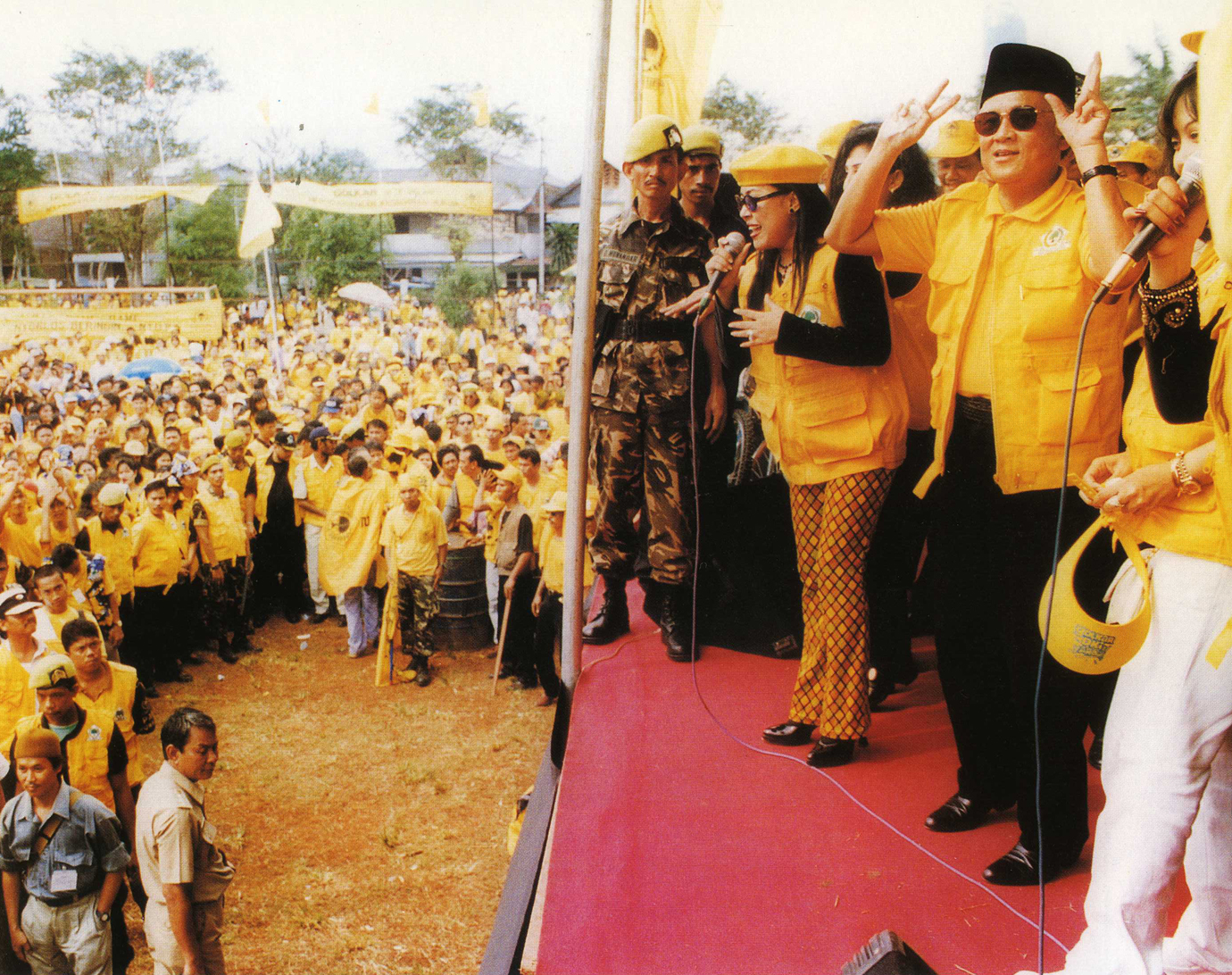
In Suharto's regime, as was expected of senior government executives, Habibie became a member of the Golkar organisation. Suharto appointed him as deputy daily coordinator for the chairman of the executive board in 1992, and the following year he became the daily coordinator.
While serving in cabinet, Habibie was also elected as the first Chair of the Indonesian Association of Muslim Intellectuals (ICMI) in 1990. This modernist Muslim organization provided him with a political base, linked to but independent of the Suharto administration.
Vice presidency (1998)
In January 1998, after accepting nomination for a seventh term as president, Suharto announced the selection criteria for the nomination of a vice president. Suharto did not mention Habibie by name, but his suggestion that the next vice president should have a mastery of science and technology made it obvious he had Habibie in mind.
In that year, in the midst of the Asian Financial Crisis, this suggestion was received badly, causing the rupiah to fall. Despite this, Habibie was elected as vice president in March 1998.
Presidency (1998–1999)

On 21 May 1998, just two months into Habibie's vice presidency, Suharto announced his resignation. Habibie, as the Constitution says, succeeded him as president. The following day, Habibie announced the Development Reform Cabinet, which removed some of the most controversial ministers in Suharto's last cabinet while maintaining others, with no major figures from the opposition. Within days of his appointment, he asked his relatives to resign from government positions, promised an early election, repealed some legislation, and ordered the release of political prisoners.
East Timor referendum
Habibie was opposed to East Timorese independence but did offer East Timor special autonomy.
Timorese independence forces led by the National Council of Timorese Resistance had been calling for a referendum in the territory for some time. Its chief diplomat, José Ramos-Horta, proposed a transitional period of autonomy leading up to a referendum. In late 1998, John Howard, the Prime Minister of Australia, sent a letter to Habibie suggesting that Indonesia defuse the East Timorese issue by providing autonomy to be followed by the promise of a referendum in the long run, following the method used by France to settle New Caledonian demands for independence. Wishing to avoid the impression that Indonesia ruled East Timor as a colony, Habibie surprised some by announcing that a referendum, offering a choice between special autonomy and independence, would be held immediately in East Timor. Leaders of the Indonesian armed forces (ABRI) were not consulted on this decision.
On 30 August 1999, the referendum was held and the East Timorese people overwhelmingly chose independence. Subsequently, pro-Indonesian militias killed and displaced large numbers of people during the 1999 East Timorese crisis. On 10 September, General Wiranto allegedly threatened to stage a military coup if Habibie allowed in peacekeeping forces, causing Habibie to back down. On 12 September, however, Habibie accepted a UN-mandated peacekeeping force to halt violence. A period of UN administration followed and East Timor became independent in May 2002.
Suharto's corruption charge
The MPR Special Session in November 1998 decried the presence of corruption in Indonesia, focusing particularly on Suharto. In response to this, Habibie then appointed Andi Muhammad Ghalib as Attorney General. A tape of a telephone conversation between Habibie and Ghalib was made public. It raised concerns about the veracity of the investigation by suggesting that the interrogation of Suharto was intended only for public appearances.
Under Habibie, the Indonesian government also began investigating and prosecuting Suharto's youngest son, Hutomo Mandala Putra (commonly known as Tommy Suharto). Ghalib charged Tommy in December 1998 in conjunction with the Goro scandal, where the government, under pressure from Tommy, allegedly gave him a desirable parcel and below-market loan for the construction of a Goro supermarket. However, Tommy was found innocent in the case after several key witnesses, including Habibie aide Rahardi Ramelan, changed their testimony and declared that the deal did not cause losses to the state.
Economy and the Chinese Indonesians
Habibie's government stabilized the economy in the face of the Asian financial crisis and the chaos of the last few months of Suharto's presidency. Habibie's government began to make conciliatory gestures towards Chinese-Indonesians who, because of their elite status, were targeted in the riots of 1998. In September 1998, Habibie issued a 'Presidential Instruction' forbidding use of the terms pribumi and non-pribumi to differentiate indigenous and non-indigenous Indonesians.
In May 1999, Habibie directed that an ID card was sufficient proof of Indonesian citizenship, revoking the previous requirement for a 'Letter of Evidence of Republic of Indonesia Citizenship' (SBKRI). Additionally, he lifted restrictions on the teaching of Mandarin Chinese.
Political reform
Under Habibie, Indonesia made significant changes to its political system that expanded competition and freedom of speech. Shortly after taking office, in June 1998, Habibie's government lifted the Suharto-era restriction on political parties and ended censorship by dissolving the Information Ministry. He also quickly committed to holding democratic elections, albeit on an initially vague timetable. In December, he proposed political reform laws that were passed by the legislature and MPR. These laws set elections for December 1999, reduced the number of seats in parliament held by the military, and barred political activity by civil servants.
However, political opponents criticized Habibie for allowing the military to retain some seats in parliament, and taking little action on other military and judicial reforms.
Habibie's government also passed laws which granted significant autonomy to regional governments, namely at the regency and city level. The laws resulted in indirect elections for mayors and regents, and allowed local legislatures to hold said executives accountable, though it was not implemented until after his presidency.
End of presidency
Although he had been viewed as leading a transitional government, Habibie seemed determined to continue as president. He was initially unclear about whether he would seek a full term as president when he announced parliamentary elections in June 1998. Habibie faced opposition from many within the government party, Golkar; in July 1998, he struggled to win control of Golkar by appointing Akbar Tandjung as chair of the party, but was ultimately able to defeat a rival camp including former vice president Try Sutrisno, defense minister Edi Sudradjat, Siswono Yudo Husodo, and Sarwono Kusumaatmadja. Habibie began to lose support from Akbar Tandjung and a faction in Golkar, composed of both reformers and hardliners, that wanted to oust him. In March 1999, Golkar put forth five presidential nominees: Habibie, Tandjung, Wiranto, Hamengkubuwono X, and Ginandjar Kartasasmita. In May 1999, after extensive lobbying, Golkar announced that Habibie would be their presidential candidate, but a large faction in the party remained loyal to Tandjung and opposed to Habibie. His political credibility was tarnished by the exposure of the 1999 Bank Bali scandal, in which banking funds were funneled to members of Habibie's re-election team.
At the 1999 MPR General Session in October, Habibie delivered an accountability speech. This was a tradition carried on from Suharto, in which he outlined the achievements of his tenure and showed how he had adhered to the Broad Lines of State Policy drafted by the MPR. Under the Constitution at the time, the MPR was responsible for developing the Broad Lines of State Policy. The president, in turn, was responsible for implementing them as the "mandatory" of the MPR. Afterward, MPR members then began voting to either accept or reject his speech. Habibie attempted to win the support of the military by offering the vice presidency to General Wiranto, but his offer was declined. After Tandjung's Golkar faction broke ranks and voted against him, Habibie's accountability speech was rejected by 355 votes to 322. Realizing that his position was untenable, Habibie withdrew his nomination as president. He was succeeded by Abdurrahman Wahid.
Post-presidency (1999–2019)
Post-presidency activities
After relinquishing the presidency, Habibie spent more time in Germany than in Indonesia, though he was active during Susilo Bambang Yudhoyono's presidency as a presidential adviser. During this time, he established the Habibie Centre, an independent think tank.
In September 2006, he released a book called Detik-Detik Yang Menentukan: Jalan Panjang Indonesia Menuju Demokrasi (Decisive Moments: Indonesia's Long Road Towards Democracy). The book recalled the events of May 1998, which led to his rise to the presidency. In the book, he controversially accused Lieutenant General Prabowo Subianto, Suharto's son-in-law (at that time) and the Kostrad Commander, of planning a coup d'état against him in May 1998.
Illness and death
In early September 2019, he was admitted to Gatot Soebroto Army Hospital, where he was undergoing treatments for heart problems, namely cardiomyopathy, and died on 11 September 2019. He became the first president of Indonesia to be buried at the Kalibata Heroes' Cemetery, next to his wife's grave.
In response to his death, the Government of Indonesia announced a three-day national mourning period starting on 12 September, and announced that the Indonesian flag is to be flown at half-staff during the period.
Malaysian prime minister Mahathir Mohamad was saddened by the loss of his old friend, Habibie. He described his demise as a considerable loss.
On 12 September 2019, a video was released showing East Timor's former president, Xanana Gusmão, visiting Habibie in hospital on 22 July 2019. Gusmão is shown talking briefly to Habibie while crying, then kissing Habibie on the forehead and lowering his face to Habibie's chest, with the other holding his head. A wreath in Gusmão's name was at the funeral, with a sign reading: "Profound Condolences - With heartfelt sympathy for the loss of Big Brother President B.J. Habibie - Timorese people will remember you forever - Rest in Peace - Xanana Gusmão."
Personal life
Habibie was married to Hasri Ainun Besari, a medical doctor, from 12 May 1962 until her death on 22 May 2010. Their wedding was held according to Javanese and Gorontalese culture. The couple had two sons, Ilham Akbar Habibie and Thareq Kemal Habibie.
B. J. Habibie's brother, Junus Effendi Habibie, was Indonesian ambassador to the United Kingdom and the Netherlands. After his wife's death, Habibie published a book titled Habibie & Ainun which recounts his relationship with Hasri Ainun from their courtship until her death. The book was adapted into a film of the same name which was released on 20 December 2012.
Honours
Habibie received several honorary degrees for his contributions in the fields of technology and science, e.g. he was awarded an honorary DSc degree from the Cranfield Institute of Technology (United Kingdom) and Dr. (H.C.) degrees from Chungbuk National University and Hankuk University of Foreign Studies (South Korea) for his services to aircraft technology. In 2010, Habibie was honored with an Honorary PhD degree in Technology by the University of Indonesia for his contribution to science in practice as a technocrat.
Habibie was appointed a Fellow of the Royal Academy of Engineering (FREng) in 1990. In 1993, he was awarded an Honorary Fellow of the Royal Aeronautical Society (HonFRAeS). He was also named an honorary member of several professional bodies, including:
- Malaysian Engineers Association (IEM)
- Japanese Academy of Engineering
- Fellowship of Engineering of the United Kingdom, London
- National Academy of Engineering, USA
- Academie Nationale de l'Air et de l'Espace, France
- Royal Aeronautical Society, UK
- Royal Swedish Academy of Engineering Science
- Deutsche Gesellschaft für Luft- und Raumfahrt (German Institute for Aviation & Space), Germany
- American Institute of Aeronautics and Astronautics, USA
National honours
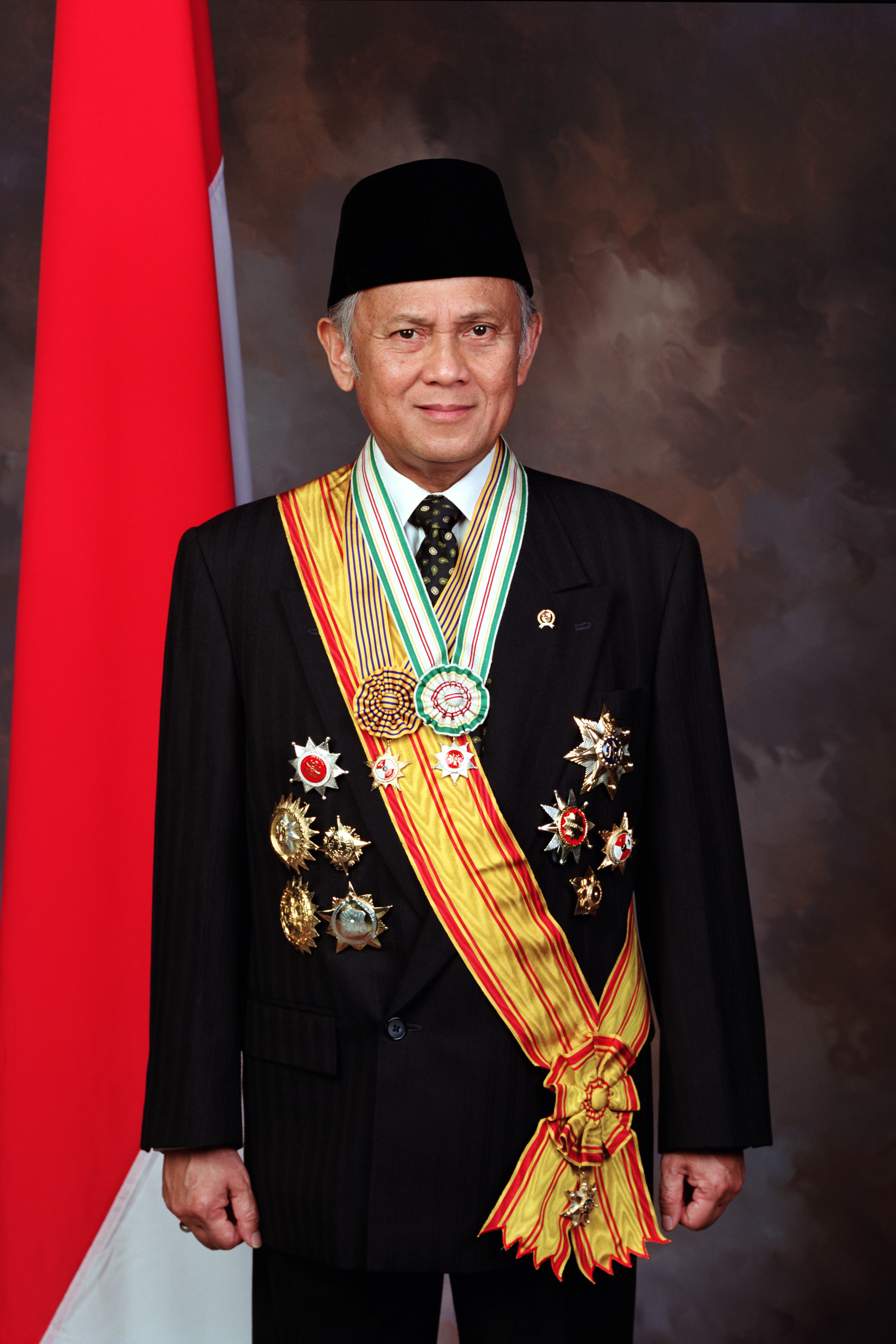
As vice president, and later president of Indonesia, he was automatically bestowed the highest class of all civilian and military Star Decorations from Indonesia, namely:
- [[File:Bintang Republik Indonesia Adipurna rib.svg|70px]] Star of the Republic of Indonesia, 1st Class () (27 May 1998)
- [[File:Bintang Republik Indonesia Adipradana rib.svg|70px]] Star of the Republic of Indonesia, 2nd Class () (12 March 1998)
- [[File:Bintang Mahaputera Adipurna rib.svg|70px]] Star of Mahaputera, 1st Class () (12 March 1998)
- [[File:Bintang Mahaputera Adipradana rib.svg|70px]] Star of Mahaputera, 2nd Class () (17 August 1982)
- [[File:Bintang Jasa Utama rib.svg|70px]] Star of Merit, 1st Class () (27 May 1998)
- [[File:Bintang Budaya Parama Dharma rib.svg|70px]] Star of Culture Parama Dharma () (27 May 1998)
- [[File:Bintang Yudha Dharma Utama rib.svg|70px]] Star of Yudha Dharma, 1st Class () (27 May 1998)
- [[File:Bintang Kartika Eka Paksi Utama rib.svg|70px]] Star of Kartika Eka Paksi, 1st Class () (27 May 1998)
- [[File:Bintang Jalasena Utama rib.svg|70px]] Star of Jalasena, 1st Class () (27 May 1998)
- [[File:Bintang Swa Bhuwana Paksa Utama rib.svg|70px]] Star of Swa Bhuwana Paksa, 1st Class () (27 May 1998)
- [[File:Bintang Bhayangkara Utama rib.svg|70px]] Star of Bhayangkara, 1st Class () (27 May 1998)
- [[File:Satyalancana Dwidya Sistha.gif|70px]] Military Instructor Service Medal () (9 August 1982)
Foreign honours
In addition, he also received several foreign decorations:
Austria:
- [[File:AUT Honour for Services to the Republic of Austria - 6th Class BAR.svg|70px]] Grand Decoration of Honour in Gold of the Decoration of Honour for Services to the Republic of Austria (1996) Belgium:
- [[File:BEL Order of Leopold II - Grand Cross BAR.png|70px]] Grand Cross of the Order of Leopold II (10 April 1991) Brazil:
- [[File:BRA - Order of the Southern Cross - Grand Cross BAR.svg|70px]] Grand Cross of the Order of the Southern Cross (2010) Chile:
- [[File:Order of Aeronautical Merit-Grand Cross-Chile.png|70px]] Grand Cross of Aeronautical Merit (3 October 1985) France:
- [[File:Legion Honneur GO ribbon.svg|70px]] Grand Officer of the Legion of Honour (4 June 1997)
- [[File:Ordre national du Merite GC ribbon.svg|70px]] Grand Cross of the National Order of Merit (September 1986) Germany:
- [[File:GER Bundesverdienstkreuz 7 Grosskreuz.svg|70px]] Grand Cross 1st Class of the Order of Merit of the Federal Republic of Germany (15 July 1997)
- [[File:GER Bundesverdienstkreuz 6 GrVK Stern Band.svg|70px]] Grand Cross with Star and Sash of the Order of Merit of the Federal Republic of Germany (11 November 1980)
- Lower Saxony:
- [[File:DE-NI Der Niedersächsische Verdienstorden (Gross) BAR.png|70px]] Commander's Cross (Großes Verdienstkreuz) of the Lower Saxony Order of Merit (1 December 1980) Italy:
- Lower Saxony:
- [[File:Cordone di gran Croce OMRI BAR.svg|70px]] Knight Grand Cross of the Order of Merit of the Italian Republic (16 June 1987) Japan:
- [[File:JPN Toka-sho BAR.svg|70px]] Grand Cordon of the Order of the Paulownia Flowers (1998) Jordan:
- [[File:JOR Order of Independence GC.svg|70px]] Grand Cordon of the Order of Independence (Wisam al-Istiqial) (14 April 1986) Netherlands:
- [[File:Order of Orange-Nassau ribbon - Knight Grand Cross.svg|70px]] Knight Grand Cross of the Order of Orange-Nassau (25 May 1983) Spain:
- [[File:ESP Order of Civil Merit GC.svg|70px]] Grand Cross of the Order of Civil Merit (24 April 1987)
- [[File:ESP Gran Cruz Merito Aeronautico (Distintivo Blanco) pasador.svg|70px]] Grand Cross of Aeronautical Merit with White Decoration (14 May 1980) Taiwan
- [[File:TWN Order of Brilliant Star 2Class BAR.svg|70px]] Grand Cordon of the Order of Brilliant Star (10 June 1994)
Places and statue
There is several places, especially in Sulawesi where he came from, that bear his name. In Parepare, a monument called Monumen Cinta Sejati Habibie Ainun (Habibie Ainun True Love Monument) featuring statue of him and Ainun was dedicated by himself at his 53rd wedding anniversary in 2015. Gelora Mandiri Stadium in the city was renamed into Gelora B.J. Habibie Stadium in 2019, shortly after his death. His former house in Parepare is converted into a presidential museum that opened in 2020. In 2022, the new B.J. Habibie Floating Mosque in Parepare was opened to the public.
In Gorontalo Regency, there is a monument of Habibie located nearby Jalaluddin Airport built by Gorontalo provincial government.
In memory of Habibie, the government of Timor-Leste named a bridge in the city of Dili B. J. Habibie Bridge shortly after Habibie died.
In popular culture
Habibie has been portrayed in several biopic movies based on both his political and personal life. In the first installment of Habibie & Ainun (2012) and its prequels, Rudy Habibie (2016) and ** (2019), Habibie was portrayed by Reza Rahadian, while Bima Azriel and Bastian Bintang Simbolon portrayed Habibie during his childhood, and teenage years in Rudy Habibie respectively. In the movie Di Balik 98, Habibie was portrayed by Agus Kuncoro.
References
References
- Romi, J. (24 November 2020). "Penasaran Tidak, Berapa Sih Tinggi Badan Semua Presiden Indonesia".
- Habibie, B. J., et al. "BJ Habibie." ''Children'' 1000.1962 (2010).
- . (9 November 2019). ["Mengenang B.J Habibie: Fokus agar Usil Tetap Genius (1)"](https://www.jawapos.com/nasional/11/09/2019/mengenang-b-j-habibie-fokus-agar-usil-tetap-genius-1/). *Jawa Pos*.
- . (3 May 2019). ["BJ Habibie, Si Jenius Indonesia dari Sulawesi"](https://kebudayaan.kemdikbud.go.id/muspres/bj-habibie-si-jenius-indonesia-dari-sulawesi/). *[[Ministry of Education, Culture, Research, and Technology]]*.
- (18 April 2022). "Daftar Julukan 6 Presiden RI, Apa Julukan Jokowi? Halaman all".
- Elson, R.E., 2009. The idea of Indonesia. Penerbit Serambi.
- Salam, S., 1986. ''BJ Habibie, Mutiara dari Timur''. Intermasa.
- (1987). "Makka, M. 1987. Prof. Dr. Ing. B.J. Habibie: Half a Century Impressions and Reminiscenses". Michigan University.
- Habibie, B.J., 2010. Habibie & Ainun. THC Mandiri.
- . (9 November 2019). ["Mengenang B.J Habibie: Fokus agar Usil Tetap Genius (1)"](https://www.jawapos.com/nasional/11/09/2019/mengenang-b-j-habibie-fokus-agar-usil-tetap-genius-1/). *Jawa Pos*.
- Hendrowinoto, N.K.S. ed., 2004. Ibu Indonesia dalam kenangan. Bank Naskah Gramedia bekerja sama dengan Yayasan Biografi Indonesia.
- Noer, G.S., 2015. Rudy: Kisah Masa Muda Sang Visioner. Bentang Pustaka.
- (1999). "BJH: Bacharuddin Jusuf Habibie, kisah hidup dan kariernya". Pustaka CIDESINDO.
- El Brahimy. (2012). "Biografi Presiden dan Wakil Presiden RI". PT Balai Pustaka (Persero).
- (11 September 2018). "BJ Habibie Setuju Desain Patung Dirinya Dimonumenkan".
- (20 January 2019). "Patung perunggu dan jejak singkat BJ Habibie di Gorontalo".
- "InfoPublik - Habibie Ajak Bupati Bone Bolango Bangun Universitas".
- (10 April 2014). "Universitas BJ Habibie, Nama Baru Universitas Negeri Gorontalo". Republika.co.id.
- de Jong, Anita. (28 May 1998). "Habibie: nauwe band met Delft".
- {{Harvnb. Habibie. 2010
- {{Harvnb. Habibie. 2010
- {{Harvnb. Habibie. 2010
- {{Harvnb. Habibie. 2010
- {{Harvnb. O'Rourke. 2002
- "Our History". Indonesian Aerospace.
- (17 April 1993). "The Economist".
- (2012). "The Technological State in Indonesia: The Co-constitution of High Technology and Authoritarian Politics". Routledge.
- Hefner, Robert W.. (2000). "Civil Islam: Muslims and Democratization in Indonesia". Princeton University Press.
- (7 February 1998). "Delapan Calon Wapres Itu: Di Antara Pujian dan Kritik". Tempo.
- (2008). "Indonesia and the ASEAN Free Trade Agreement: Nationalists and Regional Integration Strategy". Lexington Books.
- (28 May 1998). "Indonesia's new president on a tide of troubles". The Economist.
- Miller, M. (2004). 'From reform to repression: the post-New Order's shifting security policies in Aceh', Review of Indonesian and Malaysian Affairs, 38(4), 129–162.
- Ramos-Horta, Jose. (1997). "Towards a peaceful solution in East Timor". East Timor Relief Association.
- "Howard's letter to Habibie".
- Robinson, Geoffrey. (2010). ""If you leave us here, we will die" : how genocide was stopped in East Timor". Princeton University Press.
- {{Harvnb. O'Rourke. 2002
- Ziegenhain, Patrick. (2008). "The Indonesian parliament and democratization". Institute of Southeast Asian Studies.
- Elson, Robert Edward. (2001). "Suharto : a political biography". Cambridge University Press.
- {{Harvnb. O'Rourke. 2002
- (18 October 1999). "Bung Rudy, In Rapormu! Mengintip Pertanggungjawaban BJ Habibie". Kontanonline.com as found on hamline.edu.
- Purdey, Jemma. (2006). "Anti-Chinese violence in Indonesia, 1996-1999". Singapore University Press.
- (2008). "Ethnic Chinese in Contemporary Indonesia". Institute of Southeast Asian Studies.
- {{Harvnb. O'Rourke. 2002
- {{Harvnb. O'Rourke. 2002
- {{Harvnb. O'Rourke. 2002
- {{Harvnb. O'Rourke. 2002
- Samuel S. Kim. (25 October 2000). "East Asia and Globalization". Rowman & Littlefield Publishers.
- {{Harvnb. O'Rourke. 2002
- (20 October 1999). "Indonesia's Habibie Withdraws". AP News.
- Movanita, Ambaranie Nadia Kemala. (11 September 2019). "[OBITUARI] BJ Habibie, "Bapak Pesawat" yang Tak Pernah Tertarik Jadi Presiden". KOMPAS.
- (31 July 2017). "Prabowo Dipecat atau Diberhentikan? Ini Cerita BJ Habibie". detikNews.
- Movanita. (11 September 2019). "BJ Habibie Meninggal Dunia di RSPAD". KOMPAS.com.
- (8 September 2019). "BJ Habibie Dirawat di Ruang CICU RSPAD Gatot Soebroto".
- (12 September 2019). "BJ Habibie Punya Riwayat Kesehatan Lemah Jantung, Apa Itu?". Tempo.
- Alaidrus, Fadiyah. (11 September 2019). "B.J. Habibie Meninggal Dunia, 11 September Petang Ini".
- Komara. (11 September 2019). "BJ Habibie Meninggal Dunia". Detik.com.
- Kotarumalos, Ali. (11 September 2019). "Former Indonesian President Habibie Dies at Age 83". The New York Times.
- (11 September 2019). "Former Indonesian president Habibie, who described Singapore as a 'little red dot', dies aged 83".
- (11 September 2019). "Indonesia's Habibie, president during transition to democracy, dies". Media Prima Group.
- Prasetia. (11 September 2019). "BJ Habibie Akan Dimakamkan di Samping Makam Ainun". Detik.com.
- (11 September 2019). "Government declares three-day mourning for Habibie". Antara News.
- (11 September 2019). "Dr M offers condolences to late BJ Habibie's family".
- (12 September 2019). "Malaysian leaders mourn former Indonesia president BJ Habibie".
- Barker, Anne. (12 September 2019). "East Timor resistance fighter's 'touching' farewell to former Indonesian president". ABC News.
- Habibie, B.J., 2010.
''Habibie & Ainun'' . THC Mandiri. - (23 May 2010). "Former First Lady Hasri Ainun Habibie Dies At 72". Jakarta Globe.
- "Brother of Former President BJ Habibie, Fanny Habibie, Dies at 74". Antara.
- Hussain, Zakir. (25 November 2012). "Former President Habibie's Love Story to Hit the Big Screen".
- [http://www.pikiran-rakyat.com/pendidikan/2011/02/22/136033/rektor-ui-terima-penghargaan-dari-chonbuk-national-university Rektor UI Terima Penghargaan dari Chonbuk National University] - website of newspaper [[Pikiran Rakyat]]
- Wardany, Irawaty. (30 January 2010). "Habibie gets his 4th honorary doctorate, this time from UI".
- "List of Fellows - Royal Academy of Engineering".
- [https://www.aerosociety.com/Assets/Docs/Medals%20and%20Awards/2015_WOW_Medals_and_Awards_brochure_Web.pdf WOW_Medals_and_Awards] {{Webarchive. link. (10 July 2017 - website of the Royal Aeronautical Society)
- Nainggolan, Johannes. (12 September 2019). "11 Tanda Kehormatan dan Bintang Jasa Almarhum BJ Habibie Dibacakan".
- "Penghargaan Presiden BJ Habibie". National Library of the Republic of Indonesia.
- "Daftar WNI yang Menerima Tanda Kehormatan Bintang Republik Indonesia 1959 - sekarang". Ministry of State Secretariat of the Republic of Indonesia.
- "Daftar WNI yang Mendapat Tanda Kehormatan Bintang Mahaputera tahun 1959 s.d. 2003". Ministry of State Secretariat of the Republic of Indonesia.
- "Daftar Pemilik Bintang Budaya Parama Dharma Tahun 1988 – 2003". Ministry of State Secretariat of the Republic of Indonesia.
- (4 June 1997). "Habibie awarded highest French medal".
- Italian Presidency Website, [https://www.quirinale.it/onorificenze/insigniti/15397 HABIBIE Ing. Bacharuddin Jusuf]
- Spain State Agency of Official State Gazette, [https://boe.es/diario_boe/txt.php?id=BOE-A-1988-1376 Real Decreto 1756/1987, de 30 de diciembre, por el que se concede la Gran Cruz de la Orden del Mérito Civil al señor Bacharuddin Jusuf Habibie.]
- Spain State Agency of Official State Gazette, [https://www.boe.es/diario_boe/txt.php?id=BOE-A-1980-6052 Real Decreto 497/1980, de 7 de marzo, por el que se concede la Gran Cruz del Mérito Aeronáutico, con distintivo blanco, al Profesor Doctor Ingeniero don Bacharuddin Jusuf Habibie, Ministro de Investigación y Tecnología de Indonesia.]
- Ratnasari, Bella Cynthia. (25 May 2018). "Monumen Cinta Sejati Habibie Ainun, Ikon Kota Parepare yang Mempesona". Kumparan.
- Kurniawan, Tri Yari. (28 September 2019). "Resmi! BJ Habibie Diabadikan Jadi Nama Stadion di Parepare".
- "Museum BJ Habibie, Destinasi Wisata Sejarah di Parepare". Dinas Kepemudaan, Olahraga, dan Pariwisata Kota Parepare.
- (10 September 2022). "Masjid Terapung BJ Habibie Parepare Mulai Difungsikan".
- Ibrahim, Arfandi. (7 January 2019). "Patung BJ Habibie Senilai 1,7 Miliar Berdiri Megah di Jalan Trans Sulawesi". [[Liputan6.com]].
- (30 June 2016). "Kenalan yuk sama Bima, pemeran Habibie kecil di film Rudy Habibie".
This article was imported from Wikipedia and is available under the Creative Commons Attribution-ShareAlike 4.0 License. Content has been adapted to SurfDoc format. Original contributors can be found on the article history page.
Ask Mako anything about B. J. Habibie — get instant answers, deeper analysis, and related topics.
Research with MakoFree with your Surf account
Create a free account to save articles, ask Mako questions, and organize your research.
Sign up freeThis content may have been generated or modified by AI. CloudSurf Software LLC is not responsible for the accuracy, completeness, or reliability of AI-generated content. Always verify important information from primary sources.
Report