From Surf Wiki (app.surf) — the open knowledge base
Azaloxan
Chemical compound
Chemical compound
| elimination_half-life =
(fumarate)
Azaloxan (CGS-7135A) is a drug which was patented as an antidepressant by Ciba-Geigy in the early 1980s, but was never marketed.
Synthesis
Thymoleptic described as a “psychostimulant” according to patent title.
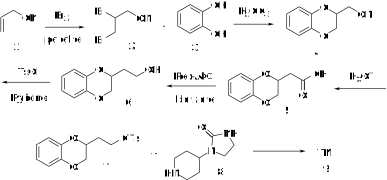
The halogenation of allyl cyanide [109-75-1] (1) with bromine gives 3,4-dibromobutyronitrile [25109-74-4] (2). This is further reacted with catechol [120-80-9] (3) to give the 1,4-benzodioxan-2-yl-acetonitrile [18505-91-4] (4). Acid catalyzed hydrolysis of the nitrile to the acid gives 1,4-benzodioxan-2-yl-acetic acid [18505-92-5] (5). The reduction of this to alcohol with sodium bis(2-methoxyethoxy)aluminium hydride gives 2-(1,4-benzodioxan-2-yl)ethanol [62590-71-0] (6). The tosylation of this intermediate gives CID:12850582 (7). The synthesis concludes with an SN-2 displacement reaction with 1-(4-piperidinyl)-2-imidazolidinone [52210-86-3] (8) completing the synthesis of ** (9).
References
References
- (1997). "Dictionary of pharmacological agents". Chapman & Hall.
- Charles F. Huebner, {{US patent. 4329348 (1982 to Ciba-Geigy Corporation).
This article was imported from Wikipedia and is available under the Creative Commons Attribution-ShareAlike 4.0 License. Content has been adapted to SurfDoc format. Original contributors can be found on the article history page.
Ask Mako anything about Azaloxan — get instant answers, deeper analysis, and related topics.
Research with MakoFree with your Surf account
Create a free account to save articles, ask Mako questions, and organize your research.
Sign up freeThis content may have been generated or modified by AI. CloudSurf Software LLC is not responsible for the accuracy, completeness, or reliability of AI-generated content. Always verify important information from primary sources.
Report