From Surf Wiki (app.surf) — the open knowledge base
Autunite
Type of phosphate mineral
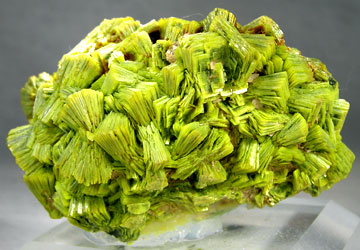
Type of phosphate mineral
| Field | Value | |
|---|---|---|
| name | Autunite | |
| boxbgcolor | #d2d75e | |
| image | Autunite-69257.jpg | |
| caption | Autunite from Daybreak Mine, Washington | |
| category | Phosphate minerals | |
| formula | Ca(UO2)2(PO4)2·10–12H2O | |
| IMAsymbol | Aut | |
| molweight | 986.26 g/mol | |
| strunz | 8.EB.05 | |
| system | Orthorhombic | |
| class | Dipyramidal (mmm) | |
| H-M symbol: (2/m 2/m 2/m) | ||
| symmetry | *Pnma* | |
| unit cell | a = 14.0135(6), | |
| b = 20.7121(8), | ||
| c = 6.9959(3) [Å]; Z = 4 | ||
| color | Lemon-yellow to sulfur-yellow, greenish yellow to pale green; may be dark green to greenish black | |
| habit | Tabular crystals, foliated or scaly aggregates, and in crusts | |
| twinning | Rare on {110} | |
| cleavage | {001} perfect, {100} and {010} poor | |
| fracture | uneven | |
| mohs | 2–2.5 | |
| luster | Vitreous – pearly | |
| streak | Pale yellow | |
| diaphaneity | Transparent to translucent | |
| gravity | 3.1–3.2 | |
| density | 3.15 | |
| opticalprop | Biaxial (−) | |
| refractive | nα = 1.553 – 1.555 nβ = 1.575 nγ = 1.577 – 1.578 | |
| birefringence | δ = 0.003 | |
| pleochroism | X = colorless to pale yellow; Y = Z = yellow to dark yellow | |
| 2V | Measured: 10° to 53° | |
| fluorescence | Strong yellow-green fluorescence in UV; Radioactive | |
| solubility | Soluble in acids | |
| alteration | Dehydrates in air | |
| other | Pseudotetragonal for synthetic material, [[Image:Radioactive.svg | 25px]] Radioactive |
| references |
H-M symbol: (2/m 2/m 2/m) b = 20.7121(8), c = 6.9959(3) [Å]; Z = 4 | length fast/slow =
Autunite (hydrated calcium uranyl phosphate), with formula Ca(UO2)2(PO4)2·10–12H2O, is a yellow-greenish fluorescent phosphate mineral with a hardness of 2–. Autunite crystallizes in the orthorhombic system and often occurs as tabular square crystals, commonly in small crusts or in fan-like masses. Due to the moderate uranium content of 48.27% it is radioactive and also used as uranium ore. Autunite fluoresces bright green to lime green under UV light. The mineral is also called calco-uranite, but this name is rarely used and effectively outdated.
Autunite was discovered in 1852 near Autun, France, which is also autunite's namesake. It occurs as an oxidation product of uranium minerals in granite pegmatites and hydrothermal deposits. Associate minerals include metaautunite, torbernite, phosphuranylite, saleeite, uranophane and sabugalite.
Etymology
Autunite was named after the town of Autun, France, where the mineral was initially found. The mineral was named by Henry J. Brooke and William H. Miller in 1854. The archaic name "calco-uranite" pairs with the similarly composed mineral, torbernite, which was named "cupro-uranite". Both minerals are named due to their uranium content, with autunite's name referring to its calcium (calco), and torbernite's copper (cupro) quantity.
Locations and mining
Mount Kit Carson, Washington
Researchers found autunite inside the Daybreak Mine on Mount Kit Carson, Spokane, Washington (or sometimes referred to as "near Mount Spokane"), in "vugs, fractures, and shear zones in granitic rock". These areas showed signs of another phosphate, apatite, which may have helped lead to the formation of autunite, by providing a source of phosphate and lime. The formation may have occurred with the interaction of uranium leached from a separate deposit.
90,000 lbs of U3O8 were produced from nine properties, although most of the ore came from the Daybreak Mine.
Other locations
One of the other locations of autunite includes Autun, France, the type locality and namesake of the mineral. The mineral was formed there as an alteration of uraninite and other uranium bearing minerals. Autunite is also found in Cornwall, Saxony, and North and South Dakota.
Meta-autunite
If the mineral dries out, it can lose its water content and convert to meta-autunite-I, which can turn into meta-autunite-II after heating. These two subsequent minerals are very rare in nature. For scientific studies it is recommended to store the mineral in a sealed container to minimize the water loss. Museums are known to have covered the mineral with lacquer to avoid drying of the mineral.
Gallery
File:Autunite UV(AB) France.jpg|Autunite under UV light File:Autunite sous UV (France).jpg|More crystals under UV light File:Autunite09.jpg|Scaly crystals of autunite File:Autunite (France).JPG|Autunite from France File:Autunite-141164.jpg|Close-up of an autunite crystal
References
References
- Warr, L.N.. (2021). "IMA–CNMNC approved mineral symbols". Mineralogical Magazine.
- [http://www.mindat.org/min-433.html Mindat.org]
- [http://rruff.geo.arizona.edu/doclib/hom/autunite.pdf Handbook of Mineralogy]
- Barthelmy, Dave. "Autunite Mineral Data".
- "Autunite: Autunite mineral information and data.".
- {{cite EB1911
- G. W. Leo. (1960). "Autunite from Mt. Spokane, Washington". The American Mineralogist.
- [https://pubs.usgs.gov/of/1998/of98-503/of98-503.pdf USGS]
- Publishing, D. K.. (2012-06-18). "Nature Guide: Rocks and Minerals". Penguin.
- (1918). "The Encyclopedia Americana: A Library of Universal Knowledge". Encyclopedia Americana Corporation.
This article was imported from Wikipedia and is available under the Creative Commons Attribution-ShareAlike 4.0 License. Content has been adapted to SurfDoc format. Original contributors can be found on the article history page.
Ask Mako anything about Autunite — get instant answers, deeper analysis, and related topics.
Research with MakoFree with your Surf account
Create a free account to save articles, ask Mako questions, and organize your research.
Sign up freeThis content may have been generated or modified by AI. CloudSurf Software LLC is not responsible for the accuracy, completeness, or reliability of AI-generated content. Always verify important information from primary sources.
Report