From Surf Wiki (app.surf) — the open knowledge base
Atomic radius
Measure of the size of an atom
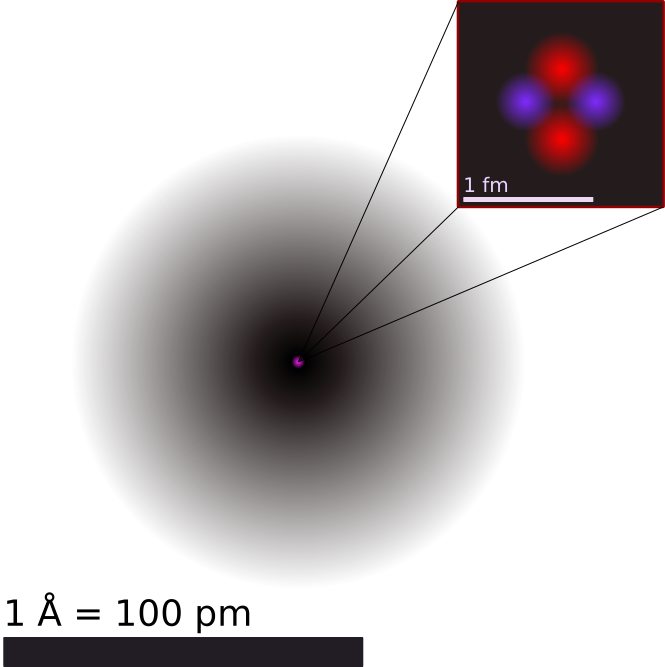
Measure of the size of an atom
The atomic radius of a chemical element is a measure of the size of its atom, usually the mean or typical distance from the center of the nucleus to the outermost isolated electron. Since the boundary is not a well-defined physical entity, there are various non-equivalent definitions of atomic radius. Five widely used definitions of atomic radius are covalent radius, Van der Waals radius, charge radius, ionic radius, and metallic radius. Typically, because of the difficulty to isolate atoms in order to measure their radii separately, the atomic radius is measured in a chemically bonded state; however, theoretical calculations are simpler when considering atoms in isolation. The dependencies on environment, probe, and state lead to a multiplicity of definitions.
Depending on the definition, the term may apply to atoms in condensed matter, covalently bonding in molecules, or in ionized and excited states; and its value may be obtained through experimental measurements, or computed from theoretical models. The value of the radius may depend on the atom's state and context.
Electrons do not have definite orbits nor sharply defined ranges. Rather, their positions must be described as probability distributions that taper off gradually as one moves away from the nucleus, without a sharp cutoff; these are referred to as atomic orbitals or electron clouds. Moreover, in condensed matter and molecules, the electron clouds of the atoms usually overlap to some extent, and some of the electrons may roam over a large region encompassing two or more atoms.
Under most definitions the radii of isolated neutral atoms range between 30 and 300 pm (trillionths of a meter), or between 0.3 and 3 ångströms. Therefore, the radius of an atom is more than 10,000 times the radius of its nucleus (1–10 fm),
For many purposes, atoms can be modeled as spheres. This is only a crude approximation, but it can provide quantitative explanations and predictions for many phenomena, such as the density of liquids and solids, the diffusion of fluids through molecular sieves, the arrangement of atoms and ions in crystals, and the size and shape of molecules.
History
The first to estimate the radius of an atom was Johann Chrysostom Magnenus in 1646. He was at Mass and noticed the smell of incense permeating the church. He knew the size of the incense and estimated the size of the church. He presumed that he could detect the incense if one atom was in each nostril. He also presumed that the incense was distributed homogenously throughout the church. With these assumptions he was able to estimate the size of an atom to be about 10 to the power of −24 cubic metres. (The units he used have been converted to metric to make comparisons with later estimates easier.) Taking the cube root this gives an estimate of the atomic radius to be about 10 to the power of −8 metres. This is somewhat larger than current estimates but given the assumptions made in the calculation is very good. These calculations were published in his work Democritus reviviscens sive de atomis.
The concept of atomic radius was preceded in the 19th century by the concept of atomic volume, a relative measure of how much space would on average an atom occupy in a given solid or liquid material. By the end of the century this term was also used in an absolute sense, as a molar volume divided by Avogadro constant. Such a volume is different for different crystalline forms even of the same compound, but physicists used it for rough, order-of-magnitude estimates of the atomic size, getting 10−8–10−7 cm for copper.
The earliest estimates of the atomic size was made by opticians in the 1830s, particularly Cauchy, who developed models of light dispersion assuming a lattice of connected "molecules". In 1857 Clausius developed a gas-kinetic model which included the equation for mean free path. In the 1870s it was used to estimate gas molecule sizes, as well as an aforementioned comparison with visible light wavelength and an estimate from the thickness of soap bubble film at which its contractile force rapidly diminishes. By 1900, various estimates of mercury atom diameter averaged around 275±20 pm (modern estimates give 300±10 pm, see below).
In 1920, shortly after it had become possible to determine the sizes of atoms using X-ray crystallography, it was suggested that all atoms of the same element have the same radii. |doi-access=free
Definitions
Widely used definitions of atomic radius include:
-
Van der Waals radius: In the simplest definition, half the minimum distance between the nuclei of two atoms of the element that are not otherwise bound by covalent or metallic interactions. |access-date=9 May 2021
-
Ionic radius: the nominal radius of the ions of an element in a specific ionization state, deduced from the spacing of atomic nuclei in crystalline salts that include that ion. In principle, the spacing between two adjacent oppositely charged ions (the length of the ionic bond between them) should equal the sum of their ionic radii.
-
Covalent radius: the nominal radius of the atoms of an element when covalently bound to other atoms, as deduced from the separation between the atomic nuclei in molecules. In principle, the distance between two atoms that are bound to each other in a molecule (the length of that covalent bond) should equal the sum of their covalent radii.
-
Metallic radius: the nominal radius of atoms of an element when joined to other atoms by metallic bonds.
-
Bohr radius: the radius of the lowest-energy electron orbit predicted by Bohr model of the atom (1913). |access-date=8 June 2011 |access-date=8 June 2011
Empirically measured atomic radius
The following table shows empirically measured covalent radii for the elements, as published by J. C. Slater in 1964.
Explanation of the general trends
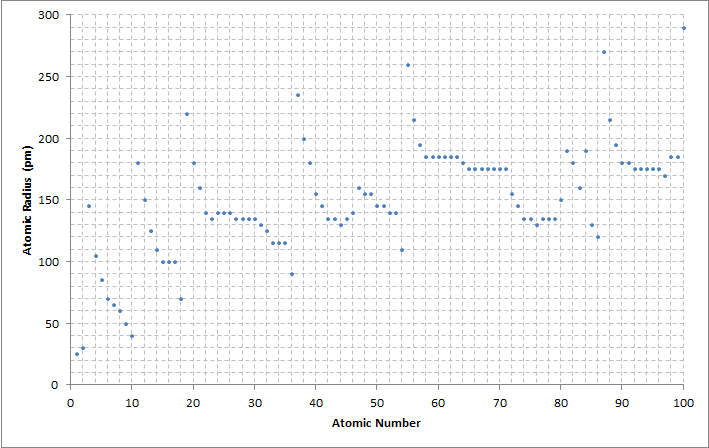
Electrons in atoms fill electron shells from the lowest available energy level. As a consequence of the Aufbau principle, each new period begins with the first two elements filling the next unoccupied s-orbital. Because an atom's s-orbital electrons are typically farthest from the nucleus, this results in a significant increase in atomic radius with the first elements of each period.
The atomic radius of each element generally decreases across each period due to an increasing number of protons, since an increase in the number of protons increases the attractive force acting on the atom's electrons. The greater attraction draws the electrons closer to the protons, decreasing the size of the atom. Down each group, the atomic radius of each element typically increases because there are more occupied electron energy levels and therefore a greater distance between protons and electrons.
The increasing nuclear charge is partly counterbalanced by the increasing number of electrons—a phenomenon that is known as shielding—which explains why the size of atoms usually increases down each column despite an increase in attractive force from the nucleus. Electron shielding causes the attraction of an atom's nucleus on its electrons to decrease, so electrons occupying higher energy states farther from the nucleus experience reduced attractive force, increasing the size of the atom. However, elements in the 5d-block (lutetium to mercury) are much smaller than this trend predicts due to the weak shielding of the 4f-subshell. This phenomenon is known as the lanthanide contraction. A similar phenomenon exists for actinides; however, the general instability of transuranic elements makes measurements for the remainder of the 5f-block difficult and for transactinides nearly impossible. Finally, for sufficiently heavy elements, the atomic radius may be decreased by relativistic effects. This is a consequence of electrons near the strongly charged nucleus traveling at a sufficient fraction of the speed of light to gain a nontrivial amount of mass.
The following table summarizes the main phenomena that influence the atomic radius of an element:
| Factor | Principle | increase in... | *tend to* | effect on radius |
|---|---|---|---|---|
| electron shells | quantum mechanics | principal and azimuthal quantum numbers | increase down each column | increases the atomic radius |
| nuclear charge | attractive force acting on electrons by protons in nucleus | atomic number | increase along each period (left to right) | decreases the atomic radius |
| shielding | repulsive force acting on outermost shell electrons by inner electrons | number of electrons in inner shells | reduce the effect of nuclear charge | increases the atomic radius |
Lanthanide contraction
Main article: Lanthanide contraction
The electrons in the 4f-subshell, which is progressively filled from lanthanum (Z = 57) to ytterbium (Z = 70), are not particularly effective at shielding the increasing nuclear charge from the sub-shells further out. The elements immediately following the lanthanides have atomic radii which are smaller than would be expected and which are almost identical to the atomic radii of the elements immediately above them.
Due to lanthanide contraction, the 5 following observations can be drawn:
- The size of Ln3+ ions regularly decreases with atomic number. According to Fajans' rules, decrease in size of Ln3+ ions increases the covalent character and decreases the basic character between Ln3+ and OH− ions in Ln(OH)3, to the point that Yb(OH)3 and Lu(OH)3 can dissolve with difficulty in hot concentrated NaOH. Hence the order of size of Ln3+ is given: La3+ Ce3+ ..., ... Lu3+.
- There is a regular decrease in their ionic radii.
- There is a regular decrease in their tendency to act as a reducing agent, with an increase in atomic number.
- The second and third rows of d-block transition elements are quite close in properties.
- Consequently, these elements occur together in natural minerals and are difficult to separate.
d-block contraction
Main article: d-block contraction
The d-block contraction is less pronounced than the lanthanide contraction but arises from a similar cause. In this case, it is the poor shielding capacity of the 3d-electrons which affects the atomic radii and chemistries of the elements immediately following the first row of the transition metals, from gallium (Z = 31) to bromine (Z = 35).
Calculated atomic radius
The following table shows atomic radii computed from theoretical models, as published by Enrico Clementi and others in 1967.
| ** | |||
|---|---|---|---|
| Ac | |||
| Th | |||
| Pa | |||
| U | |||
| Np | |||
| Pu | |||
| Am | |||
| Cm | |||
| Bk | |||
| Cf | |||
| Es | |||
| Fm | |||
| Md | |||
| No | |||
References
References
- Knight, Charles. (1859). "The English Cyclopaedia: A New Dictionary of Universal Knowledge". Bradbury and Evans.
- Fessenden, Reginald A.. (1892-07-22). "The Laws and Nature of Cohesion". Science.
- Watts, Henry. (1882). "A Dictionary of chemistry and the allied branches of other sciences v. 3, 1882". Longmans, Green & Company.
- (1893). "Electrical World". McGraw-Hill.
- Fessenden, Reginald Aubrey. (February 1900). "A Determination of the Nature of the Electric and Magnetic Quantities and of the Density and Elasticity of the Ether, II". Physical Review.
- Thomson, W.. (1870-07-01). "On the size of atoms". American Journal of Science.
- Darrigol, Olivier. (2012). "A History of Optics from Greek Antiquity to the Nineteenth Century". OUP Oxford.
- (1877). "The American chemist: a monthly journal of theoretical, analytical and technical chemistry". C. F. & W. H. Chandler.
- (1 August 1979). "Relativistic effects on chemical properties". Accounts of Chemical Research.
This article was imported from Wikipedia and is available under the Creative Commons Attribution-ShareAlike 4.0 License. Content has been adapted to SurfDoc format. Original contributors can be found on the article history page.
Ask Mako anything about Atomic radius — get instant answers, deeper analysis, and related topics.
Research with MakoFree with your Surf account
Create a free account to save articles, ask Mako questions, and organize your research.
Sign up freeThis content may have been generated or modified by AI. CloudSurf Software LLC is not responsible for the accuracy, completeness, or reliability of AI-generated content. Always verify important information from primary sources.
Report