From Surf Wiki (app.surf) — the open knowledge base
Atari 5200
Home video game console

Home video game console
| Field | Value |
|---|---|
| logo | Atari 5200 logo.svg |
| image | Atari-5200-4-Port-wController-L.jpg |
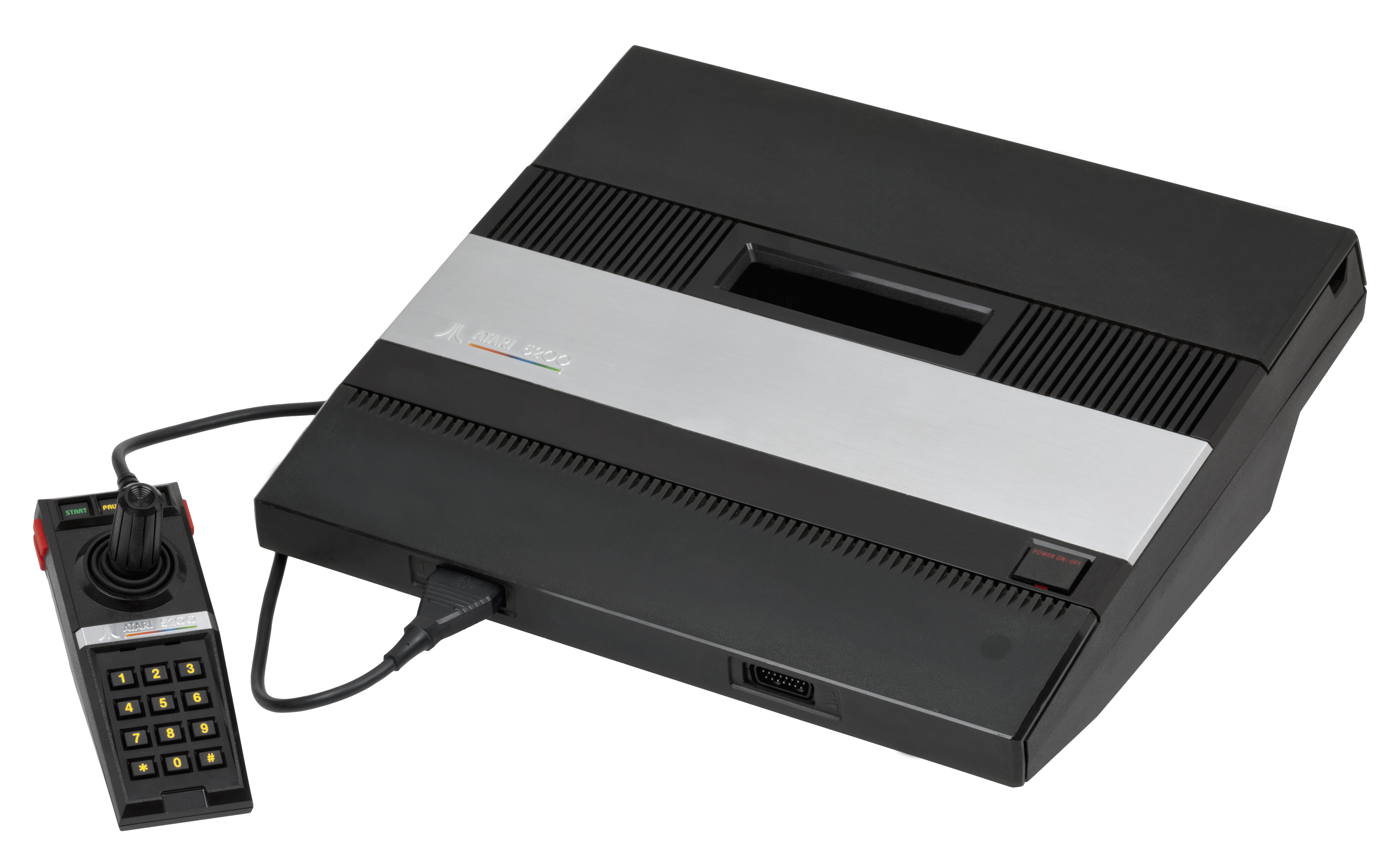
| caption | Atari 5200 and one of its controllers |
| manufacturer | Atari, Inc. |
| type | Home video game console |
| generation | Second |
| release_date | |
| cpu | MOS 6502C @ 1.79 MHz |
| memory | 16 KB RAM |
| media | ROM cartridge |
| discontinued | |
| controllers | Joystick |
| Trak-Ball | |
| units_sold | 1 million |
| predecessor | Atari 2600 |
| successor | Atari 7800 |
Trak-Ball
The Atari 5200 SuperSystem or simply Atari 5200 is a home video game console introduced in 1982 by Atari, Inc. as a higher-end complement for the popular Atari Video Computer System. The VCS was renamed to Atari 2600 at the time of the 5200's launch. Created to compete with Mattel's Intellivision, the 5200 wound up a direct competitor of ColecoVision shortly after its release. While the Coleco system shipped with the first home version of Nintendo's Donkey Kong, the 5200 included the 1978 arcade game Super Breakout, which had already appeared on previous Atari home platforms.
The system architecture is almost identical to that of the Atari 8-bit computers, although software is not directly compatible between them. The 5200's controllers have an analog joystick and a numeric keypad along with start, pause, and reset buttons. The 360-degree non-centering joystick was touted as offering more control than the eight-way Atari CX40 joystick of the 2600, but it was a focal point for criticism.
On May 21, 1984, during a press conference at which the Atari 7800 was introduced, company executives revealed that the 5200 had been discontinued after less than two years on the market. Total sales of the system were reportedly in excess of 1 million units, far short of its predecessor's sales of over 30 million.
Hardware
Following the release of the Video Computer System in 1977, Atari would begin development on hardware for it's next generation of video game consoles. This development would eventually shift towards home computers, where it would be used as the basis for the Atari 400 and 800 home computer systems.
Atari would later decide to re-enter the console market using this same Atari 8-bit technology. Prototypes were called the "Atari Video System X – Advanced Video Computer System". Actual working Atari Video System X machines, which share the exact same hardware as the 5200, have been recorded but are extremely rare.
The initial 1982 release of the system has four controller ports, compared to the two seen in most other consoles released at the time. The controllers have an analog joystick, numeric keypad, two fire buttons on each side of the controller, and three dedicated keys labeled "Start", "Pause", and "Reset". The 5200 also features an automatic TV switch box, the first of it's kind, which allows the console to automatically switch from a regular TV signal to the console's video signal whenever the game system is turned on. Previous RF adapters had required the user to slide a switch on the adapter by hand to accomplish the same task. Power supply to the console is also handled through that same unique RF adapter. A single cable coming out of the 5200 plugs into the adapter and carries both electricity and video signal for the console. A similar system had been employed for an earlier game console, the RCA Studio II.
A revision of the Atari 5200 released in 1983 removed two of the original model's four controller ports and reverted the system back to a separate more conventional power supply and standard RF adapter with no auto-switching. This hardware revision also altered the system's cartridge port to allow for compatibility with the system's Atari 2600 adapter, which released that same year. While the adapter was only designed to work with the 1983 revision of the system, modifications can be made to the console's original model to make it compatible with the adapter. In fact, towards the end of the original model's production run, a limited number of consoles were produced with these modifications included. These consoles can be identified by an asterisk in their serial numbers.
At one point following the 5200's release, Atari planned a smaller, cost-reduced version of the Atari 5200, which removed the console's controller storage bin. Code-named the "Atari 5100" (a.k.a. "Atari 5200 Jr."), only a few fully working prototypes were produced before the project was canceled.
Technical specifications

- CPU: SALLY @ 1.79 MHz (Custom MOS Technology 6502)
- Graphics chips: ANTIC and GTIA
- Support hardware: 3 custom VLSI chips
- Screen resolution: 14 modes: Six text modes (8×8, 4×8, and 8×10 character matrices supported), Eight graphics modes including 80 pixels per line (16 color), 160 pixels per line (4 color), 320 pixels per line (2 color), variable height and width up to overscan 384×240 pixels
- Color palette: 128 (16 hues, 8 luma) or 256 (16 hues, 16 luma)
- Colors on screen: 2 (320 pixels per line) to 16 (80 pixels per line). Up to 23 colors per line with player/missile and playfield priority control mixing. Register values can be changed at every scanline using ANTIC display list interrupts, allowing up to 256 (16 hues, 16 luma) to be displayed at once, with up to 16 per scanline.
- Sprites: Four 8-pixel-wide sprites, four 2-pixel-wide sprites; height of each is either 128 or 256 pixels; 1 color per sprite
- Scrolling: Coarse and fine scrolling horizontally and vertically. (Horizontal coarse scroll 4, 8, or 16-pixel/color clock increments, and vertically by mode line height 2, 4, 8, or 16 scan lines.) (Or horizontal fine scroll 0 to 3, 7, or 15 single-pixel/color clock increments and then a 4, 8, or 16-pixel/color clock increment coarse scroll; and vertical fine scroll 0 to 1, 3, 7, or 15 scan line increments and then a 2, 4, 8, or 16 scan line increment coarse scroll)
- Sound: 4-channel PSG sound via POKEY sound chip, which also handles keyboard scanning, serial I/O, high resolution interrupt capable timers (single cycle accurate), and random number generation.
- RAM: 16 KB
- ROM:
- 2 KB on-board BIOS for system startup and interrupt routing.
- 32 KB ROM window for standard game cartridges, expandable using bank switching techniques.
- Dimensions: 13" × 15" × 4.25"
Controllers
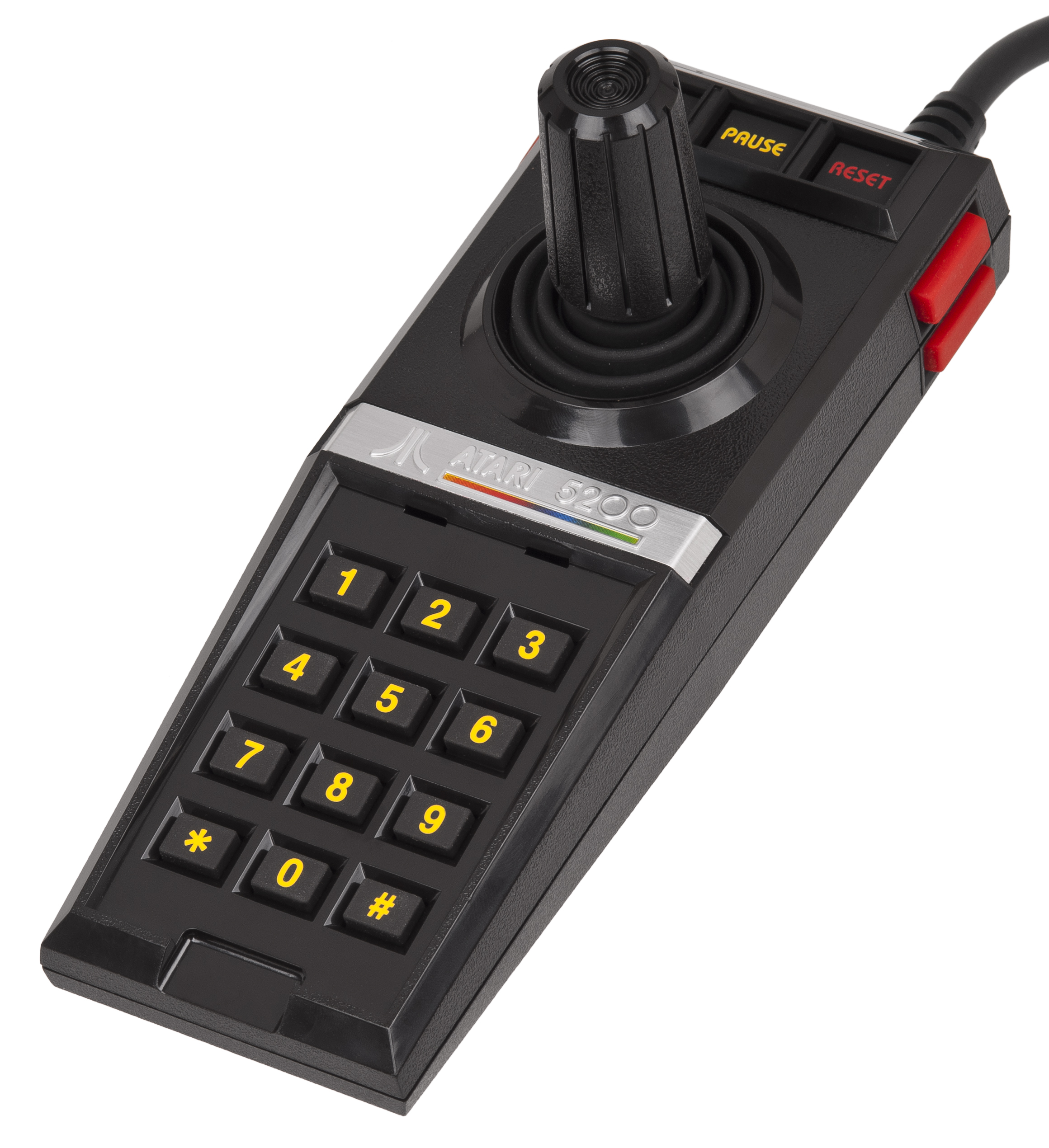

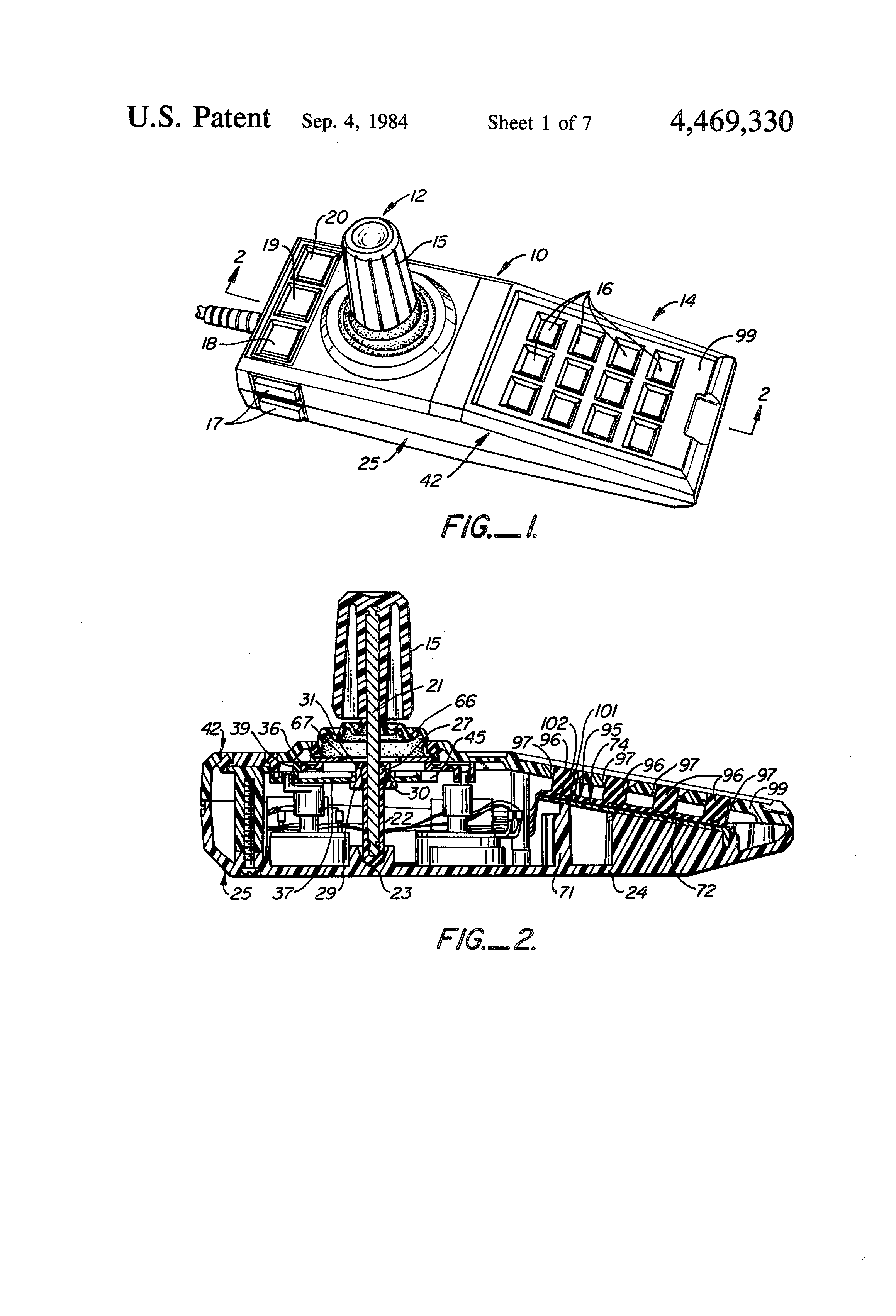
The controller prototypes used in the electrical development lab employed a yoke-and-gimbal mechanism that came from an RC airplane controller kit. The design of the analog joystick, which used a weak rubber boot rather than springs to provide centering, proved to be ungainly and unreliable. They quickly became the Achilles' heel of the system due to the combination of an overly complex mechanical design and a very low-cost internal flex circuit system. Another major flaw of the controllers was that the design did not translate into a linear acceleration from the center through the arc of the stick travel. The controllers did, however, include a pause button, a unique feature at the time. Various third-party replacement joysticks were also released, including those made by Wico.
Atari Inc. released the Pro-Line Trak-Ball controller, which was used for games such as Centipede and Missile Command. A paddle controller and an updated self-centering version of the original controller were also in development, but never made it to market.
Games were shipped with plastic card overlays that snapped in over the keypad. The cards indicated which game functions, such as changing the view or vehicle speed, were assigned to each key.
The primary controller was ranked the 10th worst video game controller by IGN editor Craig Harris. An editor for Next Generation said that their non-centering joysticks "rendered many games nearly unplayable".
Differences from Atari 8-bit computers
David H. Ahl in 1983 described the Atari 5200 as "a 400 computer in disguise". Its internal design is similar to that of Atari 8-bit computers using the ANTIC, POKEY, and GTIA coprocessors. Software designed for one does not run on the other, but source code can be mechanically converted unless it uses computer-specific features. Antic magazine reported in 1984 that "the similarities grossly outweigh the differences, so that a 5200 program can be developed and almost entirely debugged [on an Atari 8-bit computer] before testing on a 5200". John J. Anderson of Creative Computing alluded to the incompatibility being intentional, caused by Atari's console division removing 8-bit compatibility to not lose control to the rival computer division.
Besides the 5200's lack of a keyboard, the differences are:
- The Atari computer 10 KB operating system is replaced with a simpler 2 KB version, of which 1 KB is the built-in character set.
- Some hardware registers, such as those of the GTIA and POKEY chips, are at different memory locations.
- The purpose of some registers is slightly different on the 5200.
- The 5200's analog joysticks appear as pairs of paddles to the hardware, which requires different input handling from the digital joystick input on the Atari computers
In 1987, Atari Corporation released the XE Game System console, which is a repackaged 65XE (from 1985) with a detachable keyboard that can run home computer titles directly, unlike the 5200. Anderson wrote in 1984 that Atari could have released a console compatible with computer software in 1981.
Games
Main article: List of Atari 5200 games
Reception
The Atari 5200 did not fare well commercially compared to its predecessor, the Atari 2600. While it touted superior graphics to the 2600 and Mattel's Intellivision, the system was initially incompatible with the 2600's expansive library of games, and some market analysts have speculated that this hurt its sales, especially since an Atari 2600 cartridge adapter had been released for the Intellivision II. (A revised two-port model was released in 1983, along with a game adapter that allowed gamers to play all 2600 games.) This lack of new games was due in part to a lack of funding, with Atari continuing to develop most of its games for the saturated 2600 market.
Many of the 5200's games appeared simply as updated versions of 2600 titles, which failed to excite consumers. Its pack-in game, Super Breakout, was criticized for not doing enough to demonstrate the system's capabilities. This gave the ColecoVision a significant advantage as its pack-in, Donkey Kong, delivered a more authentic arcade experience than any previous game cartridge. In its list of the top 25 game consoles of all time, IGN claimed that the main reason for the 5200's market failure was the technological superiority of its competitor, while other sources maintain that the two consoles are roughly equivalent in power.
The 5200 received much criticism for the "sloppy" design of its non-centering analog controllers. Anderson described the controllers as "absolutely atrocious".
David H. Ahl of Creative Computing Video & Arcade Games said in 1983 that the "Atari 5200 is, dare I say it, Atari's answer to Intellivision, Colecovision, and the Astrocade", describing the console as a "true mass market" version of the Atari 8-bit computers despite the software incompatibility. He criticized the joystick's imprecise control but said that "it is at least as good as many other controllers", and wondered why Super Breakout was the pack-in game when it did not use the 5200's improved graphics.
Due to the system's failure, a PAL release was eventually cancelled, though a few prototypes of this model exist.
Popular culture
Critical to the plot of the 1984 film Cloak & Dagger is an Atari 5200 game cartridge called Cloak & Dagger. The arcade version appears in the movie. In actuality the Atari 5200 version was started but never completed. The game was under development with the title Agent X when the movie producers and Atari learned of each other's projects and decided to cooperate. This collaboration was part of a larger phenomenon, of films featuring video games as critical plot elements (as with Tron and The Last Starfighter) and of video game tie-ins to the same films (as with the Tron games for the Intellivision and other platforms).
References
References
- Schrage, Michael. (May 22, 1984). "Atari Introduces Game In Attempt for Survival". [[Washington Post]].
- (September 1, 1982). "The Atari 5200 will be available in October". The Milwaukee Sentinel.
- (February 28, 2008). "A History of Gaming Platforms: Atari 2600 Video Computer System/VCS". [[Gamasutra]].
- G4TV's Icons season 2 episode 1 "Atari"
- Sanger, David E.. (May 22, 1984). "Atari Video Game Unit Introduced". New York Times.
- Curt Vendel. "Video System X". Atarimuseum.com.
- Curt Vendel. "5100/5200 Jr". Atarimuseum.com.
- "Atari 8-bit Forever by Bostjan Gorisek".
- Wiegers, Karl E.. "Atari Fine Scrolling".
- "The Atari 5200 Super System". atarimuseum.com.
- (March 1996). "The Next Generation 1996 Lexicon A to Z: 5200". [[Imagine Media]].
- "Atari 5200 Controller Alternatives".
- Curt Vendel. "Atari 5200 Paddle Controller Prototypes". Atarimuseum.com.
- Curt Vendel. "Self Centering Joystick Prototypes". Atarimuseum.com.
- (31 January 2018). "Atari 5200 overlays".
- (February 21, 2006). "Top 10 Tuesday: Worst Game Controllers".
- Anderson, John J.. (March 1984). "Atari". Creative Computing.
- Buchholz, Claus. (January 1984). "Transporting Atari Computer Programs to the 5200".
- Harris, Neil. (May 12, 1987). "Re: Is Atari killing the 8 bit?".
- Moss, Stuart. (2007). "The Entertainment Industry: An Introduction". CABI.
- Mace, Scott. (August 6, 1984). "A New Atari Corp.: The House That Jack Tramiel Emptied". [[InfoWorld]].
- (February 1997). "Atari 7200". [[Ziff Davis]].
- (31 January 2018). "Atari CX-55 2600 Cartridge Adapter for the Atari 5200 Supersystem".
- Kent, Steven. (2001). "[[The Ultimate History of Video Games]]". [[Prima Publishing]].
- Staff, New York Times. (2007). "The New York Times Guide To Essential Knowledge: A Desk Reference for the Curious Mind". [[Macmillan Publishers]].
- Kent, Steven. (2001). "The Ultimate History of Video Games". [[Prima Publishing]].
- "Atari 5200 is number 23".
- "Colecovision vs Atari 5200 Hardware Comparison". AtariHQ.com.
- Hubner, John. (December 5, 1983). "What Went Wrong At Atari". [[InfoWorld]].
- Ahl, David H.. (Spring 1983). "Atari 5200 Advanced Game System".
- Parish, Jeremy. (August 10, 2015). "Cloak & Dagger, the Video Game Movie That Wasn't About Video Games".
- "Atari CX-55 2600 Cartridge Adapter for the Atari 5200 Supersystem".
This article was imported from Wikipedia and is available under the Creative Commons Attribution-ShareAlike 4.0 License. Content has been adapted to SurfDoc format. Original contributors can be found on the article history page.
Ask Mako anything about Atari 5200 — get instant answers, deeper analysis, and related topics.
Research with MakoFree with your Surf account
Create a free account to save articles, ask Mako questions, and organize your research.
Sign up freeThis content may have been generated or modified by AI. CloudSurf Software LLC is not responsible for the accuracy, completeness, or reliability of AI-generated content. Always verify important information from primary sources.
Report