From Surf Wiki (app.surf) — the open knowledge base
Ashen light
Supposed glow in Venus's light
Supposed glow in Venus's light
Ashen light is a subtle glow that has been claimed to be seen on the night side of the planet Venus. The phenomenon has not been scientifically confirmed, and theories as to the observed phenomenon's cause are numerous, such as emission of light by Venus, or optical phenomena within the observing telescope itself. A modern hypothesis as to the source of light on Venus suggests it to be associated with lightning, for which there is some evidence on Venus. This theory has fallen out of favour, however, as there is not enough light generated by this lightning so as to be observed. A more recent hypothesis is that it is a form of transient aurorae or airglow caused by unusually high solar activity interacting with the upper Venusian atmosphere.
History of observations
While the discovery of the ashen light is often attributed to Italian astronomer Giovanni Battista Riccioli, recent evidence finds that German priest Athanasius Kircher might have been the first to observe the ashen light during his one and only trip to Palermo, Sicily in the spring of 1638. However, the first distinct and detailed record of the ashen light was produced by Riccioli on 9 January 1643, who ascribed it to the refraction of light within the telescope itself: "The colours arise from the various refraction of light in the glass, as it happens with trigonal glasses." This is likely a description of a phenomenon now known as chromatic aberration. Subsequent claims have been made by various observers ever since, including Sir William Herschel, Sir Patrick Moore, Dale P. Cruikshank, and William K. Hartmann.
By the late 19th century the light phenomenon was described by those who stated they had observed it as ash-coloured, reminiscent of earthlight, therefore being called Venusian lumière cendrée or in English ashen light.
The ashen light has often been sighted when Venus is in the evening sky, when the evening terminator of the planet is toward the Earth. Observation attempts were made on 17 July 2001, when a 67% illuminated Venus reappeared from behind a 13% illuminated moon. None of the observers of this occurrence (including some using 61 cm 'Super RADOTS' telescopes) reported seeing the ashen light. Video from the event was captured, but the camera was too insensitive to detect even the earthshine.
A particularly favourable viewing opportunity occurred on 8 October 2015, with a 40% illuminated Venus reappearing from behind the unlit limb of a 15% sunlit Moon. The event was visible in dark skies throughout Central Australia and was recorded by David and Joan Dunham (of the International Occultation Timing Association) using a 10" f/4 Newton telescope with a Watec 120N+ video camera from a location just north of Alice Springs. They also observed the event visually with an 8" Schmidt–Cassegrain telescope. Neither the real-time visual observation nor close visual inspection of the video recording showed any sign of the dark side of Venus.
Light source hypotheses
The Keck telescope on Hawaii reported seeing a subtle green glow and suggested it could be produced as ultraviolet light from the Sun splits molecules of carbon dioxide (), known to be common in Venus's atmosphere, into carbon monoxide () and oxygen (). However, the green light emitted as oxygen recombines to form is thought too faint to explain the effect, and it is too faint to have been observed with amateur telescopes.
In 1967, Venera 4 found the Venusian magnetic field to be much weaker than that of Earth. This magnetic field is induced by an interaction between the ionosphere and the solar wind,{{cite book
It was hypothesised in 1957 by Urey and Brewer that CO+, CO and O ions produced by the ultraviolet radiation from the Sun were the cause of the glow. In 1969, it was hypothesised that the Ashen light is an auroral phenomena due to solar particle bombardment on the dark side of Venus.
Throughout the 1980s, it was thought that the cause of the glow was lightning on Venus. The Soviet Venera 9 and 10 orbital probes obtained optical and electromagnetic evidence of lightning on Venus. Also, the Pioneer Venus Orbiter recorded visible airglow at Venus in 1978 strong enough to saturate its star sensor. In 1990, Christopher T. Russell and J. L. Phillips gave further support to the lightning hypothesis, stating that if there are several strikes on the night side of the planet, in a sufficiently short period of time, the sequence may give off an overall glow in the skies of Venus. The European Space Agency's Venus Express in 2007 detected whistler waves, providing further evidence for lightning on Venus.
The Akatsuki spacecraft, by Japan's space agency JAXA, entered orbit around Venus on 7 December 2015. Part of its scientific payload includes the Lightning and Airglow Camera (LAC) which is looking for lightning in the visible spectrum (552–777 nm). To image lightning, the orbiter has sight of the dark side of Venus for about 30 minutes every 10 days. No lightning has been detected in 16.8 hours of night-side observation (July 2019).
Simulations indicate that the lightning hypothesis as the cause of the glow is incorrect, as not enough light could be transmitted through the atmosphere to be seen from Earth. Observers have speculated it may be illusory, resulting from the physiological effect of observing a bright, crescent-shaped object.{{cite journal|last=Baum|first=R. M.|date=2000
A more recent hypothesis is that unusually high solar activity could induce auroral or airglow-like effects on the dark side of Venus. It has been observed that after major solar storms, an emission of light with a wavelength of 557.7 nm (the oxygen green line) occurs across the entire upper atmosphere of Venus. This is the same phenomenon which gives some aurorae on Earth their greenish appearance. Generally, this emission does not occur except for during major solar events such as coronal mass ejections (CMEs) or solar flares. However, dim emissions have been detected twice outside of solar storms, on December 27, 2010, and December 12, 2013 respectively. Both of these detections coincided with the passage of a "Stream Interaction Region", a denser than average solar wind. In July 2012, a CME struck Venus producing a very bright green line emission. It is notable that after every CME impact on Venus, this emission is detected, but not after every flare. This is taken to indicate charged particles are what is responsible for the green line emission, similar to Earth's aurora.
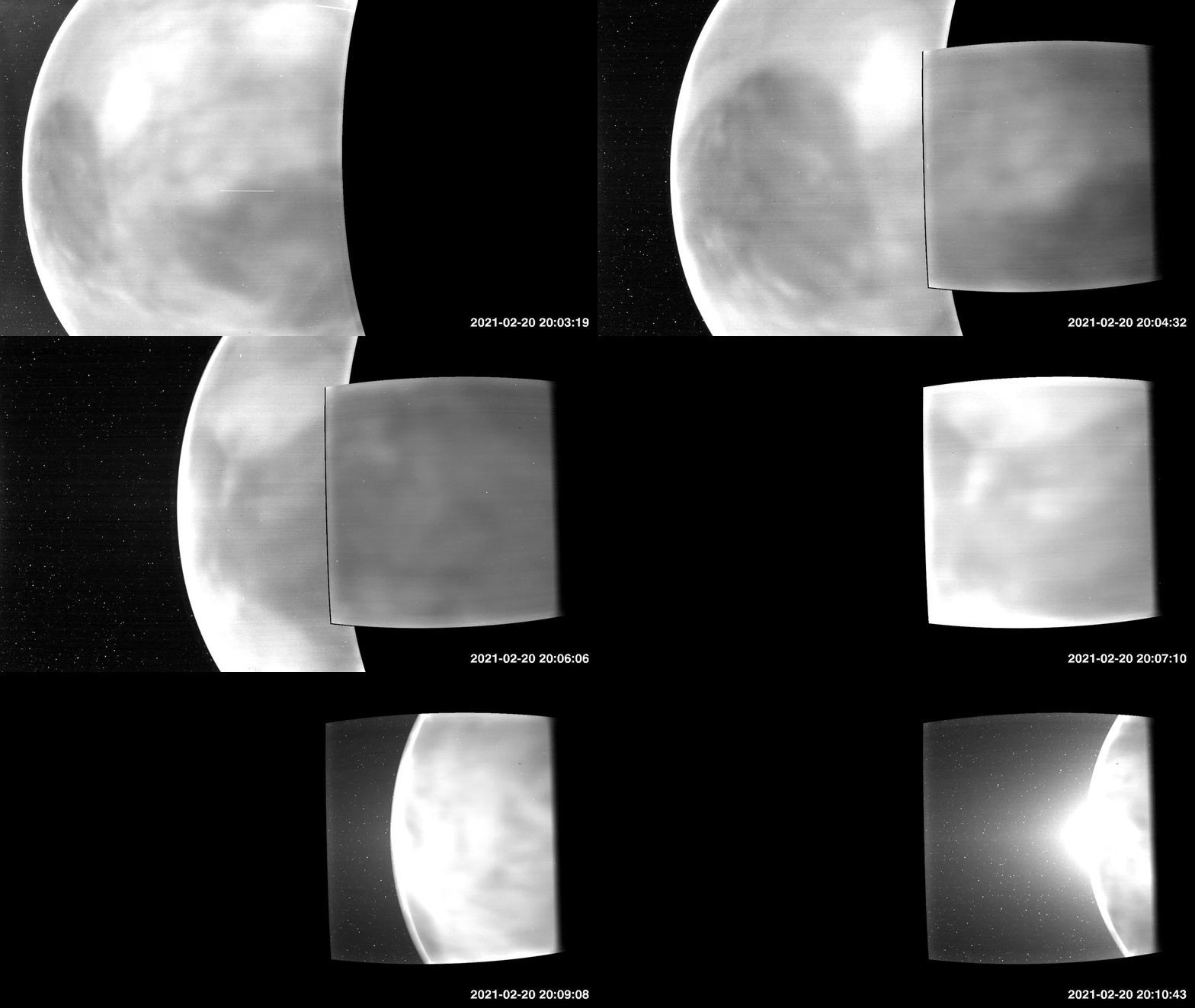
Images of the night side of Venus in visible light, by the WISPR instrument of the Parker Solar Probe, have shown in 2022 that the surface is visible through the clouds at the night side. The study of the data though points at nightglow, also observed in visible light, as the more likely candidate for the ashen light. Human eyes are less sensitive to the visible light near-infrared red glow from the surface, which also mostly obscured by the clouds, but if this light is an ashen light, then it might have been reported by people with eyesight more sensitive to the red spectrum.
References
References
- Vergano, Dan. (November 12, 2014). "'Solar Sneezes' May Trigger Auroras Around Venus".
- (2021-03-18). "Importance of airglow and auroral emissions as tracers of Venus' upper atmosphere dynamics and evolution". Bulletin of the American Astronomical Society.
- (2021-10-03). "The Venusian Oxygen Green Line — A Proton Aurora?". Bulletin of the AAS.
- University, New Mexico State. "Astronomers discover new clues to the 40-year-old mystery behind Venus's green glow".
- (1660). "Iter Exstaticum". Herbipoli : sumptibus Joh. Andr. & Wolffg. Jun. Endterorum hæredibus; Prostat Norimbergæ : apud eosdem.
- (2011). "A Study of the Life and Works of Athanasius Kircher". Brill.
- Riccioli, Giovanni Battista. (1651). "Almagestum novum astronomiam veterem novamque complectens observationibus aliorum, et propiis novisque theorematibus, problematibus, ac tabulispromotam, in tres tomos distributam quorum argumentum sequens pagina explicabit". Ex typographia Haeredis Victorii Benatii.
- Gingrich, M.. (Mar 2001). "The Paradoxical Ashen Light of Venus". Bulletin of the Eastbay Astronomical Society.
- Inglis-Arkell, Esther. (27 June 2013). "The four-hundred-year mystery of the Ashen Light of Venus". io9.
- Barentine, John C.. (2021). "Mystery of the Ashen Light of Venus: Investigating a 400-Year-Old Phenomenon". Springer International Publishing.
- Winder, Jenny. (April 27, 2012). "The Mystery of Venus' Ashen Light". [[Universe Today]].
- "Super Radot Tracking Mount".
- [http://www.smdc.army.mil/KWAJ/Hourglass/issues-archived/01Issues/hourglass7_24_01.pdf 2001 Jul 17 Reappearance of Venus from the Marshall Islands] {{Webarchive. link. (2016-10-21 , by Peter Rejcek. See page 8. Retrieved 2015-10-25.)
- [https://www.youtube.com/watch?v=r6TsRBQaMzI 2015 October 8 Reappearance of Venus from Australia], by Dunham D.W. & J.B. (2015-Oct-08).
- (9 January 2009). "Jan. 9, 1643: Astronomer Sees Ashen Light on Venus". Wired Science.
- Dolginov, Nature of the Magnetic Field in the Neighborhood of Venus, Cosmic Research, 1969
- (1960). "Some Topics in Molecular Astronomy". Journal of the Royal Astronomical Society of Canada.
- Levine, Joel S.. (June 1969). "The Ashen Light: An auroral phenomenon on Venus". Planetary and Space Science.
- Ksanfomaliti, L. V.. (20 March 1980). "Discovery of frequent lightning discharges in clouds on Venus". Nature.
- V. A. Krasnopol'skii, ''Lightning on Venus according to information obtained by the satellites Venera 9 and 10''. Kosmich. Issled. 18, 429-434 (1980).
- Russell, C. T.. (29 November 2007). "Lightning on Venus inferred from whistler-mode waves in the ionosphere". Nature.
- (29 November 2007). "Venus also zapped by lightning". [[CNN]].
- [http://adsabs.harvard.edu/abs/2017EGUGA..1911381T Hunt for optical lightning flash in Venus using LAC onboard Akatsuki spacecraft]. Takahashi, Yukihiro; Sato, Mitsuteru; Imai, Masataka. 19th EGU General Assembly, EGU2017, proceedings from the conference held 23–28 April 2017 in Vienna, Austria., p.11381.
- (2019). "Constraints on Venus Lightning From Akatsuki's First 3 Years in Orbit". Geophysical Research Letters.
- (October 1982). "The transmission to space of the light produced by lightning in the clouds of Venus". Icarus.
- (9 February 2022). "Parker Solar Probe Captures Visible Light Images of Venus' Surface".
- (9 February 2022). "Parker Solar Probe Imaging of the Night Side of Venus". Geophysical Research Letters.
- Dobbins, Thomas A.. (2022-02-22). "The Parker Solar Probe Captures Surprising Images of Venus Nightside".
- (2024-05-21). "Nightside observations by the Parker Solar Probe: implications for the reality of the Ashen Light – British Astronomical Association".
- Russell, C. T.. (1990). "The Ashen Light". Advances in Space Research.
This article was imported from Wikipedia and is available under the Creative Commons Attribution-ShareAlike 4.0 License. Content has been adapted to SurfDoc format. Original contributors can be found on the article history page.
Ask Mako anything about Ashen light — get instant answers, deeper analysis, and related topics.
Research with MakoFree with your Surf account
Create a free account to save articles, ask Mako questions, and organize your research.
Sign up freeThis content may have been generated or modified by AI. CloudSurf Software LLC is not responsible for the accuracy, completeness, or reliability of AI-generated content. Always verify important information from primary sources.
Report