From Surf Wiki (app.surf) — the open knowledge base
Aragonite
Calcium carbonate mineral
Calcium carbonate mineral
| Field | Value |
|---|---|
| name | Aragonite |
| boxbgcolor | Orange |
| image | Aragonite crystal - Los Molinillos, Ceunca, Spain - 4x3.6x3.5cm 100g.jpg |
| caption | Aragonite from Los Molinillos, Cuenca, Spain, sample width about 4 cm |
| category | Carbonate minerals |
| formula | |
| IMAsymbol | Arg (not to be confused with arginine) |
| system | Orthorhombic |
| unit cell | l a = 4.9598(5) Å, b = 7.9641(9) Å, and c = 5.7379(6) Å at 25 °C |
| color | Can come in a variety of colors, but commonly red or white |
| habit | Commonly dendritic or pseudo-hexagonal; can also be acicular, tabular, prismatic, coral-like |
| twinning | Cyclic on {110}, forms pseudohexagonal aggregates. If polysynthetic, forms fine striations parallel to [110]. |
| cleavage | Good on [110], Poor on {110}. |
| fracture | Subconchoidal |
| tenacity | Very brittle |
| mohs | 3.5–4 |
| luster | Vitreous, waxy, resinous |
| streak | White |
| diaphaneity | Transparent to opaque |
| gravity | 2.94 |
| opticalprop | Biaxial (−) |
| refractive | nω = 1.550 nε = 1.650 |
| birefringence | δ = 0.155 |
| 2V | Measured 18–19° |
| dispersion | Weak |
| extinction | Parallel |
| fluorescence | Faint white-blue to blue-violet |
| solubility | Soluble in acids, and saltwater (but takes longer) |
| impurities | Commonly strontium, zirconium, lead |
| other | Thermodynamically unstable, Morphs slowly back into calcite |
| references |
| length fast/slow =
Aragonite is a carbonate mineral and one of the three most common naturally occurring crystal forms of calcium carbonate (), the others being calcite and vaterite. It is formed by biological and physical processes, including precipitation from marine and freshwater environments.
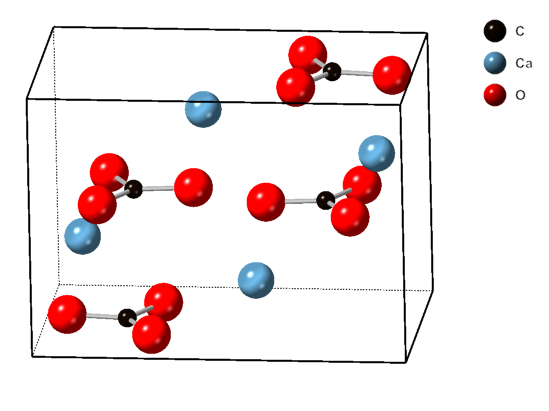
The crystal lattice of aragonite differs from that of calcite, resulting in a different crystal shape, an orthorhombic crystal system with acicular crystal. Repeated twinning results in pseudo-hexagonal forms. Aragonite may be columnar or fibrous, occasionally in branching helictitic forms called flos-ferri ("flowers of iron") from their association with the ores at the Carinthian iron mines.
Occurrence
The type location for aragonite is Molina de Aragón in the Province of Guadalajara in Castilla-La Mancha, Spain, for which it was named in 1797. Aragonite is found in this locality as cyclic twins inside gypsum and marls of the Keuper facies of the Triassic. This type of aragonite deposit is very common in Spain, and there are also some in France.
An aragonite cave, the Ochtinská Aragonite Cave, is situated in Slovakia.
In the US, aragonite in the form of stalactites and "cave flowers" (anthodite) is known from Carlsbad Caverns and other caves. For a few years in the early 1900s, aragonite was mined at Aragonite, Utah (now a ghost town).
Massive deposits of oolitic aragonite sand are found on the seabed in the Bahamas.

Aragonite is the high pressure polymorph of calcium carbonate. As such, it occurs in high pressure metamorphic rocks such as those formed at subduction zones.
Aragonite forms naturally in almost all mollusk shells, and as the calcareous endoskeleton of warm- and cold-water corals (Scleractinia). Several serpulids have aragonitic tubes. Because the mineral deposition in mollusk shells is strongly biologically controlled, some crystal forms are distinctively different from those of inorganic aragonite. In some mollusks, the entire shell is aragonite; in others, aragonite forms only discrete parts of a bimineralic shell (aragonite plus calcite).
Aragonite also forms naturally in the endocarp of Celtis occidentalis.
The skeleton of some calcareous sponges is made of aragonite.
Aragonite also forms in the ocean inorganic precipitates called marine cements (in the sediment) or as free crystals (in the water column). Inorganic precipitation of aragonite in caves can occur in the form of speleothems. Aragonite is common in serpentinites where magnesium-rich pore solutions apparently inhibit calcite growth and promote aragonite precipitation.
Aragonite is metastable at the low pressures near the Earth's surface and is thus commonly replaced by calcite in fossils. Aragonite older than the Carboniferous is essentially unknown.
Aragonite can be synthesized by adding a calcium chloride solution to a sodium carbonate solution at temperatures above 60 C or in water-ethanol mixtures at ambient temperatures.
Physical properties
Aragonite is a thermodynamically unstable phase of calcium carbonate at any pressure below about 3000 bar at any temperature. Aragonite nonetheless frequently forms in near-surface environments at ambient temperatures. The weak Van der Waals forces inside aragonite give an important contribution to both the crystallographic and elastic properties of this mineral. The difference in stability between aragonite and calcite, as measured by the Gibbs free energy of formation, is small, and effects of grain size and impurities can be important. The formation of aragonite at temperatures and pressures where calcite should be the stable polymorph may be an example of Ostwald's step rule, where a less stable phase is the first to form. The presence of magnesium ions may inhibit calcite formation in favor of aragonite. Once formed, aragonite tends to alter to calcite on scales of 107 to 108 years.
The mineral vaterite, also known as μ-CaCO3, is another phase of calcium carbonate that is metastable at ambient conditions typical of Earth's surface, and decomposes even more readily than aragonite.
Uses
In aquaria, aragonite is considered essential for the replication of reef conditions. Aragonite provides the materials necessary for much sea life and also keeps the pH of the water close to its natural level, to prevent the dissolution of biogenic calcium carbonate.Orr, J. C., et al. (2005) Anthropogenic ocean acidification over the 21st century and its impact on calcifying organisms. Nature 437: 681–686
Aragonite has been successfully tested for the removal of pollutants like zinc, cobalt and lead from contaminated wastewaters.
Gallery
Aragonite 2 Enguidanos.jpg|Aragonite crystals from Cuenca, Castile-La Mancha, Spain Aragonite - Pantoja, Toledo, Castile-La Mancha, Spain.jpg|Aragonite crystal cluster from Spain Image:BaculitesSuturesAragonite.jpg|Remnant biogenic aragonite (thin, rainbow-colored shell) on the ammonite Baculites (Pierre Shale, Late Cretaceous, South Dakota) Aragonite layers in a blue mussel shell.jpg|Scanning electron microscope image of aragonite layers in the nacre of a blue mussel (Mytilus edulis) Aragonit_-_Fluorescence.gif|Fluorescence of aragonite
References
References
- Warr, L. N.. (2021). "IMA–CNMNC approved mineral symbols". [[Mineralogical Magazine]].
- (1971). "Refinement of the Crystal Structure of the Aragonite Phase of CaCO(3)". Journal of Research of the National Bureau of Standards Section A.
- (26 October 2021). "Aragonite Properties, Occurrence » Geology Science".
- {{Mindat
- Bragg, William Lawrence. (1924-01-01). "The structure of aragonite". Proceedings of the Royal Society of London. Series A, Containing Papers of a Mathematical and Physical Character.
- (1964). "Mineralogy for amateurs.". Van Nostrand.
- (2015). "Understanding Minerals & Crystals". Struik Nature.
- Calvo, Miguel. (2012). "Minerales y Minas de España. Vol. V. Carbonatos y Nitratos". Escuela Técnica Superior de Ingenieros de Minas de Madrid. Fundación Gómez Pardo.
- (4 July 2020). "Surveying and High-Resolution Topography of the Ochtiná Aragonite Cave Based on TLS and Digital Photogrammetry". Applied Sciences.
- (1988). "Paleokarst". Springer-Verlag.
- Balaz, Christine. (2009). "An Explorer's Guide: Utah". The Countryman Press.
- (1960). "Bahamian Oölitic Sand". The Journal of Geology.
- (2000). "Introduction to mineralogy". Oxford University Press.
- (2006). "Principles of sedimentology and stratigraphy". Pearson Prentice Hall.
- (May 1996). "Control of crystal phase switching and orientation by soluble mollusc-shell proteins". Nature.
- (February 2010). "Structural distortion of biogenic aragonite in strongly textured mollusc shell layers". Nuclear Instruments and Methods in Physics Research Section B: Beam Interactions with Materials and Atoms.
- (November 2015). "A simple method to establish calcite:aragonite ratios in archaeological mollusc shells: CALCITE:ARAGONITE IN ARCHAEOLOGICAL SHELLS". Journal of Quaternary Science.
- (Spring 2001). "Ammolite: Iridescent fossilized ammonite from southern Alberta, Canada". Gems & Gemology.
- (November 2019). "Potential For [Carbon 14] Dating Of Biogenic Carbon In Hackberry (Celtis) Endocarps". Quaternary Research.
- (2002). ["Systema Porifera: A Guide to the Classification of Sponges"]({{google books). Kluwer Academic/Plenum.
- Bergquist, P.R.. (2001). "Encyclopedia of Life Sciences". John Wiley & Sons.
- (24 September 2022). "Role of oceanic abiotic carbonate precipitation in future atmospheric CO2 regulation". Scientific Reports.
- (1990). "Carbonate sedimentology". Blackwell Scientific Publications.
- (August 1980). "Aragonite from deep sea ultramafic rocks". Geochimica et Cosmochimica Acta.
- (1987). "Shell microstructures of Cambrian molluscs replicated by phosphate". Alcheringa: An Australasian Journal of Palaeontology.
- Sand, K.K., Rodriguez-Blanco, J.D., Makovicky, E., Benning, L.G. and Stipp, S. (2012) Crystallization of CaCO3 in water-ethanol mixtures: spherulitic growth, polymorph stabilization and morphology change. Crystal Growth & Design, 12, 842–853. {{doi. 10.1021/cg2012342.
- (1980). "The calcite–aragonite equilibrium: effects of Sr substitution and anion orientational disorder". American Mineralogist.
- (2022-09-01). "Structural and elastic behaviour of aragonite at high-pressure: A contribution from first-principle simulations". Computational Materials Science.
- (1964). "Calcite aragonite problem". AAPG Bulletin.
- (November 1962). "Pure aragonite synthesis". Journal of Geophysical Research.
- (1980). "Origin of sedimentary rocks". Prentice-Hall.
- (2008). "Differentiation of Calcium Carbonate Polymorphs by Surface Analysis Techniques – An XPS and TOF-SIMS study". Surf. Interface Anal..
- (November 1977). "Aragonite formation through precipitation of calcium carbonate monohydrate". Materials Research Bulletin.
- Köhler, S., Cubillas, et al. (2007) Removal of cadmium from wastewaters by aragonite shells and the influence of other divalent cations. Environmental Science and Technology, 41, 112–118. {{doi. 10.1021/es060756j
This article was imported from Wikipedia and is available under the Creative Commons Attribution-ShareAlike 4.0 License. Content has been adapted to SurfDoc format. Original contributors can be found on the article history page.
Ask Mako anything about Aragonite — get instant answers, deeper analysis, and related topics.
Research with MakoFree with your Surf account
Create a free account to save articles, ask Mako questions, and organize your research.
Sign up freeThis content may have been generated or modified by AI. CloudSurf Software LLC is not responsible for the accuracy, completeness, or reliability of AI-generated content. Always verify important information from primary sources.
Report