From Surf Wiki (app.surf) — the open knowledge base
Aqaba
City in Aqaba Governorate, Jordan
City in Aqaba Governorate, Jordan
| Field | Value |
|---|---|
| official_name | Aqaba |
| native_name | الْعَقَبَة |
| native_name_lang | ar |
| nickname | *The Bride of the Red Sea* |
| settlement_type | City |
| image_skyline | AQABA 2.png |
| imagesize | 300px |
| image_caption | Clockwise from the left top: Aqaba's skyline, Aqaba Fort and Aqaba Fields, Al-Hammamat Al-Tunisyya Street in Down Town, Resort in Aqaba, Ayla old City, Aqaba Port, Aqaba Flagpole. |
| seal_size | 200px |
| pushpin_map | Jordan |
| image_map | Map of Aqaba.png |
| mapframe | yes |
| subdivision_type | Country |
| subdivision_name | Jordan |
| subdivision_type1 | Governorate |
| subdivision_name1 | Aqaba Governorate |
| leader_title | Chief Commissioner |
| leader_title1 | Chief Commissioner; Aqaba Special Economic Zone Authority |
| established_title | Founded |
| established_date | 4000 BC |
| established_title2 | Authority |
| established_date2 | 2001 |
| area_total_km2 | 375 |
| population_as_of | 2021 |
| population_total | 95048 |
| population_urban | 148398 |
| population_density_km2 | 502 |
| timezone1 | +2 Eastern European Standard Time |
| timezone1_DST | +3 Arabia Standard Time |
| postal_code_type | Postal code |
| postal_code | 77110 |
| coordinates | |
| elevation_m | 6 |
| website | |
| area_code | +(962)3 |
| population_demonym | Aqabawi |
Aqaba ( , ; , ) is the only coastal city in Jordan and the largest and most populous city on the Gulf of Aqaba. Situated in southernmost Jordan, Aqaba is the administrative center of the Aqaba Governorate. The city had a population of 148,398 in 2015 and a land area of 144.8 sqmi. Aqaba has significant trade and tourism. The Port of Aqaba also serves other countries in the region.
Aqaba's strategic location at the northeastern tip of the Red Sea between the continents of Asia and Africa has made its port important for thousands of years. The ancient city was called Elath, known in Latin as Aela) and in Arabic as Ayla. Its strategic location and proximity to copper mines made it a regional hub for copper production and trade in the Chalcolithic period.
Aela became a bishopric under Byzantine rule and later became a Latin Catholic titular see after Islamic conquest around AD 650, when it became known as Ayla; the name Aqaba is late medieval. In the Great Arab Revolt's Battle of Aqaba Arab forces defeated the Ottoman defenders.
Aqaba's location next to Wadi Rum and Petra has made it one of the major tourist attractions in Jordan. The city is administered by the Aqaba Special Economic Zone Authority, which has turned Aqaba into a low-tax, duty-free city, attracting several mega projects like Ayla Oasis, Saraya Aqaba, Marsa Zayed and expansion of the Port of Aqaba. They are expected to turn the city into a major tourism hub in the region. However, industrial and commercial activities remain important, due to the strategic location of the city as the country's only seaport. The city sits right across the border from Eilat, likewise Israel's only port on the Red Sea. After the 1994 Israel–Jordan peace treaty, there were plans and hopes of establishing a trans-border tourism and economic area, but few of those plans have come to fruition.
Name
Elath and derivates
The ancient endonym (name given by the local population) of the city was Elath or Ailath. The name may be derived from the Semitic name of a tree in the genus Pistacia, or from the West Semitic word *'ayl 'ram' with the feminine suffix -at. A Phoenician variant of the name אֵלוֹת is mentioned once in the Hebrew Bible in , reflecting the Phoenician vowel shift. Modern Eilat (established 1947), situated about 5 km north-west of Aqaba, also takes its name from the ancient settlement. In the Hellenistic period, it was renamed Berenice ( grc), but the original name survived, and under Roman rule was re-introduced in the forms Aila, Aela or Haila, adopted in Byzantine Greek as Αἴλα grc and in Arabic as Ayla (آيلا). The crusaders called the city Elyn.
Aqaba
The present name al-ʿAqaba (العقبة) is a shortened form of ʿaqabat Aylah (عقبة آيلة, ), a name first mentioned in the 12th century by Idrisi, at a time when the settlement had been mostly reduced to a military stronghold (not positively identified by archaeologists; see here), properly referring to the pass just to the north-east of the settlement (, now traversed by the Jordanian Aqaba Highway).
History
Nearby Chalcolithic sites
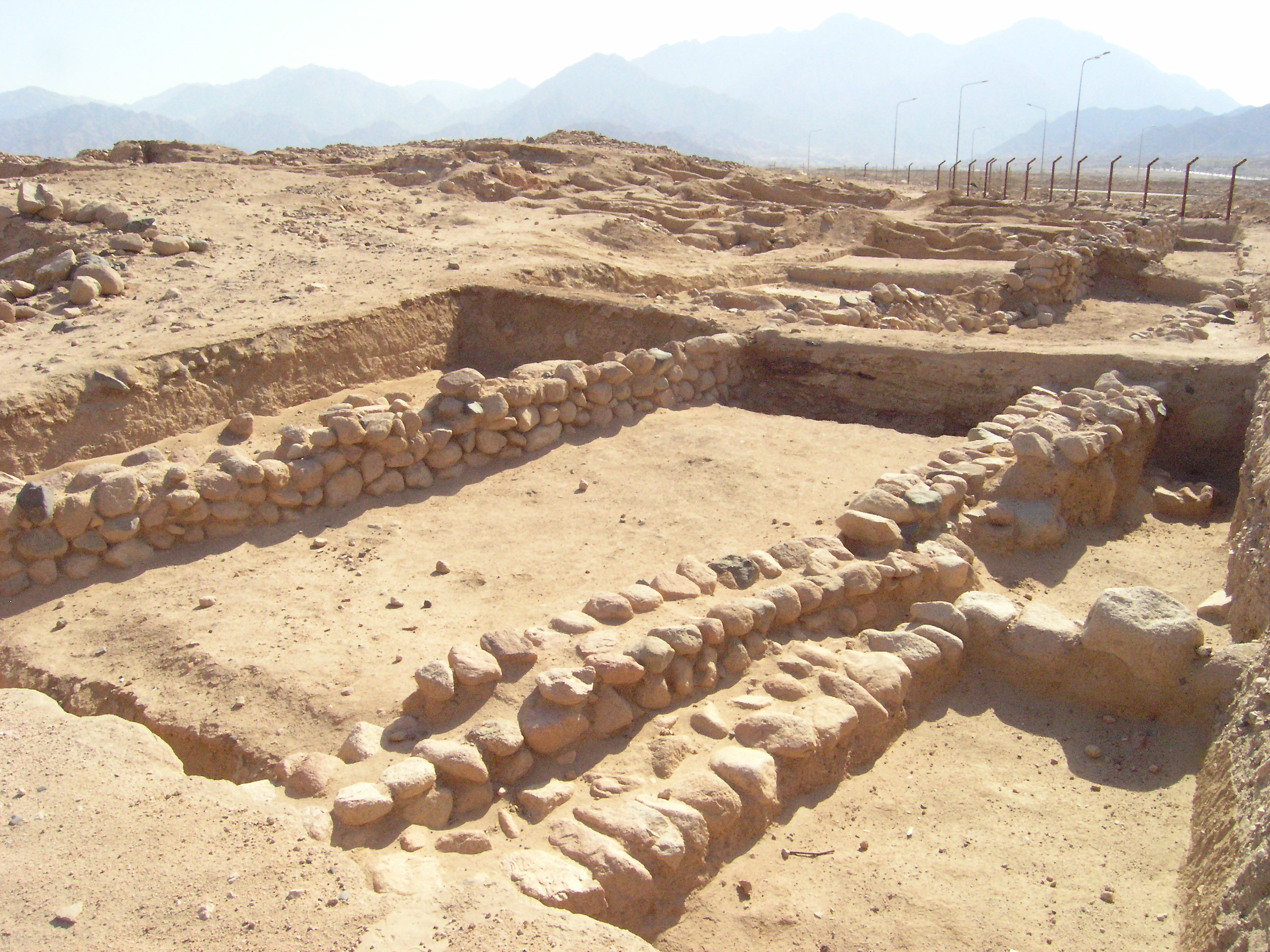
Excavations at two tells (archaeological mounds) Tall Hujayrat Al-Ghuzlan and Tall Al-Magass, both a few kilometres north of modern-day Aqaba city, revealed inhabited settlements from c. 4000 BC during the Chalcolithic period, with thriving copper production on a large scale. This period is largely unknown due to the absence of written historical sources. University of Jordan archaeologists have discovered the sites, where they found a small building whose walls were inscribed with human and animal drawings, suggesting that the building was used as a religious site. The people who inhabited the site had developed an extensive water system in irrigating their crops which were mostly made up of grapes, olives and wheat. Several different-sized clay pots were also found suggesting that copper production was a major industry in the region, the pots being used in melting the copper and reshaping it. Scientific studies performed on-site revealed that it had undergone two earthquakes, with the latter one leaving the site completely destroyed.
Early history
Elath
The Edomites, who ruled over Edom just south of the Dead Sea, are believed to have built the first port in Aqaba called Elath around 1500 BC, turning it into a major hub for the trade of copper as the Phoenicians helped them develop their maritime economy. They profited from its strategic location at the junction of trading routes between Asia and Africa.
Tell el-Kheleifeh
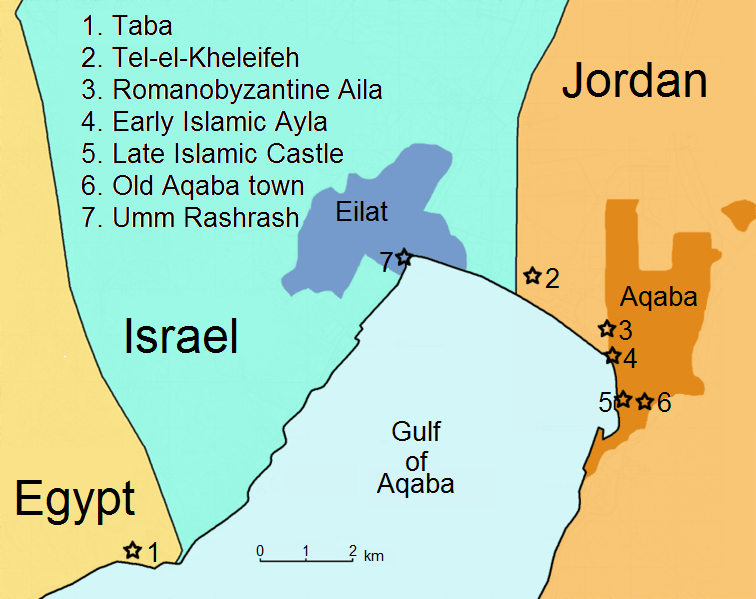
Archaeologists have investigated an Iron Age settlement at Tell el-Kheleifeh, immediately west of Aqaba, inhabited between the 8th and 4th centuries BCE.
Undefined
Around 735 BC, the city was conquered by the Assyrian empire. Because of the wars the Assyrians were fighting in the east, their trading routes were diverted to the city and the port witnessed relative prosperity. The Babylonians conquered it in 600 BC. During this time, Elath witnessed great economic growth, which is attributed to the business background of its rulers who realized how important the city's location was. The Persian Achaemenid Empire took the city in 539 BC.
Classical antiquity
Hellenistic period
The city continued to grow and prosper which made it a major trading hub by the time of the Greek rule by 300 BC, after the Wars of Alexander the Great, it was described by a Greek historian to be "one of the most important trading cities in the Arab World". The Ptolemaic Greeks called it Berenice.
The Nabatean kingdom had its capital north of the city, at Petra.
Roman period
In 64 BC, following the Roman conquest, they annexed the city and called it Aela (also Haila, Aelana, in Greek rendered Αἴλα Aila).In classical texts the Roman city is known as Aela, occasionally Haila or Aelana. Aela is the standard form of the name in Roman-era classical studies. See: [Stéphanie Benoist (editor), Rome, A City and Its Empire in Perspective (BRILL 2012 ), p. 128] Suzanne Richard, Near Eastern Archaeology: A Reader (Eisenbrauns 2003 ), p. 436
Both Petra and Aela were under strong Nabatean influence despite the Roman rule. Aela reached its peak during Roman times, the great long-distance road the Via Traiana Nova led south from Bostra through Amman, terminating in Aela, where it connected with a west road leading to the Paralia and Roman Egypt.
Around AD 106 Aela was one of the main ports for the Romans.
Late Roman and Byzantine periods
The Aqaba Church was constructed under Roman rule between 293 and 303 and is considered to be the oldest known purpose-built Christian church in the world. By the time of Eusebius, Aela became the garrison of the Legio X Fretensis, which was moved to Aela from Jerusalem.Hannah Cotton (editor), Corpus Inscriptionum Iudaeae/Palaestinae (Walter de Gruyter 2010 ), pp. 25–26 [Brian M. Fagan, Charlotte Beck (editors), The Oxford Companion to Archaeology] (Oxford University Press 1996 ), p. 617. Benjamin H. Isaac, The Near East Under Roman Rule: Selected Papers (BRILL 1998 ), p. 336

One of the oldest known texts written in the Arabic alphabet is a late 4th-century inscription found in Jabal Ram 50 km east of Aqaba.
The city became a Christian bishopric at an early stage. Its bishop Peter was present at the First Council of Nicaea, the first ecumenical council, in 325. Beryllus was at the Council of Chalcedon in 451, and Paul at the synod called by Patriarch Peter of Jerusalem in 536 against Patriarch Anthimus I of Alexandria, a council attended by bishops of the Late Roman provinces of Palaestina Prima, Palaestina Secunda and Palaestina Tertia, to the last-named of which Aela belonged.
A citadel was also built in the area that became the focal point of the Roman southern defense system.
In the 6th century, Procopius of Caesarea mentioned a Jewish population in Eilat and its surroundings which enjoyed autonomy until the time of Justinian I ().
According to Ibn Ishaq, Muhammad himself reached Aila during the expedition of Tabuk of 630, and extracted tribute from the city.
During the Late Byzantine or even Early Muslim period, Aila was the origin of what came to be known as the Ayla-Axum amphoras.
Early Muslim Ayla
Aila fell to the Islamic armies by 629, and the ancient settlement was left to decay, while a new Arab city was established outside its walls under Uthman ibn Affan, known as Ayla ().
The Early Muslim city was excavated in 1986 by a team from the University of Chicago. Artefacts are now on exhibit at Aqaba Archaeological Museum and Jordan Archaeological Museum in Amman. The fortified city was inscribed in a rectangle of 170 x 145 m, with walls 2.6 m thick and 4.5 m high, surrounding a fortified structure, occupying an area of 35 x 55 m. 24 towers defended the city. The city had four gates on all four sides, defining two main lines intersecting at the centre. The intersection of these two thoroughfares was indicated by a tetrapylon (a four-way arch), which was later transformed into a luxury residential building decorated with frescoes dated to the tenth century. This type of urban structure, known as a misr (pl. amsar), is typical of early Islamic fortified settlements.
File:Ayla02.jpg|Early Muslim Ayla File:Ayla01.jpg|Early Muslim Ayla
The city prospered from 661 to 750 under the Umayyads and beyond under the Abbasids (750–970) and the Fatimids (970–1116). Ayla took advantage of its key position as an important step on the road to India and Arab spices (frankincense, myrrh), between the Mediterranean Sea and the Arabian Peninsula. The city is also mentioned in several stories of the Arabian Nights.
The geographer Shams Eddin Muqaddasi describes Ayla as nearby the ruined ancient city.
The city was mentioned in Medieval Arabic sources as having a mixed population of Jews and Christians. It subsequently became an important station for pilgrim caravans on the way to Mecca.
The city was "completely destroyed" by the 1068 Near East earthquake.
Crusader/Ayyubid and Mamluk periods

Baldwin I of Jerusalem took over the city in 1115 without encountering much resistance. The centre of the city then moved to 500 meters along the coast to the south, and the crusader fortress of Elyn was built, which allowed the Kingdom of Jerusalem to dominate all roads between Damascus, Egypt, and Arabia, protecting the Crusader states from the east and allowing for profitable raids on trade caravans passing through the area. In order to secure this strategic position, Baldwin also built and garrisoned a fortress on Pharaoh's Island (called Île de Graye by the Franks), the modern Jazīrat Fir'aun in Egyptian territorial waters about 7 km west of Aqaba.
The garrison of Elyn (now serving primarily as a military outpost) was further strengthened in 1142 by Pagan the Butler, Lord of Oultrejourdain, who pursued an ambitious program of castle building throughout his domain. However, there was no large-scale settlement of Europeans in the area, and the region between the Dead Sea and the Gulf of Aqaba remained mainly inhabited by Bedouins, who were obliged to pay tribute to the Lordship of Oultrejourdain. Despite all efforts to fortify the region, the city was captured in 1170 by a squadron sent by Saladin as he was besieging Gaza; while it was successfully raided by Raynald of Châtillon in 1182, it was never retaken by the Crusaders.
The old fort was rebuilt, as Aqaba Fortress, by Mamluk sultan Al-Ashraf Qansuh Al-Ghuri in the early 16th century. For the next four centuries, the site was a simple fishing village of little importance.
Modern history
During World War I, the Ottoman forces were forced to withdraw from Aqaba in 1917 after the Battle of Aqaba, led by T. E. Lawrence and the Arab forces of Auda Abu Tayi and Sherif Nasir. The capture of Aqaba allowed the British to supply the Arab forces. In 1918, the regions of Aqaba and Ma'an were officially incorporated into the Kingdom of the Hejaz. In 1925, Ibn Saud the ruler of Nejd with the help of his Wahhabi Ikhwan troops successfully annexed the Hejaz, but gave up the Ma'an and Aqaba to the British protectorate of Transjordan.
File:Lcamel.jpg|Lawrence of Arabia on a camel in Aqaba in 1917 File:Air films (1937). Akkaba. Closer view LOC matpc.17054.jpg|Aqaba in 1937 File:1822 Rüppell map of the Gulf of Aqaba with modern borders.jpg|1822 area map by Eduard Rüppell, modern borders overlaid. His "Ruines d'Elana" is the site of Tell el-Kheleifeh. The Jordanian census of 1961 found 8,908 inhabitants in 'Aqaba.
In 1965, King Hussein, through an exchange deal with Saudi Arabia, gave 6000 km2 of desert land in Jordanian territories in exchange for other territories, including 12 km of an extension of prime coastline south of Aqaba, which included the Yamanieh coral reef. Aqaba was a major site for imports of Iraqi goods in the 1980s until the Persian Gulf War.
In 1997, the Aqaba Marine Reserve was established within the southern boundaries of the Gulf of Aqaba.
On 27 June 2022, a port in Aqaba became the scene of a toxic gas leak when a chemical storage container carrying 25 tons of chlorine fell from cane onto a ship and ruptured. The leak resulted in the deaths of 13 people.
Geography
The city lies at Jordan's southernmost point, on the Gulf of Aqaba lying at the tip of the Red Sea. Its strategic location is shown in the fact that it is located at the crossroads of the continents of Asia and Africa, while bordering Israel, Egypt and Saudi Arabia.
Climate
Aqaba has a hot desert climate (Köppen climate classification BWh) with mild, sometimes warm winters and very hot dry summers. Subzero temperatures can be observed every few years. The record high temperature of 49.6 C was registered on 14 August 2025 . The record low temperature of -3.9 C was on January 16, 2008, as in Eilat.
|access-date=21 December 2024 |archive-url=https://web.archive.org/web/20240221154009/http://jometeo.gov.jo/معلومات-مناخية-وزراعية/المعدلات-العامة |archive-date=21 February 2024 |url-status=live}}
Local government
In August 2000, the Aqaba Special Economic Zone Authority (ASEZA) was established which acted as the statutory institution empowered with administrative, fiscal, regulatory and economic responsibilities.
Administrative divisions
Jordan is divided into 12 administrative divisions, each called a Governorate. Aqaba Governorate divides into 3 Districts, some of which are divided into Subdistricts and further divided into villages.
Economy
With status as Jordan's special economic zone, Aqaba's economy is based on the tourism and port industry sectors. Aqaba's location next to Wadi Rum and Petra has strengthened the city's location on the world map and made it one of the major tourist attractions in Jordan. The city is administered by the Aqaba Special Economic Zone Authority, which has turned Aqaba into a low-tax, duty-free city, attracting several mega projects like Ayla Oasis, Saraya Aqaba, Marsa Zayed and expansion of the Port of Aqaba. They are expected to turn the city into a major tourism hub in the region. Industrial and commercial activities remain important, due to the strategic location of the city as the country's only seaport.
Aqaba is the only seaport of Jordan so virtually all of Jordan's exports depart from here. Heavy machinery industry is also flourishing in the city with regional assembly plants being located in Aqaba such as the Land Rover Aqaba Assembly Plant. By 2008 the ASEZ had attracted $18bn in committed investments, beating its $6bn target by 2020 by a third and more in less than a decade. The goal was adjusted to bring in another $12bn by 2020, but in 2009 alone, deals worth $14bn were inked. Some projects currently under construction are:
- Marsa Zayed a $10 billion is the largest mega mixed-use development project ever envisioned in both Jordan and the region. Marsa Zayed will host facilities including residential neighborhoods, commercial outlets and amenities, entertainment venues, financial and business facilities, and a number of hotels. Additionally, the property will feature marinas and a cruise ship terminal. Marsa Zayed will encompass 6.4 million square meters of built-up property.
- Saraya Aqaba, a $1.5 billion resort with a man made lagoon, luxury hotels, villas, and townhouses that will be completed by 2017.
- Ayla Oasis, a $1.5 billion resort around a man made lagoon with hotels, villas, an 18-hole golf course designed by Greg Norman. It also has an Arabian Venice theme with apartment buildings built along canals only accessible by walkway or boat. This project will be completed by 2017.
- Tala Bay, Tala Bay was developed in a distinctive architectural style that blends Jordanian and regional architecture with total cost of US$680 million. Another distinguishing feature of this single community resort is its two-kilometer private sandy beach on the Red Sea.
- The Red Sea Astrarium (TRSA), the world's only Star Trek themed park, worth $1.5 billion would have been completed by 2014 but cancelled in 2015.
- Port relocation. Aqaba's current port will be relocated to the southernmost part of the province near the Saudi border. Its capacity will surpass that of the current port. The project costs $5 billion, and it will be completed by 2013.
- Aqaba will be connected by the national rail system which will be completed by 2013. The rail project will connect Aqaba with all Jordan's main cities and economic centers and several countries like Saudi Arabia, Iraq, and Syria.
- The Aqaba Container Terminal (ACT) handled a record 587,530 twenty-foot equivalent units (TEUs) in 2008, an increase of 41.6% on the previous year. To accommodate the rise in trade on the back of the increasing popularity of container shipping and the stabilising political situation in Iraq, the Aqaba Development Corporation (ADC) has announced plans for a new port. The port relocation 20 km to the south will cost an estimated $600m and will improve infrastructure, while freeing up space for development in the city. Plans for upgrading the King Hussein International Airport (KHIA) and the development of a logistics centre will also help position Aqaba as a regional hub for trade and transport.
Tourism

Aqaba has a number of luxury hotels, including in the Tala Bay resort 20 km further to the south, which service those who come for fun on the beaches as well as Scuba diving. Aqaba offers more than thirty primary diving locations, with the majority of them accommodating divers of all skill levels. These diving sites comprise fringing reefs that extend for over 25 km, reaching all the way to the border with Saudi Arabia.
It also offers activities which take advantage of its desert location. Its many coffee shops offer mansaf and knafeh, and baqlawa desserts. Another very popular venue is the Turkish Bath (Hamam) built in 306 AD, in which locals and visitors alike come to relax after a hot day.

In 2006, the Tourism Division of the Aqaba Special Economic Zone Authority (ASEZA) reported that the number of tourists visiting the Zone in 2006 rose to about 432,000, an increase of 5% over previous year. Approximately 65%, or 293,000 were Jordanians. Of foreign tourists, Europeans visited the Zone in the largest numbers, with about 98,000 visiting during the year. The division has financed tourism advertising and media campaigns with the assistance of the European Union.
Aqaba has been chosen for the site of a new waterfront building project that would rebuild Aqaba with new man-made water structures, new high-rise residential and office buildings, and more tourist services to place Aqaba on the investment map and challenge other centers of waterfront development throughout the region.
Aqaba was chosen as the Arab Tourism City of 2011.
During the 5-day holiday at both the end of Ramadan and Eid Al-Adha, Jordanian and western expats flock into the city with numbers reaching up to 50,000 visitors. During this time the occupancy rate of most hotels there reaches as high as 90%, and are often fully booked.
The several development projects (i.e. Ayla, Saraya etc.) now taking place in Aqaba provide "opportunities of empowerment" for local populations that want to expand their agency within the city. According to Fulbright scholar Kimberly Cavanagh development projects will help exhibit the ways global- local partnerships and the resultant cultural exchanges, can result in mutually beneficial outcomes.
Demographics
The city of Aqaba has one of the highest population growth rates in Jordan in 2011, and only 44% of the buildings in the city had been built before 1990. A special census for Aqaba city was carried by the Jordanian department of statistics in 2007, the total population of Aqaba by the census of 2007 was 98,400. The 2011 population estimate is 136,200. The results of the census compared to the national level are indicated as follows:
| Demographic data of the city of Aqaba (2007) compared to Kingdom of Jordan nationwide | Aqaba City (2007) | Jordan (2004 census) |
|---|---|---|
| 1 | Total population | 98,400 |
| 2 | Growth rate | 4.3% |
| 3 | Male to Female ratio | 56.1 to 43.9 |
| 4 | Ratio of Jordanians to Foreign Nationals | 82.1 to 17.9 |
| 5 | Number of households | 18,425 |
| 6 | Persons per household | 4.9 |
| 7 | Percent of population below 15 years of age | 35.6% |
| 8 | Percent of population over 65 years of age | 1.7% |
Religion

ِIslam represents the majority of the population of Aqaba, but Christianity still exists today. Approximately 5,000 Christian families live in the city. There are several churches in the city and multiple Christian schools including Rosary Sisters School Aqaba.
Cityscape
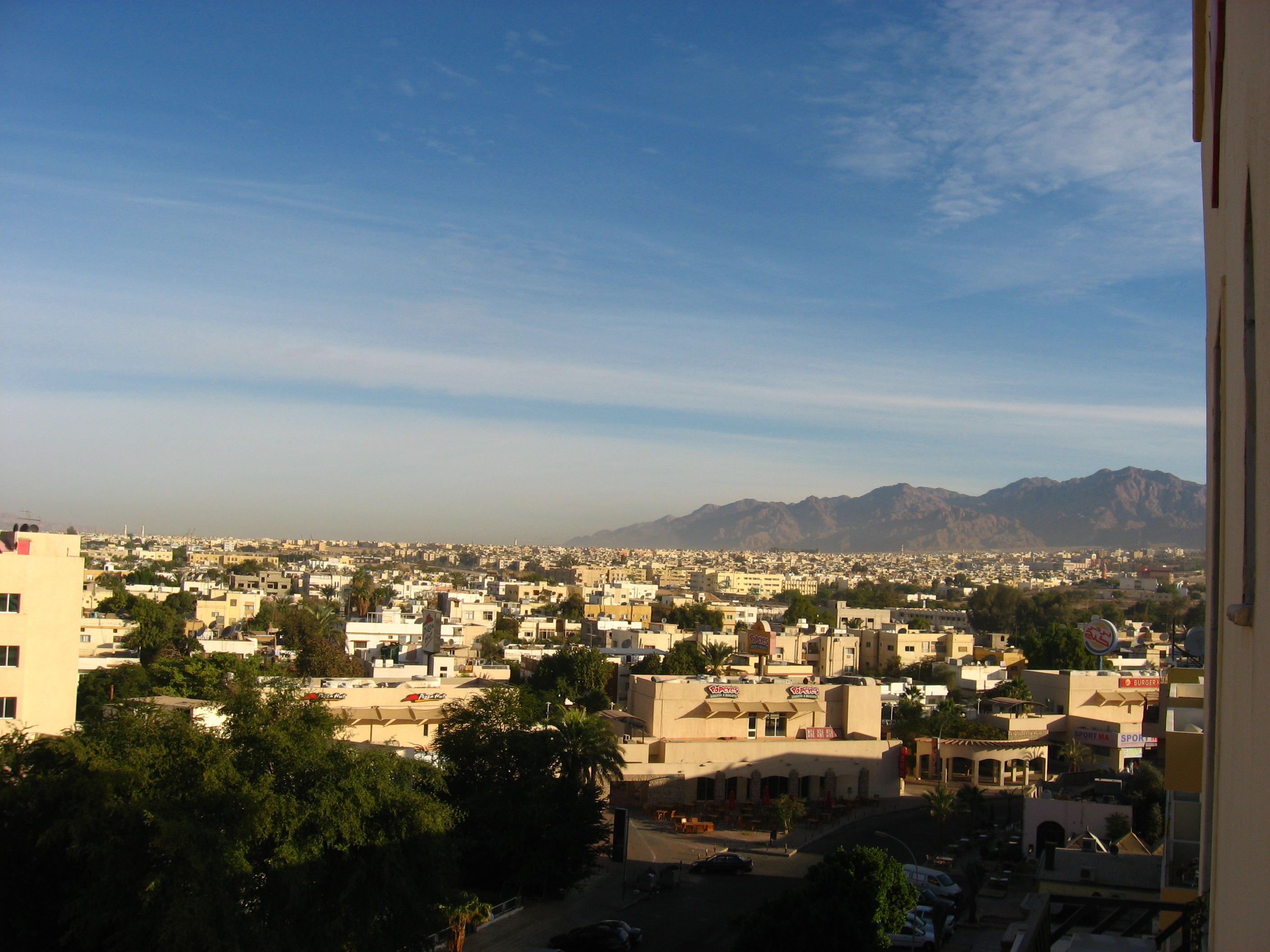
Residential buildings in Aqaba are made up of 4 stories, of which are covered with sandstone or limestone. The city has no high-rises; however, Marsa Zayed project is planned to dramatically change that reality through the construction of several high-rise towers that host hotels, residential units, offices and clinics.
Culture
Museums
The largest museum in Aqaba is the Aqaba Archaeological Museum.
Lifestyle
Aqaba has recently experienced a great growth in its nightlife, especially during the dramatic increase of tourist number in the 2000s.
Transport
Rail
The Aqaba railway which transported phosphate to the old port ceased operations in 2018. A successor line to transport phosphate from Al Shidiya and Ghor es-Safi to the new terminal in Port of Aqaba is planned through an agreement between Jordan's Ministry for Transport and Etihad Rail.
There has been propositions to connect Eilat to Aqaba by rail.
Airports
King Hussein International Airport is the only civilian airport outside of Amman in the country, located to the north of Aqaba. It is a 20-minutes drive away from the city center. Regular flights are scheduled from Amman to Aqaba with an average flying time of 45 minutes which is serviced by Royal Jordanian Airlines and Jordan Aviation Airlines. Several international airlines connect the city to Istanbul, Dubai, Alexandria, Sharm el-Sheikh, and other destinations in Asia and Europe. Since the 1994 Peace Treaty between Israel and Jordan, there were plans to jointly develop airport infrastructure in the region. However, when Israel built Ramon Airport only 10 km distant from King Hussein International Airport, this happened without consulting the Jordanian side, which caused a slight deterioration of bilateral relations between the two countries and concerns over the safety of having two airports so close together.
Roads

Aqaba is connected by an 8000 km modern highway system to surrounding countries. The city is connected to the rest of Jordan by the Desert Highway and the King's Highway that provides access to the resorts and settlements on the Dead Sea. Aqaba is connected to Eilat in Israel by taxi and bus services passing through the Wadi Araba crossing. And to Haql in Saudi Arabia by the Durra Border Crossing. There are many bus services between Aqaba and Amman and the other major cities in Jordan, JETT and Trust International are the most common lines. These tourist buses are spacious and installed with air conditioning and bathrooms.
Port
The Port of Aqaba is the only port in Jordan. Regular ferry routes to Taba are available on a daily basis and are operated by several companies such as Sindbad for Marine Transportation and Arab Bridge Maritime. The routes serve mainly the Egyptian coastal cities on the gulf like Taba and Sharm Al Sheikh. In 2006, the port was ranked as being the "Best Container Terminal" in the Middle East by Lloyd's List. The port was chosen for its recent improvements and its ability to handle local traffic as well as international traffic to four neighboring countries.
Wildlife
The Gulf of Aqaba is rich with marine life. The gulf is home to approximately 500 fish species, with many being permanent residents, like lion fish and octopus, while others are migratory, typically appearing during the summer, such as sailfish, considered the fastest fish in the ocean, as well as the world's largest fish, the whale shark. Marine mammals and reptiles also inhabit the gulf during summer, hawksbill sea turtles, and bottle nosed dolphins call Aqaba's gulf home as well. A large number of predatory shark species used to inhabit Aqaba's gulf but, due to overfishing and pollution, this population is in decline. While mostly deep water sharks such as the tiger sharks and thresher sharks are present, there are also a small number of reef sharks as well. The world's fastest shark, the short-fin mako shark is the most commonly caught species by fishermen in Aqaba. Whale sharks, locally known as Battan, are the most commonly sighted. Conservationists are working hard to protect Aqaba's shark population.
The gulf of Aqaba hosts more than 390 bird species including migratory birds such as the greater flamingo, great white pelican and the pink-backed pelican.
Education
There is a University of Jordan Aqaba Branch.
Twin towns – sister cities
Aqaba is twinned with:
- ITA Alcamo, Italy
- IRQ Basra, Iraq
- TUN Hammamet, Tunisia
- RUS Saint Petersburg, Russia
- EGY Sharm El Sheikh, Egypt
- CHN Ürümqi, China
Gallery
File:Aqaba3.jpg|View of Aqaba File:Aqaba - 8357894053.jpg File:Ayla02.JPG|The Eastern Gate of the ruins of Ayla File:Sunset in Aqaba.jpg|Sunset File:AqabaVueDeLaMer.JPG|View of the city File:Aqaba_Fort_-_Facade.jpg|Aqaba fort File:Z Aqaba Beatch JO.jpg|View of Aqaba File:Movenpick Tala Bay - Aqaba.png|One of the resorts in the city File:Aqaba Garden.jpg|Shatt Al-Ghandour gardens File:Red Sea Summit in Aqaba.jpg|The Red Sea Summit in Aqaba in 2003
References
Bibliography
References
- "The General Census – 2015". Department of Population Statistics.
- Jones, Daniel. (2003). "English Pronouncing Dictionary". Cambridge University Press.
- {{Cite American Heritage Dictionary. Aqaba
- (1 April 2016). "العقبة.. مدينة الشمس والبـــحر والسلام". Ad Dustour.
- (2013). "Fact Sheet". Aqaba Special Economic Zone Authority..
- Ghazal, Mohammad. (22 January 2016). "Population stands at around 10.24 million, including 2.9 million guests". The Jordan News.
- (27 February 2015). "Port expansion strengthens Jordanian city of Aqaba's position as modern shipping hub". Worldfolio Ltd.
- Florian Klimscha. (2011). "Long-range Contacts in the Late Chalcolithic of the Southern Levant. Excavations at Tall Hujayrat al-Ghuzlan and Tall al-Magass near Aqaba, Jordan".
- (21 June 2013). "العقبة.. ثغر الاردن الباسم". Ad-Dustor Newspaper.
- "The Taking of Akaba – 1917 – T.E. Lawrence, Auda abu Tayi, Prince Feisal, Port of Aqaba".
- (26 March 2015). "Jordan tapping popularity of UEFA Champions League to promote tourism". The Jordan News.
- (7 June 2012). "King checks on Aqaba Mega-Projects". [[The Jordan Times]].
- (29 April 2013). "Aqaba has caught mega-project fever from its Gulf neighbours". Your Middle East.
- (2003). "Knowledge Economies in the Middle East and North Africa: Toward New Development Strategies". World Bank Publications.
- "Cross border interactions across a formerly hostile border: The case of Eilat, Israel and Aqaba, Jordan".
- Gradus, Yehuda. (1 May 2001). "Is Eilat-Aqaba a bi-national city? Can economic opportunities overcome the barriers of politics and psychology?". GeoJournal.
- "Working Paper 15 : Municipal Cooperation across Securitized Borders in the PostConflict Environment: The Gulf of Aqaba".
- Grinzweig, Michael. (1993). "From the Items of the Name Eilat". Ariel Publishing.
- Rendsburg, Gary A.. (2014). "What We Can Learn about Other Northwest Semitic Dialects from Reading the Bible". Discourse, Dialogue, and Debate in the Bible.
- Tsafrir, Yoram. (1986). "The Transfer of the Negev, Sinai and Southern Transjordan from 'Arabia' to 'Palaestina.'". Israel Exploration Society.
- (2000). "The Umayyads: The Rise of Islamic Art". AIRP.
- Runciman, Steven. (1952). "A History of the Crusades: The Kingdom of Jerusalem and the Frankish East 1100-1187". Cambridge University Press.
- Sharon, Moshe. (1997). "Corpus Inscriptionum Arabicarum Palaestinae".
- Elitsur, Yoel. (2004). "Ancient place names in the Holy Land: Preservation and history". Magnes Press, Hebrew University of Jerusalem.
- (1994). "International Dictionary of Historic Places: Middle East and Africa, المجلد 4". Taylor & Francis.
- (18 February 2008). "اكتشافات أثرية في موقع حجيرة الغزلان بوادي اليتيم في جنوب الأردن". Alghad.
- "Aqaba".
- "The Beach of History (3700 BC to date)". AQABA.
- {{harvnb. Mayhew. 2006
- "First purpose-built church". Guinness World Records.
- (1997). "Treks and Climbs in Wadi Rum, Jordan". Cicerone Press Limited.
- Irfan Shahid, Byzantium and the Arabs in the Fourth Century (Dumbarton Oaks, 1984) page 345.
- Siméon Vailhé, v. ''Aela'', in [http://gallica.bnf.fr/ark:/12148/bpt6k6562709t/f344.image ''Dictionnaire d'Histoire et de Géographie ecclésiastiques''] {{Webarchive. link. (3 May 2015 , vol. I, Paris 1909, coll. 647–648)
- Siméon Vailhé, [http://www.persee.fr/web/revues/home/prescript/article/rebyz_1146-9447_1900_num_3_6_3298 ''Notes de géographie ecclésiastique''] {{Webarchive. link. (6 October 2014 , in ''Échos d'Orient'', tome 3, nº 6 (1900), pp. 337–338)
- link. (26 July 2020 .)
- M. Raith – R. Hoffbauer – H. Euler – P. Yule – K. Damgaard, ''The view from Ẓafār – an archaeometric study of the ʿAqaba late Roman period pottery complex and distribution in the 1st millennium CE'', Zeitschrift für Orient-Archäologie 6, 2013f, 320–50
- "The Oriental Institute of the University of Chicago – Aqaba Project". The Oriental Institute of the University of Chicago.
- (10 July 2009). "حفريات أثرية.. العقبة منطقة اقتصادية منذ 6 آلاف سنة". Al-Rai Newspaper.
- (27 February 1997). "A History of Palestine, 634-1099". Cambridge University Press.
- (2000). "Seismic behaviour of the Dead Sea fault along the Araba valley, Jordan". [[Wiley-Blackwell]].
- Steven Runciman. (1952). "A History of the Crusades: The Kingdom of Jerusalem and the Frankish East 1100-1187". Cambridge University Press.
- Steven Runciman. (1952). "A History of the Crusades: The Kingdom of Jerusalem and the Frankish East 1100-1187". Cambridge University Press.
- Steven Runciman. (1952). "A History of the Crusades: The Kingdom of Jerusalem and the Frankish East 1100-1187". Cambridge University Press.
- "Jordan - History - the Making of Transjordan".
- Government of Jordan, Department of Statistics, 1964, pp. [http://users.cecs.anu.edu.au/~bdm/yabber/census/JordanCensusPages/JordanCensus1961-p06.pdf 6][http://users.cecs.anu.edu.au/~bdm/yabber/census/JordanCensusPages/JordanCensus1961-p13.pdf 13]
- "Aqaba". kinghussein.gov.jo.
- Eliyahu Kanovsky. (1992). "The Economic Consequences of the Persian Gulf War: Accelerating Opec's Demise". Washington Institute for Near East Policy.
- "Location". aqaba.jo.
- . (13 August 2025). ["40340: Aqaba Airport (Jordan)"](https://ogimet.com/cgi-bin/gsynres?ind=40340&ano=2025&mes=8&day=14&hora=2&min=0&ndays=30). *OGIMET*.
- "Aseza". Aqabazone.com.
- link. (29 August 2009)
- "Final Ann Rep Eng".
- "King visits Aqaba Special Economic Zone Authority | ASEZA". Aqabazone.com.
- (20 June 1995). "Arkia to operate flights to Aqaba – Israel Travel, Ynetnews". Ynetnews.com.
- (10 February 2010). "ATO: Jordan turned Aqaba into a distinguished city". Zawya.
- (29 September 2015). "Over 50,000 vacationers visited Aqaba during Eid Al Adha".
- Cavanagh, Kimberly. (2020-05-15). "Exploring the tourism development landscape in Aqaba".
- "DoS Jordan Aqaba Census".
- (19 April 2012). "أبناء الطائفة المسيحية في العقبة يطالبون بمقعد نيابي". Al-Ghad Newspaper.
- (20 August 2010). "Construction of a Church and Multi-Purpose Hall in Aqaba". lpj.org.
- "Raising awareness on solar energy among school students in El Aqaba governorate". NATIONAL ENERGY RESEARCH CENTER.
- (6 September 2024). "Etihad Rail leads new railway construction in Jordan".
- (11 December 2016). "The Red-Med Railway: New Opportunities for China, Israel, and the Middle East".
- Medzini, Ronen. (27 July 2010). "Netanyahu, Abdullah discuss rail cooperation". Ynetnews.
- "Getting to Aqaba". aqaba.jo.
- "Israel, Jordan plan joint Aqaba airport". [[The Jerusalem Post]].
- "Israel's New Airport Is Angering Jordan, a Rare Friend in the Region". Haaretz.
- (22 June 2016). "Airport planned for Israel-Jordan border clouds neighborly ties".
- {{harvnb. Mayhew. 2006
- (31 October 2006). "Top 10 Middle East Ports". ArabianSupplyChain.com.
- "Archived copy".
- "Marine Life | Aqaba".
- "Aqaba Bird Observatory - Aqaba".
- (2013-11-26). "Siglato gemellaggio tra Alcamo e il Governatore di Aqaba nel Regno della Giordania". Alqama H.
- "Coopération Internationale". Gouvernorat de Nabeul.
- "Международные и межрегиональные связи". Federal city of Saint Petersburg.
- (2015-12-16). "اتفاقية توأمة بين شرم الشيخ والعقبة". Al Ghad.
- (2020-04-15). "Aqaba's twin city Urumchi donates medical equipment for COVID-19 response". Aqaba Development Corporation.
This article was imported from Wikipedia and is available under the Creative Commons Attribution-ShareAlike 4.0 License. Content has been adapted to SurfDoc format. Original contributors can be found on the article history page.
Ask Mako anything about Aqaba — get instant answers, deeper analysis, and related topics.
Research with MakoFree with your Surf account
Create a free account to save articles, ask Mako questions, and organize your research.
Sign up freeThis content may have been generated or modified by AI. CloudSurf Software LLC is not responsible for the accuracy, completeness, or reliability of AI-generated content. Always verify important information from primary sources.
Report