From Surf Wiki (app.surf) — the open knowledge base
April 2014 lunar eclipse
Total lunar eclipse
Total lunar eclipse
| Field | Value |
|---|---|
| type | total |
| image | Lunar eclipse April 15 2014 California Alfredo Garcia Jr1.jpg |
| caption | Totality as viewed from Lomita, California, 7:44 UTC |
| date | April 15, 2014 |
| gamma | −0.3017 |
| magnitude | 1.2918 |
| saros_ser | 122 |
| saros_no | 56 of 75 |
| totality | 77 minutes, 48 seconds |
| partiality | 214 minutes, 43 seconds |
| penumbral | 343 minutes, 53 seconds |
| p1 | 4:53:40 |
| u1 | 5:58:19 |
| u2 | 7:06:46 |
| greatest | 7:45:39 |
| u3 | 8:24:34 |
| u4 | 9:33:02 |
| p4 | 10:37:33 |
| previous | October 2013 |
| next | October 2014 |
A total lunar eclipse occurred at the Moon’s ascending node of orbit on Tuesday, April 15, 2014, with an umbral magnitude of 1.2918. A lunar eclipse occurs when the Moon moves into the Earth's shadow, causing the Moon to be darkened. A total lunar eclipse occurs when the Moon's near side entirely passes into the Earth's umbral shadow. Unlike a solar eclipse, which can only be viewed from a relatively small area of the world, a lunar eclipse may be viewed from anywhere on the night side of Earth. A total lunar eclipse can last up to nearly two hours, while a total solar eclipse lasts only a few minutes at any given place, because the Moon's shadow is smaller. The Moon's apparent diameter was near the average diameter because it occurred 6.9 days after apogee (on April 8, 2014, at 10:50 UTC) and 7.6 days before perigee (on April 22, 2014, at 20:20 UTC).
This lunar eclipse is the first of a tetrad, with four total lunar eclipses in series, the others being on October 8, 2014; April 4, 2015; and September 28, 2015.
Background
Main article: Lunar eclipse
A lunar eclipse occurs when the Moon passes within Earth's umbra (shadow). As the eclipse begins, the Earth's shadow first darkens the Moon slightly. Then, the shadow begins to "cover" part of the Moon, turning it a dark red-brown color (typically - the color can vary based on atmospheric conditions). The Moon appears to be reddish because of Rayleigh scattering (the same effect that causes sunsets to appear reddish) and the refraction of that light by the Earth's atmosphere into its umbra.
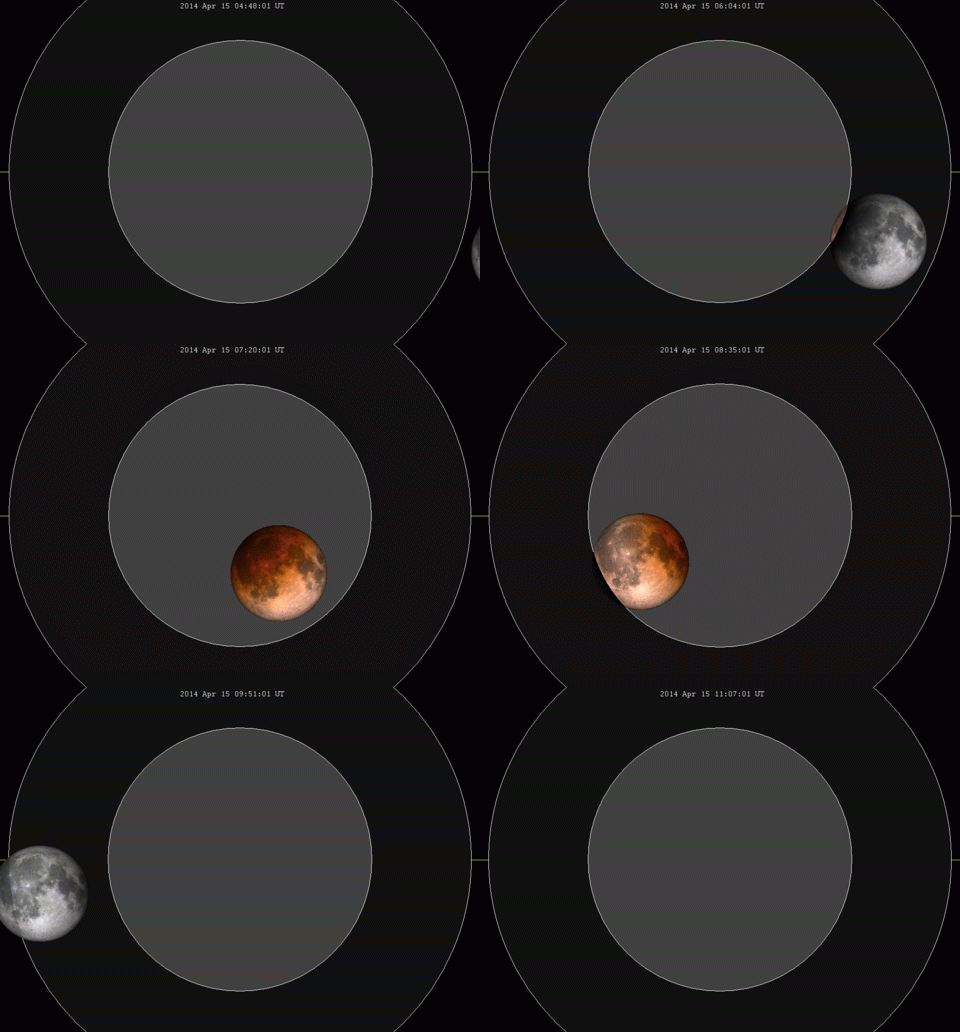
The following simulation shows the approximate appearance of the Moon passing through the Earth's shadow. The Moon's brightness is exaggerated within the umbral shadow. The northern portion of the Moon was closest to the center of the shadow, making it darkest, and most red in appearance.
Description

On April 15, 2014, the Moon passed through the southern part of the Earth's umbral shadow. In the western Pacific, the first half of the eclipse occurred before moonrise. In Europe and Africa, the eclipse began just before moonset. Spica was 2° to the west, while Arcturus was 32° north. Saturn was 26° east and Antares 44° southeast.
The Moon entered Earth's penumbral shadow at 4:53:40 UTC and the umbral shadow at 5:58:19. Totality lasted for 1 hour 17.8 minutes, from 7:06:46 to 8:24:34. The moment of greatest eclipse occurred at 7:45:39. At that point, the Moon's zenith was approximately 3000 km southwest of the Galápagos Islands. The Moon left the umbral shadow at 9:33:02 and the penumbral shadow at 10:37:33.
The peak umbral magnitude was 1.29177, at which moment the northern part of the moon was 1.7 arc-minutes south of the center of Earth's shadow, while the southern part was 40.0 arc-minutes from center. The gamma of the eclipse was −0.3017.
The eclipse was a member of Lunar Saros 122. It was the 56th such eclipse.
| [[File:Visibility Lunar Eclipse 2014-04-15.png | 640px]]Visibility map |
|---|
Timing
| Time Zone | ||||||||||||||||||||||||||||||
|---|---|---|---|---|---|---|---|---|---|---|---|---|---|---|---|---|---|---|---|---|---|---|---|---|---|---|---|---|---|---|
| adjustments from | ||||||||||||||||||||||||||||||
| UTC | +12h | -9h | -8h | -7h | -6h | -5h | -4h | -3h | NZST | HDT | AKDT | PDT | MDT | CDT | ||||||||||||||||
| PET | EDT | |||||||||||||||||||||||||||||
| BOT | ADT | |||||||||||||||||||||||||||||
| AMST | ||||||||||||||||||||||||||||||
| ART | Event | P1 | Penumbral begins* | U1 | Partial begins | U2 | Total begins | Mid-eclipse | U3 | Total ends | U4 | Partial ends | P4 | Penumbral ends | ||||||||||||||||
| Evening 15 April | Evening 14 April | Morning 15 April | ||||||||||||||||||||||||||||
| Under Horizon | 7:54 pm | 8:54 pm | 9:54 pm | 10:54 pm | 11:54 pm | 12:54 am | 1:54 am | |||||||||||||||||||||||
| 5:58 pm | 8:58 pm | 9:58 pm | 10:58 pm | 11:58 pm | 12:58 am | 1:58 am | 2:58 am | |||||||||||||||||||||||
| 7:07 pm | 10:07 pm | 11:07 pm | 12:07 am | 1:07 am | 2:07 am | 3:07 am | 4:07 am | |||||||||||||||||||||||
| 7:46 pm | 10:46 pm | 11:46 pm | 12:46 am | 1:46 am | 2:46 am | 3:46 am | 4:46 am | |||||||||||||||||||||||
| 8:25 pm | 11:25 pm | 12:25 am | 1:25 am | 2:25 am | 3:25 am | 4:25 am | 5:25 am | |||||||||||||||||||||||
| 9:33 pm | 12:33 am | 1:33 am | 2:33 am | 3:33 am | 4:33 am | 5:33 am | 6:33 am | |||||||||||||||||||||||
| 10:38 pm | 1:38 am | 2:38 am | 3:38 am | 4:38 am | 5:38 am | 6:38 am | Set |
- The penumbral phase of the eclipse changes the appearance of the Moon only slightly and is generally not noticeable.

Viewing events
Many museums and observatories planned special events for the eclipse. The United States National Park Service sponsored events at Great Basin National Park and Sleeping Bear Dunes National Lakeshore. The University of Hawaii's Institute for Astronomy held events at two locations on the islands. The Griffith Observatory in Los Angeles, California streamed the eclipse live on the Internet.
NASA hosted two live question-and-answer sessions online. The first happened roughly 12 hours before the eclipse via Reddit's Ask Me Anything. The second was a web chat hosted on NASA's site just before the eclipse began. NASA also streamed the eclipse live on their website. NASA TV provided 3 hours of live coverage beginning at 2 a.m. EDT.
Gallery
- Upload images to commons: https://commons.wikimedia.org/wiki/Special:UploadWizard
- Pick a descriptive file name, like: File:Lunar_eclipse_April_2014_Honolulu_JohnDoe1.png
- Add [[Category:Lunar eclipse of 2014 April 15]] to image
- If a high quality image, add to gallery below (Subset will be selected later) Gallery format: Filename | , UTC Example: Lunar eclipse April 2014 Honolulu JohnDoe1.png|Honolulu, 7:35 UTC -- File:Lunar eclipse from moon-2014Apr15.png|Simulation of Earth from the Moon, 7:47 UTC File:April 2014 Lunar Eclipse - Partial Phase - Albuquerque, NM.jpg|Albuquerque, NM, 6:02 UTC File:April-15-2014 Lunar Eclipse 0628 UTC Winnipeg MB.JPG|Winnipeg, MB, 6:28 UTC File:April 2014 Lunar Eclipse Partical Phase.jpg|Rosemead, CA, 6:30 UTC File:Lunar Eclipse (Partial Phase-4), Albuquerque, NM.jpg|Albuquerque, NM, 6:45 UTC File:Japanese Lantern Precedes Total Eclipse With a Splash of Color (13886488313).jpg|New Braunfels, TX, 7:02 UTC File:April 15, 2014 Lunar Eclipse with Spica.jpg|West Valley City, UT, 7:29 UTC Moon with Spica File:Lunar eclipse April 15 2014 Minneapolis Tomruen3.jpg|Minneapolis, MN, 7:40 UTC wide angle with Mars File:April 15 2014 Tustin CA.JPG|Tustin, CA, 7:40 UTC File:Lunar eclipse 04-15-2014 by R Jay GaBany.jpg|Charleston, WV, 7:44 UTC The full eclipse by R. Jay GaBany File:Lunar eclipse April 15 2014 Minneapolis Tomruen2.jpg|Minneapolis, MN, 7:46 UTC File:Near Greatest Eclipse 20140415.jpg| San Jose, CA, 7:46 UTC File:April 2014 Lunar Eclipse - Totality Phase with Stars- Albuquerque, NM.jpg|Albuquerque, NM, 7:49 UTC File:Eclipse lunar 15 de Abril - Iglesia de Dolores, Soriano, Uruguay.jpg|Dolores, Uruguay between the church's tower. File:Near Total Eclipse 20140415.jpg|San Jose, CA, 8:23 UTC End of totality File:Eclipse lunar del 15 de abril de 2014.jpg|Montevideo, Uruguay, 8:43 UTC File:Eclipsed moon casts an orange moon beam over Port Phillip Bay.jpg| Queenscliff, Victoria, 9:14 UTC File:Eclipse lunar 15 de Abril, Montevideo, Uruguay.jpg|Montevideo, Uruguay
Relation to prophecy
Main article: Blood moon prophecy
Starting in 2008, Christian pastors John Hagee and Mark Biltz began teaching "blood moon prophecies": Biltz said the Second Coming of Jesus would occur at the end of the tetrad that began with the April 2014 eclipse, while Hagee said only that the tetrad is a sign of something significant. The idea gained popular media attention in the United States, and prompted a response from the scientific radio show Earth & Sky. According to Christian Today, only a "small group of Christians" saw the eclipse as having religious significance, despite the attention.
Eclipse details
Shown below is a table displaying details about this particular lunar eclipse. It describes various parameters pertaining to this eclipse.
| Parameter | Value |
|---|---|
| Penumbral Magnitude | 2.31934 |
| Umbral Magnitude | 1.29177 |
| Gamma | −0.30174 |
| Sun Right Ascension | 01h33m40.0s |
| Sun Declination | +09°46'27.6" |
| Sun Semi-Diameter | 15'56.6" |
| Sun Equatorial Horizontal Parallax | 08.8" |
| Moon Right Ascension | 13h33m21.1s |
| Moon Declination | -10°02'59.8" |
| Moon Semi-Diameter | 15'30.9" |
| Moon Equatorial Horizontal Parallax | 0°56'56.4" |
| ΔT | 67.4 s |
Eclipse season
This eclipse is part of an eclipse season, a period, roughly every six months, when eclipses occur. Only two (or occasionally three) eclipse seasons occur each year, and each season lasts about 35 days and repeats just short of six months (173 days) later; thus two full eclipse seasons always occur each year. Either two or three eclipses happen each eclipse season. In the sequence below, each eclipse is separated by a fortnight.
| April 15 | |||
|---|---|---|---|
| Ascending node (full moon) | |||
| April 29 | |||
| Descending node (new moon) | |||
| [[File:Lunar eclipse chart close-2014Apr15.png | 200px]] | [[File:SE2014Apr29A.png | 200px]] |
| Total lunar eclipse | |||
| Lunar Saros 122 | Annular solar eclipse | ||
| Solar Saros 148 |
References
References
- "April 14–15, 2014 Total Lunar Eclipse (Blood Moon)". timeanddate.
- "Moon Distances for London, United Kingdom, England". timeanddate.
- Fred Espenak and Jean Meeus. "Visual Appearance of Lunar Eclipses". NASA.
- Elizabeth Weise. (April 3, 2014). "Blood moon eclipse on April 15 is a special event". USA Today.
- Beish, Jeffrey D.. (April 12, 2013). "The 2013-2014 Aphelic Apparition of Mars". alpo-astronomy.org.
- Espenek, Fred. "Eclipses During 2014". [[NASA]].
- Espenak, Fred. "Lunar Eclipses for Beginners". MrEclipse.
- Jim Burnett. "Parks Can Offer A Great Setting For Viewing Upcoming Total Lunar Eclipses". National Parks Traveler.
- (April 8, 2014). "Institute for Astronomy holds lunar eclipse viewing parties". University of Hawaii.
- (April 2014). "Stay 'Up All Night' to Watch the Lunar Eclipse!". NASA.
- (11 April 2014). "NASA to Provide Live Coverage and Commentary of April 15 Lunar Eclipse". NASA.
- Garrett Haley. (April 14, 2014). "Upcoming 'Blood Moon' Lunar Eclipses Spark Woes, Discussion About End Times Bible Prophecy". Christian News Network.
- Bruce McClure. (March 30, 2014). "What is a Blood Moon?". Earth & Sky.
- Samantha Blake. (April 5, 2014). "Lunar Eclipse April 15, 2014: Four Blood Moons a sign of End Times?". Christian Today.
- "Total Lunar Eclipse of 2014 Apr 15". EclipseWise.com.
- Mathematical Astronomy Morsels, Jean Meeus, p.110, Chapter 18, ''The half-saros''
This article was imported from Wikipedia and is available under the Creative Commons Attribution-ShareAlike 4.0 License. Content has been adapted to SurfDoc format. Original contributors can be found on the article history page.
Ask Mako anything about April 2014 lunar eclipse — get instant answers, deeper analysis, and related topics.
Research with MakoFree with your Surf account
Create a free account to save articles, ask Mako questions, and organize your research.
Sign up freeThis content may have been generated or modified by AI. CloudSurf Software LLC is not responsible for the accuracy, completeness, or reliability of AI-generated content. Always verify important information from primary sources.
Report