From Surf Wiki (app.surf) — the open knowledge base
Apparent magnitude
Brightness of a celestial object observed from the Earth
Brightness of a celestial object observed from the Earth
Apparent magnitude (m) is a measure of the brightness of a star, astronomical object or other celestial objects like artificial satellites. Its value depends on its intrinsic luminosity, its distance, and any extinction of the object's light caused by interstellar dust or atmosphere along the line of sight to the observer.
Unless stated otherwise, the word magnitude in astronomy usually refers to a celestial object's apparent magnitude. The magnitude scale likely dates to before the ancient Roman astronomer Claudius Ptolemy, whose star catalog popularized the system by listing stars from 1st magnitude (brightest) to 6th magnitude (dimmest). The modern scale was mathematically defined to closely match this historical system by Norman Pogson in 1856.
The scale is reverse logarithmic: the brighter an object is, the lower its magnitude number. A difference of 1.0 in magnitude corresponds to the brightness ratio of \sqrt[5]{100}, or about 2.512. For example, a magnitude 2.0 star is 2.512 times as bright as a magnitude 3.0 star, 6.31 times as magnitude 4.0, and 100 times as magnitude 7.0.
The brightest astronomical objects have negative apparent magnitudes: for example, Venus at −4.2 or Sirius at −1.46. The faintest stars visible with the naked eye on the darkest night have apparent magnitudes of about +6.5, though this varies depending on a person's eyesight and with altitude and atmospheric conditions. The apparent magnitudes of known objects range from −26.832 (the Sun) to objects in deep Hubble Space Telescope images of magnitude +31.5.{{cite web |access-date=19 May 2019 |archive-url=https://web.archive.org/web/20190518084414/https://www.aavso.org/magnitude |archive-date=18 May 2019 |url-status=live
The measurement of apparent magnitude is called photometry. Photometric measurements are made in the ultraviolet, visible, or infrared wavelength bands using standard passband filters belonging to photometric systems such as the UBV system or the Strömgren uvbyβ system. Measurement in the V-band may be referred to as the apparent visual magnitude.
Absolute magnitude is a related quantity which measures the luminosity that a celestial object emits, rather than its apparent brightness when observed, and is expressed on the same reverse logarithmic scale. Absolute magnitude is defined as the apparent magnitude that a star or object would have if it were observed from a distance of 10 parsec. Therefore, it is of greater use in stellar astrophysics since it refers to a property of a star regardless of how close it is to Earth. But in observational astronomy and popular stargazing, references to "magnitude" are understood to mean apparent magnitude.
Amateur astronomers commonly express the darkness of the sky in terms of limiting magnitude, i.e. the apparent magnitude of the faintest star they can see with the naked eye. This can be useful as a way of monitoring the spread of light pollution.
Apparent magnitude is technically a measure of illuminance, which can also be measured in photometric units such as lux.
History
| Visible to | |||
|---|---|---|---|
| typical | |||
| human | |||
| eye | Apparent | ||
| magnitude | Bright- | ||
| ness | |||
| relative | |||
| to Vega | Number of stars | ||
| (other than the Sun) | |||
| brighter than | |||
| apparent magnitude | |||
| in the night sky | |||
| Yes | −1.0 | 251% | 1 (Sirius) |
| 0.0 | 100% | 5 | |
| 1.0 | 40% | 15 | |
| 2.0 | 16% | 48 | |
| 3.0 | 6.3% | 171 | |
| 4.0 | 2.5% | 513 | |
| 5.0 | 1.0% | ||
| 6.0 | 0.4% | ||
| 6.5 | 0.25% | ||
| No | 7.0 | 0.16% | |
| 8.0 | 0.063% | ||
| 9.0 | 0.025% | ||
| 10.0 | 0.010% |
The scale used to indicate magnitude originates in the Hellenistic practice of dividing stars visible to the naked eye into six magnitudes. The brightest stars in the night sky were said to be of first magnitude (m = 1), whereas the faintest were of sixth magnitude (m = 6), which is the limit of human visual perception (without the aid of a telescope). Each grade of magnitude was considered twice the brightness of the following grade (a logarithmic scale), although that ratio was subjective as no photodetectors existed. This rather crude scale for the brightness of stars was popularized by Ptolemy in his Almagest and is generally believed to have originated with Hipparchus. This cannot be proved or disproved because Hipparchus's original star catalogue is lost. The only preserved text by Hipparchus himself (a commentary to Aratus) clearly documents that he did not have a system to describe brightness with numbers: He always uses terms like "big" or "small", "bright" or "faint" or even descriptions such as "visible at full moon".
In 1856, Norman Robert Pogson formalized the system by defining a first magnitude star as a star that is 100 times as bright as a sixth-magnitude star, thereby establishing the logarithmic scale still in use today. This implies that a star of magnitude m is about 2.512 times as bright as a star of magnitude m + 1. This figure, the fifth root of 100, became known as . The 1884 Harvard Photometry and 1886 Potsdamer Durchmusterung star catalogs popularized Pogson's ratio, and eventually it became a de facto standard in modern astronomy to describe differences in brightness.
Defining and calibrating what magnitude 0.0 means is difficult, and different types of measurements which detect different kinds of light (possibly by using filters) have different zero points. Pogson's original 1856 paper defined magnitude 6.0 to be the faintest star the unaided eye can see, but the true limit for faintest possible visible star varies depending on the atmosphere and how high a star is in the sky. The Harvard Photometry used an average of 100 stars close to Polaris to define magnitude 5.0. Later, the Johnson UVB photometric system defined multiple types of photometric measurements with different filters, where magnitude 0.0 for each filter is defined to be the average of six stars with the same spectral type as Vega. This was done so the color index of these stars would be 0. Although this system is often called "Vega normalized", Vega is slightly dimmer than the six-star average used to define magnitude 0.0, meaning Vega's magnitude is normalized to 0.03 by definition.
| Telescope | |
|---|---|
| aperture | |
| (mm) | Limiting |
| Magnitude | |
| 35 | 11.3 |
| 60 | 12.3 |
| 102 | 13.3 |
| 152 | 14.1 |
| 203 | 14.7 |
| 305 | 15.4 |
| 406 | 15.7 |
| 508 | 16.4 |
With the modern magnitude systems, brightness is described using Pogson's ratio. In practice, magnitude numbers rarely go above 30 before stars become too faint to detect. While Vega is close to magnitude 0, there are four brighter stars in the night sky at visible wavelengths (and more at infrared wavelengths) as well as the bright planets Venus, Mars, and Jupiter, and since brighter means smaller magnitude, these must be described by negative magnitudes. For example, Sirius, the brightest star of the celestial sphere, has a magnitude of −1.4 in the visible. Negative magnitudes for other very bright astronomical objects can be found in the table below.
Astronomers have developed other photometric zero point systems as alternatives to Vega normalized systems. The most widely used is the AB magnitude system, in which photometric zero points are based on a hypothetical reference spectrum having constant flux per unit frequency interval, rather than using a stellar spectrum or blackbody curve as the reference. The AB magnitude zero point is defined such that an object's AB and Vega-based magnitudes will be approximately equal in the V filter band. However, the AB magnitude system is defined assuming an idealized detector measuring only one wavelength of light, while real detectors accept energy from a range of wavelengths.
Measurement
Main article: Photometry (astronomy)
Precision measurement of magnitude (photometry) requires calibration of the photographic or (usually) electronic detection apparatus. This generally involves contemporaneous observation, under identical conditions, of standard stars whose magnitude using that spectral filter is accurately known. Moreover, as the amount of light actually received by a telescope is reduced due to transmission through the Earth's atmosphere, the airmasses of the target and calibration stars must be taken into account. Typically one would observe a few different stars of known magnitude which are sufficiently similar. Calibrator stars close in the sky to the target are favoured (to avoid large differences in the atmospheric paths). If those stars have somewhat different zenith angles (altitudes) then a correction factor as a function of airmass can be derived and applied to the airmass at the target's position. Such calibration obtains the brightness as would be observed from above the atmosphere, where apparent magnitude is defined.
The apparent magnitude scale in astronomy reflects the received power of stars and not their amplitude. Newcomers should consider using the relative brightness measure in astrophotography to adjust exposure times between stars. Apparent magnitude also integrates over the entire object, regardless of its focus, and this needs to be taken into account when scaling exposure times for objects with significant apparent size, like the Sun, Moon and planets. For example, directly scaling the exposure time from the Moon to the Sun works because they are approximately the same size in the sky. However, scaling the exposure from the Moon to Saturn would result in an overexposure if the image of Saturn takes up a smaller area on your sensor than the Moon did (at the same magnification, or more generally, f/#).
Calculations
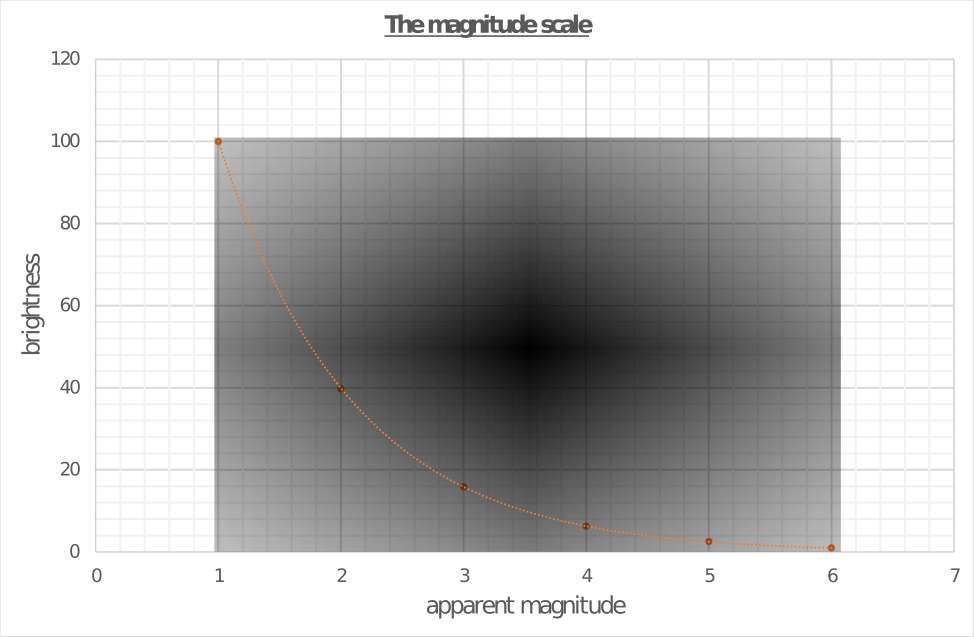
The dimmer an object appears, the higher the numerical value given to its magnitude, with a difference of 5 magnitudes corresponding to a brightness factor of exactly 100. Therefore, the magnitude m, in the spectral band x, would be given by m_{x}= -5 \log_{100} \left(\frac {F_x}{F_{x,0}}\right), which is more commonly expressed in terms of common (base-10) logarithms as m_{x} = -2.5 \log_{10} \left(\frac {F_x}{F_{x,0}}\right), where Fx is the observed irradiance using spectral filter x, and F**x,0 is the reference flux (zero-point) for that photometric filter. Since an increase of 5 magnitudes corresponds to a decrease in brightness by a factor of exactly 100, each magnitude increase implies a decrease in brightness by the factor \sqrt[5]{100} \approx 2.512 (Pogson's ratio). Inverting the above formula, a magnitude difference implies a brightness factor of \frac{F_2}{F_1} = 100^\frac{\Delta m}{5} = 10^{0.4 \Delta m} \approx 2.512^{\Delta m}.
Example: Sun and Moon
What is the ratio in brightness between the Sun and the full Moon?
The apparent magnitude of the Sun is −26.832 (brighter), and the mean magnitude of the full moon is −12.74 (dimmer).
Difference in magnitude: x = m_1 - m_2 = (-12.74) - (-26.832) = 14.09.
Brightness factor: v_b = 10^{0.4 x} = 10^{0.4 \times 14.09} \approx 432,513.
The Sun appears to be approximately times as bright as the full Moon.
Magnitude addition
Sometimes one might wish to add brightness. For example, photometry on closely separated double stars may only be able to produce a measurement of their combined light output. To find the combined magnitude of that double star knowing only the magnitudes of the individual components, this can be done by adding the brightness (in linear units) corresponding to each magnitude. 10^{-m_f \times 0.4} = 10^{-m_1 \times 0.4} + 10^{-m_2 \times 0.4}.
Solving for m_f yields m_f = -2.5\log_{10} \left(10^{-m_1 \times 0.4} + 10^{-m_2 \times 0.4} \right), where mf is the resulting magnitude after adding the brightnesses referred to by m1 and m2.
Apparent bolometric magnitude
While magnitude generally refers to a measurement in a particular filter band corresponding to some range of wavelengths, the apparent or absolute bolometric magnitude (mbol) is a measure of an object's apparent or absolute brightness integrated over all wavelengths of the electromagnetic spectrum (also known as the object's irradiance or power, respectively). The zero point of the apparent bolometric magnitude scale is based on the definition that an apparent bolometric magnitude of 0 mag is equivalent to a received irradiance of 2.518×10⁻⁸ watts per square metre (W·m−2).
Absolute magnitude
Main article: Absolute magnitude
While apparent magnitude is a measure of the brightness of an object as seen by a particular observer, absolute magnitude is a measure of the intrinsic brightness of an object. Flux decreases with distance according to an inverse-square law, so the apparent magnitude of a star depends on both its absolute brightness and its distance (and any extinction). For example, a star at one distance will have the same apparent magnitude as a star four times as bright at twice that distance. In contrast, the intrinsic brightness of an astronomical object, does not depend on the distance of the observer or any extinction.
The absolute magnitude M, of a star or astronomical object is defined as the apparent magnitude it would have as seen from a distance of 10 pc. The absolute magnitude of the Sun is 4.83 in the V band (visual), 4.68 in the Gaia satellite's G band (green) and 5.48 in the B band (blue).
In the case of a planet or asteroid, the absolute magnitude H rather means the apparent magnitude it would have if it were 1 AU from both the observer and the Sun, and fully illuminated at maximum opposition (a configuration that is only theoretically achievable, with the observer situated on the surface of the Sun).
Standard reference values
| Band | λ | ||||
|---|---|---|---|---|---|
| (μm) | |||||
| (FWHM) | Flux at , *F**x*,0 | Jy | 10−20 erg/(s·cm2·Hz) | ||
| U | 0.36 | 0.15 | 1810 | 1.81 | |
| B | 0.44 | 0.22 | 4260 | 4.26 | |
| V | 0.55 | 0.16 | 3640 | 3.64 | |
| R | 0.64 | 0.23 | 3080 | 3.08 | |
| I | 0.79 | 0.19 | 2550 | 2.55 | |
| J | 1.26 | 0.16 | 1600 | 1.60 | |
| H | 1.60 | 0.23 | 1080 | 1.08 | |
| K | 2.22 | 0.23 | 670 | 0.67 | |
| L | 3.50 | ||||
| g | 0.52 | 0.14 | 3730 | 3.73 | |
| r | 0.67 | 0.14 | 4490 | 4.49 | |
| i | 0.79 | 0.16 | 4760 | 4.76 | |
| z | 0.91 | 0.13 | 4810 | 4.81 |
The magnitude scale is a reverse logarithmic scale. A common misconception is that the logarithmic nature of the scale is because the human eye itself has a logarithmic response. In Pogson's time this was thought to be true (see Weber–Fechner law), but it is now believed that the response is a power law .
Magnitude is complicated by the fact that light is not monochromatic. The sensitivity of a light detector varies according to the wavelength of the light, and the way it varies depends on the type of light detector. For this reason, it is necessary to specify how the magnitude is measured for the value to be meaningful. For this purpose the UBV system is widely used, in which the magnitude is measured in three different wavelength bands: U (centred at about 350 nm, in the near ultraviolet), B (about 435 nm, in the blue region) and V (about 555 nm, in the middle of the human visual range in daylight). The V band was chosen for spectral purposes and gives magnitudes closely corresponding to those seen by the human eye. When an apparent magnitude is discussed without further qualification, the V magnitude is generally understood.
Because cooler stars, such as red giants and red dwarfs, emit little energy in the blue and UV regions of the spectrum, their power is often under-represented by the UBV scale. Indeed, some L and T class stars have an estimated magnitude of well over 100, because they emit extremely little visible light, but are strongest in infrared.
Measures of magnitude need cautious treatment and it is extremely important to measure like with like. On early 20th century and older orthochromatic (blue-sensitive) photographic film, the relative brightnesses of the blue supergiant Rigel and the red supergiant Betelgeuse irregular variable star (at maximum) are reversed compared to what human eyes perceive, because this archaic film is more sensitive to blue light than it is to red light. Magnitudes obtained from this method are known as photographic magnitudes, and are now considered obsolete.
For objects within the Milky Way with a given absolute magnitude, 5 is added to the apparent magnitude for every tenfold increase in the distance to the object. For objects at very great distances (far beyond the Milky Way), this relationship must be adjusted for redshifts and for non-Euclidean distance measures due to general relativity.
For planets and other Solar System bodies, the apparent magnitude is derived from its phase curve and the distances to the Sun and observer.
List of apparent magnitudes
Some of the listed magnitudes are approximate. Telescope sensitivity depends on observing time, optical bandpass, and interfering light from scattering and airglow.
| Apparent | |||||||||||||||
|---|---|---|---|---|---|---|---|---|---|---|---|---|---|---|---|
| magnitude | |||||||||||||||
| (V) | Object | Seen from... | Notes | ||||||||||||
| −67.57 | gamma-ray burst GRB 080319B | seen from 1 AU away | would be over (20 quadrillion) times as bright as the Sun when seen from the Earth | ||||||||||||
| −43.27 | star NGC 2403 V14 | seen from 1 AU away | |||||||||||||
| −41.82 | star NGC 2363-V1 | seen from 1 AU away | |||||||||||||
| −41.39 | star Cygnus OB2-12 | seen from 1 AU away | |||||||||||||
| −40.67 | star M33-013406.63 | seen from 1 AU away | |||||||||||||
| −40.17 | star η Carinae A | seen from 1 AU away | |||||||||||||
| −40.07 | star Zeta1 Scorpii | seen from 1 AU away | |||||||||||||
| −39.66 | star R136a1 | seen from 1 AU away | |||||||||||||
| −39.47 | star P Cygni | seen from 1 AU away | |||||||||||||
| −38.00 | star Rigel | seen from 1 AU away | would be seen as a large, very bright bluish disk of 35° apparent diameter | ||||||||||||
| −37.42 | star Betelgeuse | seen from 1 AU away | |||||||||||||
| −30.52Calculated from the National Geographic statistic using https://rechneronline.de/log-scale/brightness.php | Chelyabinsk meteor | seen from Chelyabinsk, Russia on Earth | about 30 times brighter than the Sun at maximum brightness | ||||||||||||
| −30.30 | star Sirius A | seen from 1 AU away | |||||||||||||
| −29.30 | star Sun | seen from Mercury at perihelion | |||||||||||||
| −27.40 | star Sun | seen from Venus at perihelion | |||||||||||||
| −26.83 | star Sun | seen from Earth | about 400,000 times as bright as mean full Moon | ||||||||||||
| −25.60 | star Sun | seen from Mars at aphelion | |||||||||||||
| −25 | *Minimum brightness that causes the typical eye slight pain to look at* | ||||||||||||||
| −23.00 | star Sun | seen from Jupiter at aphelion | |||||||||||||
| −21.70 | star Sun | seen from Saturn at aphelion | |||||||||||||
| −21.00 | star Sun | seen from Earth on an overcast midday | measuring about 1000 lux | ||||||||||||
| −20.20 | star Sun | seen from Uranus at aphelion | |||||||||||||
| −19.30 | star Sun | seen from Neptune | |||||||||||||
| −19.00 | star Sun | seen from Earth on a very strongly overcast midday | measuring about 100 lux | ||||||||||||
| −18.20 | star Sun | seen from Pluto at aphelion | |||||||||||||
| −17.70 | planet Earth | last=Agrawal | first=Dulli Chandra | title=Apparent magnitude of earthshine: a simple calculation | journal=European Journal of Physics | publisher=IOP Publishing | volume=37 | issue=3 | date=30 March 2016 | issn=0143-0807 | doi=10.1088/0143-0807/37/3/035601 | article-number=035601 | bibcode=2016EJPh...37c5601A | s2cid=124231299 }} | |
| −16.70 | star Sun | seen from Eris at aphelion | |||||||||||||
| −16.00 | star Sun | as twilight on Earth | last=Polakis | first=Tom | title=Radiometry and photometry in astronomy | website=Home page of Paul Schlyter | date=1997-09-10 | url=https://stjarnhimlen.se/comp/radfaq.html#11 | access-date=2024-04-25}} | ||||||
| −14.2 | *An illumination level of 1 lux* | ||||||||||||||
| −12.60 | full moon | seen from Earth at perihelion | opposition effect]]) | ||||||||||||
| −12.40 | Betelgeuse (when supernova) | seen from Earth when it goes supernova | |||||||||||||
| −11.20 | star Sun | seen from [Sedna](90377-sedna) at aphelion | |||||||||||||
| −10.00 | Comet Ikeya–Seki (1965) | seen from Earth | url=http://www.icq.eps.harvard.edu/brightest.html | title=Brightest comets seen since 1935 | publisher=International Comet Quarterly | access-date=18 December 2011 | archive-url=https://web.archive.org/web/20111228014918/http://www.icq.eps.harvard.edu/brightest.html | archive-date=28 December 2011 | url-status=live}} | ||||||
| −9.50 | Iridium (satellite) flare | seen from Earth | maximum brightness | ||||||||||||
| −9 to −10 | Phobos (moon) | seen from Mars | maximum brightness | ||||||||||||
| −7.50 | supernova of 1006 | seen from Earth | the brightest stellar event in recorded history (7200 light-years away) | ||||||||||||
| −6.80 | Alpha Centauri A | seen from Proxima Centauri b | last=Siegel | first=Ethan | title=Ten Ways 'Proxima b' Is Different From Earth | website=Forbes | date=6 September 2016 | url=https://www.forbes.com/sites/startswithabang/2016/09/06/ten-ways-proxima-b-is-different-from-earth/ | access-date=19 February 2023}} | ||||||
| −6.00 | *The total integrated magnitude of the night sky (incl. airglow)* | seen from Earth | measuring about 0.002 lux | ||||||||||||
| −6.00 | Crab Supernova of 1054 | seen from Earth | (6500 light-years away) | ||||||||||||
| −5.90 | International Space Station | seen from Earth | when the ISS is at its perigee and fully lit by the Sun | ||||||||||||
| −4.92 | planet Venus | seen from Earth | maximum brightness when illuminated as a crescent | ||||||||||||
| −4.14 | planet Venus | seen from Earth | mean brightness | ||||||||||||
| −4 | *Faintest objects observable during the day with naked eye when Sun is high*. An astronomical object casts human-visible shadows when its apparent magnitude is equal to or lower than −4 | ||||||||||||||
| −3.99 | star Epsilon Canis Majoris | seen from Earth | maximum brightness of 4.7 million years ago, the historical brightest star of the last and next five million years. | ||||||||||||
| −3.69 | Moon | reflecting earthlight seen from Earth (maximum) | |||||||||||||
| −2.98 | planet Venus | seen from Earth | minimum brightness during transits. | ||||||||||||
| −2.94 | planet Jupiter | seen from Earth | maximum brightness | ||||||||||||
| −2.94 | planet Mars | seen from Earth | maximum brightness | ||||||||||||
| −2.5 | *Faintest objects visible during the day with naked eye when Sun is less than 10° above the horizon* | ||||||||||||||
| −2.50 | new moon | seen from Earth | minimum brightness | ||||||||||||
| −2.50 | planet Earth | seen from Mars | maximum brightness | ||||||||||||
| −2.48 | planet Mercury | seen from Earth | maximum brightness at superior conjunction (unlike Venus, Mercury is at its brightest when on the far side of the Sun, the reason being their different phase curves) | ||||||||||||
| −2.20 | planet Jupiter | seen from Earth | mean brightness | ||||||||||||
| −1.66 | planet Jupiter | seen from Earth | minimum brightness | ||||||||||||
| −1.47 | star system Sirius | seen from Earth | Brightest star except for the Sun at visible wavelengths | ||||||||||||
| −0.83 | star Eta Carinae | seen from Earth | apparent brightness as a supernova impostor in April 1843 | ||||||||||||
| −0.72 | star Canopus | seen from Earth | 2nd brightest star in night sky | ||||||||||||
| −0.55 | planet Saturn | seen from Earth | maximum brightness near opposition and perihelion when the rings are angled toward Earth | ||||||||||||
| −0.30 | Halley's comet | seen from Earth | Expected apparent magnitude at 2061 passage | ||||||||||||
| −0.27 | star system Alpha Centauri AB | seen from Earth | Combined magnitude (3rd brightest star in night sky) | ||||||||||||
| −0.04 | star Arcturus | seen from Earth | 4th brightest star to the naked eye | ||||||||||||
| −0.01 | star Alpha Centauri A | seen from Earth | 4th brightest *individual* star visible telescopically in the night sky | ||||||||||||
| +0.03 | star Vega | seen from Earth | originally chosen as a definition of the zero point | ||||||||||||
| +0.13 | Large Magellanic Cloud | seen from Earth | |||||||||||||
| +0.23 | planet Mercury | seen from Earth | mean brightness | ||||||||||||
| +0.46 | star Sun | seen from Alpha Centauri | |||||||||||||
| +0.46 | planet Saturn | seen from Earth | mean brightness | ||||||||||||
| +0.71 | planet Mars | seen from Earth | mean brightness | ||||||||||||
| +0.90 | Moon | seen from Mars | maximum brightness | ||||||||||||
| +1.17 | planet Saturn | seen from Earth | minimum brightness | ||||||||||||
| +1.33 | star Alpha Centauri B | seen from Earth | |||||||||||||
| +1.86 | planet Mars | seen from Earth | minimum brightness | ||||||||||||
| +1.98 | star Polaris | seen from Earth | mean brightness | ||||||||||||
| +2.00 | star system T CrB (when nova) | seen from Earth | Star system that goes nova every 80 years | ||||||||||||
| +2.40 | Halley's Comet | seen from Earth | About Magnitude during 1986 perihelion | ||||||||||||
| +2.7 | Small Magellanic Cloud | seen from Earth | |||||||||||||
| +3 | *Faintest objects visible in an urban neighborhood with naked eye* | ||||||||||||||
| +3.03 | supernova SN 1987A | seen from Earth | in the Large Magellanic Cloud (160,000 light-years away) | ||||||||||||
| +3.44 | Andromeda Galaxy | seen from Earth | M31 | ||||||||||||
| +4 | *Faintest objects visible in a suburban neighborhood with naked eye* | ||||||||||||||
| +4.00 | Orion Nebula | seen from Earth | M42 | ||||||||||||
| +4.38 | moon Ganymede | seen from Earth | maximum brightness (moon of Jupiter and the largest moon in the Solar System) | ||||||||||||
| +4.50 | open cluster M41 | seen from Earth | url=http://messier.seds.org/more/m041_ari.html | title=M41 possibly recorded by Aristotle | date=28 July 2006 | publisher=SEDS (Students for the Exploration and Development of Space) | access-date=29 November 2009 | archive-url=https://web.archive.org/web/20170418184854/http://messier.seds.org/more/m041_ari.html | archive-date=18 April 2017 | url-status=live}} | |||||
| +4.50 | Sagittarius Dwarf Spheroidal Galaxy | seen from Earth | |||||||||||||
| +5.20 | asteroid [Vesta](4-vesta) | seen from Earth | maximum brightness | ||||||||||||
| +5.38 | planet Uranus | seen from Earth | maximum brightness (Uranus comes to perihelion in 2050) | ||||||||||||
| +5.68 | planet Uranus | seen from Earth | mean brightness | ||||||||||||
| +5.72 | spiral galaxy M33 | seen from Earth | url=http://simbad.u-strasbg.fr/simbad/sim-id?Ident=M33 | title=SIMBAD-M33 | publisher=SIMBAD Astronomical Database | access-date=28 November 2009 | archive-url=https://web.archive.org/web/20140913102508/http://simbad.u-strasbg.fr/simbad/sim-id?Ident=M33 | archive-date=13 September 2014 | url-status=live}} | ||||||
| +5.80 | gamma-ray burst GRB 080319B | seen from Earth | Peak visual magnitude (the "Clarke Event") seen on Earth on 19 March 2008 from a distance of 7.5 billion light-years. | ||||||||||||
| +6.03 | planet Uranus | seen from Earth | minimum brightness | ||||||||||||
| +6.49 | asteroid [Pallas](2-pallas) | seen from Earth | maximum brightness | ||||||||||||
| +6.5 | *Approximate limit of stars observed by a **mean** naked eye observer under very good conditions. There are about 9,500 stars visible to mag 6.5.* | ||||||||||||||
| +6.50 | global cluster M2 | seen from Earth | mean naked-eye target | ||||||||||||
| +6.64 | dwarf planet Ceres | seen from Earth | maximum brightness | ||||||||||||
| +6.75 | asteroid [Iris](7-iris) | seen from Earth | maximum brightness | ||||||||||||
| +6.90 | spiral galaxy M81 | seen from Earth | url=http://messier.seds.org/m/m081.html | title=Messier 81 | date=2 September 2007 | publisher=SEDS (Students for the Exploration and Development of Space) | access-date=28 November 2009 | archive-url=https://web.archive.org/web/20170714113244/http://messier.seds.org/m/m081.html | archive-date=14 July 2017 | url-status=live}} | |||||
| +7.25 | planet Mercury | seen from Earth | minimum brightness | ||||||||||||
| +7.67 | planet Neptune | seen from Earth | maximum brightness (Neptune comes to perihelion in 2042) | ||||||||||||
| +7.78 | planet Neptune | seen from Earth | mean brightness | ||||||||||||
| +8 | *Extreme naked-eye limit, Class 1 on Bortle scale, the darkest skies available on Earth.* | ||||||||||||||
| +8.00 | planet Neptune | seen from Earth | minimum brightness | ||||||||||||
| +8.10 | moon Titan | seen from Earth | maximum brightness; largest moon of Saturn; mean opposition magnitude 8.4 | ||||||||||||
| +8.29 | star UY Scuti | seen from Earth | Maximum brightness; one of largest known stars by radius | ||||||||||||
| +8.94 | asteroid [10 Hygiea](10-hygiea) | seen from Earth | maximum brightness | ||||||||||||
| +9.30 | spiral galaxy M63 | seen from Earth | |||||||||||||
| +9.5 | *Faintest objects visible using common 10×50 binoculars under typical conditions* | ||||||||||||||
| +10 | Apollo 8 CSM in orbit around the Moon | seen from Earth | title=Tracking the Apollo Flights | website=Static Web Pages for Physics and Astronomy | date=1968-12-21 | url=https://pages.astronomy.ua.edu/keel/space/apollo.html | access-date=2024-03-20}} | ||||||||
| +10 | star system T CrB(average) | seen from Earth | Star system that goes nova every 80 years | ||||||||||||
| +10.20 | moon Iapetus | seen from Earth | maximum brightness, brightest when west of Saturn and takes 40 days to switch sides | ||||||||||||
| +11.05 | star Proxima Centauri | seen from Earth | closest star (other than the Sun) | ||||||||||||
| +11.8 | moon Phobos | seen from Earth | Maximum brightness; brighter moon of Mars | ||||||||||||
| +12.23 | star R136a1 | seen from Earth | Most luminous and massive star known | ||||||||||||
| +12.89 | moon Deimos | seen from Earth | Maximum brightness | ||||||||||||
| +12.91 | quasar [3C 273](3c-273) | seen from Earth | brightest (luminosity distance of 2.4 billion light-years) | ||||||||||||
| +13.42 | moon Triton | seen from Earth | Maximum brightness | ||||||||||||
| +13.65 | dwarf planet Pluto | seen from Earth | maximum brightness, 725 times fainter than magnitude 6.5 naked eye skies | ||||||||||||
| +13.9 | moon Titania | seen from Earth | Maximum brightness; brightest moon of Uranus | ||||||||||||
| +14.1 | star WR 102 | seen from Earth | Hottest known star | ||||||||||||
| +14.6 | centaur [Chiron](2060-chiron) | seen from Earth | maximum brightness | ||||||||||||
| +15.55 | moon Charon | seen from Earth | maximum brightness (the largest moon of Pluto) | ||||||||||||
| +16.8 | dwarf planet Makemake | seen from Earth | Current opposition brightness | ||||||||||||
| +17.7 | star WOH G64 | seen from Earth | maximum brightness | ||||||||||||
| +17.27 | dwarf planet Haumea | seen from Earth | Current opposition brightness | ||||||||||||
| +18.7 | dwarf planet Eris | seen from Earth | Current opposition brightness | ||||||||||||
| +19.5 | *Faintest objects observable with the Catalina Sky Survey 0.7-meter telescope using a 30-second exposure* and also the approximate limiting magnitude of Asteroid Terrestrial-impact Last Alert System (ATLAS) | ||||||||||||||
| +20.7 | moon Callirrhoe | seen from Earth | (small ≈8 km satellite of Jupiter) | ||||||||||||
| +22 | *Faintest objects observable in visible light with a 600 mm (24″) Ritchey-Chrétien telescope with 30 minutes of stacked images (6 subframes at 5 minutes each) using a CCD detector* | ||||||||||||||
| +22.8 | Luhman 16 | seen from Earth | Closest brown dwarfs (Luhman 16A=23.25, Luhman 16B=24.07) | ||||||||||||
| +22.91 | moon Hydra | seen from Earth | maximum brightness of Pluto's moon | ||||||||||||
| +23.38 | moon Nix | seen from Earth | maximum brightness of Pluto's moon | ||||||||||||
| +24 | *Faintest objects observable with the Pan-STARRS 1.8-meter telescope using a 60-second exposure* This is currently the limiting magnitude of automated allsky astronomical surveys. | ||||||||||||||
| +25.0 | moon Fenrir | seen from Earth | (small ≈4 km satellite of Saturn) and about 25 million times fainter than what can be seen with the naked eye. | ||||||||||||
| +25.3 | Trans-Neptunian object | seen from Earth | Furthest known observable object in the Solar System about 132 AU from the Sun | ||||||||||||
| +26.2 | Trans-Neptunian object | seen from Earth | 200 km sized object about 90 AU from the Sun and about 75 million times fainter than what can be seen with the naked eye. | ||||||||||||
| +27.7 | *Faintest objects observable with a single 8-meter class ground-based telescope such as the Subaru Telescope in a 10-hour image* | ||||||||||||||
| +28.2 | Halley's Comet | seen from Earth (2003) | in 2003 when it was 28 AU from the Sun, imaged using 3 of 4 synchronised individual scopes in the ESO's Very Large Telescope array using a total exposure time of about 9 hours | ||||||||||||
| +28.4 | asteroid | seen from Earth orbit | observed magnitude of ≈15-kilometer Kuiper belt object seen by the Hubble Space Telescope (HST) in 2003, dimmest known directly observed asteroid. | ||||||||||||
| +29.4 | galaxy JADES-GS-z13-0 | seen from Earth | display-authors = etal | first1 = B. E. | last1 = Robertson | title = Identification and properties of intense star-forming galaxies at redshifts z 10 | journal = Nature Astronomy | year = 2023 | volume = 7 | issue = 5 | pages = 611–621 | doi = 10.1038/s41550-023-01921-1 | arxiv = 2212.04480 | bibcode = 2023NatAs...7..611R | s2cid = 257968812 }} Approximately a billion times fainter than can be observed with the naked eye. |
| +31.5 | *Faintest objects observable in visible light with Hubble Space Telescope via the EXtreme Deep Field with ≈23 days of exposure time collected over 10 years* | ||||||||||||||
| +35 | unnamed asteroid | seen from Earth orbit | expected magnitude of dimmest known asteroid, a 950-meter Kuiper belt object discovered (by the HST) passing in front of a star in 2009. | ||||||||||||
| +35 | stars behind the Galactic Center | seen from Earth | expected magnitude at visible wavelengths due to interstellar extinction |
Notes
References
References
- (1984). "Ptolemy's Almagest". Springer-Verlag.
- Curtis, Heber Doust. (1903). "On the Limits of Unaided Vision". [[University of California]].
- (October 2006). "Human Contrast Threshold and Astronomical Visibility.". Monthly Notices of the Royal Astronomical Society.
- "Magnitude". National Solar Observatory—Sacramento Peak.
- [[Bright Star Catalogue]]
- Hoffmann, S., Hipparchs Himmelsglobus, Springer, Wiesbaden/ New York, 2017
- Pogson, N.. (1856). "Magnitudes of Thirty-six of the Minor Planets for the first day of each month of the year 1857". [[Monthly Notices of the Royal Astronomical Society.
- Hearnshaw, John B.. (1996). "The measurement of starlight: two centuries of astronomical photometry". Cambridge Univ. Press.
- Pogson, N.. (1856-11-14). "Magnitudes of Thirty-six of the Minor Planets for the First Day of each Month of the Year 1857". Monthly Notices of the Royal Astronomical Society.
- Hearnshaw, J. B.. (1996). "The measurement of starlight: two centuries of astronomical photometry". Cambridge University Press.
- (May 1953). "Fundamental stellar photometry for standards of spectral type on the revised system of the Yerkes spectral atlas". The Astrophysical Journal.
- (15 March 1983). "Secondary standard stars for absolute spectrophotometry". The Astrophysical Journal.
- "Magnitude Arithmetic". Caglow.
- IAU Inter-Division A-G Working Group on Nominal Units for Stellar & Planetary Astronomy. (13 August 2015). "IAU 2015 Resolution B2 on Recommended Zero Points for the Absolute and Apparent Bolometric Magnitude Scales". Resolutions Adopted at the General Assemblies.
- "Lecture 4: Page 3, Properties of the Stars".
- Evans, Aaron. "Some Useful Astronomical Definitions". Stony Brook Astronomy Program.
- (21 May 2019). "The GALAH survey: unresolved triple Sun-like stars discovered by the Gaia mission". Oxford University Press (OUP).
- (September 2005). "Standard Photometric Systems". Annual Review of Astronomy and Astrophysics.
- Luciuk, M.. "Astronomical Magnitudes".
- (1997). "Misconceptions About Astronomical Magnitudes". American Journal of Physics.
- "Magnitude {{!}} Brightness, Apparent Magnitude & Absolute Magnitude {{!}} Britannica".
- "Introduction to active galaxies: View as single page".
- (1910). "1910HarCi.160....1P Page 1". Harvard College Observatory Circular.
- (2014). "Nonlinear relativistic corrections to cosmological distances, redshift and gravitational lensing magnification: II. Derivation". Classical and Quantum Gravity.
- (2002). "The K correction".
- (1967). "1967lts..conf..205W Page 205". Late-Type Stars.
- "Meteor". [[National Geographic]].
- Agrawal, Dulli Chandra. (30 March 2016). "Apparent magnitude of earthshine: a simple calculation". IOP Publishing.
- Polakis, Tom. (1997-09-10). "Radiometry and photometry in astronomy".
- Dufay, Jean. (17 October 2012). "Introduction to Astrophysics: The Stars". Courier Corporation.
- McLean, Ian S.. (2008). "Electronic Imaging in Astronomy: Detectors and Instrumentation". Springer.
- (2017). "Evolutionary Tracks for Betelgeuse". The Astrophysical Journal.
- "Brightest comets seen since 1935". International Comet Quarterly.
- Siegel, Ethan. (6 September 2016). "Ten Ways 'Proxima b' Is Different From Earth".
- "Heavens-above.com". Heavens-above.
- [https://web.archive.org/web/20070627044109/http://www.gsfc.nasa.gov/scienceques2005/20060406.htm NASA Science Question of the Week]. Gsfc.nasa.gov (7 April 2006). Retrieved on 26 April 2013.
- Tomkin, Jocelyn. (April 1998). "Once and Future Celestial Kings". Sky and Telescope.
- (2018). "Computing apparent planetary magnitudes for The Astronomical Almanac". Astronomy and Computing.
- (2008). "Direct Detection of the Close Companion of Polaris with The Hubble Space Telescope". The Astronomical Journal.
- (28 July 2006). "M41 possibly recorded by Aristotle". SEDS (Students for the Exploration and Development of Space).
- "Uranus Fact Sheet".
- "SIMBAD-M33". SIMBAD Astronomical Database.
- Lodriguss, Jerry. (1993). "M33 (Triangulum Galaxy)".
- (2 September 2007). "Messier 81". SEDS (Students for the Exploration and Development of Space).
- "Neptune Fact Sheet".
- John E. Bortle. (February 2001). "The Bortle Dark-Sky Scale". Sky & Telescope.
- (1968-12-21). "Tracking the Apollo Flights".
- "What Is the Most Massive Star?". Space.com.
- (2019-08-05). "Multiwavelength Period–Luminosity and Period–Luminosity–Color Relations at Maximum Light for Mira Variables in the Magellanic Clouds". The Astrophysical Journal.
- "Catalina Sky Survey (CSS) Facilities".
- Steve Cullen (sgcullen). (5 October 2009). "17 New Asteroids Found by LightBuckets". LightBuckets.
- "Pan-STARRS limiting magnitude".
- [http://www.skyandtelescope.com/astronomy-resources/astronomy-questions-answers/what-is-the-faintest-object-imaged-by-ground-based-telescopes/ What is the faintest object imaged by ground-based telescopes?] {{Webarchive. link. (2 February 2016 , by: The Editors of Sky Telescope, 24 July 2006)
- (1 September 2003). "New Image of Comet Halley in the Cold". [[ESO]].
- (2023). "Identification and properties of intense star-forming galaxies at redshifts z > 10". Nature Astronomy.
- (21 October 2013). "The HST eXtreme Deep Field XDF: Combining all ACS and WFC3/IR Data on the HUDF Region into the Deepest Field Ever". The Astrophysical Journal Supplement Series.
- "Hubble Finds Smallest Kuiper Belt Object Ever Seen". [[NASA]].
- Williams, David R.. (2 February 2010). "Moon Fact Sheet". [[NASA]] (National Space Science Data Center).
- Williams, David R.. (7 September 2006). "Pluto Fact Sheet". NASA.
- "Classic Satellites of the Solar System". Observatorio ARVAL.
- (3 April 2009). "Planetary Satellite Physical Parameters". [[JPL]] (Solar System Dynamics).
- Sheppard, Scott S.. "Saturn's Known Satellites". Carnegie Institution (Department of Terrestrial Magnetism).
- Yeomans. "Horizon Online Ephemeris System for Ganymede (Major Body 503)". California Institute of Technology, Jet Propulsion Laboratory.
- Yeomans. (13 November 2012). "Horizon Online Ephemeris System for Titan (Major Body 606)". California Institute of Technology, Jet Propulsion Laboratory.
- "AstDys (10) Hygiea Ephemerides". Department of Mathematics, University of Pisa, Italy.
- "AstDys (2060) Chiron Ephemerides". Department of Mathematics, University of Pisa, Italy.
- "AstDys (136472) Makemake Ephemerides". Department of Mathematics, University of Pisa, Italy.
- "AstDys (136108) Haumea Ephemerides". Department of Mathematics, University of Pisa, Italy.
- "Sirius". SIMBAD Astronomical Database.
- "Canopus". SIMBAD Astronomical Database.
- "Vega". SIMBAD Astronomical Database.
- "Arcturus". SIMBAD Astronomical Database.
- "Vmag<6.5". SIMBAD Astronomical Database.
- "SIMBAD-M31". SIMBAD Astronomical Database.
- (2003). "The SN 1006 Remnant: Optical Proper Motions, Deep Imaging, Distance, and Brightness at Maximum". [[The Astrophysical Journal]].
- "Supernova 1054 – Creation of the Crab Nebula".
- Zarenski, Ed. (2004). "Limiting Magnitude in Binoculars". Cloudy Nights.
This article was imported from Wikipedia and is available under the Creative Commons Attribution-ShareAlike 4.0 License. Content has been adapted to SurfDoc format. Original contributors can be found on the article history page.
Ask Mako anything about Apparent magnitude — get instant answers, deeper analysis, and related topics.
Research with MakoFree with your Surf account
Create a free account to save articles, ask Mako questions, and organize your research.
Sign up freeThis content may have been generated or modified by AI. CloudSurf Software LLC is not responsible for the accuracy, completeness, or reliability of AI-generated content. Always verify important information from primary sources.
Report