From Surf Wiki (app.surf) — the open knowledge base
Aosta Valley
Autonomous region of Italy
Autonomous region of Italy
| Field | Value | |
|---|---|---|
| name | Aosta Valley | |
| native_name | it | |
| fr | ||
| frp | ||
| settlement_type | Autonomous region and province | |
| short_description | Autonomous region of Italy | |
| image_skyline | CastelloDiFénisJuly292023 06.jpg | |
| image_alt | The Fénis Castle (13th century) and the Aosta Valley | |
| image_caption | The Fénis Castle ([13th century](13th-century)) and the Aosta Valley | |
| image_flag | Flag of Valle d'Aosta.svg | |
| image_shield | Valle d'Aosta-Stemma.svg | |
| shield_size | 50px | |
| anthem | *Montagnes Valdôtaines* | |
| image_map | Aosta Valley in Italy.svg | |
| coordinates | ||
| subdivision_type | Country | |
| subdivision_name | ||
| seat_type | Capital | |
| seat | Aosta | |
| leader_party | UV | |
| leader_title | President | |
| leader_name | Renzo Testolin | |
| leader_title1 | Vice President | |
| leader_name1 | Luigi Bertschy | |
| area_total_km2 | 3263 | |
| population_footnotes | ||
| population_total | 122714 | |
| population_as_of | 2025 | |
| population_density_km2 | auto | |
| population_demonyms | *Valdostan* or *Valdotainian* | |
| (man) | ||
| (woman) | ||
| (man) | ||
| (woman) | ||
| population_blank1_title | Official languages | |
| population_blank1 | Italian | |
| French | ||
| demographics_type1 | Demographics | |
| demographics1_footnotes | ||
| demographics1_title1 | Citizenship | |
| demographics1_info1 | Italian: 95% | |
| demographics1_title2 | Official Language | |
| demographics1_info2 | ||
| demographics1_title3 | Regional Language | |
| demographics1_info3 | Valdôtain | |
| <!-- GDP ---------------> | demographics_type2 | GDP |
| demographics2_footnotes | ||
| demographics2_title1 | Total | |
| demographics2_info1 | €4.737 billion (2021) | |
| demographics2_title2 | Per capita | |
| timezone1 | CET | |
| utc_offset1 | +1 | |
| timezone1_DST | CEST | |
| utc_offset1_DST | +2 | |
| area_code_type | ISO 3166 code | |
| area_code | IT-23 | |
| blank2_name_sec1 | HDI (2021) | |
| blank2_info_sec1 | 0.889 | |
| · 14th of 21 | ||
| blank_name_sec2 | NUTS Region | |
| blank_info_sec2 | ITC | |
| website | [Regione.vda.it](https://www.regione.vda.it/) |
fr frp
(man) (woman) (man) (woman) French · 14th of 21 The Aosta Valley ( ; ; ; or Ougstalland; ), officially the Autonomous Region of Aosta Valley, is a mountainous autonomous region in northwestern Italy. It is bordered by Auvergne-Rhône-Alpes, France, to the west; by Valais, Switzerland, to the north; and by Piedmont, Italy, to the south and east. The regional capital is Aosta.
Covering an area of 3263 km2 and with 122,714 inhabitants as of 2025, it is the smallest, least populous, and least densely populated region of Italy. The province of Aosta having been dissolved in 1945, the Aosta Valley region was the first region of Italy to abolish provincial subdivisions, followed by Friuli-Venezia Giulia in 2017 (where they were reestablished later). Provincial administrative functions are provided by the regional government. The region is divided into 74 comuni ().
Italian and French are the official languages, and the Valdôtain dialect of Franco-Provençal is also officially recognized. Italian is spoken as a mother tongue by 77.29% of the population, Valdôtain by 17.91%, and French by 1.25%. In 2009, reportedly 50.53% of the population could speak all three languages.
Geography
The Aosta Valley is an Alpine valley which, with its tributary valleys, includes the Italian slopes of Mont Blanc, Monte Rosa, Gran Paradiso and the Matterhorn; its highest peak is Mont Blanc (4810 m). This makes it the highest region in Italy, according to the list of Italian regions by highest point.
Climate
The valleys, usually above 1,600 m, annually have a cold continental climate (Dfc). In this climate, the snow season is very long, lasting as long as 8 to 9 months at the highest points. During the summer, mist occurs almost every day. These areas are the wettest in the western Alps. Temperatures in January are low, between -7 and, and in July are between 20 and.
Areas between 2,000 and usually have a tundra climate (ET), where every month has an average temperature below 10 °C. This climate may be either a kind of more severe cold oceanic climate, with a low summer average but mild winters, sometimes above -3 °C, especially near lakes, or a more severe cold continental climate, with a very low winter average. Temperature averages in Plateau Rosa, at 3400 m high, are -11.6 °C in January and 1.4 °C in July. It is the coldest place in Italy where the climate is verifiable.
In the past, above 3,500 m, all months had an average temperature below freezing, with a perpetual frost climate (EF). In recent years, however, there has been a rise in temperatures. See, as an example, the data for Plateau Rosa.
History

Early inhabitants of the Aosta Valley were Celts and Ligures, whose language heritage remains in some local placenames. Rome conquered the region from the local Salassi around 25 BC and founded Augusta Prætoria Salassorum (modern-day Aosta) to secure the strategic mountain passes, and they went on to build bridges and roads through the mountains. Thus, the name Valle d'Aosta literally means "Valley of Augustus".
In 1031–1032, Humbert I of Savoy, the founder of the House of Savoy, received the title Count of Aosta from Emperor Conrad II of the Franconian line and built himself a commanding fortification at Bard. Saint Anselm of Canterbury was born in Aosta in 1033 or 1034. The region was divided among strongly fortified castles, and in 1191, Thomas I of Savoy found it necessary to grant to the communes a Charte des franchises ("Charter of Liberties") which preserved autonomy—rights that were fiercely defended until 1770, when they were revoked to tie Aosta more closely to Piedmont, but which were again demanded during post-Napoleonic times. In the mid-13th century, Emperor Frederick II made the County of Aosta a duchy (see Duke of Aosta), and its arms charged with a lion rampant were carried in the Savoy arms until the reunification of Italy in 1870.
The region remained part of Savoy lands, with the exceptions of French occupations from 1539 to 1563, later in 1691, and then between 1704 and 1706. It was also ruled by the First French Empire between 1800 and 1814. During French rule, it was part of Aoste arrondissement in Doire department. As part of the Kingdom of Sardinia, it joined the new Kingdom of Italy in 1861.
French forces briefly controlled the area at the end of World War II, but withdrew under British and American pressure. The region gained special autonomous status after the end of World War II; the province of Aosta ceased to exist in 1945.
Government and politics
Main article: Politics of Aosta Valley
For decades, the valley has been dominated by autonomist regional parties such as the Valdostan Union, which represents the interests of the French-speaking population. The latest regional election was held in late September 2025. The current President is Renzo Testolin, first elected in 2023 supported by a coalition of autonomist and progressive lists.
The Aosta Valley, the smallest region by area in Italy, is not divided into provinces. It is, however, still divided into 74 comunes, namely:

| ISTAT code | Municipality | Population | ||
|---|---|---|---|---|
| (2005) | Total | 122,868 | ||
| 007001 | Allein | 243 | ||
| 007002 | Antey-Saint-André | 602 | ||
| 007003 | Aosta / Aoste | 34,270 | ||
| 007004 | Arnad | 1,294 | ||
| 007005 | Arvier | 848 | ||
| 007006 | Avise | 312 | ||
| 007007 | Ayas | 1,296 | ||
| 007008 | Aymavilles | 1,966 | ||
| 007009 | Bard | 135 | ||
| 007010 | Bionaz | 244 | ||
| 007011 | Brissogne | 962 | ||
| 007012 | Brusson | 860 | ||
| 007013 | Challand-Saint-Anselme | 695 | ||
| 007014 | Challand-Saint-Victor | 589 | ||
| 007015 | Chambave | 937 | ||
| 007016 | Chamois | 99 | ||
| 007017 | Champdepraz | 674 | ||
| 007018 | Champorcher | 417 | ||
| 007019 | Charvensod | 2,333 | ||
| 007020 | Châtillon | 4,846 | ||
| 007021 | Cogne | 1,470 | ||
| 007022 | Courmayeur | 2,979 | ||
| 007023 | Donnas | 2,661 | ||
| 007024 | Doues | 409 | ||
| 007025 | Émarèse | 217 | ||
| 007026 | Étroubles | 472 | ||
| 007027 | Fénis | 1,653 | ||
| 007028 | Fontainemore | 412 | ||
| 007029 | Gaby | 490 | ||
| 007030 | Gignod | 1,352 | ||
| 007031 | Gressan | 2,981 | ||
| 007032 | Gressoney-La-Trinité | 306 | ||
| 007033 | Gressoney-Saint-Jean | 799 | ||
| 007034 | Hône | 1,162 | ||
| 007035 | Introd | 573 | ||
| 007036 | Issime | 400 | ||
| 007037 | Issogne | 1,374 | ||
| 007038 | Jovençan | 709 | ||
| 007039 | La Magdeleine | 95 | ||
| 007040 | La Salle | 1,985 | ||
| 007041 | La Thuile | 766 | ||
| 007042 | Lillianes | 494 | ||
| 007043 | Montjovet | 1,795 | ||
| 007044 | Morgex | 1,938 | ||
| 007045 | Nus | 2,713 | ||
| 007046 | Ollomont | 161 | ||
| 007047 | Oyace | 211 | ||
| 007048 | Perloz | 467 | ||
| 007049 | Pollein | 1,441 | ||
| 007050 | Pontboset | 190 | ||
| 007051 | Pontey | 742 | ||
| 007052 | Pont-Saint-Martin | 3,957 | ||
| 007053 | Pré-Saint-Didier | 968 | ||
| 007054 | Quart | 3,263 | ||
| 007055 | Rhêmes-Notre-Dame | 124 | ||
| 007056 | Rhêmes-Saint-Georges | 200 | ||
| 007057 | Roisan | 900 | ||
| 007058 | Saint-Christophe | 3,124 | ||
| 007059 | Saint-Denis | 361 | ||
| 007060 | Saint-Marcel | 1,206 | ||
| 007061 | Saint-Nicolas | 325 | ||
| 007062 | Saint-Oyen | 218 | ||
| 007063 | Saint-Pierre | 2,785 | ||
| 007064 | Saint-Rhémy-en-Bosses | 387 | ||
| 007065 | Saint-Vincent | 4,833 | ||
| 007066 | Sarre | 4,434 | ||
| 007067 | Torgnon | 522 | ||
| 007068 | Valgrisenche | 184 | ||
| 007069 | Valpelline | 627 | ||
| 007070 | Valsavarenche | 178 | ||
| 007071 | Valtournenche | 2,169 | ||
| 007072 | Verrayes | 1,305 | ||
| 007073 | Verrès | 2,623 | ||
| 007074 | Villeneuve | 1,136 |
Demographics
|1861 |85900|1871 |84137|1881 |85504|1901 |84165|1911 |81457|1921 |83251|1931 |83479|1936 |83455 |1951 |94140 |1961 |100959 |1971 |109150 |1981 |112353 |1991 |115938 |2001 |119548 |2011 |126806|2021|123360|source=ISTAT}}
| Nationality | Population | |
|---|---|---|
| Romania | ||
| Morocco | ||
| Albania | ||
| PRC China | ||
| Ukraine | ||
| Tunisia | ||
| Dominican Republic | ||
| France | ||
| Moldova | ||
| Algeria | ||
| Poland | ||
| United Kingdom | ||
| Nigeria |
The population density of Aosta Valley is by far the lowest of the Italian regions. In 2008, 38.9 inhabitants per km2 were registered in the region, whereas the average national figure was 198.8, though the region has extensive uninhabitable areas of mountain and glacier, with a substantial part of the population living in the central valley.
Negative natural population growth since 1976 has been more than offset by immigration. The region has one of Italy's lowest birth rates, with a rising average age. This, too, is partly compensated by immigration, since most immigrants arriving in the region are younger people working in the tourist industry. Between 1991 and 2001, the population of Aosta Valley grew by 3.1%, which is the highest growth among the Italian regions. With a negative natural population growth, this is due exclusively to positive net migration. Between 2001 and 2011, the population of Aosta Valley grew by a further 7.07%. , the Italian National Institute of Statistics (ISTAT) estimated that 4,976 foreign-born immigrants live in Aosta Valley, equal to 4.0% of the total regional population.
The Valdôtain population and their language dialects have been the subject of some sociological research.
Economy
The economy of the Aosta Valley is based above all on the tertiary sector, in particular on tourism. Due to the autonomy conferred by the special statute, the public sector, which administers most of the regional financial resources, plays a role of primary importance in the Aosta Valley economy. The industries are concentrated in the lower valley (between Verrès-Champdepraz and Pont-Saint-Martin) and are often small to medium sized. However, the contribution of agriculture and livestock to the regional economy is modest. Potatoes, apples, vines, barley are grown and cattle are raised. The artisanal production is significant, in which wooden sculpture emerges.
Aosta Valley has many small and picturesque villages, three of them have been selected by I Borghi più belli d'Italia (), a non-profit private association of small Italian towns of strong historical and artistic interest, that was founded on the initiative of the Tourism Council of the National Association of Italian Municipalities. These villages are:
- Bard
- Fontainemore
- Etroubles
Notable wines include two white wines from Morgex (Blanc de Morgex et de La Salle and Chaudelune), a red wine blend from Arvier (Enfer d'Arvier) and one from Gamay. The Valle d'Aosta DOC (or Vallée d'Aoste DOC, in French) is an Italian denominazione di origine controllata located in the Aosta Valley of north-west Italy. Surrounded by the Alps, the Valle d'Aosta is home to the highest elevated vineyards in all of Europe. The principal winemaking region of the Valle d'Aosta is found along the eastern banks of the Dora Baltea (fr., Doire baltée) river with the city of Aosta serving as the central winemaking location. The region is divided into three main vineyard areas; the upper valley, Valdigne, the central valley (locally Valle centrale in Italian, Vallée centrale in French) and the lower valley, (locally Bassa valle in Italian, Basse vallée in French).
Culture
Languages
Main article: Aostan French, Valdôtain dialect
The Aosta Valley was the first government authority to adopt Modern French as the official language in 1536, three years before France itself.
Since 1946, Italian and French are the region's official languages
Legal decree No.365 of 11 November 1946 (art.2) states that it is mandatory to know both Italian and French to teach in Aosta Valley's schools. According to Aosta Valley's autonomous status (art.39), the same number of hours of French and Italian teaching must be held. The decree No.861 of the President of the Republic of 31 October 1975 (art.5) states that it is mandatory to pass a French exam to teach in Aosta Valley for Italian native speakers, as well an Italian exam for French native speakers. Italian law No.196 of 16 May 1978 states the adaptation rules of national educational programmes into French for Aosta Valley, and states as well that all members of the examination boards must be fluent both in Italian and French. Aosta Valley students must pass an extra test in French at the Secondary education final exam, similar to the first test (in Italian).
The regional language, known as patoué valdotèn or simply patoué (patois valdôtain in French), is a dialectal variety of Franco-Provençal. It is spoken as a native and second language by 68,000 residents, or about 58% of the population according to a sociolinguistic survey carried out by the Fondation Émile Chanoux in 2001.
The survey found that the Italian language was native to 77.29% of respondents, Franco-Provençal to 17.91%, and French to 1.25%, though the active use of these languages by the population shows French at 75.41% and Franco-Provençal at 55.77%. The population of Gressoney-Saint-Jean, Gressoney-La-Trinité and Issime, in the Lys Valley, speak two dialects of Walser German, Titsch and Töitschu respectively. According to the survey, Walser German was spoken as a mother tongue by 207 people, or 17.78%, in these three villages. Nevertheless, it was known to 56.38% of the population.
Castles and fortresses
There are numerous medieval castles and fortified houses in the Aosta Valley, including Châtel-Argent, Saint-Pierre Castle, Fénis Castle, Issogne Castle, Bard Fort, Ussel Castle, Sarre Castle, Cly Castle, Verrès Castle, and Châtelard Castle. Savoy Castle in Gressoney-Saint-Jean was conceived in the 19th century and completed in 1904. Since 1990, it has also been home to the Savoy Castle Alpine Botanical Garden. File:CastelloDiSaintPierreJuly312023 03.jpg|The Saint-Pierre Castle File:A08.M01.ValDAosta03.jpg|The Sarre Castle File:CastelloDiVerresJuly292023 04.jpg|The Verrès Castle File:IssogneJuly292023 01.jpg|The Issogne Castle File:Castello di Bard, infinito.jpg|The Bard Fort File:CastelloSavoiaAugust192023 01.jpg|The Savoy Castle File:CastelloDiAymavillesJuly312023 02.jpg|The Aymavilles Castle File:Villeneuve Chatel Argent 01.jpg|The Châtel-Argent Castle
Cuisine
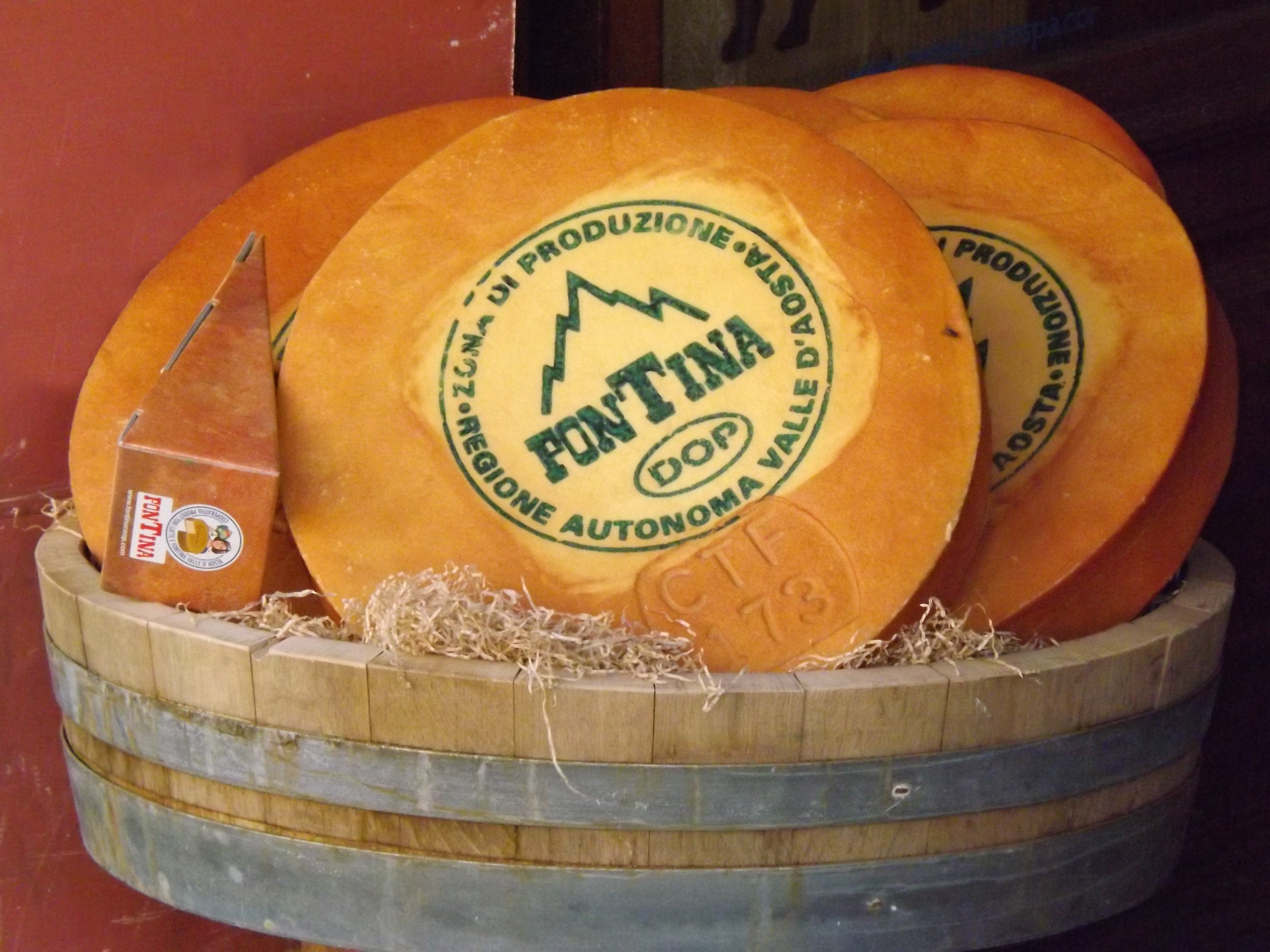
The cuisine of Aosta Valley is characterized by simplicity and revolves around "robust" ingredients such as potatoes, polenta; cheese and meat; and rye bread. Many of the dishes involve Fontina, a cheese with PDO status, made from cow's milk that originates from the valley. It is found in dishes such as the soup à la vâpeuleunèntse (Valpelline Soup). Other cheeses made in the region are Tomme de Gressoney and Seras. Fromadzo (Valdôtain for cheese) has been produced locally since the 15th century and also has PDO status.
Regional specialities, besides Fontina, are Motzetta (dried chamois meat), Vallée d'Aoste Lard d'Arnad (a cured and brined fatback product with PDO designation), Vallée d'Aoste Jambon de Bosses (a kind of ham, likewise with PDO designation), a dark bread made with rye, and honey.
Notable dishes include Carbonnade, similar to the Belgian dish of the same name consisting of salt-cured beef cooked with onions and red wine served with polenta; breaded veal cutlets called costolette; teuteuns, salt-cured cow's udder that is cooked and sliced; and steak à la valdôtaine, a steak with croûtons, ham and melted cheese.
Transport
The main road axes arise in the valley floor. They are the Aosta Valley state road 26 and the Autostrada A5 (Turin-Aosta-Mont Blanc Tunnel). The Mont Blanc Tunnel connects Courmayeur to Chamonix, France. The Great Saint Bernard Pass connects Saint-Rhémy-en-Bosses with Martigny in Switzerland, while the Little Saint Bernard Pass connects the La Thuile valley with the Isère valley and the municipality of Bourg-Saint-Maurice, in France.
The railway line is the Chivasso–Ivrea–Aosta railway, currently undergoing modernization works, the railway service, therefore, will be carried out from January 2024 with replacement buses. The region's only airport is the Aosta Valley Airport, in Saint-Christophe. However, there are currently no scheduled flight services at the airport. Other airports that are close to region are Turin Airport and Geneva Airport.
Gallery
File:Sito archeologico di Chenal 1120484.JPG|The prehistoric site near Chenal castle, Montjovet, rich in petroglyphs File:La Thuile-Rifugio Deffeyes 2.jpg|A view from refuge Albert Deffeyes, La Thuile File:Capra ibex gran paradiso.jpg|Male Alpine Ibex in Gran Paradiso National Park File:Marmotta alpina (Marmota marmota).jpg| Alpine marmot in Gran Paradiso National Park
Notes
References
Sources
References
- "Monthly Demographic Balance". [[Italian National Institute of Statistics.
- Kellas, James G.. (2004). "Nationalist Politics in Europe: The Constitutional and Electoral Dimensions". Palgrave.
- (2013). "Political Handbook of the World 2013". SAGE Publications.
- (2001). "Statut spécial de la Vallee d'Aoste". Conseil régional de la Vallée d'Aoste.
- [http://stats.oecd.org/ Regions and Cities > Regional Statistics > Regional Economy > Regional Gross Domestic Product (Small regions TL3)], OECD.Stats. Accessed on 16 November 2018.
- "Sub-national HDI – Area Database – Global Data Lab".
- Jean-Marie Pierret. (1994). "Phonétique historique du français et notions de phonétique générale". Peeters.
- (1948). "Le Statut spécial de la Vallée d'Aoste".
- "Italian Parliament – VI Commission document 2000-07-18 (in Italian)".
- (2009). "Profil de la politique linguistique de la Vallée d'Aoste". Le Château.
- [https://www.lovevda.it/en/database/7/lakes-waterfalls/breuil-cervinia/blue-lake/1188 Lovevda.it]
- (2012). "Tempo in atto su Plateau Rosa". meteoam.it.
- Poling, Dean. (12 October 2009). "What does Valdosta mean?".
- François Velde. (2000). "Heraldry in the House of Savoia". Heraldica.
- [http://gallica.bnf.fr/ark:/12148/bpt6k204214z/f388.image Almanach Impérial an bissextil MDCCCXII], pp. 392–393, accessed in [[Gallica]] 18 February 2015 {{in lang. fr
- (1957). "Allied military administration of Italy, 1943–1945". H. M. Stationery Office.
- Vampa, Davide. (15 September 2016). "The Regional Politics of Welfare in Italy, Spain and Great Britain". Springer.
- (2 March 2023). "Regione Valle d'Aosta, Renzo Testolin è il nuovo presidente - Valle d'Aosta".
- (29 September 2025). "Valle d'Aosta, i risultati delle elezioni regionali 2025: Vince l'Union Valdôtaine. Centrodestra al 29,5 per cento. Verso maggioranza con Autonomisti e Pd".
- (1971-10-24). "Popolazione residente e presente dei comuni. Censimenti dal 1861 al 1971". [[National Institute of Statistics (Italy).
- "Dashboard Permanent census of population and housing". [[National Institute of Statistics (Italy).
- "Foreign Citizens. Resident Population by sex and citizenship on 31st December 2019". [[National Institute of Statistics (Italy).
- "Statistiche demografiche ISTAT". Demo.istat.it.
- Saint-Blancat, Chantal. (1984). "The Effect of Minority Group Vitality upon Its Sociopsychological Behaviour and Strategies". Journal of Multilingual and Multicultural Development.
- (9 January 2017). "Valle d'Aosta".
- (16 January 2023). "Borghi più belli d'Italia. Le 14 novità 2023, dal Trentino alla Calabria".
- "I Borghi più belli d'Italia, la guida online ai piccoli centri dell'Italia nascosta".
- (9 January 2017). "Valle d'Aosta".
- (2014). "D.O.C. Wine". Valle D'Aosta Official Tourism Website.
- Due to the official bilingual status of the Aosta Valley.
- (25 October 2012). "La Vallée d'Aoste: enclave francophone au sud-est du Mont Blanc". Zigzag magazine.
- AA. VV.. "Une Vallée d'Aoste bilingue dans une Europe plurilingue". Fondation Émile Chanoux.
- [http://www.edizionieuropee.it/LAW/HTML/30/zn57_07_054.html#_ART0002 D.Lgs.C.P.S. 11 novembre 1946, n. 365. Ordinamento delle scuole e del personale insegnante della Valle d'Aosta ed istituzione nella Valle stessa di una Sovraintendenza agli studi.]
- [http://www.consiglio.vda.it/fr/app/statuto#:~:text=CONSEIL%20DE%20LA%20VALLEE&text=La%20Vall%C3%A9e%20d'Aoste%20est,et%20selon%20le%20pr%C3%A9sent%20Statut. Loi constitutionnelle n° 4 du 26 février 1948 – Statut spécial pour la Vallée d'Aoste.]
- [http://www.edizionieuropee.it/law/html/31/zn57_07_394.html#_ART0005 D.P.R. 31 ottobre 1975, n. 861. – Organici delle scuole primarie, secondarie ed artistiche della Valle d'Aosta.]
- [https://www.gazzettaufficiale.it/eli/id/1978/05/23/078U0196/sg Legge del 16 maggio 1978, n. 196 – Norme di attuazione dello statuto speciale della Valle d'Aosta. (GU Serie Generale n.141 del 23-05-1978)]
- "Sondaggio linguistico: Q 0301 Lingua materna – Qual è la sua lingua materna?".
- "Sondaggio Linguistico Comunità Walser".
- Massetti, E. [http://www.naturaosta.it/castles.htm "Aosta Valley Castles"] n.d., accessed 15 March 2014.
- [https://web.archive.org/web/20151228110543/http://museoscienze.it/?lang=en Aosta Valley Regional Museum of Natural Science] museoscienze.it
- (2014). "Fontina". Valle D'Aosta Official Tourism Website.
- (2014). "Seupa à la Vapelenentse (Valpelline Soup)". Valle D'Aosta Official Tourism Website.
- (2014). "Gressoney toma cheese". Aosta Valley Official Tourism Website.
- (2014). "Fromadzo cheese". Valle D'Aosta Official Tourism Website.
- (2014). "Valleé d'Aoste Lard d'Arnad". Aosta Valley Official Tourism Website.
- (2014). "Vallée d'Aoste Jambon de Bosses". Aosta Valley Official Tourism Website.
- (2014). "The Teuteun". Valle D'Aosta Official Tourism Website.
- "Steak Valdaostan style". Consorzio Produttori e Tutela Della Fontina DOP.
This article was imported from Wikipedia and is available under the Creative Commons Attribution-ShareAlike 4.0 License. Content has been adapted to SurfDoc format. Original contributors can be found on the article history page.
Ask Mako anything about Aosta Valley — get instant answers, deeper analysis, and related topics.
Research with MakoFree with your Surf account
Create a free account to save articles, ask Mako questions, and organize your research.
Sign up freeThis content may have been generated or modified by AI. CloudSurf Software LLC is not responsible for the accuracy, completeness, or reliability of AI-generated content. Always verify important information from primary sources.
Report