From Surf Wiki (app.surf) — the open knowledge base
Antimatter
Material composed of antiparticles
Material composed of antiparticles
In modern physics, antimatter is defined as matter composed of the antiparticles (or "partners") of the corresponding particles in "ordinary" matter, and can be thought of as matter with reversed charge and parity, or going backward in time (see CPT symmetry). Antimatter occurs in natural processes like cosmic ray collisions and some types of radioactive decay, but only a tiny fraction of these have successfully been bound together in experiments to form antiatoms. Minuscule numbers of antiparticles can be generated at particle accelerators, but total artificial production has been only a few nanograms. No macroscopic amount of antimatter has ever been assembled due to the extreme cost and difficulty of production and handling. Nonetheless, antimatter is an essential component of widely available applications related to beta decay, such as positron emission tomography, radiation therapy, and industrial imaging.
In theory, a particle and its antiparticle (for example, a proton and an antiproton) have the same mass, but opposite electric charge, and other differences in quantum numbers.
A collision between any particle and its anti-particle partner leads to their mutual annihilation, giving rise to various proportions of intense photons (gamma rays), neutrinos, and sometimes less-massive particleantiparticle pairs. The majority of the total energy of annihilation emerges in the form of ionizing radiation. If surrounding matter is present, the energy content of this radiation will be absorbed and converted into other forms of energy, such as heat or light. The amount of energy released is usually proportional to the total mass of the collided matter and antimatter, in accordance with the mass–energy equivalence equation, .
Antiparticles bind with each other to form antimatter, just as ordinary particles bind to form normal matter. For example, a positron (the antiparticle of the electron) and an antiproton (the antiparticle of the proton) can form an antihydrogen atom. The nuclei of antihelium have been artificially produced, albeit with difficulty, and are the most complex anti-nuclei so far observed. Physical principles indicate that complex antimatter atomic nuclei are possible, as well as anti-atoms corresponding to the known chemical elements.
There is strong evidence that the observable universe is composed almost entirely of ordinary matter, as opposed to an equal mixture of matter and antimatter. This asymmetry of matter and antimatter in the visible universe is one of the great unsolved problems in physics. The process by which this inequality between matter and antimatter particles is hypothesised to have occurred is called baryogenesis.
Definitions
Antimatter particles carry the same charge as matter particles, but of opposite sign. That is, an antiproton is negatively charged and an antielectron (positron) is positively charged. Neutrons do not carry a net charge, but their constituent quarks do. Protons and neutrons have a baryon number of +1, while antiprotons and antineutrons have a baryon number of –1. Similarly, electrons have a lepton number of +1, while that of positrons is –1. When a particle and its corresponding antiparticle collide, they are both converted into energy. |access-date=10 October 2019 |archive-date=10 October 2019 |archive-url=https://web.archive.org/web/20191010172411/https://assets.nobelprize.org/uploads/2018/06/dirac-lecture.pdf |url-status=live
The French term for "made of or pertaining to antimatter", , led to the initialism "C.T." and the science fiction term , as used in such novels as Seetee Ship.
History
Conceptual
The idea of negative matter appears in past theories of matter that have now been abandoned. Using the once popular vortex theory of gravity, the possibility of matter with negative gravity was discussed by William Hicks in the 1880s. Between the 1880s and the 1890s, Karl Pearson proposed the existence of "squirts"
The term antimatter was first used by Arthur Schuster in two rather whimsical letters to Nature in 1898,{{cite journal |doi-access=free |access-date=31 August 2020 |archive-date=10 October 2021 |archive-url=https://web.archive.org/web/20211010050639/https://zenodo.org/record/1429382 |url-status=live |access-date=31 August 2020 |archive-date=10 October 2021 |archive-url=https://web.archive.org/web/20211010050640/https://books.google.com/books?id=wzpKc3bZqDoC |url-status=live
The modern theory of antimatter began in 1928, with a paper |doi-access=free
The Feynman–Stueckelberg interpretation states that antiparticles obey the same equations of motion as regular particles but with charge, parity and time inverted. This allows analysis of antiparticles using Feynman diagrams with time reversed. |author-link=David J. Griffiths
Particle discoveries
After Carl Anderson's discovery of the positron in 1932, it was 22 years before the next antimatter particle was found. In 1955 Chamberlain, Segrè, Wiegand, Ypsilantis announced in a publication the discovery of the antiproton, in 1956 Cork, Lambertson, Piccioni, Wenzel discovered the antineutron; both using the Bevatron in Berkeley, California in 1954 via Ernest Lawrence. {{cite web
Notation
One way to denote an antiparticle is by adding a bar over the particle's symbol. For example, the proton and antiproton are denoted as and , respectively. The same rule applies if one were to address a particle by its constituent components. A proton is made up of quarks, so an antiproton must therefore be formed from antiquarks. Another convention is to distinguish particles by positive and negative electric charge. Thus, the electron and positron are denoted simply as and respectively. To prevent confusion, however, the two conventions are never mixed.
Properties
There is no difference in the gravitational behavior of matter and antimatter. In other words, antimatter falls down when dropped, not up. This was confirmed with the thin, very cold gas of thousands of antihydrogen atoms that were confined in a vertical shaft surrounded by superconducting electromagnetic coils. These can create a magnetic bottle to keep the antimatter from coming into contact with matter and annihilating. The researchers then gradually weakened the magnetic fields and detected the antiatoms using two sensors as they escaped and annihilated. Most of the anti-atoms came out of the bottom opening, and only one-quarter out of the top.
There are compelling theoretical reasons to believe that, aside from the fact that antiparticles have different signs on all charges (such as electric and baryon charges), matter and antimatter have exactly the same properties. |display-authors=etal |doi-access=free |hdl-access=free
Origin and asymmetry
Most things observable from the Earth seem to be made of matter rather than antimatter. If antimatter-dominated regions of space existed, the gamma rays produced in annihilation reactions along the boundary between matter and antimatter regions would be detectable.{{cite journal |access-date=22 June 2008 |archive-date=12 October 2008 |archive-url=https://web.archive.org/web/20081012012543/http://www.slac.stanford.edu/pubs/beamline/26/1/26-1-sather.pdf |url-status=live
Antiparticles are created everywhere in the universe where high-energy particle collisions take place. High-energy cosmic rays striking Earth's atmosphere (or any other matter in the Solar System) produce minute quantities of antiparticles in the resulting particle jets, which are immediately annihilated by contact with nearby matter. They may similarly be produced in regions like the center of the Milky Way and other galaxies, where very energetic celestial events occur (principally the interaction of relativistic jets with the interstellar medium). The presence of the resulting antimatter is detectable by the two gamma rays produced every time positrons annihilate with nearby matter. The frequency and wavelength of the gamma rays indicate that each carries 511 keV of energy (that is, the rest mass of an electron multiplied by c2).
Observations by the European Space Agency's INTEGRAL satellite may explain the origin of a giant antimatter cloud surrounding the Galactic Center. The observations show that the cloud is asymmetrical and matches the pattern of X-ray binaries (binary star systems containing black holes or neutron stars), mostly on one side of the Galactic Center. While the mechanism is not fully understood, it is likely to involve the production of electron–positron pairs, as ordinary matter gains kinetic energy while falling into a stellar remnant. |access-date=24 May 2008 |archive-url=https://web.archive.org/web/20080618215031/http://www.esa.int/esaCP/SEMKTX2MDAF_index_0.html |archive-date=18 June 2008 |url-status=live |display-authors=etal
Antimatter may exist in relatively large amounts in far-away galaxies due to cosmic inflation in the primordial time of the universe. Antimatter galaxies, if they exist, are expected to have the same chemistry and absorption and emission spectra as normal-matter galaxies, and their astronomical objects would be observationally identical, making them difficult to distinguish.{{cite book |access-date=18 June 2010 |archive-url=https://web.archive.org/web/20100316213149/http://www.nasa.gov/mission_pages/chandra/news/08-160.html |archive-date=16 March 2010 |url-status=live
In October 2017, scientists working on the BASE experiment at CERN reported a measurement of the antiproton magnetic moment to a precision of 1.5 parts per billion. |access-date=26 October 2017 |archive-url=https://web.archive.org/web/20171026031017/http://www.techtimes.com/articles/214821/20171025/universe-should-not-actually-exist-big-bang-produced-equal-amounts-of-matter-and-antimatter.htm |archive-date=26 October 2017 |url-status=live |display-authors=etal |doi-access=free
Antimatter quantum interferometry has been first demonstrated in 2018 in the Positron Laboratory (L-NESS) of Rafael Ferragut in Como (Italy), by a group led by Marco Giammarchi.
Natural production
Main article: Positron emission
Positrons are produced naturally in β+ decays of naturally occurring radioactive isotopes (for example, potassium-40) and in interactions of gamma quanta (emitted by radioactive nuclei) with matter. Antineutrinos are another kind of antiparticle created by natural radioactivity (β− decay). Many different kinds of antiparticles are also produced by (and contained in) cosmic rays. In January 2011, research by the American Astronomical Society discovered antimatter (positrons) originating above thunderstorm clouds; positrons are produced in terrestrial gamma ray flashes created by electrons accelerated by strong electric fields in the clouds. |access-date=11 January 2011 |archive-url=https://web.archive.org/web/20110112080623/http://www.bbc.co.uk/news/science-environment-12158718 |archive-date=12 January 2011 |url-status=live |access-date=2015-05-14 |url-status=live |archive-url=https://web.archive.org/web/20150514233632/http://www.scientificamerican.com/article/rogue-antimatter-found-in-thunderclouds/ |archive-date=14 May 2015 |doi-access=free |display-authors=etal |access-date=12 August 2011 |archive-url=https://web.archive.org/web/20111010014111/http://news.nationalgeographic.com/news/2011/08/110810-antimatter-belt-earth-trapped-pamela-space-science |archive-date=10 October 2011
Antiparticles are also produced in any environment with a sufficiently high temperature (mean particle energy greater than the pair production threshold). It is hypothesized that during the period of baryogenesis, when the universe was extremely hot and dense, matter and antimatter were continually produced and annihilated. The presence of remaining matter, and absence of detectable remaining antimatter, |access-date=24 May 2008 |archive-url=https://web.archive.org/web/20080604155823/https://science.nasa.gov/headlines/y2000/ast29may_1m.htm |archive-date=4 June 2008
Recent observations indicate black holes and neutron stars produce vast amounts of positron-electron plasma via the jets. |url-status=live |archive-url=https://web.archive.org/web/20160404102941/http://pc.astro.brandeis.edu/pdfs/elec-pos.pdf |archive-date=4 April 2016 |hdl-access=free |url-status=live |archive-url=https://web.archive.org/web/20160307195428/http://www.nasa.gov/centers/goddard/news/topstory/2007/antimatter_binary.html |archive-date=7 March 2016}}
Observation in cosmic rays
Main article: Cosmic ray
Satellite experiments have found evidence of positrons and a few antiprotons in primary cosmic rays, amounting to less than 1% of the particles in primary cosmic rays. This antimatter cannot all have been created in the Big Bang, but is instead attributed to have been produced by cyclic processes at high energies. For instance, electron-positron pairs may be formed in pulsars, as a magnetized neutron star rotation cycle shears electron-positron pairs from the star surface. Therein the antimatter forms a wind that crashes upon the ejecta of the progenitor supernovae. This weathering takes place as "the cold, magnetized relativistic wind launched by the star hits the non-relativistically expanding ejecta, a shock wave system forms in the impact: the outer one propagates in the ejecta, while a reverse shock propagates back towards the star."
Preliminary results from the presently operating Alpha Magnetic Spectrometer (AMS-02) on board the International Space Station show that positrons in the cosmic rays arrive with no directionality, and with energies that range from 10 GeV to 250 GeV. In September, 2014, new results with almost twice as much data were presented in a talk at CERN and published in Physical Review Letters. |display-authors=etal |archive-url=https://web.archive.org/web/20141017131844/http://ams.nasa.gov/Documents/AMS_Publications/PhysRevLett.113.121101.pdf |archive-date=17 October 2014 |url-status=live |doi-access=free |article-number=121102 |access-date=22 August 2018 |archive-date=29 November 2019 |archive-url=https://web.archive.org/web/20191129164628/https://cds.cern.ch/record/1756487 |url-status=live |access-date=21 September 2014 |archive-url=https://web.archive.org/web/20140923222913/http://ams.nasa.gov/Documents/AMS_Publications/ams_new_results_-_18.09.2014.pdf |archive-date=23 September 2014 |url-status=live |display-authors=etal |archive-url=https://web.archive.org/web/20170419205517/https://archive-ouverte.unige.ch/unige:40557 |archive-date=19 April 2017 |url-status=live |doi-access=free |hdl-access=free
Cosmic ray antiprotons also have a much higher energy than their normal-matter counterparts (protons). They arrive at Earth with a characteristic energy maximum of 2 GeV, indicating their production in a fundamentally different process from cosmic ray protons, which on average have only one-sixth of the energy.
There is an ongoing search for larger antimatter nuclei, such as antihelium nuclei (that is, anti-alpha particles), in cosmic rays. The detection of natural antihelium could imply the existence of large antimatter structures such as an antistar. A prototype of the AMS-02 designated AMS-01, was flown into space aboard the on STS-91 in June 1998. By not detecting any antihelium at all, the AMS-01 established an upper limit of 1.1×10⁻⁶ for the antihelium to helium flux ratio. |display-authors=etal |hdl-access=free
Artificial production
Positrons
Main article: Positron
Positrons were reported |archive-url=https://web.archive.org/web/20151206012202/http://phys.org/news/2008-11-billions-particles-anti-matter-laboratory.html |archive-date=6 December 2015 |access-date=19 November 2008 |access-date=1 July 2009 |archive-url=https://web.archive.org/web/20090522151227/http://www.cosmosmagazine.com/news/2345/laser-creates-billions-particles-antimatter |archive-date=22 May 2009 |url-status=live
In 2023, the production of the first electron-positron beam-plasma was reported by a collaboration led by researchers at University of Oxford working with the High-Radiation to Materials (HRMT) facility at CERN. The beam demonstrated the highest positron yield achieved so far in a laboratory setting. The experiment employed the 440 GeV proton beam, with 3\times 10^{11} protons, from the Super Proton Synchrotron, and irradiated a particle converter composed of carbon and tantalum. This yielded a total 1.5\times 10^{13} electron-positron pairs via a particle shower process. The produced pair beams have a volume that fills multiple Debye spheres and are thus able to sustain collective plasma oscillations.
Antiprotons, antineutrons, and antinuclei
Main article: Antiproton, Antineutron
The existence of the antiproton was experimentally confirmed in 1955 by University of California, Berkeley physicists Emilio Segrè and Owen Chamberlain, for which they were awarded the 1959 Nobel Prize in Physics. An antiproton consists of two up antiquarks and one down antiquark (). The properties of the antiproton that have been measured all match the corresponding properties of the proton, with the exception of the antiproton having opposite electric charge and magnetic moment from the proton. Shortly afterwards, in 1956, the antineutron was discovered in proton–proton collisions at the Bevatron (Lawrence Berkeley National Laboratory) by Bruce Cork and colleagues.
In addition to antibaryons, anti-nuclei consisting of multiple bound antiprotons and antineutrons have been created. These are typically produced at energies far too high to form antimatter atoms (with bound positrons in place of electrons). In 1965, a group of researchers led by Antonino Zichichi reported production of nuclei of antideuterium at the Proton Synchrotron at CERN. At roughly the same time, observations of antideuterium nuclei were reported by a group of American physicists at the Alternating Gradient Synchrotron at Brookhaven National Laboratory.
Antihydrogen atoms
Main article: Antihydrogen
In 1995, CERN announced that it had successfully brought into existence nine hot antihydrogen atoms by implementing the SLAC/Fermilab concept during the PS210 experiment. The experiment was performed using the Low Energy Antiproton Ring (LEAR), and was led by Walter Oelert and Mario Macri.{{Cite web |display-authors=etal |access-date=22 August 2018 |archive-date=25 March 2020 |archive-url=https://web.archive.org/web/20200325005019/https://cds.cern.ch/record/299823/files/B00006161.pdf |url-status=live
In 1999, CERN activated the Antiproton Decelerator, a device capable of decelerating antiprotons from to – still too "hot" to produce study-effective antihydrogen, but a huge leap forward. In late 2002 the ATHENA project announced that they had created the world's first "cold" antihydrogen.{{cite journal |display-authors=etal |access-date=30 August 2017 |archive-date=23 March 2020 |archive-url=https://web.archive.org/web/20200323082118/https://cds.cern.ch/record/581488 |url-status=live |doi-access=free |display-authors=etal |article-number=213401 |access-date=30 August 2017 |archive-date=23 March 2020 |archive-url=https://web.archive.org/web/20200323082107/https://cds.cern.ch/record/977774 |url-status=live
The antiprotons are still hot when initially trapped. To cool them further, they are mixed into an electron plasma. The electrons in this plasma cool via cyclotron radiation, and then sympathetically cool the antiprotons via Coulomb collisions. Eventually, the electrons are removed by the application of short-duration electric fields, leaving the antiprotons with energies less than . |display-authors=etal
In 2005, ATHENA disbanded and some of the former members (along with others) formed the ALPHA Collaboration, which is also based at CERN. The ultimate goal of this endeavour is to test CPT symmetry through comparison of the atomic spectra of hydrogen and antihydrogen (see hydrogen spectral series). |doi-access=free
Most of the sought-after high-precision tests of the properties of antihydrogen could only be performed if the antihydrogen were trapped, that is, held in place for a relatively long time. While antihydrogen atoms are electrically neutral, the spins of their component particles produce a magnetic moment. These magnetic moments can interact with an inhomogeneous magnetic field; some of the antihydrogen atoms can be attracted to a magnetic minimum. Such a minimum can be created by a combination of mirror and multipole fields. |access-date=20 January 2011 |archive-url=https://web.archive.org/web/20110123232026/http://public.web.cern.ch/press/pressreleases/Releases2010/PR22.10E.html |archive-date=23 January 2011
On 26 April 2011, ALPHA announced that they had trapped 309 antihydrogen atoms, some for as long as 1,000 seconds (about 17 minutes). This was longer than neutral antimatter had ever been trapped before.{{cite journal |access-date=22 August 2018 |archive-date=23 March 2020 |archive-url=https://web.archive.org/web/20200323082111/https://cds.cern.ch/record/1347171 |url-status=live |display-authors=etal |access-date=25 October 2017 |archive-date=23 March 2020 |archive-url=https://web.archive.org/web/20200323082130/https://cds.cern.ch/record/1430040/files/Nature_pre.pdf |url-status=live
In 2016, a new antiproton decelerator and cooler called ELENA (extra low energy antiproton decelerator) was built. It takes the antiprotons from the antiproton decelerator and cools them to 90 keV, which is "cold" enough to study. This machine works by using high energy and accelerating the particles within the chamber. More than one hundred antiprotons can be captured per second, a huge improvement, but it would still take several thousand years to make a nanogram of antimatter.
The biggest limiting factor in the large-scale production of antimatter is the availability of antiprotons. Recent data released by CERN states that, when fully operational, their facilities are capable of producing ten million antiprotons per minute.{{cite journal |doi-access=free |access-date=9 September 2019 |archive-date=29 March 2020 |archive-url=https://web.archive.org/web/20200329132655/https://zenodo.org/record/889475 |url-status=live
Antihelium
Antihelium-3 nuclei (, i.e. two antiprotons and one antineutron) were first observed in the 1970s in proton–nucleus collision experiments at the Institute for High Energy Physics by Y. Prockoshkin's group (Protvino near Moscow, USSR) |display-authors=etal |orig-date=Received 30 March 1970 |display-authors=1 |orig-date=Received 11 December 1970 |access-date=29 October 2025 |display-authors=etal |doi-access=free |display-authors=etal
The Alpha Magnetic Spectrometer on the International Space Station has, as of 2021, recorded eight events that seem to indicate the detection of antihelium-3.
Preservation
Antimatter cannot be stored in a container made of ordinary matter because antimatter reacts with any matter it touches, annihilating itself and an equal amount of the container. Antimatter in the form of charged particles can be contained by a combination of electric and magnetic fields, in a device called a Penning trap. This device cannot, however, contain antimatter that consists of uncharged particles, for which atomic traps are used. In particular, such a trap may use the dipole moment (electric or magnetic) of the trapped particles. At high vacuum, the matter or antimatter particles can be trapped and cooled with slightly off-resonant laser radiation using a magneto-optical trap or magnetic trap. Small particles can also be suspended with optical tweezers, using a highly focused laser beam. |hdl-access=free
In 2011, CERN scientists were able to preserve antihydrogen for approximately 17 minutes. The record for storing antiparticles is currently held by the TRAP experiment at CERN: antiprotons were kept in a Penning trap for 405 days. A proposal was made in 2018 to develop containment technology advanced enough to contain a billion anti-protons in a portable device to be driven to another lab for further experimentation.
Cost
Scientists claim that antimatter is the costliest material to make. In 2006, Gerald Smith estimated $250 million could produce 10 milligrams of positrons |access-date=11 June 2010 |archive-url=https://web.archive.org/web/20110806181954/http://www.nasa.gov/exploration/home/antimatter_spaceship.html |archive-date=6 August 2011 |url-status=live |access-date=11 June 2010 |archive-url=https://web.archive.org/web/20100612110153/http://science.nasa.gov/science-news/science-at-nasa/1999/prop12apr99_1/ |archive-date=12 June 2010 |url-status=live |archive-url=https://archive.today/20080421220420/http://livefromcern.web.cern.ch/livefromcern/antimatter/FAQ1.html |archive-date=2008-04-21 |access-date=24 May 2008 |archive-url=https://web.archive.org/web/20141222033224/http://www.ctbto.org/nuclear-testing/history-of-nuclear-testing/manhattan-project/ |archive-date=22 December 2014 |url-status=live
Several studies funded by NASA Innovative Advanced Concepts are exploring whether it might be possible to use magnetic scoops to collect the antimatter that occurs naturally in the Van Allen belt of the Earth, and ultimately the belts of gas giants like Jupiter, ideally at a lower cost per gram. |archive-url=https://web.archive.org/web/20080723210113/http://www.niac.usra.edu/files/studies/abstracts/1071Bickford.pdf |archive-date=23 July 2008 |url-status=live
Uses
Medical
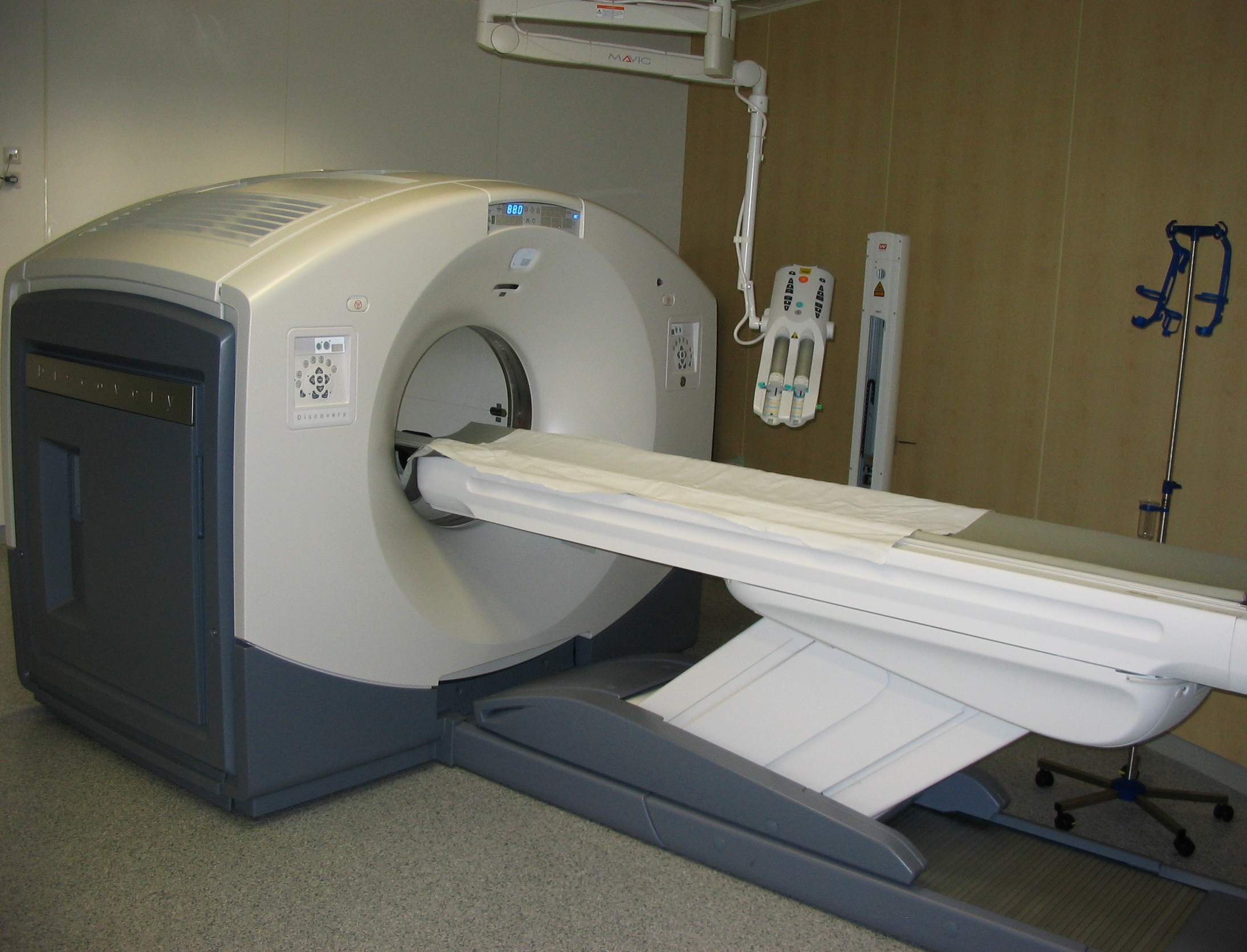
Matter–antimatter reactions have practical applications in medical imaging, such as positron emission tomography (PET). In positive beta decay, a nuclide loses surplus positive charge by emitting a positron (in the same event, a proton becomes a neutron, and a neutrino is also emitted). Nuclides with surplus positive charge are easily made in a cyclotron and are widely generated for medical use. Antiprotons have also been shown within laboratory experiments to have the potential to treat certain cancers, in a similar method currently used for ion (proton) therapy. |archive-url=https://web.archive.org/web/20110822150631/http://www.engr.psu.edu/antimatter/Papers/pbar_med.pdf |archive-date=22 August 2011
Fuel===
Isolated and stored antimatter could be used as a fuel for interplanetary or interstellar travel{{cite book
If matter–antimatter collisions resulted only in photon emission, the entire rest mass of the particles would be converted to kinetic energy. The energy per unit mass () is about 10 orders of magnitude greater than chemical energies, and about 3 orders of magnitude greater than the nuclear potential energy that can be liberated, today, using nuclear fission (about per fission reaction{{cite web |access-date=18 June 2010 |archive-url=https://web.archive.org/web/20100305114800/http://www.kayelaby.npl.co.uk/atomic_and_nuclear_physics/4_7/4_7_1.html |archive-date=5 March 2010
Not all of that energy can be utilized by any realistic propulsion technology because of the nature of the annihilation products. While electron–positron reactions result in gamma ray photons, these are difficult to direct and use for thrust. In reactions between protons and antiprotons, their energy is converted largely into relativistic neutral and charged pions. The neutral pions decay almost immediately (with a lifetime of 85 attoseconds) into high-energy photons, but the charged pions decay more slowly (with a lifetime of 26 nanoseconds) and can be deflected magnetically to produce thrust.
Charged pions ultimately decay into a combination of neutrinos (carrying about 22% of the energy of the charged pions) and unstable charged muons (carrying about 78% of the charged pion energy), with the muons then decaying into a combination of electrons, positrons and neutrinos (cf. muon decay; the neutrinos from this decay carry about 2/3 of the energy of the muons, meaning that from the original charged pions, the total fraction of their energy converted to neutrinos by one route or another would be about ). |access-date=24 May 2008 |archive-url=https://web.archive.org/web/20080528030524/http://gltrs.grc.nasa.gov/reports/1996/TM-107030.pdf |archive-date=28 May 2008
For more regular (earthly) applications (for example, regular transport, use in portable generators, and the powering of cities) artificially created antimatter is not a suitable energy carrier, despite its high energy density, because the process of creating antimatter is extremely inefficient. According to CERN, only one part in ten billion () of the energy invested in the production of antimatter particles can be subsequently retrieved. |access-date=18 November 2010 |archive-url=https://web.archive.org/web/20101116160609/http://public.web.cern.ch/public/en/Spotlight/SpotlightAandD-en.html |archive-date=16 November 2010
Antimatter production is currently very limited, but has been growing at a nearly geometric rate since the observation of the first antiproton in 1955 by Segrè and Chamberlain. |access-date=18 November 2010 |archive-url=https://web.archive.org/web/20100610093620/http://sciencematters.berkeley.edu/archives/volume1/issue1/legacy.php |archive-date=10 June 2010
Some researchers claim that with current technology, it is possible to obtain antimatter for US$25 million per gram by optimizing the collision and collection parameters (given current electricity generation costs). Many experts, however, dispute these claims as being far too optimistic by many orders of magnitude. They point out that, in 2004, the annual production of antiprotons at CERN was several picograms at a cost of $20 million. This means that to produce 1 gram of antimatter, CERN would need to spend 100 quadrillion () dollars and run the antimatter factory for 100 billion years.
Antimatter production costs, in mass production, are almost linearly tied to electricity costs, so economical pure-antimatter thrust applications are unlikely to come online unless a very cheap power source is found.
Storage is another problem, as antiprotons are negatively charged and repel each other, so that they cannot be concentrated in a small volume (cf. space charge). Plasma oscillations in the charged cloud of antiprotons can cause instabilities that drive antiprotons out of the storage trap. For these reasons, to date, only a few million antiprotons have been stored simultaneously in a magnetic trap, which corresponds to much less than a femtogram. Antihydrogen atoms or molecules are of neutral charge, they are not as ionically unstable as antiprotons. The drawback is that cold antihydrogen is far more complex to produce than mere antiprotons.
One researcher from the CERN laboratories, which produces antimatter regularly, said:
If we could assemble all of the antimatter we've ever made at CERN and annihilate it with matter, we would have enough energy to light a single electric light bulb for a few minutes.
|access-date=2010-11-18 |archive-url=https://web.archive.org/web/20101116160609/http://public.web.cern.ch/public/en/Spotlight/SpotlightAandD-en.html |archive-date=2010-11-16
Weapons
Main article: Antimatter weapon
Antimatter has been considered as a trigger mechanism for nuclear weapons. |archive-url=https://web.archive.org/web/20130424174413/http://cui.unige.ch/isi/sscr/phys/anti-BPP-3.html |archive-date=24 April 2013 |url-status=live |editor1-last=Velarde |editor1-first=G. |editor2-last=Minguez |editor2-first=E. |archive-url=https://web.archive.org/web/20120609101650/http://www.sfgate.com/cgi-bin/article.cgi?file=%2Fc%2Fa%2F2004%2F10%2F04%2FMNGM393GPK1.DTL |archive-date=9 June 2012 |url-status=live
References
References
- "Ten things you might not know about antimatter". symmetry magazine.
- (2014-01-16). "A systematic review of antiproton radiotherapy". Frontiers in Physics.
- (11 August 2011). "Smidgen of Antimatter Surrounds Earth". Discovery News.
- Agakishiev, H.. (2011). "Observation of the antimatter helium-4 nucleus". [[Nature (journal).
- Canetti, L.. (2012). "Matter and Antimatter in the Universe". New J. Phys..
- Tenenbaum, David. (28 December 2012). "One step closer: UW-Madison scientists help explain scarcity of antimatter". University of Wisconsin–Madison News.
- "Antimatter".
- McCaffery, Larry. (July 1991). "An Interview with Jack Williamson". Science Fiction Studies.
- Dirac, Paul. (1931). "Quantised singularities in the electromagnetic field". Proceedings of the Royal Society of London. Series A, Containing Papers of a Mathematical and Physical Character.
- "Discovering the positron".
- "Carl Anderson discovers the positron {{!}} timeline.web.cern.ch".
- This is a consequence of the [[CPT theorem]]
- As Dirac said in 1933 ''It is quite possible that for some of the stars it is the other way about, these stars being built up mainly of positrons and negative protons. In fact, there may be half the stars of each kind. The two kinds of stars would both show exactly the same spectra, and there would be no way of distinguishing them by present astronomical methods.'' {{harvnb. Dirac. 1965
- (2019). "First demonstration of antimatter wave interferometry". Science Advances.
- (2008). "Antiproton distributions around the Earth, Saturn and Jupiter from cosmic ray driven albedo antineutron decay". 37th COSPAR Scientific Assembly.
- Cowen, Ron. (2011-08-09). "Antimatter Belt Found Circling Earth".
- Sokol, Joshua. (April 2017). "Giant space magnet may have trapped antihelium, raising idea of lingering pools of antimatter in the cosmos". Science.
- (2011). "HiRadMat: A New Irradiation Facility for Material Testing at CERN". 2nd International Particle Accelerator Conference.
- (2024-06-12). "Laboratory realization of relativistic pair-plasma beams". Nature Communications.
- "All Nobel Prizes in Physics".
- (2006). "Breaking Through: A Century of Physics at Berkeley, 1868–1968". [[Regents of the University of California]].
- (1965). "Experimental observation of antideuteron production". Il Nuovo Cimento.
- (June 1965). "Observation of Antideuterons". Physical Review Letters.
- (December 2022). "Antimatter-Based Propulsion for Exoplanet Exploration". Nuclear Technology.
- Jackson, Gerald P.. (2022-08-01). "Deceleration of Exoplanet Missions Utilizing Scarce Antimatter". Acta Astronautica.
- (May 1, 2021). "Antimatter stars may lurk in the solar system's neighbourhood". New Scientist.
- Sokol, Joshua. (Apr 19, 2017). "Giant space magnet may have trapped antihelium, raising idea of lingering pools of antimatter in the cosmos". Science.
- (9 June 2011). "Antimatter of Fact". The Economist.
- (2017). "Improved limit on the directly measured antiproton lifetime". New Journal of Physics.
- (compared to the [[heat of formation. formation]] of water at {{val. 1.56
This article was imported from Wikipedia and is available under the Creative Commons Attribution-ShareAlike 4.0 License. Content has been adapted to SurfDoc format. Original contributors can be found on the article history page.
Ask Mako anything about Antimatter — get instant answers, deeper analysis, and related topics.
Research with MakoFree with your Surf account
Create a free account to save articles, ask Mako questions, and organize your research.
Sign up freeThis content may have been generated or modified by AI. CloudSurf Software LLC is not responsible for the accuracy, completeness, or reliability of AI-generated content. Always verify important information from primary sources.
Report