From Surf Wiki (app.surf) — the open knowledge base
Anthraquinones
Type of compounds
Type of compounds
For the parent molecule 9,10-anthraquinone, see anthraquinone
Anthraquinones (also known as anthraquinonoids) are a class of naturally occurring phenolic compounds based on the 9,10-anthraquinone skeleton. They are widely used industrially and occur naturally.
The name "anthraquinone" was first used by German chemists Carl Graebe and Carl Theodore Liebermann in a 1868 publication describing the chemical synthesis of the red dye alizarin from anthracene, a component of coal tar. This discovery led to the industrial production of alizarin and the impetus for further research on anthraquinone chemistry.
Occurrence in plants
:[[Image:Caloplaca thallincola.jpg|thumb|left|The yellow color of certain lichens, particularly in the family [[Teloschistaceae]] (here [[Variospora thallincola]]), is due to the presence of anthraquinones.]] Natural pigments that are derivatives of anthraquinone are found, inter alia, in aloe latex, senna, rhubarb, and cascara buckthorn, fungi, lichens, and some insects. A type II polyketide synthase is responsible for anthraquinone biosynthesis in the bacterium Photorhabdus luminescens. Chorismate, formed by isochorismate synthase in the shikimate pathway, is a precursor of anthraquinones in Morinda citrifolia. Tests for anthraquinones in natural extracts have been established.
- Senna glycosides from the senna.
- Frangulin in Frangula alnus.
- Aloe-emodin in aloe resin.
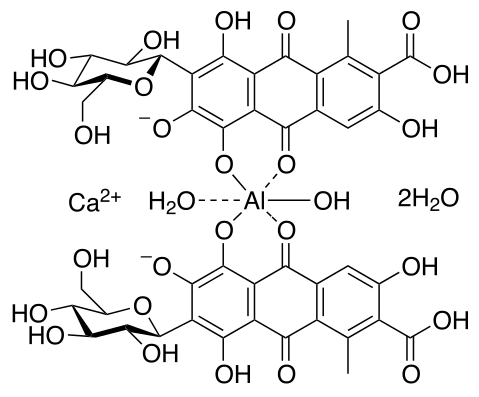
- Carmine, a bright-red pigment derived from insects.
- Hypericin and fagopyrin are naphthodianthrones, anthraquinone-derivatives.
Applications
In the production of hydrogen peroxide
Main article: Anthraquinone process
A large industrial application of anthraquinones is for the production of hydrogen peroxide. 2-Ethyl-9,10-anthraquinone or a related alkyl derivative is used, rather than anthraquinone itself.
Millions of tons of hydrogen peroxide are manufactured by the anthraquinone process.{{cite journal
Pulping
Sodium 2-anthraquinonesulfonate (AMS) is a water-soluble anthraquinone derivative that was the first anthraquinone derivative discovered to have a catalytic effect in the alkaline pulping processes.
Dyestuff precursor
Main article: Anthraquinone dyes
The 9,10-anthraquinone skeleton occurs in many dyes, such as alizarin. Important derivatives of 9,10-anthraquinone are 1-nitroanthraquinone, anthraquinone-1-sulfonic acid, and the dinitroanthraquinone.
an "acid dye" for wool (also called "Acilan Saphirol SE"), C.I. Vat Violet 1, which is applied by transfer printing using sublimation, a blue colorant commonly used in gasoline, and C.I. Disperse Red 60.]]
Medicine
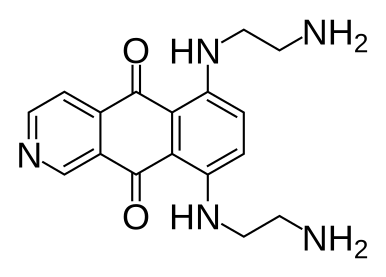
Derivatives of 9,10-anthraquinone include drugs such as the anthracenediones and the anthracycline family of chemotherapy drugs. The latter drugs are derived from the bacterium Streptomyces peucetius, discovered in a soil sample near the Adriatic Sea. Drugs in the anthraquinone family include the prototypical daunorubicin, doxorubicin, mitoxantrone, losoxantrone, and pixantrone. Most of these drugs, with the notable exception of pixantrone, are extremely cardiotoxic, causing irreversible cardiomyopathy, which can limit their practical usefulness in cancer treatment.
The anthracenediones also include
- Antimalarials such as rufigallol
- DNA dyes / nuclear counterstains such as DRAQ5, DRAQ7 and CyTRAK Orange for flow cytometry and fluorescence microscopy.
- Anthraquinone derivatives: rhein, emodin, aloe emodin, parietin (physcion), and chrysophanol extracted from Cassia occidentalis are toxic and known to cause hepatomyoencephalopathy in children.
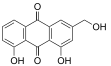

Dantron, emodin, and aloe emodin, and some of the senna glycosides have laxative effects. Prolonged use and abuse leads to melanosis coli.
Flow batteries
Soluble anthraquinones such as 9,10-anthraquinone-2,7-disulfonic acid are used as reactants in redox flow batteries, which provide electrical energy storage.
References
it:Antrachinoni
References
- Phillips, Max. (1929). "The chemistry of anthraquinone". Chemical Reviews.
- (2023). "Metagenomics shines light on the evolution of "sunscreen" pigment metabolism in the Teloschistales (lichen-forming Ascomycota)". Genome Biology and Evolution.
- (2007). "A type II polyketide synthase is responsible for anthraquinone biosynthesis in ''Photorhabdus luminescens''". ChemBioChem.
- (2003). "Regulation of anthraquinone biosynthesis in cell cultures of ''Morinda citrifolia''". Journal of Plant Physiology.
- (2010). "Antibacterial activity of leave extracts of ''Nymphaea lotus'' (Nymphaeaceae) on Methicillin resistant ''Staphylococcus aureus'' (MRSA) and Vancomycin resistant ''Staphylococcus aureus'' (VRSA) isolated from clinical samples". Annals of Biological Research.
- (2007). "Revised procedures for the certification of carmine (C.I. 75470, Natural red 4) as a biological stain". Biotechnic & Histochemistry.
- {{ cite encyclopedia. (2007). Wiley-VCH
- (1978-07-05). "Anthraquinone / Alkali Pulping - A Literature Review". The Institute of Paper Chemistry.
- (2005). "Anthraquinone Dyes and Intermediates".
- Vogel, A.. "Anthraquinone".
- (2015). "Investigation of the interaction of anthraquinones of ''Cassia occidentalis'' seeds with bovine serum albumin by molecular docking and spectroscopic analysis: Correlation to their in vitro cytotoxic potential". Food Research International.
- Müller-Lissner, S. A.. (1993). "Adverse Effects of Laxatives: Fact and Fiction". Pharmacology.
- (1988). "Laxative Abuse". Digestive Diseases.
- Fontmorin, Jean-Marie. (2022). "How anthraquinones can enable aqueous organic redox flow batteries to meet the needs of industrialization". Current Opinion in Colloid & Interface Science.
This article was imported from Wikipedia and is available under the Creative Commons Attribution-ShareAlike 4.0 License. Content has been adapted to SurfDoc format. Original contributors can be found on the article history page.
Ask Mako anything about Anthraquinones — get instant answers, deeper analysis, and related topics.
Research with MakoFree with your Surf account
Create a free account to save articles, ask Mako questions, and organize your research.
Sign up freeThis content may have been generated or modified by AI. CloudSurf Software LLC is not responsible for the accuracy, completeness, or reliability of AI-generated content. Always verify important information from primary sources.
Report