From Surf Wiki (app.surf) — the open knowledge base
Anthraquinone dyes
Class of chemical compounds

Class of chemical compounds
Anthraquinone dyes are an abundant group of dyes comprising a anthraquinone unit as the shared structural element. Anthraquinone itself is colourless, but red to blue dyes are obtained by introducing electron donor groups such as hydroxy or amino groups in the 1-, 4-, 5- or 8-position. Anthraquinone dyestuffs are structurally related to indigo dyestuffs and are classified together with these in the group of carbonyl dyes.
Members of this dye group can be found in natural dyes as well as in synthetic dyes. Anthraquinone dyestuffs are represented in mordant and vat, but also in reactive and disperse dyes. They are characterized by very good light fastness.
Natural anthraquinone dyes
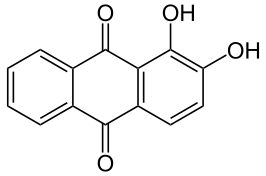
One of the most important anthraquinone dyes of herbal origin is alizarin, which is extracted from the dyer's madder (Rubia tinctorum). Alizarin is the eponym for a number of structurally related dyes that use alizarin dyes (sometimes synonymous with anthraquinone dyes). It was the first natural dye for which an industrial synthesis was developed as early as 1869.
Anthraquinone dyes include red insect dyes derived from scale insects such as carminic acid, kermesic acid, and laccaic acids. The colorant carmine, with the main component carminic acid, is used, for example, as an approved food colorant E 120. The traditional methods for carmine production are labour-, land-, and insect-intensive. Because demand for red dyes is predicted to increase, researchers are exploring metabolic engineering approaches for the production of synthetic carminic acid.
Synthetic anthraquinone dyes
The synthesis of most anthraquinone dyes is based on anthraquinone sulfonic acid (2) or nitroanthraquinone (3), which is obtained by sulfonation or nitration of anthraquinone (1).
:[[File:Synthesis 1-Aminoanthraquinone.svg|frameless|upright=2.2|Synthese von 1-Aminoanthrachinon]] :Synthesis of 1-aminoanthraquinone
Sulfonation in α position is reversible and both the sulfonic acid groups and the nitro groups can be relatively easily replaced by amino, alkylamino, hydroxy and alkoxy groups. Aminoanthraquinone (4) is thus accessible by reaction of anthraquinone sulfonic acid with ammonia or by reduction of nitroanthraquinone.{{citation |editor-first=Klaus |editor-last=Hunger |publisher=WILEY-VCH Verlag|publication-place=Weinheim|pages=200 ff.|isbn=978-3-662-01950-4|date=2003 |title=Industrial Dyes: Chemistry, Properties, Applications |url=
An important intermediate product for many acid anthraquinone dyes is bromamic acid (1-amino-4-bromoanthraquinone-2-sulfonic acid) (6), which can be obtained from 1-aminoanthraquinone (4) by sulfonation with chlorosulfonic acid and subsequent bromination.
:[[File:Synthesis Bromaminic Acid.svg|frameless|upright=2.7|Synthese von Bromaminsäure]] :Synthesis of bromamic acid
By replacing the bromine substituent with an aliphatic or aromatic amine, vibrant blue dyes are obtained.{{citation|surname1=Heinz-Gerhard Franck, Jürgen W. Stadelhofer|publisher=Springer Verlag|publication-place=Berlin, Heidelberg|pages=365 ff.|isbn=978-3-662-07876-1|date=1978 |language=de |title=Industrielle Aromatenchemie: Rohstoffe · Verfahren · Produkte |url=
:[[File:Synthesis Reactive Blue 19.svg|frameless|upright=3.0|Synthese von C.I. Reactive Blue 19]] :Synthesis of C.I. Reactive Blue 19
Reactive Blue 19 is one of the oldest and still the most important reactive dyes, patented in 1949.
The first anthraquinone-based synthetic vat dye was indanthrone (C.I. Vat Blue 4) - the synthesis of which was developed by René Bohn in 1901:
:[[File:Synthesis Indanthrone.svg|frameless|upright=3.2|Synthese von Indanthron]] :Synthesis of indanthrone
By dimerization of 2-aminoanthraquinone (1) under strongly alkaline conditions at 220-235 °C, intermediate stage 3 is obtained in two steps, which is cyclized intramolecularly and oxidized to indanthrone 5.
References
References
- (2003). ["Industrial Dyes: Chemistry, Properties, Applications"]({{Google books). WILEY-VCH Verlag.
- Zollinger, Heinrich. (2003). "Color Chemistry: Syntheses, Properties, and Applications of Organic Dyes and Pigments". WILEY-VCH Verlag.
- {{RömppOnline
- (17 February 2019). "The red insect dyes: carminic, kermesic and laccaic acids and their derivatives". Biotechnic & Histochemistry.
- (25 March 2022). "Cochineal, a red dye from bugs, moves to the lab". Knowable Magazine.
- (25 March 2022). "Next-Generation Genetic and Fermentation Technologies for Safe and Sustainable Production of Food Ingredients: Colors and Flavorings". Annual Review of Food Science and Technology.
- "Verfahren zur Herstellung von C.I. Reactive Blue 19".
- "Verfahren zum Fixieren wasserloeslicher organischer Verbindungen auf Unterlagen faseriger Struktur".
- Zollinger, Heinrich. (2003). "Color Chemistry: Syntheses, Properties, and Applications of Organic Dyes and Pigments". WILEY-VCH Verlag.
This article was imported from Wikipedia and is available under the Creative Commons Attribution-ShareAlike 4.0 License. Content has been adapted to SurfDoc format. Original contributors can be found on the article history page.
Ask Mako anything about Anthraquinone dyes — get instant answers, deeper analysis, and related topics.
Research with MakoFree with your Surf account
Create a free account to save articles, ask Mako questions, and organize your research.
Sign up freeThis content may have been generated or modified by AI. CloudSurf Software LLC is not responsible for the accuracy, completeness, or reliability of AI-generated content. Always verify important information from primary sources.
Report