From Surf Wiki (app.surf) — the open knowledge base
Annexation of Tibet by China
1950–1951 annexation in Asia
.jpg)
1950–1951 annexation in Asia
| Field | Value | |
|---|---|---|
| conflict | Annexation of Tibet by China | |
| image | 解放军在康定.jpg | |
| caption | PLA marching into Kangding | |
| date | 6 October 1950 – 24 October 1951 | |
| place | Tibet | |
| result | Chinese victory | |
| territory | Ü-Tsang and Chamdo Region of Kham came under the control of China. | |
| combatant1 | Tibet (1912–1951) | |
| combatant2 | People's Republic of China | |
| commander1 | {{Plainlist | |
| * Ngapoi Ngawang Jigme<ref name | "Mac"Mackerras, Colin. Yorke, Amanda. *The Cambridge Handbook of Contemporary China*. [1991]. Cambridge University Press. . p. 100. | |
| * Lhalu Tsewang Dorje<ref name | "Goldstein_1991_639" | |
| commander2 | {{Plainlist | |
| units1 | ||
| units2 |
- Tibet Ngawang Sungrab Thutob
- Tibet Ngapoi Ngawang Jigme
- Tibet Lhalu Tsewang Dorje
- China Mao Zedong
- China Liu Bocheng
- China Zhang Guohua
- China Fan Ming Central Tibet came under the control of the People's Republic of China (PRC) after the government of Tibet signed the Seventeen Point Agreement which the 14th Dalai Lama ratified on 24 October 1951. This followed attempts by the Tibetan government to modernize its military, negotiate with the PRC, and the defeat of the Tibetan Army by the People's Liberation Army at Chamdo in western Kham that resulted in several thousand casualties and captives. The Chinese government calls the signing of the agreement the "Peaceful Liberation of Tibet". The events are called the "Chinese invasion of Tibet" by the Central Tibetan Administration and the Tibetan diaspora.
The Tibetan government and local social structure remained in place under the authority of China until they were dissolved after the 1959 Tibetan uprising, when the 14th Dalai Lama fled into exile and repudiated the Seventeen Point Agreement, saying that he had approved it under duress.
Background
Qing dynasty
Main article: Tibet under Qing rule
Tibet came under the rule of the Qing dynasty of China in 1720 after the Qing expelled the forces of the Dzungar Khanate from Tibet. Emperor Kangxi then wrote an edict for the Imperial Stele Inscriptions of the Pacification of Tibet. His successor Emperor Yongzheng went on to establish new boundaries between what are now the Tibet Autonomous Region (TAR), Qinghai, Sichuan and Yunnan.
Republic of China and ''de facto'' independence
Central Tibet remained under Qing suzerainty until the 1911 revolution. The succeeding Republic of China claimed inheritance of all Qing territories, including Tibet, described in the Imperial Edict of the Abdication of the Qing Emperor as an integral republic comprising different ethnic groups. This is also reflected in the Provisional Constitution of the Republic of China adopted in 1912, though ethnic clashes occurred in Lhasa following the Wuchang Uprising.
By 1917 however the area comprising the present-day TAR eventually became a de facto independent polity. Some border areas with high ethnic Tibetan populations (Amdo and Eastern Kham) remained under the Chinese Nationalist Party (Kuomintang) or local warlord control.
The TAR region is also known as "Political Tibet", while all areas with a high ethnic Tibetan population are collectively known as "Ethnic Tibet". Political Tibet refers to the polity ruled continuously by Tibetan governments since earliest times until 1951, whereas ethnic Tibet refers to regions north and east where Tibetans historically predominated but where, down to modern times, Tibetan jurisdiction was irregular and limited to just certain areas.
At the time Political Tibet obtained de facto independence, its socio-economic and political systems resembled Medieval Europe. Attempts by the 13th Dalai Lama between 1913 and 1933 to enlarge and modernize the Tibetan military had eventually failed, largely due to opposition from powerful aristocrats and monks. On 12 August 1927, the Republic of China mandated that before the publication of new laws, all laws in history regarding Tibetan Buddhism should continue unless there were conflicts with new doctrine or new laws of the Central Government. The Tibetan government had little contact with other governments of the world during its period of de facto independence, with some exceptions; notably India, the United Kingdom, and the United States. This left Tibet diplomatically isolated and cut off to the point where it could not make its positions on issues well known to the international community.
People's Republic of China
In July 1949, in order to prevent Chinese Communist Party-sponsored agitation from spreading to Central Tibet, the Tibetan government expelled the Nationalist delegation in Lhasa. The (Nationalist) Chinese approved a request to exempt Lhamo Dhondup from lot-drawing process using Golden Urn to become the 14th Dalai Lama on 31 January 1940. In November 1949, Tibetan government sent a letter to the U.S. State Department and a copy to Mao Zedong, and a separate letter to the British government, declaring its intent to defend itself "by all possible means" against PRC troop incursions into Tibet.
In the preceding three decades, the conservative Tibetan government had consciously de-emphasized its military and refrained from modernizing. Hasty attempts at modernization and enlarging the military began in 1949, but proved mostly unsuccessful on both counts. By then, it was too late to raise and train an effective army. India provided some small arms aid and military training. However, the People's Liberation Army (PLA) was much larger, better led, trained, equipped and more experienced than the Tibetan Army.
In 1950, the 14th Dalai Lama was 15 years old and had not attained his majority, so Regent Taktra was the acting head of the Tibetan Government. The period of the Dalai Lama's minority is traditionally one of instability and division, exacerbated by the recent Reting conspiracy and a 1947 regency dispute.[[File:Map of Tibet- "TIBET CONFIDENTIAL" "Ethnographic Boundary of Tibet" "Approximate Line of Communist Advance" and "Reportedly occupied by Communists" "11518, CIA, 2-50" February 1950 map- 305945 11518 01.jpg|thumb|Approximate Line of Communist Advance (CIA, February 1950)]]
Both the PRC and their predecessors the Kuomintang (ROC) had always maintained that Tibet was a part of China. The PRC also proclaimed an ideological motivation to "liberate" the Tibetans from a theocratic feudal system. In September 1949, shortly before the proclamation of the People's Republic of China, the Chinese Communist Party (CCP) made it a top priority to incorporate Tibet, Taiwan Island, Hainan Island, and the Penghu Islands into the PRC, peacefully or by force. China viewed incorporating Tibet as important to consolidate its frontiers and address national defense concerns in the southwest. Because Tibet was unlikely to voluntarily give up its de facto independence, Mao in December 1949 ordered that preparations be made to march into Tibet at Qamdo (Chamdo), in order to induce the Tibetan Government to negotiate. The PRC had over a million men under arms and had extensive combat experience from the recently concluded Chinese Civil War.
Negotiations between Tibet and the PRC
Talks between Tibet and China were mediated by the governments of Britain and India. On 7 March 1950, a Tibetan delegation arrived in Kalimpong, India, to open a dialogue with the newly declared People's Republic of China and to secure assurances that the Chinese would respect Tibetan territorial integrity, among other things. The onset of talks was delayed by debate between the Tibetan, Indian, British, and Chinese delegations about the location of the talks. Tibet favored Singapore or Hong Kong (not Beijing; at the time romanized as Peking); Britain favored India (not Hong Kong or Singapore); and India and the Chinese favored Beijing. The Tibetan delegation did eventually meet with the PRC's ambassador General Yuan Zhongxian in Delhi on 16 September 1950. Yuan communicated a 3-point proposal that Tibet be regarded as part of China, that China be responsible for Tibet's defense, and that China be responsible for Tibet's trade and foreign relations. Acceptance would lead to peaceful Chinese sovereignty, or otherwise war. The Tibetans undertook to maintain the relationship between China and Tibet as one of priest-patron:
"Tibet will remain independent as it is at present, and we will continue to have very close 'priest-patron' relations with China. Also, there is no need to liberate Tibet from imperialism, since there are no British, American or Guomindang imperialists in Tibet, and Tibet is ruled and protected by the Dalai Lama (not any foreign power)."
They and their head delegate Tsepon W. D. Shakabpa, on 19 September, recommended cooperation, with some stipulations about implementation. Chinese troops need not be stationed in Tibet. It was argued that Tibet was under no threat, and if attacked by India or Nepal, could appeal to China for military assistance. While Lhasa deliberated, on 7 October 1950, Chinese troops advanced into eastern Tibet, crossing the border at five places. The purpose was not to invade Tibet per se but to capture the Tibetan army in Chamdo, demoralize the Lhasa government, and thus exert powerful pressure to send negotiators to Beijing to sign terms for a handover of Tibet. On 21 October, Lhasa instructed its delegation to leave immediately for Beijing for consultations with the Communist government, and to accept the first provision, if the status of the Dalai Lama could be guaranteed, while rejecting the other two conditions. It later rescinded even acceptance of the first demand, after a divination before the Six-Armed Mahākāla deities indicated that the three points could not be accepted, since Tibet would fall under foreign domination.
PLA capture of Chamdo
Main article: Battle of Chamdo
After months of failed negotiations, attempts by Tibet to secure foreign support and assistance, PRC and Tibetan troop buildups, the People's Liberation Army (PLA) crossed the Jinsha River on 6 or 7 October 1950. Two PLA units quickly surrounded the outnumbered Tibetan forces and captured the border town of Chamdo by 19 October, by which time 114 PLA soldiers and 180 Tibetan soldiers had been killed or wounded. Writing in 1962, Zhang Guohua claimed "over 5,700 enemy men were destroyed" and "more than 3,000" peacefully surrendered. The Peace Research Institute Oslo (PRIO) estimated that 2,000 PLA and 2,000 Tibetans were killed including noncombatants. Active hostilities were limited to a border area northeast of the Gyamo Ngul Chu River and east of the 96th meridian. After capturing Chamdo, the PLA broke off hostilities, sent a captured commander, Ngabo, to Lhasa to reiterate terms of negotiation, and waited for Tibetan representatives to respond through delegates to Beijing.
Further negotiations and annexation

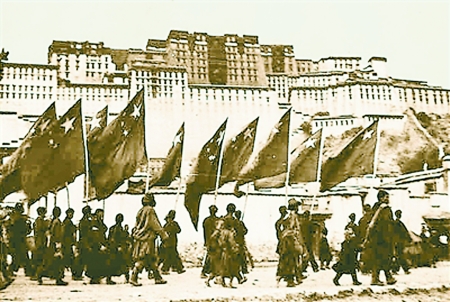
The PLA sent released prisoners (among them the governor-general of Kham, Ngapoi Ngawang Jigme), to Lhasa to negotiate with the Dalai Lama on the PLA's behalf. Chinese broadcasts promised that if Tibet was "peacefully liberated", the Tibetan elites could keep their positions and power.
One month after China invaded Tibet, El Salvador sponsored a complaint by the Tibetan government at the UN, but India and the United Kingdom prevented it from being debated.
Tibetan negotiators were sent to Beijing and presented with an already-finished document commonly referred to as the Seventeen Point Agreement. There was no negotiation offered by the Chinese delegation; although the PRC stated it would allow Tibet to reform at its own pace and in its own way, keep internal affairs self-governing and allow religious freedom; it would also have to agree to be part of China. The Tibetan negotiators were not allowed to communicate with their government on this key point, and pressured into signing the agreement on 23 May 1951, despite never having been given permission to sign anything in the name of the government. This was the first time in Tibetan history its government had acceptedalbeit unwillinglyChina's position on the two nations' shared history.
Tibetan representatives in Beijing and the PRC Government signed the Seventeen Point Agreement on 23 May 1951, authorizing the PLA presence and Central People's Government rule in Political Tibet. The terms of the agreement had not been cleared with the Tibetan Government before signing and the Tibetan Government was divided about whether it was better to accept the document as written or to flee into exile. The Dalai Lama, who by this time had ascended to the throne, chose not to flee into exile, and formally accepted the 17 Point Agreement in October 1951. According to Tibetan sources, on 24 October, on behalf of the Dalai Lama, general Zhang Jingwu sent a telegram to Mao Zedong with confirmation of the support of the Agreement, and there is evidence that Ngapoi Ngawang Jigme simply came to Zhang and said that the Tibetan Government agreed to send a telegram on 24 October, instead of the formal Dalai Lama's approval. Shortly afterwards, the PLA entered Lhasa. The subsequent annexation of Tibet is officially known in the People's Republic of China as the "Peaceful Liberation of Tibet" ( Hépíng jiěfàng xīzàng dìfāng), as promoted by the state media.
Aftermath

For several years, the Tibetan Government remained in place in the areas of Tibet where it had ruled prior to the outbreak of hostilities, except for the area surrounding Qamdo that was occupied by the PLA in 1950, which was placed under the authority of the Qamdo Liberation Committee and outside the Tibetan Government's control. During this time, areas under the Tibetan Government maintained a large degree of autonomy from the Central Government and were generally allowed to maintain their traditional social structure.
In 1956, Tibetan militias in the ethnically Tibetan region of eastern Kham just outside the Tibet Autonomous Region, spurred by PRC government experiments in land reform, started fighting against the government. The militias united to form Chushi Gangdruk Volunteer Force. When the fighting spread to Lhasa in March 1959, the Dalai Lama left Lhasa on March 17 with an entourage of twenty, including six Cabinet ministers, and fled Tibet.
Both the Dalai Lama and the PRC government in Tibet subsequently repudiated the 17 Point Agreement, and the PRC government in Tibet dissolved the Tibetan Local Government. The legacy of this action continues to the present day.
Notes
References
Citations
Sources
- Ford, Robert. Wind Between the Worlds: The extraordinary first-person account of a Westerner's life in Tibet as an official of the Dalai Lama (1957) David Mckay Co., Inc.
- Robert W. Ford. Captured in Tibet, Oxford University Press, 1990,
- Knaus, Robert Kenneth. Orphans of the Cold War: America and the Tibetan Struggle for Survival (1999) PublicAffairs .
- Laird, Thomas. The Story of Tibet: Conversations with the Dalai Lama (2006) Grove Press.
References
- Mackerras, Colin. Yorke, Amanda. ''The Cambridge Handbook of Contemporary China''. [1991]. Cambridge University Press. {{ISBN. 0-521-38755-8. p. 100.
- (1991). "A history of modern Tibet, 1913–1951, the demise of the lamaist state". University of California Press.
- [[Tenzin Gyatso. 14th Dalai Lama]] (1990). ''[[Freedom in Exile. Freedom in Exile: The Autobiography of the Dalai Lama]]''. London: Little, Brown and Co. {{ISBN. 0-349-10462-X.
- Laird 2006 p. 301.
- Shakya 1999, p. 43
- A. Tom Grunfeld. (30 July 1996). "The Making of Modern Tibet". M.E. Sharpe.
- (2008). "Authenticating Tibet: Answers to China's 100 Questions". University of California Press.
- Tsepon Wangchuk Deden Shakabpa. (October 2009). "One Hundred Thousand Moons: An Advanced Political History of Tibet". BRILL.
- (May 1951). "China confirms 'peaceful liberation' of Tibet – archive, 1951". The Guardian.
- Dawa Norbu. (2001). "China's Tibet Policy". Psychology Press.
- {{harvp. Goldstein, A History of Modern Tibet, Vol. 1. 1989
- (25 May 2017). "China could not succeed in destroying Buddhism in Tibet: Sangay". [[Central Tibetan Administration]].
- Siling, Luo. (2016-08-14). "A Writer's Quest to Unearth the Roots of Tibet's Unrest". The New York Times.
- (March 17, 2015). "How and Why the Dalai Lama Left Tibet". Time.
- {{harvp. Goldstein, The Snow Lion and the Dragon. 1997. Feigon. 1996
- (18 April 1959). "The Dalai Lama's Press Statements - Statement issued at Tezpur".
- (January 2015). "《御制平定西藏碑》The Imperial Stele Inscriptions of the Pacification of Tibet in Four Languages". 西北民族论丛Northwest Ethnology Series.
- Kolmaš, Josef. (1967). "Tibet and Imperial China: A Survey of Sino-Tibetan Relations Up to the End of the Manchu Dynasty in 1912". Centre of Oriental Studies, Australian National University, Canberra.
- (2009). "China: A History". Hackett.
- (2006). "Empire to Nation: Historical Perspectives on the Making of the Modern World". Rowman & Littlefield Publishers.
- (2017). "憲法何以中國". City University of HK Press.
- (2016). "政治憲法與未來憲制". City University of HK Press.
- (2004). "A Nation-state by Construction: Dynamics of Modern Chinese Nationalism". Stanford University Press.
- Shakya 1999 p. 4
- {{harvp. Goldstein, A History of Modern Tibet, Vol. 1. 1989
- Feigon 1996 p.119
- Shakya 1999 p.6,27. Feigon 1996 p.28
- The classic distinction drawn by [[Sir Charles Bell]] and [[Hugh Edward Richardson. Hugh Richardson]]. See Melvin C. Goldstein, 'Change, Conflict and Continuity among a community of Nomadic Pastoralists: A Case Study from Western Tibet, 1950–1990,' in Robert Barnett and Shirin Akiner, (eds.,) ''Resistance and Reform in Tibet,'' Indiana University Press, Bloomington, 1994, pp. 76–90, pp.77–8.
- Shakya 1999 p.11
- Feigon 1996 p.119-122. {{harvp. Goldstein, The Snow Lion and the Dragon. 1997
- Shakya 1999 p.5,11
- (16 April 2021). "【边疆时空】喜饶尼玛 李双{{!}}国民政府管理藏传佛教活佛措施评析".
- Shakya 1999 p.7,15,16
- {{harvp. Goldstein, The Snow Lion and the Dragon. 1997
- {{harvp. Goldstein, The Snow Lion and the Dragon. 1997
- Shakya 1999 p.5,7,8
- (1940). "Report to Wu Zhongxin from the Regent Reting Rinpoche Regarding the Process of Searching and Recognizing the Thirteenth Dalai lama's Reincarnated Soul Boy as well as the Request for an Exemption to Drawing Lots". Museum of Tibetan Culture of China Tibetology Research Center.
- (1940). "Executive Yuan's Report to the National Government Regarding the Request to Approve Lhamo Thondup to Succeed the Fourteenth Dalai lama and to Appropriate Expenditure for His Enthronement". Museum of Tibetan Culture of China Tibetology Research Center.
- Shakya 1999 p.20; {{harvp. Goldstein, The Snow Lion and the Dragon. 1997
- Melvin C. Goldstein,''A History of Modern Tibet:The Calm Before the Storm: 1951–1955,'' University of California Press, 2009, Vol.2, p.51.
- Shakya 1999 p.12
- Shakya 1999 p.20,21; {{harvp. Goldstein, The Snow Lion and the Dragon. 1997
- Goldstein, 209 pp.51–2.
- Shakya 1999 p.26
- Shakya 1999 p.12 (Tibetan army poorly trained and equipped).
- {{harvp. Goldstein, The Snow Lion and the Dragon. 1997
- Feigon 1996 p.142 (trained).
- Shakya 1999 p.5
- Shakya 1999 p.4,5
- Dawa Norbu, ''China's Tibet policy,''Routledge, 2001, p.195
- {{harvp. Goldstein, The Snow Lion and the Dragon. 1997
- Shakya 1999 p.3.
- Goldstein 1997 p.44
- Singh, Swaran. (2016). "The new great game : China and South and Central Asia in the era of reform". [[Stanford University Press]].
- Goldstein, Melvyn C. (2009). "A History of Modern Tibet. Volume 2: The Calm Before the Storm, 1951–1955". University of California Press.
- Melvin C. Goldstein, ''A History of Modern Tibet: The Calm Before the Storm: 1951–1955,'' University of California Press, 2009, Vol.2, p.48.
- Melvin C. Goldstein, ''A History of Modern Tibet,'' vol.2, p.48-9.
- Shakya 1999 p.27-32 (entire paragraph).
- W. D. Shakabpa,''One hundred thousand moons'', BRILL, 2010 trans. Derek F. Maher, Vol.1, pp.916–917, and ch.20 pp.928–942, esp.pp.928–33.
- Melvin C. Goldstein, ''A History of Modern Tibet: The Calm Before the Storm: 1951–1955,'' Vol.2, ibid.pp.41–57.
- Shakya 1999 p.28-32
- Shakya 1999 p.12,20,21
- Feigon 1996 p.142. Shakya 1999 p.37.
- Shakya 1999 p.32 (6 Oct); {{harvp. Goldstein, The Snow Lion and the Dragon. 1997
- link. (18 March 2012 , ''china.com.cn''): "The Quamdo battle thus came to a victorious end on October 24, with 114 PLA soldiers and 180 Tibetan troops killed or wounded.")
- Shakya 1999, pg. 45.
- Feigon 1996, p.144.
- Survey of China Mainland Press, no. 2854 p.5,6
- Lacina, Bethany. (2009). "PRIO battle deaths dataset, 1946-2008, version 3.0: Documentation of coding decisions".
- Shakya 1999 map p.xiv
- {{harvp. Goldstein, The Snow Lion and the Dragon. 1997
- Shakya 1999 p.49
- Laird, 2006 p. 306.
- "UN General Assembly Resolutions".
- 'The political and religious institutions of Tibet would remain unchanged, and any social and economic reforms would be undertaken only by the Tibetans themselves at their own pace.' Thomas Laird, ''The Story of Tibet: Conversations with the Dalai Lama,''Grove Press, 2007, p.307.
- {{harvp. Goldstein, The Snow Lion and the Dragon. 1997
- (1999). "The Dragon in the Land of Snows: A History of Modern Tibet Since 1947". Columbia University Press.
- {{harvp. Goldstein, The Snow Lion and the Dragon. 1997
- link. (30 October 2012 {{ISBN). 978-93-80359-47-2
- {{harvp. Goldstein, The Snow Lion and the Dragon. 1997
- (10 April 2018). "西藏和平解放65周年:细数那些翻天覆地的变化". 中国军网.
- Goldstein, Melvyn C.. (2007-08-01). "A History of Modern Tibet, volume 2: The Calm before the Storm: 1951–1955". University of California Press.
- Shakya 1999 p.96,97,128.
- {{harvp. Goldstein, The Snow Lion and the Dragon. 1997
- {{harvp. Goldstein, The Snow Lion and the Dragon. 1997
- (April 20, 1959). "The Dalai Lama Escapes from the Chinese". Time.
- (February 13, 2021). "Time To Break The Silence On Tibet". The Sunday Guardian.
- (June 23, 1984). "China's Tibet Problem". The New York Times.
This article was imported from Wikipedia and is available under the Creative Commons Attribution-ShareAlike 4.0 License. Content has been adapted to SurfDoc format. Original contributors can be found on the article history page.
Ask Mako anything about Annexation of Tibet by China — get instant answers, deeper analysis, and related topics.
Research with MakoFree with your Surf account
Create a free account to save articles, ask Mako questions, and organize your research.
Sign up freeThis content may have been generated or modified by AI. CloudSurf Software LLC is not responsible for the accuracy, completeness, or reliability of AI-generated content. Always verify important information from primary sources.
Report