From Surf Wiki (app.surf) — the open knowledge base
Annapurna
10th-highest mountain on Earth
10th-highest mountain on Earth
| Field | Value | ||||||
|---|---|---|---|---|---|---|---|
| name | Annapurna | ||||||
| photo | South Face of Annapurna I (Main).jpg | ||||||
| photo_caption | South face of Annapurna I (Main) | ||||||
| elevation_m | 8091 | ||||||
| elevation_ref | |||||||
| Ranked 10th | |||||||
| parent_peak | Cho Oyu | ||||||
| prominence_m | 2984 | ||||||
| prominence_ref | {{cite web | ||||||
| url | http://www.peaklist.org/WWlists/ultras/everest.html | title=Nepal/Sikkim/Bhutan Ultra-Prominences | publisher=peaklist.org | access-date=12 January 2009 | archive-url= https://web.archive.org/web/20081225145550/http://www.peaklist.org/WWlists/ultras/everest.html | archive-date= 25 December 2008 | url-status= live}} |
| Ranked 94th | |||||||
| listing | Eight-thousander | ||||||
| Ultra | |||||||
| location | Gandaki Province, Nepal | ||||||
| range | Annapurna | ||||||
| map_image | |||||||
| label_position | right | ||||||
| coordinates | |||||||
| first_ascent | 3 June 1950 | ||||||
| Maurice Herzog and Louis Lachenal | |||||||
| (First winter ascent 3 February 1987 Jerzy Kukuczka and Artur Hajzer) | |||||||
| easiest_route | northeast face |
the individual mountain
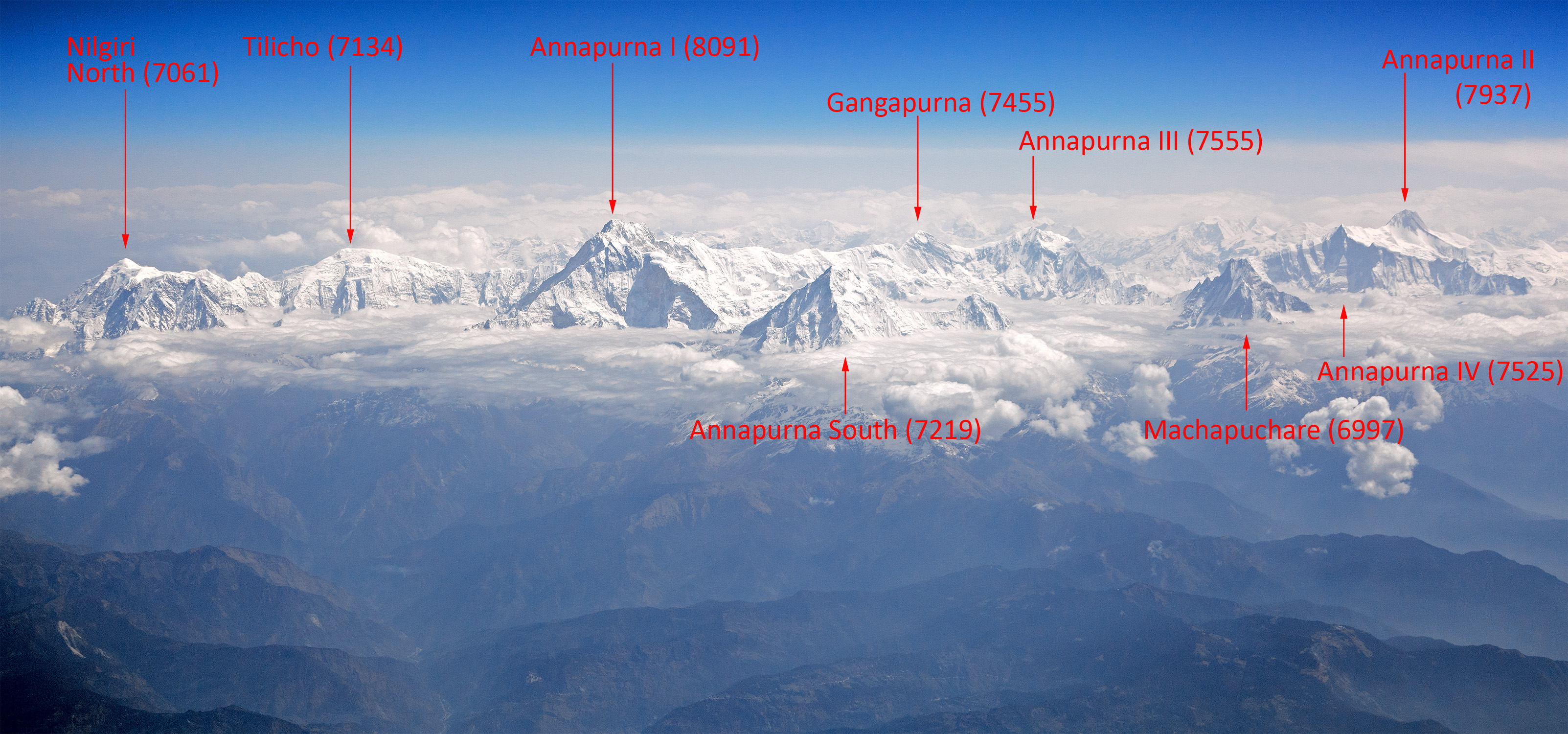
Ranked 10th Ranked 94th Ultra Maurice Herzog and Louis Lachenal (First winter ascent 3 February 1987 Jerzy Kukuczka and Artur Hajzer) Annapurna (; ) is a mountain situated in the Annapurna mountain range of Gandaki Province, north-central Nepal. It is the 10th highest mountain in the world at 8091 m above sea level and is well known for the difficulty and danger involved in its ascent.
Maurice Herzog led a French expedition to its summit through the north face in 1950, making it the first eight-thousander to be successfully climbed. The entire massif and surrounding area are protected within the 7629 km2 Annapurna Conservation Area, the first and largest conservation area in Nepal. The Annapurna Conservation Area is home to several world-class treks, including Annapurna Sanctuary and Annapurna Circuit.
For decades, Annapurna I held the highest fatality-to-summit rate of all principal eight-thousander summits; it has, however, seen great climbing successes in recent years, with the fatality rate falling from 32% to under 20% from 2012 to 2022. This figure places it just under the most recent fatality rate estimates for K2, at about 24%. The mountain still poses grave threats to climbers through avalanche danger, unpredictable weather and the extremely steep and committing nature of its climbing routes, in particular its 3000 m south face, renowned as one of the most difficult climbs in the world. It is also a dangerous peak for trekkers, as in the case of a 2014 snowstorm near it and Dhaulagiri which claimed at least 43 lives. As of 2022, 365 people had reached the summit of Annapurna I, while 72 had died in the attempt.
Etymology
The mountain is named after Annapurna, the Hindu goddess of food and nourishment, who is said to reside there. The name Annapurna is derived from the Sanskrit-language words purna ("filled") and anna ("food"), and can be translated as "everlasting food". Many streams descending from the slopes of the Annapurna Massif provide water for the agricultural fields and pastures located at lower elevations.
Climbing history
Climbing expeditions
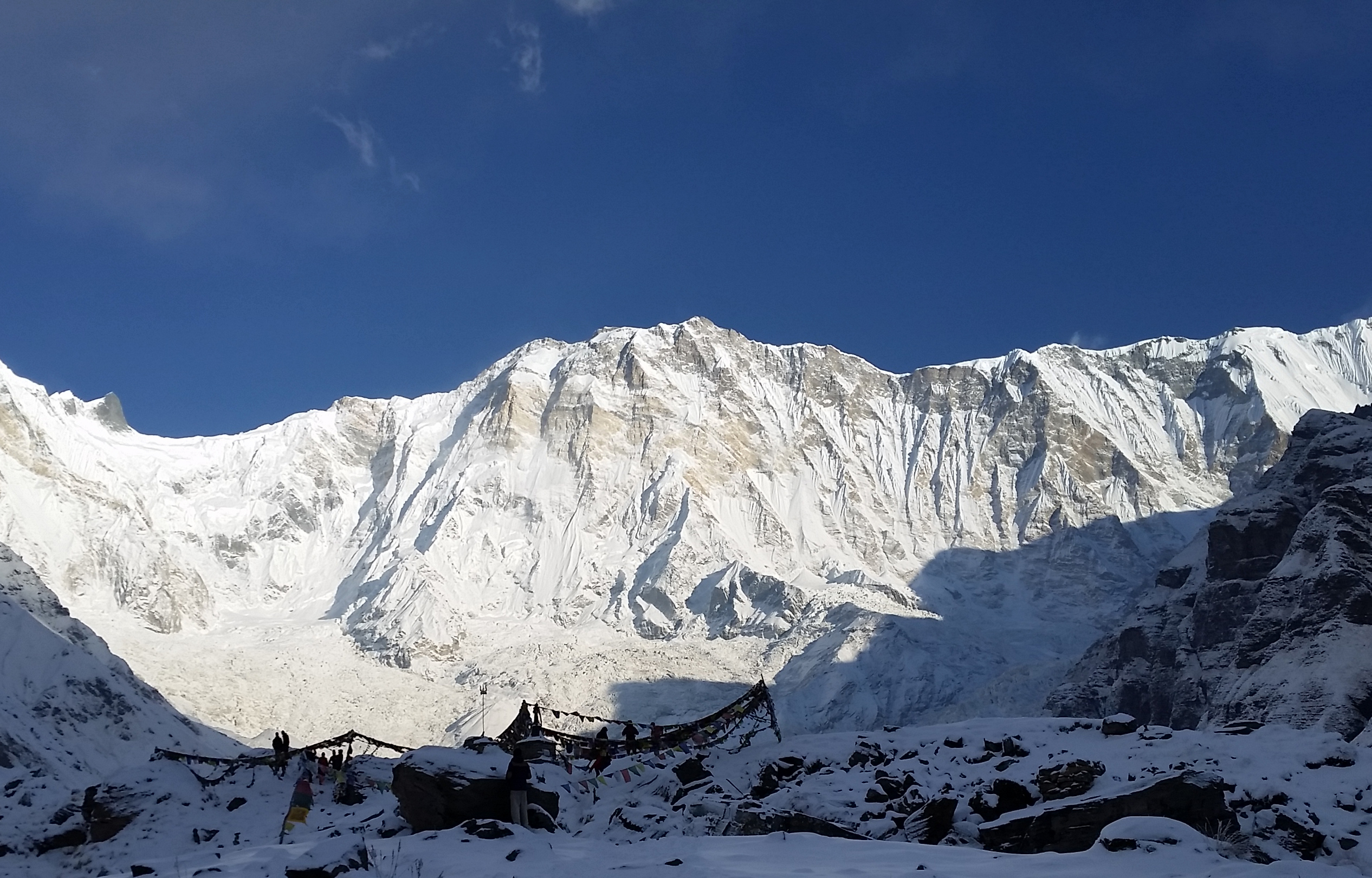
Annapurna I was the first 8000 m peak to be climbed. Maurice Herzog and Louis Lachenal, of the French Annapurna expedition led by Herzog (including Lionel Terray, Gaston Rébuffat, Marcel Ichac, Jean Couzy, Marcel Schatz, Jacques Oudot, Francis de Noyelle), reached the summit on 3 June 1950. Ichac made a documentary of the expedition, called Victoire sur l'Annapurna. Its summit was the highest one ever attained at the time, but not the highest climb; higher non-summit points – at least 8500 m – had already been attained on Mount Everest in the 1920s.
The south face of Annapurna was first climbed in 1970 by Don Whillans and Dougal Haston also without using supplementary oxygen, members of a British expedition led by Chris Bonington that included Ian Clough, who was killed by a falling serac during the descent. They were, however, beaten to the second ascent of Annapurna by a matter of days by a British Army expedition whose climbing team was led by then-Captain Henry Day.
In 1978, the American Women's Himalayan Expedition, a team led by Arlene Blum, became the first United States team to climb Annapurna I. The first summit team, composed of Vera Komarkova and Irene Miller, and Sherpas Mingma Tsering and Chewang Ringjing, reached the top at 3:30 pm on 15 October 1978. The second summit team, Alison Chadwick-Onyszkiewicz and Vera Watson, died during this climb.
In 1981 Polish expedition Zakopane Alpine Club set a new route on Annapurna I Central (8051 m). Maciej Berbeka and Bogusław Probulski reached the summit on 23 May 1981. The route called Zakopiańczyków Way was recognized as the best achievement of the Himalayan season in 1981.
On 3 February 1987, Polish climbers Jerzy Kukuczka and Artur Hajzer made the first winter ascent of Annapurna I.
The first solo ascent of the south face was made in October 2007 by Slovenian climber Tomaž Humar; he climbed to Roc Noir and then to Annapurna East (8,047m).
On 8 and 9 October 2013 Swiss climber Ueli Steck soloed the Lafaille route this was his third attempt on the route and has been called "one of the most impressive Himalayan climbs in history", with Steck taking 28 hours to make the trip from Base Camp to summit and back again. There are significant doubts about this claim.
Fatality rate
Along with K2 and Nanga Parbat, Annapurna I has consistently ranked as one of the most dangerous of the principal eight-thousander summits. Climbers killed on the peak include Britons Ian Clough in 1970, Kazakh Anatoli Boukreev in 1997, Spaniard Iñaki Ochoa in 2008, Korean Park Young-seok in 2011 and the Finn Samuli Mansikka in 2015.
Flights
Several airlines offer sightseeing flights over Annapurna.
References
Bibliography
- {{cite book | last = Blum | first = Arlene | author-link = Arlene Blum
- {{cite book | last = Herzog | first = Maurice | author-link = Maurice Herzog
References
- "Annapurna".
- Hawley, Elizabeth. (1987). "Asia, Nepal, Annapurna Winter Ascent: Kukuczka's 13th 8000er, 1987".
- Benavides, Angela. (20 April 2022). "Annapurna: A Climbers' Guide".
- {{Dictionary.com. Annapurna
- "Annapurna". [[Oxford University Press]].
- (17 December 2013). "The Eight-Thousanders". [[NASA Earth Observatory]].
- (19 June 2008). "Complete ascent — fatalities statistics of all 14 main 8000ers". 8000ers.com.
- Loar, Julie. (2011). "Goddesses for Every Day: Exploring the Wisdom and Power of the Divine Feminine Around the World". New World Library.
- Frankel, Edith Rogovin. (15 September 2003). "Walking in the Mountains: A Woman's Guide". Derrydale Press.
- (29 May 2013). "Stairway to heaven". The Economist.
- Herzog, 1953, p. 257.
- Frost, Tom. (1971). "Annapurna South Face".
- Bonington, Chris. (March 1971). "Annapurna South Face". Book Club Associates.
- Blum, 1980.
- "8000m Peak". summitpost.org.
- "New Alpine Solo Route on the South Face of Annapurna". russianclimb.com.
- (29 January 2008). "Climbing Annapurna: Tomaz Humar".
- "Tomaz Humar klettert solo durch die Annapurna Südwand". Bergsteigen.at.
- Von: Text: adidas eyewear. (26 November 2007). "Tomaz Humar glückt Erstbegehung am Annapurna im Alpinstil - Climbing.de - Alle Infos für Bergsteiger und Kletterer". Climbing.de.
- [http://www.russianclimb.com/annapurna/2008/anna2008.jpg "Annapurna South Face Routes"], russianclimb.com, accessed 13 October 2013.
- "Ueli Steck and Annapurna: the interview after his South Face solo".
- (10 October 2013). "Steck Solos Annapurna South Face".
- [http://www.ukclimbing.com/news/item.php?id=68412 "Annapurna South Face Solo - 28 Hours"], ukclimbing.com, accessed 13 October 2013.
- (9 April 2021). "I think Ueli Steck lied".
- Lafaille, Jean-Christophe. (1993). "Asia, Nepal, Annapurna South Face Tragedy".
- (23 May 2008). "It's over: Iñaki Ochoa lost on Annapurna". mounteverest.net.
- Woo, Jaeyeon. (31 October 2011). "With Park Gone, Korea Loses Its Trailblazer". The Wall Street Journal.
- (2 April 2015). "Farewell Samuli Mansikka, the fearless Finn".
- "Annapurna flying- Nepali Times".
This article was imported from Wikipedia and is available under the Creative Commons Attribution-ShareAlike 4.0 License. Content has been adapted to SurfDoc format. Original contributors can be found on the article history page.
Ask Mako anything about Annapurna — get instant answers, deeper analysis, and related topics.
Research with MakoFree with your Surf account
Create a free account to save articles, ask Mako questions, and organize your research.
Sign up freeThis content may have been generated or modified by AI. CloudSurf Software LLC is not responsible for the accuracy, completeness, or reliability of AI-generated content. Always verify important information from primary sources.
Report