From Surf Wiki (app.surf) — the open knowledge base
Anise
Species of flowering plant
Species of flowering plant
This article is about the Pimpinella species (not to be confused with star anise, Illicium verum, or with Japanese star anise, Illicium anisatum).
|Anisum odoratum Raf. |Anisum officinale DC. |Anisum officinarum Moench |Anisum vulgare Gaertn. |Apium anisum (L.) Crantz |Carum anisum (L.) Baill. |Pimpinele anisa St.-Lag. |Ptychotis vargasiana DC. |Selinum anisum (L.) E.H.L. Krause |Seseli gilliesii Hook. & Arn. |Sison anisum (L.) Spreng. |Tragium anisum (L.) Link
Anise (; Pimpinella anisum), also called aniseed or rarely anix, is a flowering plant in the family Apiaceae native to the eastern Mediterranean region and Southwest Asia.
The flavor and aroma of its seeds have similarities with some other spices and herbs, such as star anise, fennel, liquorice, and tarragon. It is widely cultivated and used to flavor food, candy, and alcoholic drinks, especially around the Mediterranean.
Etymology
The name "anise" is derived via Old French from the Latin words anīsum or anēthum from Greek ἄνηθον ánēthon referring to dill.
An obsolete English word for anise is anet, also coming from anīsum.
Botany
Anise is an herbaceous annual plant growing to 2 - or more. The leaves at the base of the plant are simple, 3/8 – long and shallowly lobed, while leaves higher on the stems are feathery or lacy, pinnate, divided into numerous small leaflets.
Both leaves and flowers are produced in large, loose clusters. The flowers are either white or yellow, approximately 1/8 in in diameter, produced in dense umbels.
The fruit is a dry oblong and curved schizocarp, 1/6 – long, usually called "aniseed".
|Gardenology.org-IMG 2834 rbgs11jan.jpg|Royal Botanic Garden, Sydney |Aniseed held in hand.jpg|Fruits in hand for scale |Aniseed p1160018.jpg|Fruits (aniseed) |AniseSeeds.jpg|Close-up of fruits |Anisi fructus - microscopy.jpg|Microscope cross-section of fruit
Ecology
Anise is a food plant for the larvae of some Lepidoptera species (butterflies and moths), including the lime-speck pug and wormwood pug.
Cultivation
Anise was first cultivated in the Middle East, and was brought to Europe for its medicinal value. It has been cultivated in Egypt for approximately 4,000 years.
Anise plants grow best in light, fertile, well-drained soil. The seeds should be planted as soon as the ground warms up in spring. Because the plants have a taproot, they do not transplant well after being established so they should either be started in their final location or be transplanted while the seedlings are still small.
Production
Western cuisines have long used anise to flavor dishes, drinks, and candies. The word is used for both the species of herb and its licorice-like flavor. The most powerful flavor component of the essential oil of anise, anethole, is found in both anise and an unrelated spice indigenous to South China called star anise (Illicium verum) widely used in South Asian, Southeast Asian and East Asian dishes. Star anise is considerably less expensive to produce and has gradually displaced P. anisum in Western markets. While formerly produced in larger quantities, by 1999 world production of the essential oil of anise was 8 tons, compared to 400 tons of star anise.
Uses
Composition
As with all spices, the composition of anise varies considerably with origin and cultivation method. These are typical values for the main constituents.
:Moisture: 9–13% :Protein: 18% :Fatty oil: 8–23% :Essential oil: 2–7% :Starch: 5% :N-free extract: 22–28% :Crude fibre: 12–25%
In particular, the anise seeds products should also contain more than 0.2 milliliter volatile oil per 100 grams of spice.
Culinary
Anise is sweet and aromatic, distinguished by its characteristic flavor. (alone or in combination with other aromatic herbs), as well many regional and ethnic confectioneries, including black jelly beans (often marketed as licorice-flavored), British aniseed balls, aniseed twists and "troach" drops, Australian humbugs, New Zealand aniseed wheels, Italian pizzelle and biscotti, German Pfeffernüsse and Springerle, Austrian Anisbögen, Dutch muisjes, New Mexican bizcochitos and Peruvian picarones.
The culinary uses of anise are not limited only to sweets and confections, as it is a key ingredient in Mexican atole de anís and champurrado, which is similar to hot chocolate. In India and Pakistan, it is taken as a digestive after meals, used in brines in the Italian region of Apulia and as a flavoring agent in Italian sausage, pepperoni and other Italian processed meat products. The freshly chopped leaves are added to cheese spreads, dips or salads, while roots and stems impart a mild licorice flavor to soups and stews.
Liquor
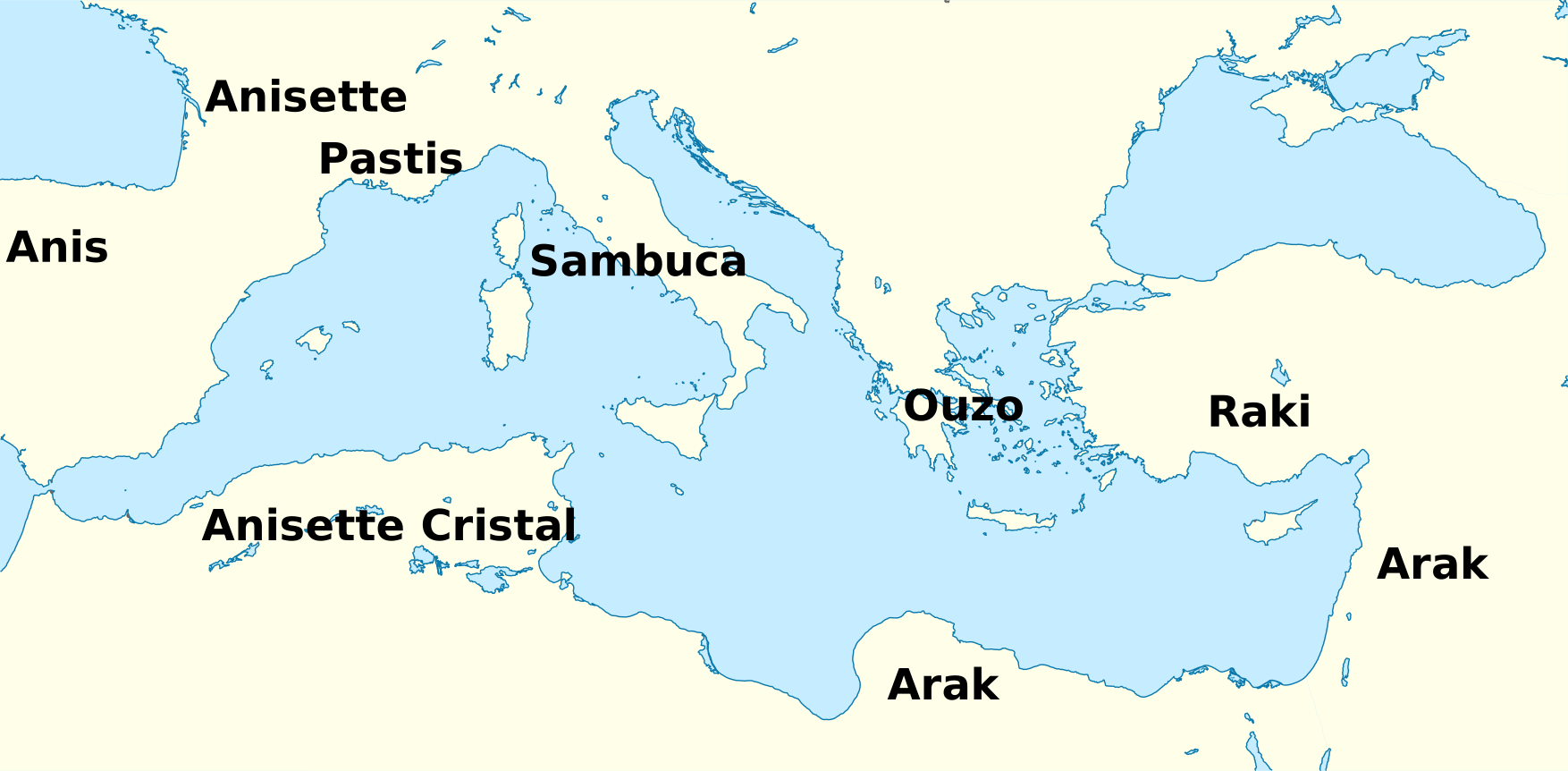
Anise is used to flavour Greek ouzo and Bulgarian mastika; Portuguese anis which has an aniseed stem in each bottle crystallised with sugar, Spanish anis de chinchón, anís, anísado, Turkish and Armenian rakı; and Algerian Anisette Cristal. and Mexican Xtabentún. These liqueurs are clear, but on addition of water become cloudy, a phenomenon known as the ouzo effect.
Anise is used together with other herbs and spices in some root beers, such as Virgil's in the United States.
Traditional medicine
The main use of anise in traditional European herbal medicine was for its carminative effect (reducing flatulence), as noted by John Gerard in his Great Herball, an early encyclopedia of herbal medicine:
The seed wasteth and consumeth winde, and is good against belchings and upbraidings of the stomach, alaieth gripings of the belly, provoketh urine gently, maketh abundance of milke, and stirreth up bodily lust: it staieth the laske (diarrhea), and also the white flux (leukorrhea) in women.
According to Pliny the Elder, anise was used as a cure for sleeplessness, chewed with alexanders and a little honey in the morning to freshen the breath, and, when mixed with wine, as a remedy for asp bites (N.H. 20.72). In 19th-century medicine, anise was prepared as aqua anisi ("Water of Anise") in doses of an ounce or more and as spiritus anisi ("Spirit of Anise") in doses of 5–20 minims. In Turkish folk medicine, its seeds have been used as an appetite stimulant, tranquilizer or diuretic.
Essential oil

Anise essential oil can be obtained from the fruits by either steam distillation or extraction using supercritical carbon dioxide. The yield of essential oil is influenced by the growing conditions and extraction process, with supercritical extraction being more efficient. Regardless of the method of isolation the main component of the oil is anethole (80–90%), with minor components including 4-anisaldehyde, estragole and pseudoisoeugenyl-2-methylbutyrates amongst others. (Alternately found by Orav et al. 2008 to be 2–6% extracted oil by weight of raw seed material, 74–94% being trans-anethole and the remaining fraction estragole (methylchavicol), anisaldehyde and γ-himachalene.) Anethole is responsible for anise's characteristic odor and flavor.
Other uses
Builders of steam locomotives in Britain incorporated capsules of aniseed oil into white metal plain bearings so the distinctive smell would give warning in case of overheating. Anise can be made into a liquid scent and is used for both drag hunting and fishing. It is put on fishing lures to attract fish.
References
References
- from Franz Eugen Köhlae, Köhlae's Medizinal-Pflanzen, 1897
- (2023). "''Pimpinella anisum'' L.". World Flora Consortium.
- {{cite LPD. 3
- (n.d.). "Anice vera, ''Pimpinella anisum'' L.". Altervista.
- (1879). "ănēthum". Perseus Digital Library.
- (2018). "Anise". Oxford Dictionaries, Oxford University Press.
- "''s.v.'' 'anise'".
- (April 1997). "Anise—''Pimpinella anisum'' L.". [[University of Florida]] Institute of Food and Agricultural Sciences.
- Katzer, Gernot. (9 September 1998). "Anise (''Pimpinella anisum'' L.)".
- "Aniseed - Cargo Handbook - the world's largest cargo transport guidelines website".
- "Anise Uses, Benefits & Side Effects - Drugs.com Herbal Database".
- "Tips for Transplanting Seedlings".
- Peter, K. V.. (2004). "Handbook of Herbs and Spices". Woodhead Publishing.
- Philip R. Ashurst. (August 2023). "Food Flavorings". Springer.
- J.S. Pruthi: Spices and Condiments, New Delhi: National Book Trust (1976), p. 19.
- Branch, Legislative Services. "Consolidated federal laws of canada, Food and Drug Regulations".
- "Anise seed: Properties, benefits, mischief, dosage, and side effects".
- (4 November 2015). "Favourite traditional British sweets: in pictures".
- Peter, K.V.. (2012). "Handbook of herbs and spices Volume 2".
- (2003). "Alcohol and Temperance in Modern History: An International Encyclopedia". ABC-CLIO.
- admin. "Chincon".
- (2004). "El libro de los licores de España". Ediciones Robinbook.
- (29 February 2012). "Xtabentún Cocktail Guide, with Origins and Recipes". Wine Enthusiast Magazine.
- Sitnikova, Natalia L.. (2005). "Spontaneously Formed trans-Anethol/Water/Alcohol Emulsions: Mechanism of Formation and Stability". Langmuir.
- Ganachaud, François. (2005). "Nanoparticles and Nanocapsules Created Using the Ouzo Effect: Spontaneous Emulsification as an Alternative to Ultrasonic and High-Shear Devices". ChemPhysChem.
- "Virgil's Bavarian Nutmeg". Reeds.
- "Virgil's Rootbeer – Spike's Root Beer Reviews and Ratings". Root Beer Reviews.
- John Gerard, [http://caliban.mpiz-koeln.mpg.de/gerarde/high/IMG_0940.html ''The Herball, or Generall Historie of Plantes''] {{Webarchive. link. (2011-06-14 , 1597, p. 880, side 903)
- Pliny. (1856). "The Natural History of Pliny". Henry Bohn.
- Baytop, T. (1999) ''Therapy with medicinal plants in Turkey, Past and Present.'' Kitapevi, Istanbul, Turkey, 2nd edition, pp. 142.
- (September 2007). "Economic analysis of rosemary, fennel and anise essential oils obtained by supercritical fluid extraction". Flavour and Fragrance Journal.
- (May 2001). "Effects of water supply and sowing date on performance and essential oil production of anise (''Pimpinella anisum'' L.)". Acta Agronomica Hungarica.
- (March 2003). "Supercritical Extraction of Essential Oil from Aniseed using sCO2: Solubility, Kinetics and Composition Data". Journal of Agricultural and Food Chemistry.
- (2017). "The Apiaceae: Ethnomedicinal family as source for industrial uses". [[Elsevier]].
- Jodral, Manuel Miro. ''Illicium, Pimpinella and Foeniculum''. CRC Press, 2004. pp. 205
- (1953). "none". [[The Railway Magazine]].
- Collins, Tony. (2005). "Encyclopedia of traditional British rural sports". Routledge.
- Gabriel, Otto. (2005). "Fish catching methods of the world". Blackwell.
This article was imported from Wikipedia and is available under the Creative Commons Attribution-ShareAlike 4.0 License. Content has been adapted to SurfDoc format. Original contributors can be found on the article history page.
Ask Mako anything about Anise — get instant answers, deeper analysis, and related topics.
Research with MakoFree with your Surf account
Create a free account to save articles, ask Mako questions, and organize your research.
Sign up freeThis content may have been generated or modified by AI. CloudSurf Software LLC is not responsible for the accuracy, completeness, or reliability of AI-generated content. Always verify important information from primary sources.
Report