From Surf Wiki (app.surf) — the open knowledge base
Angular frequency
Rate of change of angle
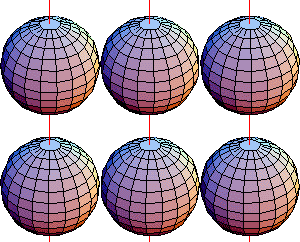
Rate of change of angle
| Field | Value |
|---|---|
| name | Angular frequency |
| othernames | angular speed, angular rate |
| image | File:AngularFrequency.gif |
| caption | |
| unit | radian per second (rad/s) |
| otherunits | degrees per second (°/s) |
| symbols | *ω* |
| baseunits | s−1 |
| derivations | , |
| dimension | wikidata |
In physics, angular frequency (symbol ω), also called angular speed and angular rate, is a scalar measure of the angle rate (the angle per unit time) or the temporal rate of change of the phase argument of a sinusoidal waveform or sine function (for example, in oscillations and waves). Angular frequency (or angular speed) is the magnitude of the pseudovector quantity angular velocity.
Angular frequency can be obtained by multiplying rotational frequency, ν (or ordinary frequency, f) by a full turn (2 radians): . It can also be formulated as , the instantaneous rate of change of the angular displacement, θ, with respect to time, t. | url-access = registration
Unit
In SI units, angular frequency is normally presented in the unit radian per second. The unit hertz (Hz) is dimensionally equivalent, but by convention it is only used for frequency f, never for angular frequency ω. This convention is used to help avoid the confusion that arises when dealing with quantities such as frequency and angular quantities because the units of measure (such as cycle or radian) are considered to be one and hence may be omitted when expressing quantities in terms of SI units.
In digital signal processing, the frequency may be normalized by the sampling rate, yielding the normalized frequency.
Examples
Circular motion
Main article: Circular motion
In a rotating or orbiting object, there is a relation between distance from the axis, r, tangential speed, v, and the angular frequency of the rotation. During one period, T, a body in circular motion travels a distance vT. This distance is also equal to the circumference of the path traced out by the body, 2\pi r. Setting these two quantities equal, and recalling the link between period and angular frequency we obtain: \omega = v/r. Circular motion on the unit circle is given by \omega = \frac{2 \pi}{T} = {2 \pi f} , where:
- ω is the angular frequency (SI unit: radians per second),
- T is the period (SI unit: seconds),
- f is the ordinary frequency (SI unit: hertz).
Oscillations of a spring
An object attached to a spring can oscillate. If the spring is assumed to be ideal and massless with no damping, then the motion is simple and harmonic with an angular frequency given by \omega = \sqrt{\frac{k}{m}}, where
- k is the spring constant,
- m is the mass of the object.
ω is referred to as the natural angular frequency (sometimes be denoted as ω0).
As the object oscillates, its acceleration can be calculated by a = -\omega^2 x, where x is displacement from an equilibrium position.
Using standard frequency f, this equation would be a = -(2 \pi f)^2 x.
LC circuits
The resonant angular frequency in a series LC circuit equals the square root of the reciprocal of the product of the capacitance (C, with SI unit farad) and the inductance of the circuit (L, with SI unit henry): \omega = \sqrt{\frac{1}{LC}}.
Adding series resistance (for example, due to the resistance of the wire in a coil) does not change the resonant frequency of the series LC circuit. For a parallel tuned circuit, the above equation is often a useful approximation, but the resonant frequency does depend on the losses of parallel elements.
Terminology
Although angular frequency is often loosely referred to as frequency, it differs from frequency by a factor of 2, which potentially leads confusion when the distinction is not made clear.
References and notes
Related Reading:
- {{cite book
ca:Freqüència angular he:תדירות זוויתית
References
- (2019). "ISO 80000-3:2019 Quantities and units — Part 3: Space and time". [[International Organization for Standardization]].
- Lerner, Lawrence S.. (1996-01-01). "Physics for scientists and engineers". Jones & Bartlett Learning.
- (2015). "Dimensionless Units in the SI". Metrologia.
- (7 August 2011). "SI units need reform to avoid confusion". Nature.
This article was imported from Wikipedia and is available under the Creative Commons Attribution-ShareAlike 4.0 License. Content has been adapted to SurfDoc format. Original contributors can be found on the article history page.
Ask Mako anything about Angular frequency — get instant answers, deeper analysis, and related topics.
Research with MakoFree with your Surf account
Create a free account to save articles, ask Mako questions, and organize your research.
Sign up freeThis content may have been generated or modified by AI. CloudSurf Software LLC is not responsible for the accuracy, completeness, or reliability of AI-generated content. Always verify important information from primary sources.
Report