From Surf Wiki (app.surf) — the open knowledge base
Anencephaly
Neural tube defect involving absence of much of the brain, skull and scalp

Neural tube defect involving absence of much of the brain, skull and scalp
| Field | Value |
|---|---|
| name | Anencephaly |
| image | Anencephaly-web.jpg |
| caption | Illustration of an anencephalic fetus |
| specialty | Medical genetics; pediatrics |
| symptoms | Absence of the cerebrum and cerebellum |
| risks | Folate deficiency |
| prevention | Mother taking enough folic acid (vitamin B9) |
| prognosis | Death typically occurs within hours to days after birth |
| frequency | 1 in 4600 in the U.S. |

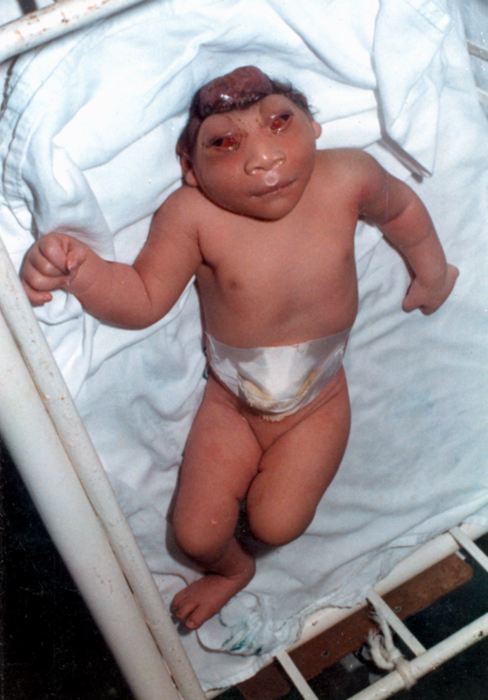
Anencephaly is the absence of a major portion of the brain, skull, and scalp that occurs during embryonic development. It is a cephalic disorder that results from a neural tube defect that occurs when the rostral (head) end of the neural tube fails to close, usually between the 23rd and 26th day following conception. Strictly speaking, the Greek term translates as "without a brain", but it is accepted that children born with this disorder usually only lack a telencephalon, the largest part of the brain consisting mainly of the cerebral hemispheres, including the neocortex, which is responsible for cognition. The remaining structure is usually covered only by a thin layer of membrane—skin, bone, meninges, etc., are all lacking. With very few exceptions, infants with this disorder do not survive longer than a few hours or days after birth.
Anencephaly is a severe neural tube defect typically considered incompatible with prolonged postnatal survival, and as such, surgical intervention is not commonly indicated.
Signs and symptoms
The National Institute of Neurological Disorders and Stroke (NINDS) describes the presentation of this condition as follows: "A baby born with anencephaly is usually blind, deaf, unaware of its surroundings and unable to feel pain. Although some individuals with anencephaly may be born with a main brain stem, the lack of a functioning cerebrum permanently rules out the possibility of ever gaining awareness of their surroundings. Reflex actions such as breathing and responses to sound or touch may occur."
Causes
Folic acid has been shown to be important in neural tube formation since at least 1991, and as a subtype of neural tube defect, folic acid may play a role in anencephaly. Studies have shown that the addition of folic acid to the diet of women of child-bearing age may significantly reduce, although not eliminate, the incidence of neural tube defects. Therefore, it is recommended that all women of child-bearing age consume 0.4 mg of folic acid daily, especially those attempting to conceive or who may possibly conceive, as this can reduce the risk to 0.03%. It is not advisable to wait until pregnancy has begun, since, by the time a woman knows she is pregnant, the critical time for the formation of a neural tube defect has usually already passed. A physician may prescribe even higher dosages of folic acid (5 mg/day) for women having had a previous pregnancy with a neural tube defect.
Neural tube defects can follow patterns of heredity, with direct evidence of autosomal recessive inheritance. As reported by Bruno Reversade and colleagues, the homozygous inactivation of the NUAK2 kinase leads to anencephaly in humans. Animal models indicate a possible association with deficiencies of the transcription factor TEAD2. A woman who has had one child with a neural tube defect such as anencephaly has about a 3% risk of having another child with a neural tube defect, as opposed to the background rate of 0.1% occurrence in the population at large. Genetic counseling is usually offered to women at a higher risk of having a child with a neural tube defect to discuss available testing.
Relation to genetic ciliopathy
Until recently, medical literature did not indicate a connection among many genetic disorders, both genetic syndromes and genetic diseases, that are now being found to be related. As a result of new genetic research, some of these are, in fact, highly related in their root cause despite the widely varying set of medical symptoms that are clinically visible in the disorders. Anencephaly is one such disease, part of an emerging class of diseases called ciliopathies. The underlying cause may be a dysfunctional molecular mechanism in the primary cilia structures of the cell, organelles present in many cellular types throughout the human body. The cilia defects adversely affect "numerous critical developmental signaling pathways" essential to cellular development and, thus, offer a plausible hypothesis for the often multi-symptom nature of a large set of syndromes and diseases. Known ciliopathies include primary ciliary dyskinesia, Bardet–Biedl syndrome, polycystic kidney and liver disease, nephronophthisis, Alström syndrome, Meckel–Gruber syndrome, and some forms of retinal degeneration.
Diagnosis

Anencephaly can often be diagnosed before birth through an ultrasound examination. The maternal serum alpha-fetoprotein (AFP screening) and detailed fetal ultrasound can be useful for screening for neural tube defects such as spina bifida or anencephaly.
Meroanencephaly
Meroanencephaly is a rare form of anencephaly characterized by malformed cranial bones, a median cranial defect, and a cranial protrusion called area cerebrovasculosa. Area cerebrovasculosa is a section of abnormal, spongy, vascular tissue admixed with glial tissue ranging from simply a membrane to a large mass of connective tissue, hemorrhagic vascular channels, glial nodules, and disorganized choroid plexuses.
Holoanencephaly
The most common type of anencephaly, where the brain has entirely failed to form, except for the brain stem. Infants rarely survive more than one day after birth with holoanencephaly.
Craniorachischisis
Main article: Rachischisis
The most severe type of anencephaly where area cerebrovasculosa and area medullovasculosa fill both cranial defects and the spinal column. Craniorachischisis is characterized by anencephaly accompanied by bony defects in the spine and the exposure of neural tissue as the vault of the skull fails to form. Craniorachischisis occurs in about 1 of every 1000 live births, but various physical and chemical tests can detect neural tube closure during early pregnancy.
Prognosis
There is no cure or standard treatment for anencephaly. Prognosis is extremely poor, as many anencephalic fetuses do not survive birth and infants that are not stillborn will usually die within a few hours or days after birth from cardiorespiratory arrest.
In 2023, Menekse and colleagues reported what they described as the first surgical procedure performed on an infant with anencephaly who survived beyond the neonatal period. The case involved a multidisciplinary approach and neurosurgical intervention aimed at improving the patient's quality of life.
Epidemiology
As of 2024, anencephaly occurs in about 1 out of every 5250 births (1.9‱) in the United States. In 1990, rates in Nigeria were estimated at 3 per 10,000 (3.0‱). Meanwhile, rates in Ghana were estimated at 8 per 10,000 (8.0‱) in 1992, and rates in China were estimated at 5 per 10,000 (5.0‱) in 2005.
A high anencephaly rate of 19.7 per 10,000 live births was found in 1990/1991 in Brownsville, Texas. A cluster of cases made national headlines and prompted a public health investigation and the Texas Neural Tube Defect Project. It was found, that neural tube defects in general, including spina bifida, and encephalocele had been occurring in Mexican-American women undetected for years in the area. Subsequently, multiple risk factors were found, foremost folic acid deficiency, low serum vitamin B12, high serum homocysteine levels, and obesity independently contributed to risk. Increasing dietary folate intake had a protective effect.
Research has suggested that, overall, female babies are more likely to be affected by the disorder.
Ethical issues
Organ donation
One issue concerning anencephalic newborns is organ donation. Initial legal guidance came from the case of Baby Theresa in 1992, in which the boundaries of organ donation were tested for the first time. Infant organs are scarce, and the high demand for pediatric organ transplants poses a major public health issue. In 1999, it was found that for American children under the age of two who are waiting for a transplant, 30–50% die before an organ becomes available.
Within the medical community, the main ethical issues with organ donation are a misdiagnosis of anencephaly, the slippery slope argument, that anencephalic neonates would rarely be a source of organs, and that it would undermine confidence in organ transplantation. Slippery slope concerns are a major issue in personhood debates, across the board. In regards to anencephaly, those who oppose organ donation argue that it could open the door for involuntary organ donors such as an elderly person with severe dementia. Another point of contention is the number of children who would actually benefit. There are discrepancies in statistics; however, it is known that most anencephalic children are stillborn.
Proposals have been made to bypass the legal and ethical issues surrounding organ donation. These include waiting for death to occur before procuring organs, expanding the definition of death, creating a special legal category for anencephalic infants, and defining them as non-persons.
In the United Kingdom, a child born with anencephaly was reported as the country's youngest organ donor. Teddy Houlston was diagnosed as anencephalic at 12 weeks of gestation. His parents, Jess Evans and Mike Houlston, decided against abortion and instead proposed organ donation. Teddy was born on 22 April 2014, in Cardiff, Wales, and lived for 100 minutes, after which his heart and kidneys were removed. His kidneys were later transplanted into an adult in Leeds. Teddy's twin, Noah, was born healthy.
Brain death
There are four different concepts used to determine brain death: failure of heart, failure of lungs, whole brain death, and neocortical death.
Neocortical death, similar to a persistent vegetative state (PVS), involves loss of cognitive functioning of the brain. A proposal by law professor David Randolph Smith, in an attempt to prove that neocortical death should legally be treated the same as brain death, involved PET scans to determine the similarities. However, this proposal has been criticized on the basis that confirming neocortical death by PET scan may risk indeterminacy.
Pregnancy termination
Anencephaly can be diagnosed before delivery with a high degree of accuracy. Although anencephaly is a fatal condition, the option of abortion is dependent on the abortion laws in the jurisdiction. According to a 2013 report, 26% of the world's population reside in a country where abortion is generally prohibited. In 2012, Brazil extended the right of abortion to mothers with anencephalic fetuses. This decision, however, received vocal disapproval from several religious groups.
Legal proceedings
The case of baby Theresa was the beginning of the ethical debate over anencephalic infant organ donation. The story of baby Theresa remains a focus of basic moral philosophy. Baby Theresa was born with anencephaly in 1992. Her parents, knowing that their child was going to die, requested that her organs be given for transplantation. Although her physicians agreed, Florida law prohibited the infant's organs from being removed while she was still alive. By the time she died nine days after birth, her organs had deteriorated past the point of being viable.
United States uniform acts
The Uniform Determination of Death Act (UDDA) is a model bill, adopted by many US states, stating that an individual who has sustained either 1) irreversible cessation of circulatory and respiratory functions or 2) irreversible cessation of all functions of the entire brain, including the brain stem, is dead. This bill was a result of much debate over the definition of death and is applicable to the debate over anencephaly. A related bill, the Uniform Anatomical Gift Act (UAGA), grants individuals and, after death, their family members the right to decide whether or not to donate organs. Because it is against the law for any person to pay money for an organ, the person in need of an organ transplant must rely on a volunteer.
There have been two state bills that proposed to change current laws regarding death and organ donation. California Senate Bill 2018 proposed to amend the UDDA to define anencephalic infants as already dead, while New Jersey Assembly Bill 3367 proposed to allow anencephalic infants to be organ sources even if they are not dead.
Research
Some genetic research has been conducted to determine the causes of anencephaly. It has been found that cartilage homeoprotein (CART1) is selectively expressed in chondrocytes (cartilage cells). The CART1 gene to chromosome 12q21.3–q22 has been mapped. Also, it has been found that mice homozygous for deficiency in the Cart1 gene manifested acrania and meroanencephaly, and prenatal treatment with folic acid will suppress acrania and meroanencephaly in the Cart1-deficient mutants.
References
References
- (3 September 2015). "Cephalic disorders – Overview, Anencephaly, Colpocephaly – neurologychannel".
- (1992). "Human Embryology & Teratology". Wiley-Liss, Inc.
- Chervenak, F.A.. (1995). "Ultrasound and the Fetal Brain: Progress in Obstetric and Gynecological Sonography Series". Parthenon Pub. Group.
- "Anencephaly Information Page: National Institute of Neurological Disorders and Stroke (NINDS)".
- "Baby Without A Brain, Nickolas Coke, Update".
- (24 March 2023). "First report of surgery for anencephaly in twin pregnancies: Technical notes and postoperative management". Medicine.
- Centers for Disease Control (CDC). (2 August 1991). "Use of folic acid for prevention of spina bifida and other neural tube defects--1983-1991". MMWR. Morbidity and Mortality Weekly Report.
- (1991). "Prevention of neural tube defects: Results of the Medical Research Council Vitamin Study.". Lancet.
- (October 2012). "Family medicine obstetrics". Mosby Elsevier.
- (1990). "Evidence for a major gene in familial anencephaly". American Journal of Medical Genetics.
- (7 December 2020). "A loss-of-function NUAK2 mutation in humans causes anencephaly due to impaired Hippo-YAP signaling". The Journal of Experimental Medicine.
- (2007). "Transcription factor TEAD2 is involved in neural tube closure". Genesis.
- (1980). "The recurrence risk for neural tube defects in the United States: A collaborative study". American Journal of Medical Genetics.
- "Neural Tube Defects (NTD)".
- "Anencephaly {{!}} Genetic and Rare Diseases Information Center (GARD) – an NCATS Program".
- (22 August 2011). "Anencephaly". National Institutes of Health.
- (2006). "The Ciliopathies: An Emerging Class of Human Genetic Disorders". Annual Review of Genomics and Human Genetics.
- (2007). "Neural tube defects in the sample of genetic counselling". Prenat. Diagn..
- (2006). "Detection of fetal structural abnormalities by an 11-14-week ultrasound dating scan in an unselected Swedish population". Acta Obstetricia et Gynecologica Scandinavica.
- (1993). "Meroanencephaly: Pathology and Prenatal Diagnosis". Fetal Diagnosis and Therapy.
- (2010). "Craniorachischisis totalis". Journal of Neurosciences in Rural Practice.
- Gilbert, Scott F.. (2010). "Developmental biology". Sinauer Associates.
- (26 December 2024). "Anencephaly". Centers for Disease Control and Prevention.
- (2005). "Neural Tube Defects: From Origin to Treatment: From Origin to Treatment". Oxford University Press.
- Xiao, Emily. (July 2023). "Lessons from Brownsville's anencephaly cluster". The Lancet.
- Centers for Disease Control and Prevention (CDC). (14 January 2000). "Neural tube defect surveillance and folic acid intervention--Texas-Mexico border, 1993-1998". MMWR. Morbidity and Mortality Weekly Report.
- (November 2012). "Neural tube defects on the Texas-Mexico border: What we've learned in the 20 years since the Brownsville cluster". Birth Defects Research Part A: Clinical and Molecular Teratology.
- (1970). "The sex ratio in anencephaly". Genetica.
- (1999). "The diagnosis is anencephaly and the parents ask about organ donation: Now what? A guide for hospital counsel and ethics committees". Western New England Law Review.
- (1995). "The Use of Anencephalic Neonates as Organ Donors". JAMA.
- (1992). "Anencephalic infants as organ donors: Beware the slippery slope". CMAJ.
- [https://www.bbc.co.uk/news/health-32425666] {{Webarchive. link. (28 May 2018. BBC News. Retrieved on 23 April 2015.)
- "Archived copy".
- Beresford, H. Richard. (July 1996). "Ethics in Neuroscience: Mind over Matter". Indiana University.
- Meinke, Sue. (June 1989). "Anencephalic Infants as Potential Organ Sources: Ethical and Legal Issues". National Reference Center for Bioethics Literature.
- "The World's Abortion Laws Map 2013 Update".
- "Anencephaly in Brazil: A New Decision, Old Issues".
- Rachels, James. "What is Morality".
- "Uniform Declaration of Death Act (UDDA)".
- (2008). "Syndromes, Disorders and Maternal Risk Factors Associated with Neural Tube Defects (III)". Taiwanese Journal of Obstetrics and Gynecology.
- (1996). "Prenatal folic acid treatment suppresses acrania and meroanencephaly in mice mutant for the Cart1 homeobox gene". Nature Genetics.
This article was imported from Wikipedia and is available under the Creative Commons Attribution-ShareAlike 4.0 License. Content has been adapted to SurfDoc format. Original contributors can be found on the article history page.
Ask Mako anything about Anencephaly — get instant answers, deeper analysis, and related topics.
Research with MakoFree with your Surf account
Create a free account to save articles, ask Mako questions, and organize your research.
Sign up freeThis content may have been generated or modified by AI. CloudSurf Software LLC is not responsible for the accuracy, completeness, or reliability of AI-generated content. Always verify important information from primary sources.
Report