From Surf Wiki (app.surf) — the open knowledge base
Andean condor
Species of bird
Species of bird
- Vultur magellanicus Shaw, 1792
- Sarcoramphus cuntur Duméril, 1806
- Vultur condor Shaw, 1809
- Sarcorhamphus aequatorialis Sharpe, 1874
- Vultur fossilis Moreno & Mercerat, 1891
- Vultur patruus Lönnberg, 1902
- Vultur pratruus Emslie, 1988 (lapsus)
The Andean condor (Vultur gryphus) is a South American New World vulture and is the only extant member of the genus Vultur. It is found in the Andes mountains and adjacent Pacific coasts of western South America. With a maximum wingspan of 3.3 m and weight of 15 kg, the Andean condor is one of the largest flying birds in the world, and is generally considered to be the largest bird of prey in the world.
One of two species commonly referred to as condors, it is a large black vulture with a ruff of white feathers surrounding the base of the neck and, especially in the male, large white patches on the wings. The head and neck are nearly featherless, and are a dull red color, which may flush and therefore change color in response to the bird's emotional state. In the male, there is a wattle on the neck and a large, dark red comb or caruncle on the crown of the head. The female condor is smaller than the male, an exception to the usual sexual dimorphism seen in birds of prey.
The condor is primarily a scavenger, feeding on carrion. It prefers large carcasses, such as those of deer or cattle. It reaches sexual maturity at five or six years of age and nests at elevations of up to 5000 m, generally on inaccessible rock ledges. One or two eggs are usually laid per clutch. It is one of the world's longest-living birds, with a lifespan of over 70 years in some cases.
The Andean condor is a national symbol of Bolivia, Chile, Colombia, Ecuador, and Peru and plays an important role in the folklore and mythology of the Andean regions. The Andean condor is considered vulnerable by the IUCN. It is threatened by habitat loss and by secondary poisoning from lead in carcasses killed by hunters. Captive breeding programs have been instituted in several countries.
Taxonomy and systematics
The Andean condor was described by Swedish scientist Carl Linnaeus in 1758 in the tenth edition of his Systema Naturae and retains its original binomial name of Vultur gryphus.
Etymology
The Andean condor is sometimes called the Argentinean condor, Bolivian condor, Chilean condor, Colombian condor, Ecuadorian condor, or Peruvian condor after one of the nations to which it is native. The generic term Vultur is directly taken from the Latin vultur or voltur, which means "vulture". Its specific epithet is derived from a variant of the Greek word γρυπός (grupós, "hook-nosed"). The word condor itself is derived from the Quechua kuntur.
Phylogeny
The exact taxonomic placement of the Andean condor and the remaining six species of New World vultures remains unclear. Although New World and Old World vultures are similar in appearance and have similar ecological roles, they are not closely related, having evolved from different ancestors in different parts of the world. The difference between the two is currently under debate, with some earlier authorities suggesting that the New World vultures are more closely related to storks. More recent authorities maintain their overall position in the order Accipitriformes along with the Old World vultures or place them in their own order, Cathartiformes. The South American Classification Committee has removed the New World vultures from Ciconiiformes and instead described them as incertae sedis, but notes that a move to Falconiformes or Cathartiformes is possible.
Fossil record
The Andean condor is the only accepted living species of its genus, Vultur.{{cite web | access-date = 2008-01-13 | archive-url = https://web.archive.org/web/20081209091152/http://www.itis.gov/servlet/SingleRpt/SingleRpt?search_topic=TSN&search_value=175279 | archive-date = 2008-12-09
Distribution and habitat
The Andean condor is found in South America in the Andes and the Santa Marta Mountains. In the north, its present range begins in Venezuela and Colombia, where it is extremely rare, then continues south along the Andes in Ecuador, Peru, and Chile, through Bolivia and western Argentina to the Tierra del Fuego. However, its historic range was greater; in the early 19th century, the Andean condor bred from western Venezuela to Tierra del Fuego, along the entire chain of the Andes. Its range was significantly reduced due to human activity.
File:Condor des Andes mâle adulte.jpg|At Torres del Paine National Park, Chile File:Andean condor (Vultur gryphus) male in flight Farellones.jpg|Male, Farellones, Chile File:Andean condor (Vultur gryphus) at Colca Canyon.jpg|At Colca Canyon, Peru |access-date=2007-01-10 |archive-url=https://web.archive.org/web/20061220141630/http://www.clemetzoo.com/rttw/condor/habitat.htm |archive-date=20 December 2006
Description
The overall length of the Andean condor can range from 100 –. Among standard measurements, the wing chord is 75.7 –, the tail is 33 – and the tarsus is 11.5 -. Measurements are usually taken from specimens reared in captivity.{{cite book |access-date=2007-01-10 |archive-url=https://web.archive.org/web/20061219194934/http://www.clemetzoo.com/rttw/condor/behavior.htm |archive-date=19 December 2006 | url-access = registration
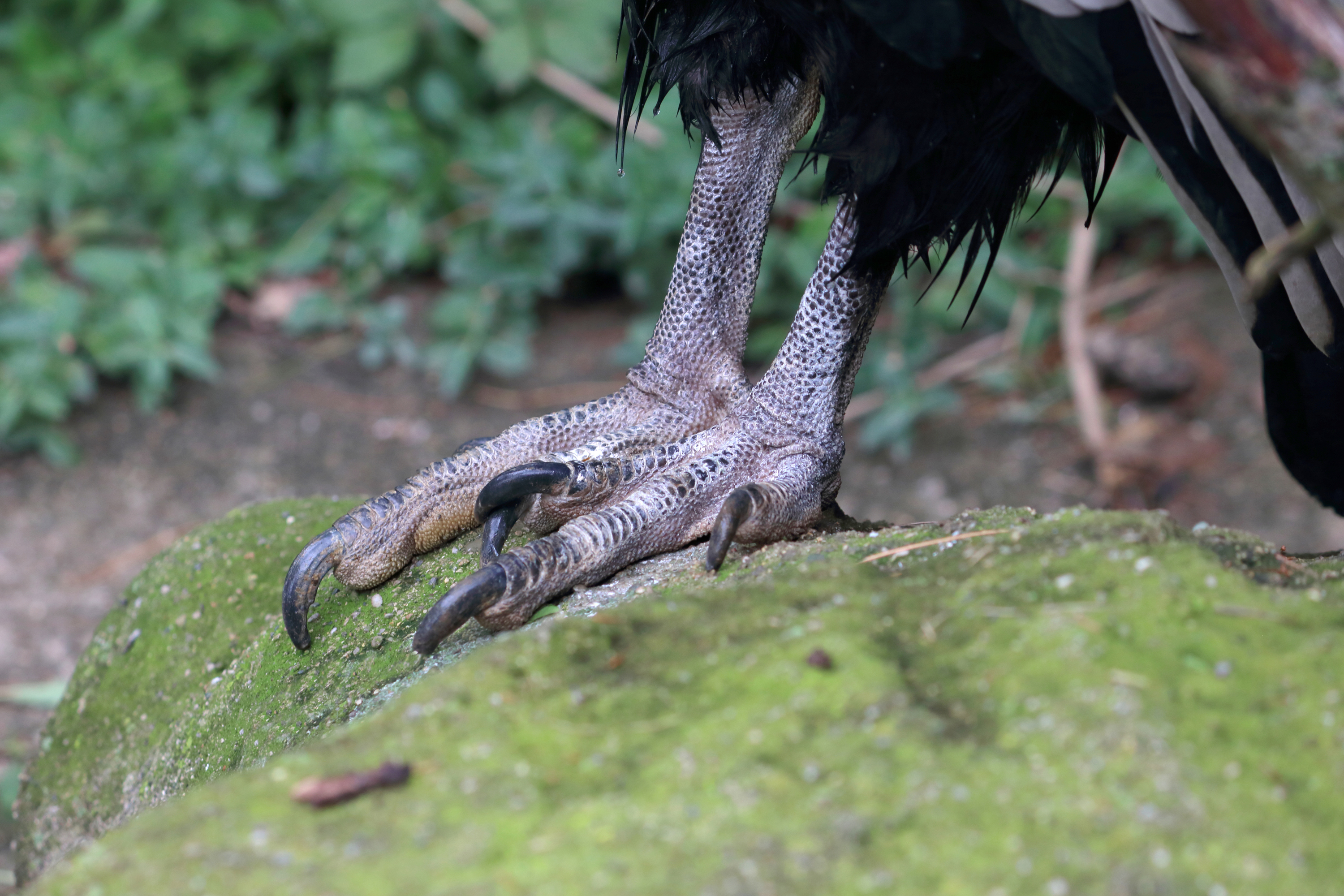
The middle toe is greatly elongated, and the hind one is only slightly developed, while the talons of all the toes are comparatively straight and blunt. The feet are thus more adapted to walking, and are of little use as weapons or organs of prehension as in birds of prey and Old World vultures. The beak is hooked, and adapted to tear rotting meat. The irises of the male are brown, while those of the female are deep red. They have no eyelashes. Unlike the case with most other birds of prey,{{cite book |access-date = 19 July 2010 |access-date = 19 July 2010
Observation of wing color patterns, and the size and shape of the male's crest, are the best ways of identifying individual Andean condors. Sighting-resighting methods assess the size and structure of populations.
Ecology and behavior
The condor soars with its wings held horizontally and its primary feathers bent upwards at the tips. The lack of a large sternum to anchor its correspondingly large flight muscles physiologically identifies it as primarily being a soarer. It flaps its wings on rising from the ground, but after attaining a moderate elevation it flaps its wings very rarely, relying on thermals to stay aloft. In The Voyage of the Beagle, Charles Darwin mentioned watching condors for half an hour without once observing a flap of their wings.{{cite book |url-access=registration | isbn = 978-1-74059-749-4}} Flight recorders have shown that "75% of the birds' flapping was associated with take-off", and that it "flaps its wings just 1% of the time during flight".{{cite news |access-date=14 July 2020

Like other New World vultures, the Andean condor has the unusual habit of urohidrosis: it often empties its cloaca onto its legs and feet. A cooling effect through evaporation has been proposed as a reason for this behavior, but it does not make any sense in the cold Andean habitat of the bird.{{cite book
There is a well-developed social structure within large groups of condors, with competition to determine a 'pecking order' by body language, competitive play behavior, and vocalizations.{{cite journal | access-date = 2008-01-10 | hdl-access = free | archive-date = 2012-09-04 | archive-url = https://web.archive.org/web/20120904025221/http://cat.inist.fr/?aModele=afficheN&cpsidt=14022914
Breeding
Sexual maturity and breeding behavior do not appear in the Andean condor until the bird is five or six years of age.{{cite web |access-date=2007-01-10 |archive-url=https://web.archive.org/web/20070205055624/http://www.peregrinefund.org/Explore_Raptors/vultures/andcondr.html |archive-date=5 February 2007 | access-date = 2007-01-10 | access-date = 2007-01-10
The Andean condor prefers to roost and breed at elevations of 3000 to.{{cite book |access-date=2008-01-08 |archive-url=https://web.archive.org/web/20071009075845/http://nationalzoo.si.edu/Animals/Birds/Facts/FactSheets/fact-andeancondor.cfm |archive-date=2007-10-09
Feeding

The Andean condor is a scavenger, feeding mainly on carrion.{{cite book | archive-url = https://web.archive.org/web/20070612145057/http://animals.nationalgeographic.com/animals/birds/andean-condor.html | archive-date = June 12, 2007 | access-date = 2007-01-10}} Andean condors have been observed to do some hunting of small, live animals, such as rodents, birds and rabbits, which (given their lack of powerful, grasping feet or developed hunting technique) they usually kill by jabbing repeatedly with their bill.
Coastal areas provide a constant food supply, and in particularly plentiful areas, some Andean condors limit their foraging area to several kilometers of beach-front land.{{cite web |archive-url = https://web.archive.org/web/20071204213025/http://www.ecology.info/condors.htm |archive-date = 4 December 2007 |access-date = March 30, 2009 |url-access=registration | isbn = 0-7603-2582-0}} It may follow New World vultures of the genus Cathartes—the turkey vulture (C. aura), the lesser yellow-headed vulture (C. burrovianus), and the greater yellow-headed vulture (C. melambrotus)—to carcasses. The Cathartes vultures forage by smell, detecting the scent of ethyl mercaptan, a gas produced by the beginnings of decay in dead animals. These smaller vultures cannot rip through the tougher hides of these larger animals with the efficiency of the larger condor, and their interactions are often an example of mutual dependence between species.{{cite book |access-date=2008-01-06 |archive-url=https://web.archive.org/web/20080129233040/http://md1.csa.com/partners/viewrecord.php?requester=gs&collection=ENV&recid=3646491&q=Cathartes+melambrotus&uid=791396595&setcookie=yes |archive-date=29 January 2008 |url-access=subscription
Andean condors can efficiently absorb a wide variety of carotenoid pigments from the vegetal matter within the viscera that they consume from carcasses. These include carotenoids such as β-carotene and echineone. The pigments result in the yellow skin colouration of adult males and their ability to flush their skin a brilliant yellow during contests for dominance, as well as the colour of the iris and bright orange tongues of both sexes. Captive Andean condors have a lower concentration of carotenoid pigments in their bodies than wild condors, likely because the diet of captive condors is usually restricted to just flesh. An analysis of the droppings of wild condors found that 90% contained vegetal remains, and of those that contained vegetal remains, 35% of them were composed of primarily vegetal matter (around 80% by volume). The potential sources for the vegetal matter is posited to include the viscera of herbivore carcasses as well as fresh vegetation.
Longevity
Being a slowly-maturing bird with no known natural predators in adulthood, an Andean condor is a long-lived bird. Longevity and mortality rates are not known to have been extensively studied in the wild. Some estimations of lifespans of wild birds has exceeded 50 years. In 1983, the Guinness Book of World Records considered the longest-lived bird of any species with a confirmed lifespan was a male Andean condor named Kuzya that died after living 72 years in captivity, having been captured from the wild as a juvenile of undetermined age. Several species of parrot have been reported to live for perhaps over 100 years in captivity, but these (at least in 1983) were not considered authenticated. Another early captive-held specimen of condor reportedly lived for 71 years. However, these lifespans have been exceeded by a male, nicknamed "Thaao", who was kept at Beardsley Zoo in Connecticut. Thaao was born in captivity in 1930 and died on January 26, 2010, at the age of 79. This is the greatest verified age ever known for a bird.
Relationship with humans
Conservation status
The Andean condor is considered vulnerable by the IUCN and the Peruvian Conservation Organization. As a result of research on its plight, its status was changed to Vulnerable from Near Threatened in 2020, and only about 10,000 individuals remain. It was first placed on the United States Endangered Species list in 1970, a status which is assigned to an animal that is in danger of extinction throughout all or a significant portion of its range.{{cite web |access-date=2007-10-16 |archive-url=https://web.archive.org/web/20070921072436/http://www.fws.gov/Endangered/wildlife.html |archive-date=2007-09-21 |url-status=live | url-access =registration | archive-url = https://web.archive.org/web/20040726192641/http://news.nationalgeographic.com/news/2004/07/0722_040722_andeancondor.html | archive-date = July 26, 2004 | access-date = 2007-01-10}} have been introduced in Argentina, Venezuela, and Colombia. The first captive-bred Andean condors were released into the wild in 1989.{{cite web |access-date=2007-01-10 |archive-url=https://web.archive.org/web/20061010112901/http://cres.sandiegozoo.org/projects/rb_condor_andean.html |archive-date=2006-10-10
In response to the capture of all the wild individuals of the California condor, in 1988 the US Fish and Wildlife Service began a reintroduction experiment involving the release of captive Andean condors into the wild in California. Only females were released to prevent it becoming an invasive species. The experiment was a success, and all the Andean condors were recaptured and re-released in South America before the reintroduction of the California condors took place.
Role in culture
The Andean condor is a national symbol of Argentina, Bolivia, Chile, Colombia, Ecuador, Peru and Venezuelan Andes states. It is the national bird of Bolivia, Chile, Colombia, and Ecuador.{{cite web | access-date = 2007-10-06 | archive-url= https://web.archive.org/web/20071006063912/http://www.camacdonald.com/birding/CountryIndex.htm#A| archive-date= 6 October 2007 | url-status= live}} It plays an important role in the folklore and mythology of the South American Andean regions, and has been represented in Andean art from onward,{{cite book | access-date = 2007-01-10}}{{cite web |access-date=2007-01-10 |archive-url=https://web.archive.org/web/20061219195345/http://www.clemetzoo.com/rttw/condor/history.htm |archive-date=19 December 2006
The Andean condor is a popular figure on stamps in many countries, appearing on one for Ecuador in 1958, Argentina in 1960, Peru in 1973, Bolivia in 1985, Colombia in 1992, Chile in 1935 and 2001, and Venezuela in 2004. It has also appeared on the coins and banknotes of Colombia and Chile.
|File:Escudo de Bolivia.svg|Coat of arms of Bolivia. |File:Coat of arms of Chile (c).svg|Coat of arms of Chile. |File:Coat of arms of Colombia.svg|Coat of arms of Colombia. |File:Coat of arms of Ecuador.svg|Coat of arms of Ecuador. |File:Coat of arms of Peru (1821-1825).svg|First Coat of arms of Peru. |File:Coat of arms of Venezuela (1812).svg|Former coat of arms of Venezuela. ||Coat of arms of Pichincha Province, Ecuador. ||Coat of arms of Chimborazo Province, Ecuador. |File:Coat of arms of Mérida State.svg|Coat of arms of State of Mérida, Venezuela. |File:Imperial standard of the ethnocacerist movement.jpg|Imperial standard of the Ethnocacerist Movement, Peru. |File:Escudo-UNAM-escalable.svg|National Autonomous University of Mexico, depicting a condor and golden eagle. ||National University of Cuyo, Argentina. |File:Vultur gryphus Chili XIX.jpg|Hunting for condor. Chile, 1854.{{Cite web|title=Image 61 of Atlas of the Physical and Political History of Chile [Plates, Volume 1].|url=https://www.loc.gov/resource/gdcwdl.wdl_03979/?sp=61&r=0.004,-0.763,1,1.526,0|access-date=2023-02-11|website=Library of Congress |File:CondorLassoLyd.jpg|Argentine gauchos lassoing a condor, 1895. |File:60 cent Chile Condor.jpg|Chilean 60-centavo stamp, 1935. ||Aero Cóndor, an airline that flies over the Nazca lines in Peru. |File:Condorito.jpg|Condorito, a Chilean comic book character.|mode=packed}}
References
References
- BirdLife International. (2020). "''Vultur gryphus''".
- "Appendices {{!}} CITES".
- Linnaeus, C. (1758). "Systema naturae per regna tria naturae, secundum classes, ordines, genera, species, cum characteribus, differentiis, synonymis, locis. Tomus I. Editio decima, reformata.". Laurentii Salvii.
- Simpson, D.P.. (1979). "Cassell's Latin Dictionary". Cassell Ltd..
- Liddell, Henry George. (1980). "Greek-English Lexicon, Abridged Edition". Oxford University Press.
- (1989). "Raven". Clarendon Press.
- "A Quechua metaphor for a plane: Kuntur-man = "looking like a Condor"". Quechua.org.uk.
- (1990). "Distribution and Taxonomy of Birds of the World". Yale University Press.
- (2006). "Diversification of Neoaves: Integration of molecular sequence data and fossils". Biology Letters.
- Remsen, J. V. Jr.; Cadena, C. D.; Jaramillo, A.; Nores, M.; Pacheco, J. F.; Robbins, M. B.; Schulenberg, T. S.; Stiles, F. G.; Stotz, D. F. and Zimmer, K. J. (2007). [http://www.museum.lsu.edu/~Remsen/SACCBaseline.html ''A classification of the bird species of South America.''] {{webarchive. link. (2009-03-02 South American Classification Committee. Retrieved on 2007-10-15)
- Fisher, Harvey L.. (1944). "The skulls of the Cathartid vultures". [[Condor (journal).
- (2018). "Low-frequency, threatened habitats drive the large-scale distribution of Andean Condors in southern Patagonia". Ibis.
- (1996). "Handbook of the Birds of the World". [[Lynx Edicions]].
- (2008). "CRC Handbook of Avian Body Masses". CRC Press.
- (1987). "Competitive interactions within and between species in a guild of avian scavengers". The Auk.
- (2007). "The near to linear allometric relationship between total metabolic energy per life span and body mass of nonpasserine birds". Bulgarian Journal of Veterinary Medicine.
- "Andean Condor ''Vultur gryphus''". Birdlife International.
- Wood, Gerald. (1983). "The Guinness Book of Animal Facts and Feats". Guinness Superlatives.
- (2000). "Endangered Animals: A Reference Guide to Conflicting Issues". Greenwood Press.
- Harrison, Peter. (1991). "Seabirds: An Identification Guide". Houghton Mifflin Harcourt.
- Lutz, Dick. (2002). "Patagonia: At the Bottom of the World". DIMI Press.
- (2013-06-13). "Need and Seek for Dietary Micronutrients: Endogenous Regulation, External Signalling and Food Sources of Carotenoids in New World Vultures". PLOS ONE.
- Fisher, Harvey L.. (1942). "The Pterylosis of the Andean Condor". [[Condor (journal).
- (2019). "Assessing population size and structure for Andean Condor Vultur gryphus in Bolivia using a photographic 'capture-recapture' method". Ibis.
- (2020-07-10). "Physical limits of flight performance in the heaviest soaring bird". Proceedings of the National Academy of Sciences.
- Avian Report. "Andean Condor Nesting Habits". https://avianreport.com/andean-condor-nesting/
- Cisneros-Heredia, Diego F. (2006). [http://citeseerx.ist.psu.edu/viewdoc/download?doi=10.1.1.177.5617&rep=rep1&type=pdf "Notes on breeding, behaviour and distribution of some birds in Ecuador"]. ''Bulletin of the British Ornithologists' Club'' '''126''' (2): 153–164 contains a record of a juvenile accompanying an adult male in July, too early to have been of that year's cohort.
- Kidd, Travis. "Vultur gryphus (Andean condor)".
- Lambertucci, S. A., Speziale, K. L., Rogers, T. E., & Morales, J. M. (2009). ''How do roads affect the habitat use of an assemblage of scavenging raptors?'' Biodiversity and Conservation, 18(8), 2063-2074. {{doi. 10.1007/s10531-008-9573-3
- Elbroch, L. M., & Wittmer, H. U. (2013). ''Nuisance ecology: do scavenging condors exact foraging costs on pumas in Patagonia?'' PLOS ONE, 8(1), e53595. {{doi. 10.1371/journal.pone.0053595
- Perrig, P. L., Donadio, E., Middleton, A. D., & Pauli, J. N. (2017). ''Puma predation subsidizes an obligate scavenger in the high Andes''. Journal of applied ecology, 54(3), 846–853. {{doi. 10.1111/1365-2664.12802
- [http://beardsleyzoo.org/node/150 Zoo Family Mourns Death of Oldest Living Andean Condor in Captivity. Connecticut's Beardsley Zoo] {{webarchive. link. (2012-05-20 . Beardsleyzoo.org (2010-01-26). Retrieved on 2012-12-19.)
- "Species Profile: Andean Condor". United States Department of Fish and Wildlife.
- (2004). "Species factsheet: Vultur Gryphus". BirdLife International.
- "California condor, (Gymnogyps californianus)". U.S. Fish and Wildlife Service.
- Kokotovic, Misha. (2007). "The Colonial Divide in Peruvian Narrative:Social Conflict and Transculturation". Sussex Academic Press.
- "Andean Condor". Bird Stamps.
- "A Field Guide to the Birds on Banknotes". Krause Publications.
- (2013). "Need and seek for dietary micronutrients: endogenous regulation, external signaling and food sources of carotenoids in New World vultures". PLOS ONE.
- (2014). "Allometric deviations of plasma carotenoids in raptors". Ibis.
This article was imported from Wikipedia and is available under the Creative Commons Attribution-ShareAlike 4.0 License. Content has been adapted to SurfDoc format. Original contributors can be found on the article history page.
Ask Mako anything about Andean condor — get instant answers, deeper analysis, and related topics.
Research with MakoFree with your Surf account
Create a free account to save articles, ask Mako questions, and organize your research.
Sign up freeThis content may have been generated or modified by AI. CloudSurf Software LLC is not responsible for the accuracy, completeness, or reliability of AI-generated content. Always verify important information from primary sources.
Report