From Surf Wiki (app.surf) — the open knowledge base
Anaerobic oxidation of methane
Microbial process in anoxic marine and freshwater sediments
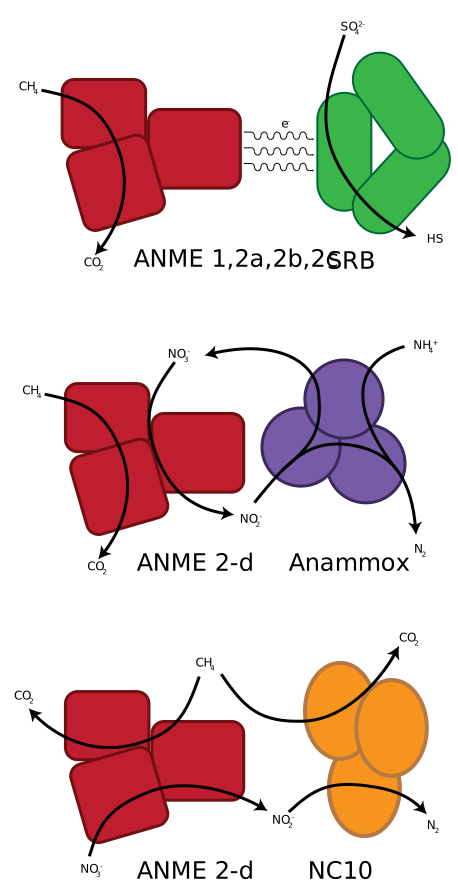
Microbial process in anoxic marine and freshwater sediments
Anaerobic oxidation of methane (AOM) is a methane-consuming microbial process occurring in anoxic marine and freshwater sediments. AOM is known to occur among mesophiles, but also in psychrophiles, thermophiles, halophiles, acidophiles, and alkophiles. During AOM, methane is oxidized with different terminal electron acceptors such as sulfate, nitrate, nitrite and metals, either alone or in syntrophy with a partner organism.
Coupled to sulfate reduction
.{{cite journal |hdl-access=free
The overall reaction is: :CH4 + SO42− → HCO3− + HS− + H2O
Sulfate-driven AOM is mediated by a syntrophic consortium of methanotrophic archaea and sulfate-reducing bacteria. They often form small aggregates or sometimes voluminous mats. The archaeal partner is abbreviated ANME, which stands for "anaerobic methanotroph". ANME's are very closely related to methanogenic archaea and recent investigations suggest that AOM is an enzymatic reversal of methanogenesis.{{cite journal Countless isolation efforts have not been able to isolate one of the anaerobic methanotrophs, a possible explanation can be that the ANME archaea and the SRB have an obligate syntrophic interaction and can therefore not be isolated individually.
In benthic marine areas with strong methane releases from fossil reservoirs (e.g. at cold seeps, mud volcanoes or gas hydrate deposits) AOM can be so high that chemosynthetic organisms like filamentous sulfur bacteria (see Beggiatoa) or animals (clams, tube worms) with symbiont sulfide-oxidizing bacteria can thrive on the large amounts of hydrogen sulfide that are produced during AOM. The bicarbonate (HCO3−) produced from AOM can (i) get sequestered in the sediments by the precipitation of calcium carbonate or so-called methane-derived authigenic carbonates and (ii) get released to the overlying water column. Methane-derived authigenic carbonates are known to be the most 13C depleted carbonates on Earth, with δ13C values as low as -125 per mil PDB reported.
Coupled to nitrate and nitrite reduction
The overall reactions are: :CH4 + 4 NO3− → CO2 + 4 NO2− + 2 H2O :3 CH4 + 8 NO2− + 8 H+ → 3 CO2 + 4 N2 + 10 H2O
ANME-2d is shown to be responsible nitrate-driven AOM. The ANME-2d, named Methanoperedens nitroreducens, is able to perform nitrate-driven AOM without a partner organism via reverse methanogenesis with nitrate as the terminal electron acceptor, using genes for nitrate reduction that have been laterally transferred from a bacterial donor. This was also the first complete reverse methanogenesis pathway including the mcr and mer genes.
In 2010, omics, especially metagenomics, analysis showed that nitrite reduction can be coupled to methane oxidation by a single bacterial species Candidatus Methylomirabilis oxyfera (phylum NC10), without the need for an archaeal partner.{{cite journal
Environmental relevance
AOM is considered an important process reducing the emission of the greenhouse gas methane from the ocean into the atmosphere. It is estimated that almost 80% of all the methane that arises from marine sediments is oxidized anaerobically by this process.
References
Bibliography
- Dennis D. Coleman; J. Bruno Risatti; Martin Schoell (1981) Fractionation of carbon and hydrogen isotopes by methane-oxidizing bacteria | Geochimica et Cosmochimica Acta |Volume 45, Issue 7, July 1981, Pages 1033-1037 |https://doi.org/10.1016/0016-7037(81)90129-0 | abstract
References
- Dunfield, Peter F.. (2009). "Methanotrophy in Extreme Environments". John Wiley & Sons, Ltd.
- (2006). "A microbial consortium couples anaerobic methane oxidation to denitrification". Nature.
- (2009). "Anaerobic oxidation of methane: progress with an unknown process". Annu. Rev. Microbiol..
- (1987). "Methane-derived authigenic carbonates formed by subduction-induced pore-water expulsion along the Oregon/Washington margin". GSA Bulletin.
- (2020). "Dissolved Inorganic Carbon Pump in Methane-Charged Shallow Marine Sediments: State of the Art and New Model Perspectives". Frontiers in Marine Science.
- Drake, H.. (2015). "Extreme 13C depletion of carbonates formed during oxidation of biogenic methane in fractured granite". Nature Communications.
- (2007). "Oceanic Methane Biogeochemistry". Chemical Reviews.
This article was imported from Wikipedia and is available under the Creative Commons Attribution-ShareAlike 4.0 License. Content has been adapted to SurfDoc format. Original contributors can be found on the article history page.
Ask Mako anything about Anaerobic oxidation of methane — get instant answers, deeper analysis, and related topics.
Research with MakoFree with your Surf account
Create a free account to save articles, ask Mako questions, and organize your research.
Sign up freeThis content may have been generated or modified by AI. CloudSurf Software LLC is not responsible for the accuracy, completeness, or reliability of AI-generated content. Always verify important information from primary sources.
Report