From Surf Wiki (app.surf) — the open knowledge base
Ametrine
Mineral, quartz variety
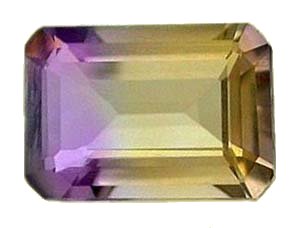
Mineral, quartz variety
| Field | Value |
|---|---|
| name | Ametrine |
| boxbgcolor | #9966cc |
| boxtextcolor | #fff |
| image | Ametrin from Bolivia.jpg |
| caption | Ametrine from Bolivia |
| category | Tectosilicate minerals |
| group | Quartz group |
| species | Quartz |
| formula | Silica (silicon dioxide, SiO2) |
| molweight | 60.08 g/mol |
| system | Trigonal |
| color | Purple, yellow to orange |
| habit | 6-sided prism ending in 6-sided pyramid (typical) |
| twinning | Dauphine law and Brazil law |
| cleavage | none |
| fracture | Conchoidal |
| mohs | 7 |
| lustre | Vitreous |
| refractive | nω = 1.543–1.553 |
| nε = 1.552–1.554 | |
| opticalprop | Unixal (+) |
| birefringence | +0.009 |
| pleochroism | Amethyst section shows weak to moderate purple/reddish purple |
| "Citrine" section shows very weak yellow/orange | |
| streak | white |
| gravity | 2.65 |
| melt | 1650±75 °C |
| diagnostic | Distinct segments that are purple and yellow |
| solubility | Insoluble in common solvents |
| diaphaneity | Transparent to translucent |
| impurities | Iron |
nε = 1.552–1.554 "Citrine" section shows very weak yellow/orange
Ametrine, also known as trystine, golden amethyst, or by the trade name bolivianite, is a variety of quartz with alternating zones of purple and yellow-orange coloration. Its name is a portmanteau of amethyst and citrine. While ametrine is commonly referred to as a combination of these two quartz varieties, some sources claim this is not accurate. Almost all commercially available ametrine is mined in Bolivia.
Color
Ametrine, as its name suggests, is commonly believed to be a combination of citrine and amethyst in the same crystal. However, sources do not agree that the yellow-orange quartz component of ametrine may properly be called citrine. Like the purple color of amethyst, the yellow color in ametrine originates from trace amounts of iron in the crystal structure. The difference in coloration is due to the iron existing in different oxidation states. The yellow segments have been oxidized by heat, while the amethyst segments remain unoxidized. Some sources define citrine solely as quartz with its color originating from aluminum-based color centers, similar to those of smoky quartz. This definition excludes any amethyst that has been oxidized by heat. Accordingly, the yellow quartz in ametrine would not be considered true citrine.
Origin
Naturally occurring ametrine is sourced almost exclusively from a single mine in Bolivia. Deposits also exist in Brazil and India. The different oxidation states occur due to there being a temperature gradient across the crystal during its formation. However, most ametrine on the market is created by partially heating or irradiating amethyst.
Ametrine in the low price segment may stem from synthetic material. Green-yellow or golden-blue ametrine does not exist naturally. Synthetic ametrine is grown with the hydrothermal method using solutions doped with specific elements, followed by irradiation of the created crystals.Vladimir S. Balitsky; Taijin Lu; George R. Rossman; Irina B. Makhina; Anatolii A. Mar’in; James E. Shigley; Shane Elen; Boris A. Dorogovin. "Russian Synthetic Ametrine," Gems and Gemology, Summer 1999, p. 122-134
Structure
Ametrine is composed of silicon dioxide (SiO2) and it is a tectosilicate, which means it has a silicate framework linked together through shared oxygen atoms.
History
Legend has it that ametrine was first introduced to Europe by a conquistador's gifts to the Spanish Queen in the 1600s, after he received a mine in Bolivia as a dowry when he married a princess from the native Ayoreos tribe.
References
References
- "Ametrine Value, Price, and Jewelry Information - International Gem Society". International Gem Society.
- "Ametrine".
- "Citrine".
- "Quartz (var. ametrine) {{!}} Smithsonian National Museum of Natural History".
- Vasconcelos, Paolo; Wenk, Hanz-Rudolf; Rossman, George. "The Anahí Ametrine Mine, Bolivia," Gems and Gemology, Spring 1994, p. 4-23
This article was imported from Wikipedia and is available under the Creative Commons Attribution-ShareAlike 4.0 License. Content has been adapted to SurfDoc format. Original contributors can be found on the article history page.
Ask Mako anything about Ametrine — get instant answers, deeper analysis, and related topics.
Research with MakoFree with your Surf account
Create a free account to save articles, ask Mako questions, and organize your research.
Sign up freeThis content may have been generated or modified by AI. CloudSurf Software LLC is not responsible for the accuracy, completeness, or reliability of AI-generated content. Always verify important information from primary sources.
Report