From Surf Wiki (app.surf) — the open knowledge base
Aluminium hydride
reacts in ethanol Gallane Indigane Thallane Diborane Digallane Aluminium hydride (also known as alane and alumane) refers to a collection of inorganic compounds with the formula . As a gas, alane is a planar molecule. When generated in ether solutions, it exists as an ether adduct. Solutions of alane polymerizes to a solid, which exists in several crystallographically distinguishable forms.
Structure
Alane can adopt 3-, 4-, or 6-coordination, depending on conditions.
Gaseous alane
Monomeric has been isolated at low temperature in a solid noble gas matrix. It was shown to be planar. The dimeric form, , has been isolated in solid hydrogen. It is isostructural with diborane () and digallane ().
Solid alane
Solid alane, which is colorless and nonvolatile, precipitates from ethereal solutions over the course of hours at room temperature. Numerous polymorphs can be obtained, which have been labeled α-, α'-, β-, γ-, ε-, and ζ-alanes. α'-Alane forms needle-like crystals, and γ-alane forms bundles of fused needles.
| Crystallographic Structure of α- | The α- unit cell | Aluminium coordination | Hydrogen coordination | |||
|---|---|---|---|---|---|---|
| [[File:Aluminium-hydride-unit-cell-3D-balls.png | 150px]] | [[File:Aluminium-hydride-Al-coordination-3D-balls.png | 125px]] | [[File:Aluminium-hydride-H-coordination-3D-balls.png | 150px]] |
Handling
Alane is not spontaneously flammable. Even so, it should be handled like (the chemical reagent, lithium aluminium hydride) as its reactivity is comparable to this related reducing reagent. For these reagents, both preparations in solutions and isolated solids are "highly flammable and must be stored in the absence of moisture". Laboratory guides recommend alane use inside a fume hood. Solids of this reagent type carry recommendations of handling "in a glove bag or dry box". After use, solution containers are typically sealed tightly with concomitant flushing with inert gas to exclude the oxygen and moisture of ambient air.
Passivation greatly diminishes the decomposition rate associated with alane preparations. Passivated alane nevertheless retains a hazard classification of 4.3 (chemicals which in contact with water, emit flammable gases).
Reported accidents
Alane reductions are believed to proceed via an intermediate coordination complex, with aluminum attached to the partially reduced functional group, and liberated when the reaction undergoes protic quenching. If the substrate is also fluorinated, the intermediate may explode if exposed to a hot spot above 60 °C.
In 1964, a lab explosion was reported during the reduction of perfluorosuccinimide using lithium aluminum hydride, which produces similar aluminum hydride complexes. Following the explosion, the lab tested various LAH complexes containing perfluorinated substrates, each of which were found to be explosive.
In 2020, a lab reported an explosion when cold methanol was used to quench a solution containing alane complexed with a perfluorinated nitrile.
Preparation
Many different Synthesis processes of Aluminium hydride uses Li[AlH4] which can be synthesized by the following process under high pressure and temperature in step 1 and a salt metathesis reaction in step 2:
: [Step 1]
: [Step 2]
Aluminium hydrides and various complexes thereof have long been known. Its first synthesis was published in 1947, and a patent for the synthesis was assigned in 1999. Aluminium hydride is prepared by treating lithium aluminium hydride with aluminium trichloride. The procedure is intricate: attention must be given to the removal of lithium chloride. :
The ether solution of alane requires immediate use, because polymeric material rapidly precipitates as a solid. Aluminium hydride solutions are known to degrade after 3 days. Aluminium hydride is more reactive than .
Several other methods exist for the preparation of aluminium hydride: : : : : :
Electrochemical synthesis
Several groups have shown that alane can be produced electrochemically. Different electrochemical alane production methods have been patented. Electrochemically generating alane avoids chloride impurities. Two possible mechanisms are discussed for the formation of alane in Clasen's electrochemical cell containing THF as the solvent, sodium aluminium hydride as the electrolyte, an aluminium anode, and an iron (Fe) wire submerged in mercury (Hg) as the cathode. The sodium forms an amalgam with the Hg cathode preventing side reactions and the hydrogen produced in the first reaction could be captured and reacted back with the sodium mercury amalgam to produce sodium hydride. Clasen's system results in no loss of starting material. For insoluble anodes, reaction 1 occurs, while for soluble anodes, anodic dissolution is expected according to reaction 2:
- −
- −
In reaction 2, the aluminium anode is consumed, limiting the production of aluminium hydride for a given electrochemical cell.
The crystallization and recovery of aluminium hydride from electrochemically generated alane has been demonstrated.
High pressure hydrogenation of aluminium
α- can be produced by hydrogenation of aluminium at 10 GPa and 600 C. The reaction between the liquified hydrogen produces α- which could be recovered under ambient conditions.
Reactions
Formation of adducts with Lewis bases
readily forms adducts with strong Lewis bases. For example, both 1:1 and 1:2 complexes form with trimethylamine. The 1:1 complex is tetrahedral in the gas phase, but in the solid phase it is dimeric with bridging hydrogen centres, . The 1:2 complex adopts a trigonal bipyramidal structure. Some adducts (e.g. dimethylethylamine alane, ) thermally decompose to give aluminium and may have use in MOCVD applications.
Its complex with diethyl ether forms according to the following stoichiometry: : Similar adducts are assumed to form when alane is generated in THF from lithium aluminium hydride.
The reaction with lithium hydride in ether produces lithium aluminium hydride: :
Various alanates have been characterized beyond lithium aluminium hydride. They tend to feature five- and six-coordinate Al centers: , , ).
Reduction of functional groups
Alane and its derivatives are reducing reagents in organic synthesis based around group 13 hydrides. In solution—typically in ethereal solvents such tetrahydrofuran or diethyl ether—aluminium hydride forms complexes with Lewis bases, and reacts selectively with particular organic functional groups (e.g., with carboxylic acids and esters over organic halides and nitro groups), and although it is not a reagent of choice, it can react with carbon-carbon multiple bonds (i.e., through hydroalumination). Given its density, and with hydrogen content on the order of 10% by weight, active candidates for storing hydrogen and so for power generation in fuel cell applications, including electric vehicles. As of 2006 it was noted that further research was required to identify an efficient, economical way to reverse the process, regenerating alane from spent aluminium product.
In organic chemistry, aluminium hydride is mainly used for the reduction of functional groups. In many ways, the reactivity of aluminium hydride is similar to that of lithium aluminium hydride. Aluminium hydride will reduce aldehydes, ketones, carboxylic acids, anhydrides, acid chlorides, esters, and lactones to their corresponding alcohols. Amides, nitriles, and oximes are reduced to their corresponding amines.
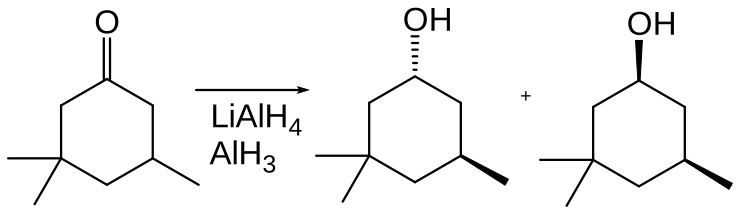
In terms of functional group selectivity, alane differs from other hydride reagents. For example, in the following cyclohexanone reduction, lithium aluminium hydride gives a trans:cis ratio of 1.9 : 1, whereas aluminium hydride gives a trans:cis ratio of 7.3 : 1.
Alane enables the hydroxymethylation of certain ketones (that is the replacement of by at the alpha position). The ketone itself is not reduced as it is "protected" as its enolate.

Organohalides are reduced slowly or not at all by aluminium hydride. Therefore, reactive functional groups such as carboxylic acids can be reduced in the presence of halides.

Aluminium hydride reduces esters in the presence of nitro groups.

Aluminium hydride reduces acetals to half protected diols.

Aluminium hydride reduces epoxides to their corresponding alcohols:

The allylic rearrangement reaction carried out using aluminium hydride is a SN2 reaction, and it is not sterically demanding:

Aluminium hydride will reduce carbon dioxide to methane with heating: :
Hydroalumination
Akin to hydroboration, aluminium hydride can, in the presence of titanium tetrachloride, add across multiple bonds. When the multiple bond in question is a propargylic alcohols, the results are Alkenylaluminium compounds.

Fuel
In its passivated form, alane is an active candidate for storing hydrogen, and can be used for efficient power generation via fuel cell applications, including fuel cell and electric vehicles and other lightweight power applications.{{cite journal | doi-access = free contains up 10.1% hydrogen by weight (at a density of 1.48 grams per milliliter), or twice the hydrogen density of liquid . As of 2006, was described as a candidate for which "further research w[ould] be required to develop an efficient and economical process to regenerate [it] from the spent Al powder".
Alane is also a potential additive to solid rocket fuel and to explosive and pyrotechnic compositions due to its high hydrogen content and low dehydrogenation temperature. However, can degrade when stored at room temperature, and some of its crystal forms have "poor compatibility" with some fuel components.
Deposition
Heated alane releases hydrogen gas and produces a very fine thin film of aluminum metal that can be deposited onto other materials.
References
References
- (2014). "Nomenclature of Organic Chemistry : IUPAC Recommendations and Preferred Names 2013 (Blue Book)". [[Royal Society of Chemistry.
- (1993). "Molecular Aluminium Trihydride, AlH3: Generation in a Solid Noble Gas Matrix and Characterisation by its Infrared Spectrum and ''ab initio'' Calculations". Journal of the Chemical Society, Chemical Communications.
- (2003). "The Infrared Spectrum of Al2H6 in Solid Hydrogen". Science.
- (1991). "Gallane: Synthesis, Physical and Chemical Properties, and Structure of the Gaseous Molecule Ga2H6 as Determined by Electron Diffraction". Journal of the American Chemical Society.
- Housecroft, Catherine. (2018). "Inorganic Chemistry". Pearson.
- The best characterized solid alane is α-alane. According to [[X-ray crystallography]], adopts a cubic or rhombohedral morphology. It features octahedral AlH6 centers interconnected by Al-H-Al bridges. The Al-H distances are all equivalent (172 pm) and the Al-H-Al angles are 141°.{{harvnb. Turley. Rinn. 1969. (Abstract) "The final Al⋯H distance of 1.72 Å, the participation of each Al in six bridges, and the equivalence of all Al⋯H distances suggest that 3c-2e bonding occurs." Angle is lasted as "Al(6)-H(5)-Al(4)" in Table IV.
- {{harvnb. Galatsis. Sintim. Wang. 2008, which describes the phenomenon using [[Combustibility and flammability#Definitions. the synonym "inflammable"]].
- 2013 CFR Title 29 Volume 6 Section 1900.1200 Appendix B.12
- Taydakov, Ilya V.. (2020-07-08). "Serious Explosion during Large-Scale Preparation of an Amine by Alane (AlH3) Reduction of a Nitrile Bearing a CF3 Group". American Chemical Society (ACS).
- (1951-07-23). "SAFETY FORUM". Chemical & Engineering News Archive.
- (1976). "Preparation and Properties of Aluminum Hydride". [[Journal of the American Chemical Society]].
- (1947). "Lithium Aluminum Hydride, Aluminum Hydride and Lithium Gallium Hydride, and Some of their Applications in Organic and Inorganic Chemistry". [[Journal of the American Chemical Society]].
- "Preparation of Aluminum Hydride Polymorphs, Particularly Stabilized α-AlH3".
- (1973). "Inorganic Syntheses".
- "Method for the Production of α-Alane.".
- (1968). "Physicochemical Properties and Structure of Complex Compounds of Aluminium Hydride". Russian Chemical Reviews.
- (1966). "Aluminium Hydride". Russian Chemical Reviews.
- (1966). "none". Elektrokhimiya.
- (2009). "Aluminium hydride: a reversible material for hydrogen storage". Chemical Communications.
- (2012). "Advances in the electrochemical regeneration of aluminum hydride". Applied Physics A: Materials Science & Processing.
- "Verfahren zur Herstellung von Aluminiumhydrid bzw. aluminiumwasserstoffreicher komplexer Hydride".
- "Electrochemical process and production of novel complex hydrides".
- (2010). "In situX-ray diffraction measurement of the hydrogenation and dehydrogenation of aluminum and characterization of the recovered AlH3". Journal of Physics: Conference Series.
- {{Greenwood&Earnshaw
- (1991). "Tertiary Amine Stabilized Dialane". Journal of the American Chemical Society.
- (1998). "Metal-Organic Chemical Vapor Deposition of Aluminum from Dimethylethylamine Alane". Thin Solid Films.
- (2019). "Alanates, a Comprehensive Review". Materials.
- (1979). "Forty Years of Hydride Reductions". [[Tetrahedron (journal).
- {{cite encyclopedia. Galatsis, P.. (2001)
- (1967). "The Stereoselective Reduction of Ketones by Aluminium Hydride". Journal of the Chemical Society B.
- (1971). "Controlled Hydroxymethylation of Ketones". [[Journal of Organic Chemistry]].
- (1977). "Reactions of Lithium Aluminum Hydride or Alane with Olefins Catalyzed by Titanium Tetrachloride or Zirconium Tetrachloride. A Convenient Route to Alkanes, 1-Haloalkanes and Terminal Alcohols from Alkenes". [[Journal of Organometallic Chemistry]].
- Smith (2020), ''March's Advanced Organic Chemistry'', rxn. 15-12.
- (1967). "New Stereospecific Synthesis of Trisubstituted Olefins. Stereospecific Synthesis of Farnesol". [[Journal of the American Chemical Society]].
- (2006). "Aluminum Hydride, A1H3, As a Hydrogen Storage Compound". Office of Science and Technical Information [OSTI].
- Calabro, M.. (2011). "Overview of Hybrid Propulsion". Progress in Propulsion Physics.
- (2018). "Inorganic Chemistry". [[Prentice-Hall]].
- (15 September 2008). "Encyclopedia of Reagents for Organic Synthesis". John Wiley & Sons.
- (15 October 2004). "Encyclopedia of Reagents for Organic Synthesis". John Wiley & Sons.
- (1969). "The Crystal Structure of Aluminum Hydride". Inorganic Chemistry.
This article was imported from Wikipedia and is available under the Creative Commons Attribution-ShareAlike 4.0 License. Content has been adapted to SurfDoc format. Original contributors can be found on the article history page.
Ask Mako anything about Aluminium hydride — get instant answers, deeper analysis, and related topics.
Research with MakoFree with your Surf account
Create a free account to save articles, ask Mako questions, and organize your research.
Sign up freeThis content may have been generated or modified by AI. CloudSurf Software LLC is not responsible for the accuracy, completeness, or reliability of AI-generated content. Always verify important information from primary sources.
Report