From Surf Wiki (app.surf) — the open knowledge base
Allylic rearrangement
Type of organic chemical reaction

Type of organic chemical reaction
An allylic rearrangement or allylic shift is an organic chemical reaction in which reaction at a center vicinal to a double bond causes the double bond to shift to an adjacent pair of atoms:
It is encountered in both nucleophilic and electrophilic substitution, although it is usually suppressed relative to non-allylic substitution. For example, reaction of 1-chloro-2-butene with sodium hydroxide gives 2-buten-1-ol and 3-buten-2-ol:

In the similar substitution of 1-chloro-3-methyl-2-butene, the secondary 2-methyl-3-buten-2-ol is produced in a yield of 85%, while that for the primary 3-methyl-2-buten-1-ol is 15%.
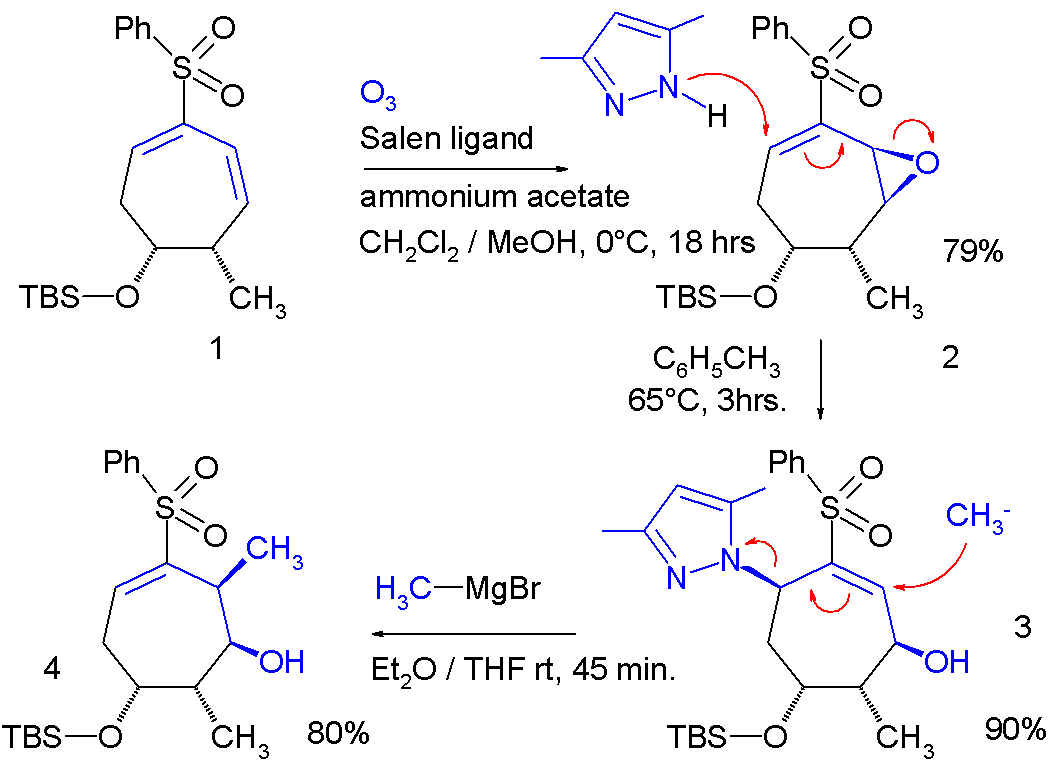
Allylic shifts occur because the transition state is an allyl intermediate. In other respects they are similar to classical nucleophilic substitution, and admit both bimolecular and monomolecular mechanisms (respectively the **SN2'''' and **SN1'/SNi' substitutions''').
Scope
Allylic shifts become the dominant reaction pathway when there is substantial resistance to a normal (non-allylic) substitution. For nucleophilic substitution, such resistance is known when there is substantial steric hindrance at or around the leaving group, or if there is a geminal substituent destabilizing an accumulation of positive charge. The effects of substitution at the vinyl group are less clear. Metal complexes that admit an allyl ligand also catalyze allylic substitution, sometimes to rates exceeding direct substitution.
Although rarer still than SN', allylic shifts can occur vinylogously, as a "butadienylic shift":
SN2' reduction
In SN2' reduction, a hydride allylically displaces a good leaving group in a formal organic reduction, similar to the Whiting diene synthesis. One example occurred in taxol total synthesis (ring C):
:[[Image:SN2reduction.png|400px|SN2 reduction]]
The hydride is lithium aluminium hydride and the leaving group a phosphonium salt; the allylic shift causes the exocyclic double bond in the product. Only when the cyclohexane ring is properly substituted will the proton add trans to the adjacent methyl group.
Electrophilic allyl shifts
Allyl shifts can also take place with electrophiles. In the example below the carbonyl group in benzaldehyde is activated by diboronic acid prior to reaction with the allyl alcohol (see: Prins reaction):

The active catalyst system in this reaction is a combination of a palladium pincer compound and p-toluenesulfonic acid, the reaction product is obtained as a single regioisomer and stereoisomer.
Examples
Repeated allylic shifts can "flip-flop" a double-bond between two possible locations:
An SN2' reaction should explain the outcome of the reaction of an aziridine carrying a methylene bromide group with methyllithium:
:[[File:AziridineAllylicRearrangement.png|400x400px|conversion of 1-alkyl-2-(bromomethyl)aziridines into 1-alkyl-2-(N-alkyl-N-ethylaminomethyl)aziridines]] In this reaction one equivalent of acetylene is lost.
Named reactions
- Ferrier rearrangement
- Meyer–Schuster rearrangement
- Mislow-Evans rearrangement
References
References
- (1964-01-01). "Allylic reactions". John Wiley & Sons, Ltd..
- Trost, Barry Martin. (1988-01-01). "Chemical Chameleons: Organosulfones as synthetic building blocks". Bulletin of the Chemical Society of Japan.
- ''Molecular yardsticks. Synthesis of extended equilibrium transfer alkylating cross-link reagents and their use in the formation of macrocycles'' Stephen J. Brocchini, Martin Eberle, and Richard G. Lawton [[J. Am. Chem. Soc.]]; '''1988'''; 110(15) pp 5211 - 5212; {{doi. 10.1021/ja00223a061
- ''Synthetic Studies on Taxol: Highly Stereoselective Construction of the Taxol C-Ring via SN2' Reduction of an Allylic Phosphonium Salt'' Masayuki Utsugi, Masayuki Miyano, and Masahisa Nakada [[Org. Lett.]]; '''2006'''; 8(14) pp 2973 - 2976; (Letter) {{doi. 10.1021/ol0608606
- ''Highly Selective and Robust Palladium-Catalyzed Carbon-Carbon Coupling between Allyl Alcohols and Aldehydes via Transient Allylboronic Acids'' Nicklas Selander, Sara Sebelius, Cesar Estay, Kálmán J. Szabó [[European Journal of Organic Chemistry]] Volume '''2006''', Issue 18 , Pages 4085 - 4087 {{doi. 10.1002/ejoc.200600530
- ''Double Lawton SN2' Addition to Epoxyvinyl Sulfones: Selective Construction of the Stereotetrads of Aplyronine A'' Ahmad El-Awa and Philip Fuchs [[Org. Lett.]]; '''2006'''; 8(14) pp 2905 - 2908; (Letter) {{doi. 10.1021/ol060530l
- ''Highly unusual conversion of 1-alkyl-2-(bromomethyl)aziridines into 1-alkyl-2-(''N''-alkyl-''N''-ethylaminomethyl)aziridines using methyllithium'' Matthias D'hooghe and Norbert De Kimpe [[Chem. Commun.]], '''2007''', 1275 - 1277, {{doi. 10.1039/b616606g
This article was imported from Wikipedia and is available under the Creative Commons Attribution-ShareAlike 4.0 License. Content has been adapted to SurfDoc format. Original contributors can be found on the article history page.
Ask Mako anything about Allylic rearrangement — get instant answers, deeper analysis, and related topics.
Research with MakoFree with your Surf account
Create a free account to save articles, ask Mako questions, and organize your research.
Sign up freeThis content may have been generated or modified by AI. CloudSurf Software LLC is not responsible for the accuracy, completeness, or reliability of AI-generated content. Always verify important information from primary sources.
Report