From Surf Wiki (app.surf) — the open knowledge base
Alkali basalt
Type of volcanic rock

Type of volcanic rock
Alkali basalt or alkali olivine basalt is a dark-colored, porphyritic volcanic rock usually found in oceanic and continental areas associated with volcanic activity, such as oceanic islands, continental rifts and volcanic fields. Alkali basalt is characterized by relatively high alkali (Na2O and K2O) content relative to other basalts and by the presence of olivine and titanium-rich augite in its groundmass and phenocrysts, and nepheline in its CIPW norm.
Geochemical characterization
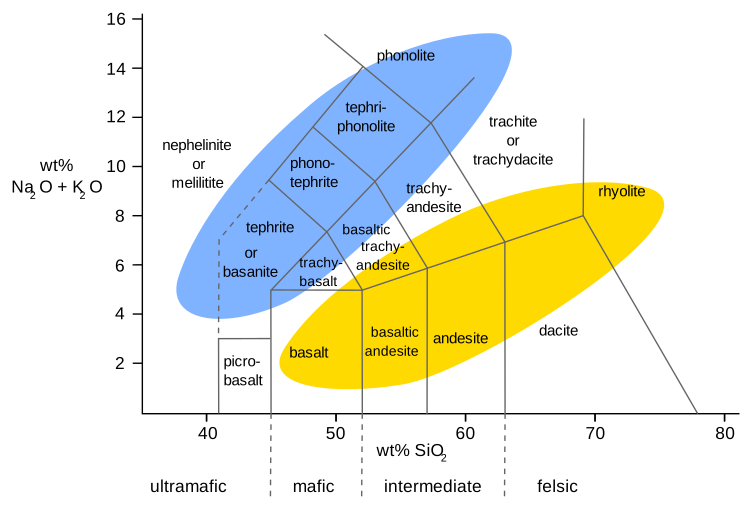
Alkali basalt is chemically classified as a rock in region B (basalt) of the total alkali versus silica (TAS) diagram that contains nepheline in its CIPW norm. Basalts that do not contain normative nepheline are characterized as sub-alkali basalts, which include tholeiitic basalts and calc-alkaline basalts.
Petrography
The groundmass of alkali basalt is mainly composed of olivine, titanium-rich augite and plagioclase feldspar and may have alkali feldspar or feldspathoid interstitially, but is poor in silica minerals, such as hypersthene and quartz.
Phenocrysts are ubiquitous in alkali basalt and, similarly to the groundmass, are usually made up of olivine and titanium-rich augite but can also have plagioclase and iron oxides with lower frequency.
Geologic context
Alkali basalt can be found in areas associated with volcanic activity, such as oceanic islands (Hawaii, Madeira, Saint Helena, Ascension, etc.), continental rifts and volcanic fields. Continental alkali basalt can be found in every continent, with prominent examples being the Rio Grande Rift (USA), the East African Rift and the Pali-Aike volcanic field.
The results from the gamma ray spectrometer on Venera 8 on Venus suggest it landed on alkali basalt.
References
References
- (1979). "Petrology and geochemistry of alkali basalts and ultramafic inclusions from the palei-aike volcanic field in Southern Chile and the origin of the patagonian plateau lavas". Journal of Volcanology and Geothermal Research.
- "Basalt {{!}} Definition, Properties, & Facts".
- Haldar, S. K.. (2017). "Platinum-Nickel-Chromium Deposits". Elsevier.
- Winter, John DuNann. (2001). "An Introduction to Igneous and Metamorphic Petrology". Prentice Hall.
- (1971). "A Guide to the Chemical Classification of the Common Volcanic Rocks". Canadian Journal of Earth Sciences.
- (2002). "Igneous Rocks: A Classification and Glossary of Terms". Cambridge University Press.
- (1972). "Basalts from Madeira: A petrochemical contribution to the genesis of oceanic alkali rock series". Contributions to Mineralogy and Petrology.
- Baker, Ian. (1969). "Petrology of the Volcanic Rocks of Saint Helena Island, South Atlantic". GSA Bulletin.
- Farmer, G.L.. (2005). "Treatise on Geochemistry: The crust". Gulf Professional Publishing.
- (2007). "Robotic Exploration of the Solar System Part I: The Golden Age 1957-1982". Springer.
This article was imported from Wikipedia and is available under the Creative Commons Attribution-ShareAlike 4.0 License. Content has been adapted to SurfDoc format. Original contributors can be found on the article history page.
Ask Mako anything about Alkali basalt — get instant answers, deeper analysis, and related topics.
Research with MakoFree with your Surf account
Create a free account to save articles, ask Mako questions, and organize your research.
Sign up freeThis content may have been generated or modified by AI. CloudSurf Software LLC is not responsible for the accuracy, completeness, or reliability of AI-generated content. Always verify important information from primary sources.
Report