From Surf Wiki (app.surf) — the open knowledge base
Alexandria, Virginia
Independent city in Virginia, US
Independent city in Virginia, US
| Field | Value |
|---|---|
| name | Alexandria |
| settlement_type | Independent city |
| image_skyline | Front View of George Washington Masonic National Memorial.jpg |
| image_caption | George Washington Masonic Memorial |
| image_flag | Flag of Alexandria, Virginia.svg |
| image_seal | Seal of Alexandria, Virginia.png |
| mapframe | yes |
| mapframe-zoom | 10 |
| pushpin_map | Virginia#USA |
| pushpin_label | Alexandria |
| pushpin_relief | yes |
| coordinates | |
| subdivision_type | Country |
| subdivision_name | United States |
| subdivision_type1 | State |
| subdivision_name1 | Virginia |
| established_title | Founded |
| established_date | 1749 |
| established_title1 | Incorporated (town) |
| established_date1 | 1779 |
| established_title2 | Incorporated (city) |
| established_date2 | 1852 |
| established_title3 | Incorporated (Independent city) |
| established_date3 | 1870 |
| government_type | Council-manager |
| leader_title | Mayor |
| leader_name | Alyia Gaskins (D) |
| leader_title1 | Virginia Senate |
| leader_name1 | 39: Adam Ebbin (D) |
| area_total_sq_mi | 15.35 |
| area_land_sq_mi | 14.93 |
| area_water_sq_mi | 0.41 |
| area_footnotes | |
| area_total_km2 | 39.75 |
| area_land_km2 | 38.68 |
| area_water_km2 | 1.07 |
| unit_pref | Imperial |
| elevation_min_ft | 0 |
| elevation_max_ft | 287 |
| population_total | 159467 |
| population_as_of | 2020 |
| population_density_sq_mi | 10680.97 |
| population_density_km2 | 4122.72 |
| population_rank | 169th in United States |
| 6th in Virginia | |
| population_demonym | Alexandrian |
| postal_code_type | ZIP Codes |
| postal_code | 20598, 22301-22315, 22320, 22331-22334, 22350 |
| area_codes | 703 and 571 |
| website | |
| leader_title2 | Delegate |
| leader_name2 | 3: Alfonso Lopez (D) |
| 4: Charniele Herring (D) | |
| 5: Elizabeth Bennett-Parker (D) | |
| leader_title3 | U.S. Senate |
| leader_name3 | Mark Warner (D) |
| Tim Kaine (D) | |
| leader_title4 | U.S. House |
| leader_name4 | 8: Don Beyer (D) |
| timezone | EST |
| utc_offset | −5 |
| timezone_DST | EDT |
| utc_offset_DST | −4 |
| blank_name | FIPS code |
| blank_info | 51-01000 |
| blank1_name | GNIS feature ID |
| blank1_info | 1492456 |
| blank2_name | Primary Airports |
| blank2_info | Ronald Reagan Washington National Airport |
| Dulles International Airport | |
| blank3_name | Commuter rail |
| blank3_info | Virginia Railway Express |
| mapframe-zoom = 10 6th in Virginia 4: Charniele Herring (D) 5: Elizabeth Bennett-Parker (D) Tim Kaine (D) Dulles International Airport
Alexandria is an independent city in Northern Virginia, United States. It lies on the western bank of the Potomac River approximately 7 mi south of Washington, D.C. The city's population of 159,467 at the 2020 census made it the sixth-most populous city in Virginia and 169th-most populous city in the U.S. Alexandria is a principal city of the Washington metropolitan area, which is part of the larger Washington–Baltimore combined statistical area.
Like the rest of Northern Virginia and Central Maryland, present-day Alexandria has been influenced by its proximity to the U.S. capital. It is largely populated by professionals working in the federal civil service, in the U.S. military, or for one of the many private companies which contract to provide services to the U.S. federal government. The city's largest employers include the U.S. Department of Defense and the U.S. Patent and Trademark Office. Alexandria is the highest-income independent city in Virginia.
The historic center of Alexandria is known as Old Town Alexandria, or simply "Old Town". With its concentration of boutiques, restaurants, antique shops and theaters, it is a major draw for city residents and visitors. Like Old Town, many Alexandria neighborhoods are compact and walkable. A large portion of adjacent Fairfax County, mostly south but also west of the city, has Alexandria mailing addresses. However, this area is under the jurisdiction of Fairfax County's government and separate from the independent city. The city is therefore sometimes referred to as the "City of Alexandria" to avoid confusion.
History
Main article: History of Alexandria, Virginia
Early history
According to archaeologists' estimates, a succession of indigenous peoples began to occupy the Chesapeake and Tidewater region about 3,000 to 10,000 years ago. Various Algonquian-speaking peoples inhabited the lands in the Potomac River drainage area since at least the early 14th century.
In the summer of 1608, English settler John Smith explored the Potomac River and came into contact with the Patawomeck (loosely affiliated with the Powhatan) and Doeg tribes who lived on the Virginia side, as well as on Theodore Roosevelt Island, and the Piscataway (also known as the Conoy), who resided on the Maryland side. On this visit, Smith recorded the presence of a settlement called Assaomeck near the south bank of what is now Hunting Creek.
Colonial era
On October 21, 1669, a patent granted 6,000 acre to Robert Howsing for transporting 120 people to the Colony of Virginia. That tract later became the City of Alexandria. Virginia's comprehensive Tobacco Inspection Law of 1730 mandated that all tobacco grown in the colony must be brought to locally designated public warehouses for inspection before sale. One of the sites designated for a warehouse on the upper Potomac River was at the mouth of Hunting Creek. However, the ground proved to be unsuitable, and the warehouse was built half a mile up-river, where the water was deep near the shore.
Following the 1745 settlement of the Colony of Virginia's 10-year dispute with Thomas Fairfax, 6th Lord Fairfax of Cameron over the western boundary of the Northern Neck Proprietary, when the Privy Council in London found in favor of Lord Fairfax's expanded claim, some of the Fairfax County gentry formed the Ohio Company of Virginia. They intended to conduct trade into the interior of America, and they required a trading center near the head of navigation on the Potomac. The best location was Hunting Creek tobacco warehouse, since the deep water could easily accommodate sailing ships. Many local tobacco planters, however, wanted a new town further up Hunting Creek, away from nonproductive fields along the river.
Around 1746, Captain Philip Alexander II (1704–1753) moved to what is south of present Duke Street in Alexandria. His estate, which consisted of 500 acre, was bounded by Hunting Creek, Hooff's Run, the Potomac River, and approximately the line which would become Cameron Street. At the opening of Virginia's 1748–49 legislative session, there was a petition submitted in the House of Burgesses on November 1, 1748, that the "inhabitants of Fairfax (Co.) praying that a town may be established at Hunting Creek Warehouse on Potowmack River," since Hugh West was the owner of the warehouse. The petition was introduced by Lawrence Washington, the representative for Fairfax County, the son-in-law of William Fairfax, and a founding member of the Ohio Company. To support the company's push for a town on the river, Lawrence's younger brother George Washington, an aspiring surveyor, made a sketch of the shoreline touting the advantages of the tobacco warehouse site.
Since the river site was amidst his estate, Philip opposed the idea and strongly favored a site at the head of Hunting Creek (also known as Great Hunting Creek). It has been said that in order to avoid a predicament the petitioners offered to name the new town Alexandria, in honor of Philip's family. As a result, Philip and his cousin Captain John Alexander (1711–1763) gave land to assist in the development of Alexandria and are thus listed as the founders. This John was the son of Robert Alexander II (1688–1735). On May 2, 1749, the House of Burgesses approved the river location and ordered "Mr. Washington do go up with a Message to the Council and acquaint them that this House have agreed to the Amendments titled An Act for erecting a Town at Hunting Creek Warehouse, in the County of Fairfax." A "Public Vendue" (auction) was advertised for July, and the county surveyor laid out street lanes and town lots. The auction was conducted on July 13–14, 1749.
Almost immediately upon establishment, the town founders called the new town "Belhaven", believed to be in honor of a Scottish patriot, John Hamilton, 2nd Lord Belhaven and Stenton, the Northern Neck tobacco trade being then dominated by Scots. The name Belhaven was used in official lotteries to raise money for a Church and Market House, but it was never approved by the legislature and fell out of favor in the mid-1750s. The town of Alexandria did not become incorporated until 1779.
In 1755, General Edward Braddock organized his fatal expedition against Fort Duquesne at Carlyle House in Alexandria. In April 1755, the governors of Virginia, and the provinces of Maryland, Pennsylvania, Massachusetts, and New York met to determine upon concerted action against the French in America.
In March 1785, commissioners from Virginia and Maryland met in Alexandria to discuss the commercial relations of the two states, finishing their business at Mount Vernon. The Mount Vernon Conference concluded on March 28 with an agreement for freedom of trade and freedom of navigation of the Potomac River. The Maryland legislature, in ratifying this agreement on November 22, proposed a conference among representatives from all the states to consider the adoption of definite commercial regulations. This led to the calling of the Annapolis Convention of 1786, which in turn led to the calling of the Federal Convention of 1787.
As part of the District of Columbia
In 1814, during the War of 1812, the British military carried out a successful raid on Alexandria, which surrendered without a fight. In order to avoid the town's destruction, twenty-two merchant ships and large quantities of flour, tobacco, cotton, wine, and sugar were handed over by Alexandria's municipal authorities to the British. In 1823 William Holland Wilmer, Francis Scott Key, and others founded the Virginia Theological Seminary. From 1828 to 1836, Alexandria was home to the Franklin & Armfield Slave Market, one of the largest slave trading companies in the country. By the 1830s, they were sending more than 1,000 slaves annually from Alexandria to their Natchez, Mississippi, New Orleans, and later Texas markets to help meet the demand for slaves in Mississippi and nearby states. Later owned by Price, Birch & Co., the slave pen became a jail under Union occupation.
A portion of the City of Alexandria—most of the area now known as Old Town as well as the areas of the city northeast of what is now King Street—and all of today's Arlington County share the distinction of having been the portion of Virginia ceded to the U.S. Government in 1791 to help form the new District of Columbia. Over time, a movement grew to separate what was called "Alexandria County" from the District of Columbia. As competition grew with the port of Georgetown and the Chesapeake and Ohio Canal fostered development on the north side of the Potomac River, Alexandria's economy stagnated; at the same time, residents had lost any representation in Congress and the right to vote and were disappointed with the negligible economic benefit (on the Alexandria side) of being part of the national capital. Alexandria still had an important port and market in the slave trade, and as talk increased of abolishing slavery in the national capital, there was concern that Alexandria's economy would suffer greatly if this step were taken. After a referendum, voters petitioned Congress and Virginia to return the portion of the District of Columbia south of the Potomac River (Alexandria County) to Virginia. On July 9, 1846, Congress retroceded Alexandria County to Virginia. The City of Alexandria was re-chartered in 1852 and became independent of Alexandria County in 1870. The remaining portion of Alexandria County changed its name to Arlington County in 1920.
Late 19th century
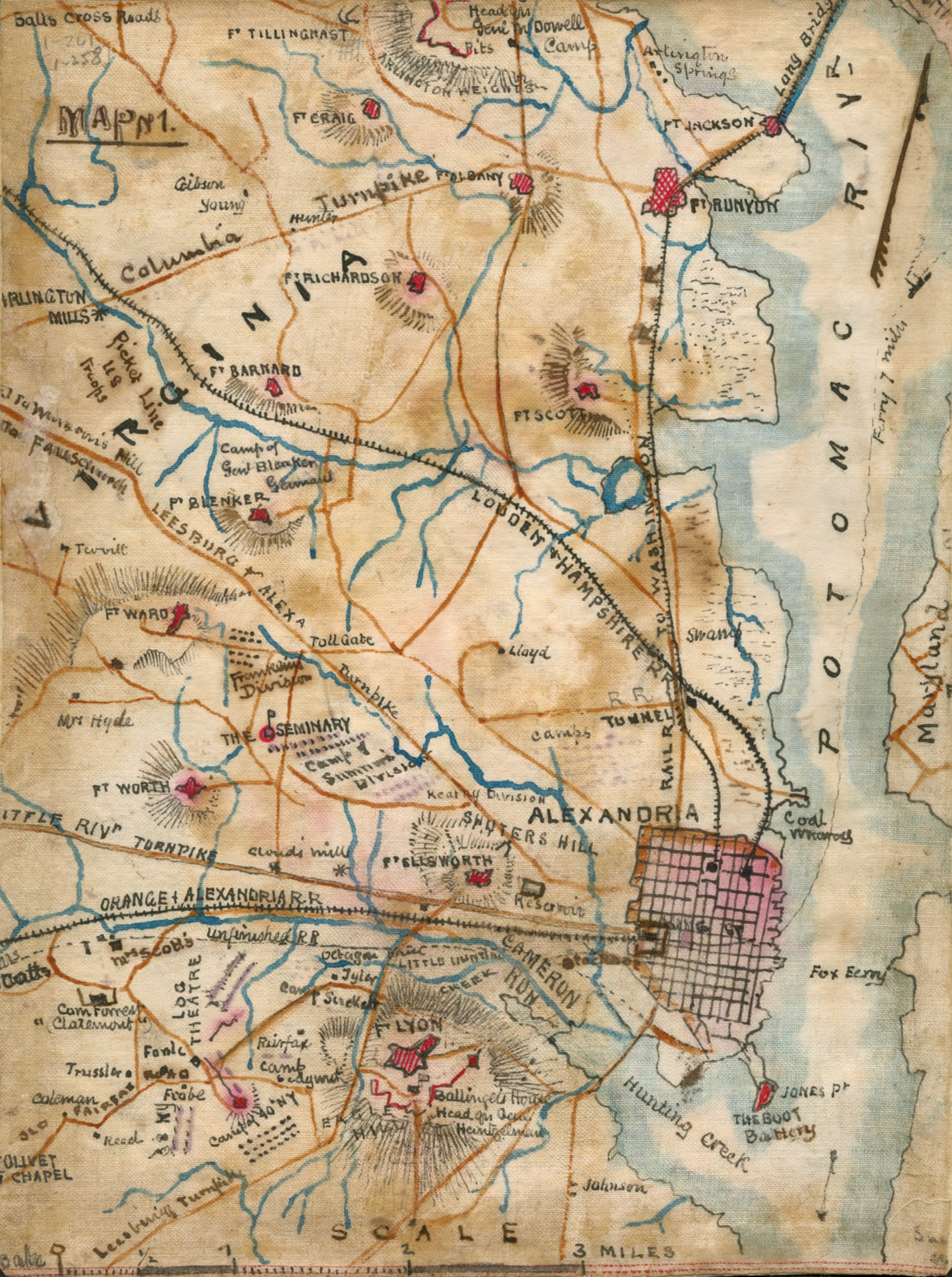
The first fatalities of the North and South in the American Civil War occurred in Alexandria. Within a month of the Battle of Fort Sumter, the Civil War's first battle, Union Army troops occupied Alexandria, landing troops at the base of King Street on the Potomac River on May 24, 1861. A few blocks up King Street from their landing site, the commander of the New York Fire Zouaves, Colonel Elmer E. Ellsworth, sortied with a small detachment to remove a large Confederate flag displayed on the roof of the Marshall House Inn that had been visible from the White House. While descending from the roof, Ellsworth was shot dead by James W. Jackson, the hotel's proprietor. One of Ellsworth's soldiers immediately killed Jackson. Ellsworth was publicized as a Union martyr, and the incident generated great excitement in the North, with many children being named for him.
Alexandria remained under military occupation until the end of the Civil War. Fort Ward, one of a ring of forts built by the Union army for the defense of Washington, D.C., is located inside the boundaries of present-day Alexandria. There were five military prisons in the city, the largest being the Washington Street Military Prison. After the creation by the Union government of the state of West Virginia in 1863 and until the close of the war, Alexandria was the seat of the so-called Restored Government of Virginia, also known as the "Alexandria Government". During the Union occupation, a recurring contention between the Alexandria citizenry and the military occupiers was the Union army's periodic insistence that church services include prayers for the President of the United States. Failure to do so resulted in incidents including the arrest of ministers in their church.
In 1861 and 1862, escaped African American slaves poured into Alexandria. Safely behind Union lines, the cities of Alexandria and Washington offered comparative freedom and employment. Alexandria became a major supply depot and transport and hospital center for the Union army. Until the Emancipation Proclamation of January 1, 1863, escaped slaves legally remained the property of their owners. Therefore, they were labeled contrabands to avoid returning them to their masters. Contrabands worked for the Union army in various support roles.
After all slaves in the seceding states were liberated, even more African Americans came to Alexandria. By the fall of 1863, the population of Alexandria had exploded to 18,000an increase of 10,000 people in 16 months.
As of ratification of the Fifteenth Amendment, Alexandria County's black population was more than 8,700, or about half the total number of residents in the county. This newly enfranchised constituency provided the support necessary to elect the first black Alexandrians to the City Council and the Virginia Legislature.
In the waning years of the 19th century, Alexandria suffered its two documented lynchings. The first, in 1897, was Joseph H. McCoy and the second, in 1899, was Benjamin Thomas. Both were Black male teenagers accused, but never convicted, of assaulting young white girls that were known to them. They were both kidnapped from jail and hanged by mobs.
20th century
.jpg)
.jpg)
At the turn of the 20th century the most common production in the city was glass, fertilizer, beer, and leather. The glass often went into beer bottles. Much of the Virginia Glass Company effort went to supply the demands of the Robert Portner Brewing Company, until fire destroyed the St. Asaph Street plant on February 18, 1905. The Old Dominion Glass Company also had a glass works fall to fire, then built a new one. The Belle Pre Bottle Company held a monopoly on a milk bottle that they patented, yet that organization only lasted 10 years. Most businesses were smaller where the business occupied the first floor of a building and the owner and family lived above. Prohibition closed Portner Brewing in 1916.
President Woodrow Wilson visited the Virginia Shipbuilding Corporation on May 30, 1918, to drive the first rivet into the keel of the . In 1930, Alexandria annexed the town adjacent to Potomac Yard incorporated in 1908 named Potomac. In 1938 the Mt. Vernon Drive-In cinema opened. In 1939, the segregated public library experienced a sit-in organized by Samuel Wilbert Tucker. In 1940, both the Robert Robinson Library, which is now the Alexandria Black History Museum, and the Vernon Theatre opened Jim Morrison of The Doors, as well as Cass Elliot and John Phillips of The Mamas & The Papas attended the George Washington High School in the 1950s.
In 1955, then-Representative and future President Gerald Ford and his family moved to Alexandria from Georgetown. The Fords remained in their Alexandria home during Ford's tenure as Vice President (1973–1974), as the vice president did not yet have an official residence. Following the resignation of Richard Nixon, Ford spent his first 10 days as President in the house before moving to the White House.
In March 1959, Lieutenant Colonel William Henry Whalen, the "highest-ranking American ever recruited as a mole by the Russian Intelligence Service", provided Colonel Sergei A. Edemski three classified Army manuals in exchange for $3,500 at a shopping center parking lot within the city. Agents of the Federal Bureau of Investigation later arrested Whalen on July 12, 1966, at his home in the city.
In 1961 the original Woodrow Wilson Bridge opened.
In 1965, the city integrated schools. In 1971, the city consolidated all high school junior and senior students into T. C. Williams High School. Freshman and sophomore students were assigned to attend either Francis C Hammond or George Washington, formerly four-year high schools, as part of a system-wide overhaul of the public school system, beginning with kindergarten classes, in an attempt to racially "balance" student population throughout the city's public schools to better reflect the city's racial makeup. The plan was known as the "K-6, 2, 2, 2 plan". Classes were broken out, beginning with kindergarten through sixth grade; then seventh through eighth; then freshman and sophomore classes; and finally junior and senior classes, with the changes including being moved to a different school building. The same year that head coach Herman Boone joined the school and lead the football team to a 13–0 season, a state championship, and a national championship runner-up; the basis for the 2000 film Remember the Titans where Boone was portrayed by Denzel Washington.
In 1973, Nora Lamborne and Beverly Beidler became the first women elected to the city council. In 1974, the Torpedo Factory Art Center opened. In 1983, the King Street–Old Town station, Braddock Road station, and Eisenhower Avenue station opened as the Washington Metro system expanded. In 1991, the Van Dorn Street station opened and Patricia Ticer became the first woman to be elected mayor.
21st century

Until 2014, local legislation mandated that all new north–south streets in the city be named for Confederate military leaders. Efforts have increased in recent years to expedite the renaming of these streets with Mayor Justin Wilson and the City Council setting a goal of renaming three of these streets annually. In 2019, the name of U.S. 1 was changed from Jefferson Davis Highway to Richmond Highway.
In November 2020, the school board unanimously voted to rename T. C. Williams High School and Matthew Maury Elementary School. The high school was renamed Alexandria City High School and Maury Elementary was renamed Naomi L. Brooks Elementary School, effective July 1, 2021.
In December 2023, Virginia Governor Glenn Youngkin and Monumental Sports & Entertainment founder Ted Leonsis announced plans to develop a 70-acre area in Potomac Yards to include a concert venue, businesses, and a new arena that would have been home to the Washington Capitals and Washington Wizards. The proposal failed in March 2024 with the announcement Virginia negotiations were ending and Monumental planning to sign an additional lease with Washington, D.C. after it did not advance in the Virginia General Assembly.
Geography

According to the U.S. Census Bureau, the city has a total area of 40.1 sqkm, of which 38.9 sqkm is land and 1.1 sqkm, or 2.85%, is water. Alexandria is bounded on the east by the Potomac River (which forms the boundary between the city and Washington, D.C. and Prince George's County, Maryland), on the north and northwest by Arlington County, and on the south by Fairfax County. The western portions of the city were annexed from those two entities beginning in the 1930s.
The addressing system in Alexandria is not uniform and reflects the consolidation of several originally separate communities into a single city. In Old Town Alexandria, building numbers are assigned north and south from King Street and west (only) from the Potomac River. In the areas formerly in the town of Potomac, such as Del Ray and St. Elmo, building numbers are assigned east and west from Commonwealth Avenue and north (only) from King Street. In the western parts of the city, building numbers are assigned north and south from Duke Street.
The ZIP Code prefix 223 uniquely identifies the Alexandria postal area. However, the Alexandria postal area extends into Fairfax County and includes addresses outside of the city. Delivery areas have ZIP Codes 22301, 22302, 22303, 22304, 22305, 22306, 22307, 22308, 22309, 22310, 22311, 22312, 22314, and 22315, with other ZIP Codes in use for post office boxes and large mailers (22313, 22331, 22332, 22333).
Part of the George Washington Memorial Parkway is the one national protected area within the borders of Alexandria.
Neighborhoods and planning areas
Main article: Neighborhoods of Alexandria, Virginia
As of 2024, the City of Alexandria is divided into 19 "Small Area Plans" and 11 additional overlapping plans. These areas and their component neighborhoods include:
| Planning area | |||
|---|---|---|---|
| (Small Area Plans) | |||
| Neighborhoods/ | |||
| Subdivisions | Landmarks | Parks/ | |
| Cemeteries | |||
| Old Town: |
Many areas outside the city have an Alexandria mailing address yet are a part of Fairfax County including: Hollin Hills, Franconia, Groveton, Hybla Valley, Huntington, Lincolnia, Belle Haven, Mount Vernon, Fort Hunt, Engleside, Burgundy Village, Waynewood, Wilton Woods, Rose Hill, Virginia Hills, Hayfield, and Kingstowne. Some refer to these areas as Lower Alexandria, South Alexandria, or Alexandria, Fairfax County.
Climate
The climate in this area is characterized by hot, humid summers and generally mild to cool winters. According to the Köppen climate classification system, Alexandria has a humid subtropical climate, abbreviated "Cfa" on climate maps.
Demographics
|align-fn=center 1790–1960 1900–1990 1990–2000 2010-2020 2010 2020
2020 census
| Race / Ethnicity (*NH = Non-Hispanic*) | Pop 1980 | Pop 1990 | title=P004: Hispanic or Latino, and Not Hispanic or Latino by Race – 2000: DEC Summary File 1 – Alexandria city, Virginia | url=https://data.census.gov/table?g=160XX00US5101000&tid=DECENNIALSF12000.P004 | website=United States Census Bureau }} | title=P2: Hispanic or Latino, and Not Hispanic or Latino by Race – 2010: DEC Redistricting Data (PL 94-171) – Alexandria city, Virginia | url=https://data.census.gov/cedsci/table?q=p2&g=160XX00US5101000&tid=DECENNIALPL2010.P2 | website=United States Census Bureau }} | Pop 2020 | % 1980 | % 1990 | % 2000 | % 2010 | % 2020 |
|---|---|---|---|---|---|---|---|---|---|---|---|---|---|---|
| White alone (NH) | 72,061 | 71,486 | 68,889 | 74,878 | 78,519 | 69.82% | 64.30% | 53.70% | 53.50% | 49.24% | ||||
| Black or African American alone (NH) | 22,764 | 23,957 | 28,463 | 29,778 | 31,314 | 22.05% | 21.55% | 22.19% | 21.28% | 19.64% | ||||
| Native American or Alaska Native alone (NH) | 269 | 299 | 255 | 327 | 217 | 0.26% | 0.27% | 0.20% | 0.23% | 0.14% | ||||
| Asian alone (NH) | 2,888 | 4,503 | 7,199 | 8,351 | 11,205 | 2.80% | 4.05% | 5.61% | 5.97% | 7.03% | ||||
| Native Hawaiian or Pacific Islander alone (NH) | x | x | 100 | 109 | 77 | x | x | 0.08% | 0.08% | 0.05% | ||||
| Other race alone (NH) | 1,193 | 160 | 506 | 485 | 1,026 | 1.16% | 0.14% | 0.39% | 0.35% | 0.64% | ||||
| Mixed race or Multiracial (NH) | x | x | 3,989 | 3,514 | 7,737 | x | x | 3.11% | 2.51% | 4.85% | ||||
| Hispanic or Latino (any race) | 4,042 | 10,778 | 18,882 | 22,524 | 29,372 | 3.92% | 9.69% | 14.72% | 16.09% | 18.42% | ||||
| **Total** | **103,217** | **111,183** | **128,283** | **139,966** | **159,467 ** | **100.00%** | **100.00%** | **100.00%** | **100.00%** | **100.00%** |
2010 census
At the 2010 census, there were 139,966 people, 68,082 households and 30,978 families residing in the city. The population density was 8,452.0 PD/sqmi. There were 68,082 housing units at an average density of 4,233.2 /sqmi. The racial/ethnic mix of the population was:
- 60.9% White
- 21.8% African American
- 6.0% Asian (1.3% Indian, 1.0% Filipino, 0.9% Chinese, 0.8% Korean, 0.5% Thai, 0.3% Vietnamese, 0.2% Japanese, 1.0% Other)
- 0.4% Native American
- 0.1% Pacific Islander
- 3.7% from two or more races
- 16.1% of the population were Hispanics or Latinos of any national origin (4.6% Salvadoran, 1.7% Mexican, 1.6% Honduran, 1.1% Guatemalan, 1.1% Puerto Rican, 0.9% Bolivian, 0.8% Peruvian, 0.4% Colombian)
In 2000, there were 61,889 households, of which 18.6% had children under the age of 18 living with them, 32.2% were married couples living together, 9.2% had a female householder with no husband present, and 55.2% were non-families. 43.4% of all households were made up of individuals, and 6.8% had someone living alone who was 65 years of age or older. The average household size was 2.04 and the average family size was 2.87.
The age distribution was 16.8% under the age of 18, 9.2% from 18 to 24, 43.5% from 25 to 44, 21.5% from 45 to 64, and 9.0% who were 65 years of age or older. The median age was 34 years. For every 100 females, there were 93.5 males. For every 100 females aged 18 and over, there were 91.7 males.
American Community Survey
According to 2024 American Community Survey 1-Year Estimates, the median household income was $124,593 and median family income was $178,036. Additionally, 5.9% of the population of the population were below the poverty line. 5.6% of those under the age of 18 and 8.6% of those 65 and older were living below the poverty line. 69.4% of Alexandria residents aged 25 and older have attained a bachelor's degree or higher, compared with 43.3% statewide.
Economy

Companies headquartered in Alexandria include Crooked Beat Records, Five Guys, the Institute for Defense Analyses (IDA), The Motley Fool, Oblon law firm, Pentagon Federal Credit Union (PenFed), Port City Brewing Company, Purple Strategies, ThinkFun, and VSE. Several federal agencies are based in Alexandria, including the National Credit Union Administration, United States Patent and Trademark Office, National Science Foundation, Office of the Inspector General, U.S. Department of Defense, and the Food and Nutrition Service. The Department of Defense Education Activity (DoDEA), the federal school system for military dependents, is headquartered in Alexandria.
Alexandria is home to many charities and non-profit organizations including the national headquarters of Catholic Charities, Citizens for the Republic, Global Impact, Good360, International Centre for Missing & Exploited Children, Islamic Relief USA, United Way, and Volunteers of America. Trade associations located in the city include the American Counseling Association, the Human Resource Certification Institute, the Society for Human Resource Management, the National Society of Professional Engineers, the National Beer Wholesalers Association, the American Society of Clinical Oncology, National Industries for the Blind, American Physical Therapy Association, the National Association of Convenience Stores, and the American International Automobile Dealers Association. Alexandria also has a Chamber of Commerce and other business associations including the West End Business Association, the Del Ray Business Association and the Old Town Business Association.

13% of people that work in Alexandria live in the city, while 87% commute in, with 37% of those commuters being from Fairfax County. An additional 61,000 people commute out of Alexandria to work. 35% commute to Washington, D.C., and 29% commute to Fairfax County. As of March 2024, 2.0% of Alexandria residents are unemployed.
| # | Employer | # of employees |
|---|---|---|
| 1 | United States Department of Defense - Mark Center | 8,000 |
| 2 | United States Patent and Trademark Office | 6,000 |
| 3 | City of Alexandria | 2,600 |
| 4 | Alexandria City Public Schools | 2,500 |
| 5 | United States Inspector General | 2,400 |
| 6 | United States Department of Commerce | 2,000 |
| 7 | National Science Foundation | 1,800 |
| 8 | Washington Metropolitan Area Transit Authority | 1,500 |
| 9 | United States Department of Agriculture | 800 |
| 10 | Northern Virginia Community College | 600 |
| # | Employer | # of employees |
|---|---|---|
| 1 | Inova Health System | 2,500 |
| 2 | Systems Planning & Analysis Inc | 1,600 |
| 3 | Institute for Defense Analyses | 1,500 |
| 4 | Goodwin House | 1,000 |
| 5 | Kearney & Company | 700 |
| 6 | Wegmans | 600 |
| National Center for Missing and Exploited Children | 600 | |
| 7 | Harris Teeter | 450 |
| 8 | Woodbine Rehabilitation & Healthcare Center | 300 |
| 9 | Giant Food | 200 |
Culture
Events
A popular Christmas time attraction in Alexandria is the Scottish Christmas Walk, which was established in 1969. The event, which involves a parade through the center of Old Town Alexandria, celebrates the city's Scottish heritage, and is the centerpiece of a yearly holiday festival. It serves as a fundraiser for social services in Alexandria. Other parades in Old Town celebrate Saint Patrick's Day and the birthday of George Washington. Other annual events include the Red Cross Waterfront Festival in June, the city's birthday celebration with fireworks show in July, various ethnic heritage days at Tavern Square, and "First Night Alexandria" on New Year's Eve.
These parades and other official events are typically led by Alexandria's town crier, who, often dressed in elaborately, by a tradition dating to the 18th century, in a red coat, breeches, black boots and a tricorne hat, welcomes participants.
Sites of Interest
Landmarks within the city include the George Washington Masonic National Memorial (also known as the Masonic Temple) and Observation Deck, Christ Church, Gadsby's Tavern, Stabler-Leadbeater Apothecary Shop, John Carlyle House, Lee-Fendall House, Robert E. Lee's boyhood home, and the Alexandria City Hall with the adjacent Market Square. Other sites of historical interest in the city include Fort Ward Park and Museum, Phoenix Mill, and the Alexandria Canal lock re-creation at Canal Office Center. The Alexandria Black History Museum, Alexandria Archaeology Museum, and the Lyceum display various aspects of the city's history.
The Torpedo Factory Art Center, located on the Old Town waterfront, is a former torpedo factory that now serves as an art center filled with independent art studios and exhibits. The Athenaeum is another center for the arts. Also located in Old Town is Little Theatre of Alexandria, a community theatre at 600 Wolfe Street. South of Old Town on the Potomac River is the Jones Point Light and the nearby south cornerstone of the original District of Columbia. Immediately west of Old Town is the United States Patent and Trademark Office which includes the National Inventors Hall of Fame Museum. The Birchmere is a concert hall that features musical acts as well as ethnic and comedic performers. Site of interests with Alexandria addresses but located outside of the city include River Farm, Collingwood Library & Museum, Green Spring Gardens Park, Huntley Meadows Park, Historic Huntley, Pope-Leighey House (designed by Frank Lloyd Wright), Woodlawn Plantation, and George Washington's Grist Mill and Mount Vernon Estate.
In 1830, John Hollensbury's home in Alexandria was one of two homes directly bordering an alleyway that received a large amount of horse-drawn wagon traffic and loiterers. In order to prevent people from using the alleyway, Hollensbury constructed a 7 ft wide, 25 ft deep, 325 sqft, two-story home using the existing brick walls of the adjacent homes for the sides of the new home. The brick walls of the Hollensbury Spite House living room have gouges from wagon-wheel hubs; the house is still standing, and is occupied.
The Oswald Durant Center in the Upper King Street neighborhood of the Old Town is named after Dr. Oswald Durant, one of the first African American doctors in Alexandria.
Media
Alexandria has two local weekly newspapers: the Alexandria Gazette Packet and the Alexandria Times. The Alexandria Gazette was once published in the city from 1834 to 1974.
Sports
The city is home to the Alexandria Aces of the Cal Ripken Sr. Collegiate Baseball League. The team's home field is Frank Mann Field. Alexandria had previously been home of one professional sports team, the Alexandria Dukes, a minor league baseball team which moved to Woodbridge in 1984 to become The Prince William Pirates (now known as the Fredericksburg Nationals).
Parks and recreation

Alexandria has over 900 acre of protected open space with 566 acres of city-owned park land and 11 recreation centers, of which Chinquapin Park is one of the largest. Chinquapin offers facilities for swimming, tennis, racquetball, and other sports. Additionally, on March 19, 2024, a year-round recreation center opened inside of the Minnie Howard campus of Alexandria City High School, with a competition size swimming pool and a therapeutic training pool. The city also organizes several sports leagues throughout the year including volleyball, softball and basketball.
The city is home to Cameron Run Regional Park, operated by NOVA Parks, which includes a water park, a miniature golf course, and batting cages. NOVA Parks also operates the Winkler Botanical Preserve in the city's West End. A portion of the Mount Vernon Trail, a popular bike and jogging path, runs through Old Town near the Potomac River on its way from the Mount Vernon Estate to Roosevelt Island in Washington, D.C. There is also a largely unbroken line of parks stretching along the Alexandria waterfront.
Government

As an independent city of Virginia (as opposed to an incorporated town within a county), Alexandria derives its governing authority from the Virginia General Assembly using the Dillon Rule. In order to revise the power and structure of the city government, the city must request the General Assembly to amend the charter. The present charter was granted in 1950 and it has been amended in 1968, 1971, 1976, and 1982.
Alexandria adopted a council-manager form of government by way of referendum in 1921. This type of government empowers the elected City Council to pass legislation and appoint the City Manager. The City Manager is responsible for overseeing the city's administration.
The Mayor, who is chosen on a separate ballot, presides over meetings of the Council and serves as the ceremonial head of government. The Mayor does not have the power to veto Council action. Council members traditionally choose the person receiving the most votes in the election to serve as Vice Mayor. In the absence or disability of the Mayor, the Vice Mayor performs the mayoral duties.
| Position | Name | Party | First Election | District | |
|---|---|---|---|---|---|
| Democratic Party (United States)}}" | Mayor | Alyia Gaskins | Democratic Party | 2024 (previously served as councilmember from 2022 to 2024) | |
| Democratic Party (United States)}}" | Vice Mayor | Sarah R. Bagley | Democratic Party | 2021 | |
| Democratic Party (United States)}}" | Member | Canek Aguirre | Democratic Party | 2018 | |
| Democratic Party (United States)}}" | Member | John Taylor Chapman | Democratic Party | 2012 | |
| Democratic Party (United States)}}" | Member | Abdel Elnoubi | Democratic Party | 2024 | |
| Democratic Party (United States)}}" | Member | Jacinta Greene | Democratic Party | 2024 | |
| Democratic Party (United States)}}" | Member | R. Kirk McPike | Democratic Party | 2021 |
In 2024, the city has 55 boards and commissions to advise the City Council on major issues affecting the community. The majority of members are appointed by the City Council. In addition, Alexandria City Public Schools has a school board with nine members. Three are elected from each of the city's three school board districts.
Alexandria has a circuit court and a general district court. The city also has a juvenile and domestic relations district court. All of these courts are located in the Alexandria Courthouse at 520 King Street. The city is also the site of the Alexandria Division of the United States District Court for the Eastern District of Virginia.
In the Virginia General Assembly, Alexandria is represented in the House of Delegates as part of the 3rd district, 4th district, and 5th district. In the Virginia Senate, the city is represented as part of the 39th district. At the federal level, Alexandria is part of Virginia's 8th congressional district, represented by Democrat and Alexandria resident Don Beyer, elected in 2014. The state's senior member of the United States Senate is Democrat Mark Warner, first elected in 2008. The state's junior member of the United States Senate is Democrat Tim Kaine, first elected in 2012.
History
Since its foundation, Alexandria's government has had several different forms of government. Before 1921, Alexandria had an elected eight-member Board of Aldermen and a sixteen-member Common Council whose members were elected by ward. In addition, there was an elected mayor with the power to veto legislation from the two councils. Reformers within the city during the early 20th century hoped to adopt the then-popular council-manager system. As a means to implementing this new system, the reformists proposed a plan to create a single city council elected at-large. This new system was adopted in 1921 and the first at-large councilmen were elected in June 1922.
In 1930, Alexandria annexed the town of Potomac from Arlington County. Alexandria and Potomac stood in stark contrast. The streetcar suburb commuter town of Potomac had, as part of Arlington, been heavily influenced by the anti-vice crusades of staunch progressive Commonwealth's Attorney Crandal Mackey. In Potomac, slaughterhouses and saloons were banned. Residents of the former town of Potomac had a different identity from those in Alexandria, and after annexation former Potomac residents began to push for the reimplementation of the ward system. In a 1932 referendum, voters decided in favor of a new plan that would expand the city council to nine members; three elected at-large and six elected by ward. Support for the new plan was highest in the former town of Potomac.
City councils elected under the new ward system began to take a more direct role in city administration. The city council and city manager gave conflicting orders to city employees while spending increased to accommodate appropriations coming from both the council and manager. With over one million dollars spent on unauthorized projects, a movement to go back to at-large councilmen emerged. In 1944, a referendum to eliminate the ward system ended with a vote in favor of the ward system. Shortly afterwards, a number of high-ranking city officials resigned, and residents appealed to the Circuit Court for an order to force a referendum. Unbeknownst to the city government, Delegate Armistead Boothe introduced a bill in Richmond to hold another referendum. This bill passed the General Assembly and a vote was held on March 2, 1948. The options in the referendum included retaining the extant system or replacing it with a council of seven at-large members. Voters approved the new system with 61% of votes in favor. More recently, a 1983 push by the Virginia NAACP to return to the ward system failed because of a lack of support from elected officials.
Ecocity
In 2008 the City Council approved a charter where "citizens, businesses, and city government participate in a vibrant community that is always mindful of the needs and lifestyles of the generations to come". That charter defined sustainability as "meeting our community's present needs while preserving our historic character and ensuring the ability of future generations to meet their own needs". An ecocity is defined as "an ecologically healthy city". In 2022, Alexandria enacted a 5-cent plastic bag tax consistent with the phase-out of lightweight plastic bags in the United States.
Public safety
Alexandria's primary law enforcement is the Alexandria Police Department (APD) which is led by a Chief of Police who is appointed by city government. In April 2022, Don Hayes was appointed as Chief of Police. As of 2023, the APD employs roughly 300 officers that receive training at the Northern Virginia Criminal Justice Training Academy.
Every four years, Alexandria residents elect a sheriff that leads the Sheriff's Office in overseeing roughly 200 deputies and a detention center for pre-trial and short-term inmates. This jail is used to house pre-trial inmates in federal espionage cases.
The Alexandria Fire Department is the city's fire protection and emergency medical services provider and is led by Fire/EMS Chief Corey A. Smedley. The AFD operates 10 stations throughout the city and employs over 300 fire and EMS professionals.
Education
Colleges and universities
Virginia Tech's Washington-Alexandria Architecture Center, also known as WAAC, is located on Prince Street in Old Town, offering graduate programs in Urban Affairs and Planning, Public and International Affairs, Architecture, and Landscape Architecture. In 2018, Virginia Tech announced the construction of an "Innovation Campus" in Potomac Yard with graduate programs in computer science and computer engineering. Virginia Commonwealth University operates a Northern Virginia branch of its School of Social Work and The George Washington University also has a campus near the station. This campus mainly offers professional and vocational programs, such as an executive MBA program, urban planning and security studies. The city also has a campus of the Northern Virginia Community College. The largest seminary in the Episcopal Church, Virginia Theological Seminary, is located on Seminary Road.
Primary and secondary schools
The city is served by the Alexandria City Public Schools system. Alexandria's public school system consists of twelve elementary schools for grades Kindergarten through 5th grade, with three of them also offering Pre-K. Two schools, Patrick Henry and Jefferson-Houston, are Pre-K through 8th grade schools while the middle schools, George Washington and Francis C. Hammond, serve 6th through 8th graders. Alexandria City High School serves as the only high school (9th through 12th) for the entire city across two campuses - "Minnie Howard" and "King Street."
The demographics of the public school system contrast with those of the city. In 2008, only 14% of the students at Francis C. Hammond Middle School were non-Hispanic whites, compared to about 60% when looking at the city as a whole. 27% were of Hispanic descent, and 48% were black. About 9% of the school was of Asian descent. In 2004, 62% of school-going children received free lunches; by 2008, that number had decreased to 56%. At George Washington Middle School, 41% of students are non-Hispanic whites, 34% were Hispanic, 21% was black, and 2% of the students were Asian; 52% of students received free lunch. Alexandria City High School follows this trend as well; 23% of the students were classified as non-Hispanic whites, 25% as Hispanic, 44% as black, and 7% of the school was Asian; 47% of all students received free lunch.
Alexandria is home to private schools such as St. Stephen's and St. Agnes School, Bishop Ireton High School, and Episcopal High School. Also in the city are Alexandria Country Day School, Commonwealth Academy, the Basilica School of Saint Mary, St. Rita's Catholic School, Blessed Sacrament School, and Global Health College.
Infrastructure
Healthcare
Alexandria is served by Inova Alexandria Hospital. The city's health department operates a health clinic at Mark Center in the city's West End and a teen wellness center at Alexandria City High School.
Transportation
Concurrent highways I-95 and I-495 (the Capital Beltway), including the Woodrow Wilson Bridge over the Potomac River, roughly parallels the city's southern boundary with Fairfax County before very briefly passing through D.C. and entering Maryland. I-395 crosses north and south through the western part of the city. Alexandria is bisected east and west by SR 7 (King Street). The most western section of King Street in the city was once the terminus of the Leesburg Turnpike. SR 7 terminates at SR 400 (Washington Street), which connects the northern and southern segments of the George Washington Memorial Parkway. SR 236 (Duke Street) runs east–west along the southern side of the city, also terminating at VA 400 in Old Town. Other primary state highways serving Alexandria include the short limited-access SR 241 (Telegraph Road), as well as multiple thoroughfares serving the western side of the city, which are SR 401 (Van Dorn Street), SR 402 (Quaker Lane), and SR 420 (Seminary Road in the west, Janneys Lane in the east). US 1 (Richmond Highway) passes north–south through the city, parallel and west of Washington Street and the George Washington Memorial Parkway. Through Old Town, the highway follows Patrick and Henry streets.
The Alexandria city government operates its own mass transit system, the DASH bus, connecting points of interest with local transit hubs. Since 2021, DASH is fare-free. DASH also offers a "trolley" diesel bus service on King Street from the Metro station to the Waterfront. Metrobus also serves Alexandria along with Metrorail's Blue and Yellow Lines with stops at , , King Street-Old Town, , and . Hornblower Cruises operates the Potomac Water Taxi to and from Georgetown and The Wharf development in D.C. and the National Harbor development in Prince George's County.
Union Station, the city's historic train station, has Amtrak intercity services and the Virginia Railway Express regional rail service. The station is directly adjacent to the King Street–Old Town Metro station. The traditional boundary between Old Town and the latterly annexed sections of the city follows the railway acquired by Virginia in 2021 and formerly owned by CSX Transportation. In addition, Norfolk Southern Railway operates a freight rail line and a transload terminal in the city.
Capital Bikeshare, a bicycle-sharing public transportation system, launched in Alexandria in 2012. The system has 62 rental locations throughout the city. The East Coast Greenway and Mount Vernon Trail cycle routes pass through Alexandria.
Notable people
- Diedrich Bader, actor
- Don Beyer, U.S. representative, former U.S. Ambassador to Switzerland and Liechtenstein and Lieutenant Governor of Virginia
- Hannibal Brumskine III, internet entrepreneur
- Stewart Copeland, drummer for The Police
- Leon Day, Hall of Fame baseball pitcher who played in the Negro leagues
- Elena Delle Donne, forward-guard, Washington Mystics, WNBA champion, two-time league MVP
- Stefon Diggs, wide receiver for the New England Patriots
- Donna Dixon, former actress, model
- William O. Douglas, American jurist who served as an Associate Justice of the Supreme Court of the US 1939–75, and environmentalist resided in Old Town for four decades
- Chad Dukes, Alexandria, Virginia radio personality, pioneer in podcasting
- Marion Moncure Duncan, 25th President General of the Daughters of the American Revolution
- Cass Elliot and John Phillips of The Mamas & The Papas
- Charles Esten, actor, singer
- Margaret Fetterolf, previously unidentified murder victim discovered in Woodlawn, Baltimore County, Maryland in 1976, identified in 2021
- Gerald Ford, former President of the United States, lived at 1521 Mount Eagle Place in Parkfairfax, and later at 514 Crown View Drive, where he lived during his term as vice president and for the first ten days of his presidency
- Rick Franklin, a Piedmont blues guitarist, singer and songwriter, was born in Alexandria
- Dave Grohl, founder and frontman of Foo Fighters, drummer for Nirvana
- Tom Harkin, former U.S. Senator from Iowa
- Moses Hepburn, first African American town councilor of West Chester, Pennsylvania
- Sarah Gibson Jones, African American educator, journalist, poet, lecturer, and clubwoman
- Archie Kao, actor, who grew up in Alexandria and graduated from George Mason University in nearby Fairfax, Virginia.
- Thomas Kail, theater director
- Angus King, U.S. Senator for the state of Maine
- Gregory Lawler, mathematician who won the 2019 Wolf Prize in mathematics
- Henry Lee III, often known by his nickname "Light-Horse Harry", Revolutionary War lieutenant colonel, Virginia Governor, father of Robert E. Lee moved to Alexandria in 1810
- Robert E. Lee, Civil War general, grew up on Oronoco Street
- Thad Levine, general manager of Minnesota Twins, was born in Alexandria
- Emma Louise Lowe, American musician, educator, former First Lady of American Samoa and former First Lady of Guam
- Noah Lyles, Olympian
- Serena McIlwain, secretary of the Maryland Department of the Environment
- Scott McKenzie, musician
- Jim Morrison of The Doors lived at 310 Woodland Terrace 1959–61
- David Lynch, filmmaker
- Dean Muhtadi, former American football player and former WWE wrestler
- Dermot Mulroney, American Actor, known for his role in My Best Friend's Wedding, among others
- Mick Mulvaney, Director of the Office of Management and Budget and former U.S. Congressman representing South Carolina, born in Alexandria
- Richard Nixon, former President of the United States, lived at 3426 Gunston Rd in Parkfairfax
- Sandie Pendleton, Lieutenant Colonel in the C.S. Army, Adjutant to Stonewall Jackson and other Confederate Generals.
- Eddie Royal, Chicago Bears wide receiver
- Willard Scott, national television personality, grew up in Rosemont
- Mikie Sherrill, U.S. representative, 57th Governor of New Jersey
- Garren Stitt, actor known for his roles in General Hospital and Andi Mack
- Nicholas Trist, Diplomat who negotiated the Treaty of Guadeloupe Hidalgo
- Kali Uchis, singer
- Wernher von Braun, NASA rocket scientist, residence on Vicar Lane, buried in Ivy Hill Cemetery
- Ella Wall Van Leer, American artist, architect and women's rights activist
- Mark Warner, U.S. Senator, 69th Governor of Virginia
- George Washington, owned a house in Alexandria where he would stay while conducting business. He was also active in the local government and masonic lodge.
- Richard Hooker Wilmer, former Episcopal bishop, second Bishop of Alabama
- Megan Young, Miss World Philippines 2013 and Miss World 2013
Sister cities
Alexandria has four sister cities:
- ARM Gyumri, Shirak Province, Armenia
- SWE Helsingborg, Skåne County, Sweden
- SCO Dundee, Scotland
- FRA Caen, Calvados, France
Alexandria was twinned with Gyumri as a means of showing goodwill in the wake of the 1988 Armenian earthquake.
References
References
- "2019 U.S. Gazetteer Files". United States Census Bureau.
- (October 25, 2007). "US Board on Geographic Names". [[United States Geological Survey]].
- "Alexandria city, Alexandria city, Virginia".
- "Tax Guide for New City Residents".
- Ferguson, Alice and Henry. (1960). "The Piscataway Indians of Southern Maryland". Alice Ferguson Foundation.
- Humphrey, Robert L.; Chambers, Mary Elizabeth (1977). ''Ancient Washington: American Indian Cultures of the Potomac Valley''. George Washington University.
- Cressey, Pamela. (June 6, 1996). "Assaomeck village depended on fish". [[Alexandria Gazette Packet]].
- (1883). "A Concise History of the City of Alexandria, Va: From 1669 to 1883, with a Directory of Reliable Business Houses in the City". Gazette Book and Job office.
- "Economic Aspects of Tobacco during the Colonial Period 1612–1776".
- (January 5, 2011). "Discovering the Decades: 1740s | Historic Alexandria | City of Alexandria, VA".
- "George Washington: Surveyor and Mapmaker".
- Virginia. General Assembly. House of Burgesses. (1909). "Journals of the House of Burgesses of Virginia, 1742–1747, 1748–1749". Colonial Press, E. Waddey Company.
- "The Scheme of a Lottery, at Belhaven, in Fairfax County: January 24, 1750/51; Virginia Gazette extracts; The William and Mary Quarterly, Vol.12 No.2 (October 1903)".
- "Discovering the Decades: 1810s". Alexandria Archaeology Museum.
- (Sep 27, 2012). "Essays Irreverent". iUniverse.
- "Self-Guided Walking Tour Black Historic Sites". Alexandria Black History Museum.
- Jim Barnett and H. Clark Burkett. (2004). "The Forks of the Road Slave Market at Natchez". Mississippi History Now.
- (May 20, 2004). "Photographs of African Americans During the Civil War: A List of Images in the Civil War Photograph Collection". Library of Congress.
- "Get to know D.C. – Frequently Asked Questions About Washington, D.C.". History Society of Washington, D.C..
- (2018-03-28). "Wayfinding: Marshall House". City of Alexandria, Virginia.
- (1861-06-08). "The Murder of Colonel Ellsworth". [[Harper's Weekly]].
- ""The Marshall House" marker". HMdb: The Historical Marker Database.
- "Fort Ward Museum".
- Kilian, Michael. (September 28, 2003). "The uncivil war for Alexandria". Chicago Tribune.
- Lee, Daniel. (May 11, 2017). "Alexandria cotton mill that became a Civil War torture chamber". Alexandria Times.
- "Office of Historic Alexandria, Alexandria Freedmen's Cemetery: Historical Overview, April 2007, p. 2.".
- [http://www.alexandriaweba.com/go/alexandriaafricanamericanhistory/freedmancemetery]{{dead link. (January 2012)
- Theismann, Jeanne. (2022-09-29). "'This Soil Cries Out'".
- (December 13, 2015). "Discovering the Decades: 1900s". City of Alexandria.
- (2011). "Historic Alexandria: An Illustrated History". HPN.
- "Movie Theaters in Alexandria, VA". Cinema Treasures LLC.
- (2012). "Alexandria". Arcadia.
- "Alexandria Historic Timeline". Visit Alexandria.
- (April 22, 2005). "Gerald Ford and the Challenges of the 1970s". University Press of Kentucky.
- "Gerald Ford in Alexandria".
- (Jul 17, 1997). "A Century of Spies: Intelligence in the Twentieth Century". Oxford University Press.
- (July 13, 1966). "Ex-Army Officer Accused Of Spying For Russians". Toledo Blade.
- "Timeline of Alexandria History". City of Alexandria, VA.
- (Dec 16, 2008). "The Great Book of Washington DC Sports Lists". Running.
- (2013). "Legendary Locals of Edgecombe and Nash Counties, North Carolina". Arcadia.
- "Alexandria Historic Timeline". Visit Alexandria.
- Neibauer, Michael. (September 4, 2015). "Will Alexandria take action on its Confederacy-tied street names? Here's the full list.". [[Washington Business Journal]].
- Dauray, Kevin. (2023-01-12). "Mayor Wilson Wants To Speed Up Process for Renaming Streets That Honor Confederacy".
- . (2018-06-24). ["Jefferson Davis Highway to be Renamed"](https://alexandrialivingmagazine.com/api/content/88dbd858-77f4-11e8-a5dc-12408cbff2b0/).
- Sullivan, Lindsey. (2020-12-03). "School board votes to rename T.C. Williams High School". Alexandria Times.
- "The Identity Project / The Identity Project: Renaming Our Schools".
- Rogers, Winston. (2023-12-13). "Massive proposed expansion plan for Capitals and Wizards in Alexandria unveiled".
- Leayman, Emily. (2024-03-27). "Potomac Yard Arena Proposal Not Advancing, Arena To Stay In D.C.". Del Ray, VA Patch.
- (February 12, 2011). "US Gazetteer files: 2010, 2000, and 1990". [[United States Census Bureau]].
- Miles, Vernon. (August 29, 2017). "How Alexandria Got Its Shape". The Connection To Your Community.
- "City Master Plan map (PDF)".
- "Small Area Plans".
- "Old Town Small Area Plan".
- "Old Town North Small Area Plan".
- "Hunting Creek Area Plan".
- "King Street Retail Strategy".
- "Northeast Small Area Plan".
- "Southwest Quadrant Small Area Plan".
- "African American neighborhoods".
- "Alexandria West area plan".
- (22 January 2022). "Arlandia Chirilagua Small Area Plan".
- "Beauregard Small Area Plan".
- "Braddock Road Metro Station Small Area Plan".
- (October 2025). "Eisenhower Partnership – Home". wildapricot.org.
- "Fairlington/Bradlee Small Area Plan".
- (2022). "North Ridge/Rosemont Small Area Plan".
- "Potomac Yard/Potomac Green Small Area Plan".
- "North Potomac Yard Small Area Plan".
- "Seminary Valley/Strawberry Hill Small area Plan".
- "Taylor Run/Duke Street Small Area Plan".
- "About homes and condos of Alexandria VA in Fairfax County". Nesbitt Realty.
- "Climate Summary for Alexandria, Virginia". Weatherbase.
- "Census of Population and Housing from 1790-2000". [[US Census Bureau]].
- "Historical Census Browser". University of Virginia Library.
- "Population of Counties by Decennial Census: 1900 to 1990". United States Census Bureau.
- "Census 2000 PHC-T-4. Ranking Tables for Counties: 1990 and 2000". United States Census Bureau.
- "2020 Population and Housing State Data". United States Census Bureau.
- "P004: Hispanic or Latino, and Not Hispanic or Latino by Race – 2000: DEC Summary File 1 – Alexandria city, Virginia".
- "P2: Hispanic or Latino, and Not Hispanic or Latino by Race – 2010: DEC Redistricting Data (PL 94-171) – Alexandria city, Virginia".
- "P2: Hispanic or Latino, and Not Hispanic or Latino by Race – 2020: DEC Redistricting Data (PL 94-171) – Alexandria city, Virginia".
- included in the Asian category in the 1980 Census
- included in the Asian category in the 1990 Census
- not an option in the 1980 Census
- not an option in the 1990 Census
- "U.S. Census website". [[United States Census Bureau]].
- "Explore Census Data".
- "Explore Census Data".
- "Explore Census Data".
- "Contact Us". Department of Defense Education Activity.
- Belmore, Ryan. (2025-09-26). "Alexandria tourism taxes hit record $88M, fund city services {{!}} ALXnow".
- Belmore, Ryan. (2025-09-26). "Alexandria tourism hits $1 billion milestone for first time in city's history {{!}} ALXnow".
- "Community Profile: Alexandria, Virginia".
- U.S. Bureau of Labor Statistics. (1990-01-01). "Unemployment Rate in Alexandria City, VA".
- "FY2024 Annual Comprehensive Financial Report". City of Alexandria.
- "Scottish Christmas Walk – St. Andrew's Society of Washington, D.C.".
- "Scottish Christmas Walk Weekend".
- Cooper, Rachel. "2015 Alexandria Virginia Saint Patrick's Day Parade".
- "George Washington Birthday Celebration – Alexandria, VA".
- (November 2016)
- Lawton, Beth. (December 10, 2018). "Oyez, Oyez: Alexandria Town Crier Brings History Alive". Alexandria Living.
- "Visit Museums and Historic Sites". City of Alexandria.
- (June 18, 2018). "Alexandria museums get involved in PTO's 10-millionth patent". WTOP News.
- Bailey, Steve. (February 29, 2008). "A Tiny, Beloved Home That Was Built for Spite". [[The New York Times]].
- "Oswald Durant Center".
- (16 February 2018). "Member Spotlight: Denise Dunbar, The Alexandria Times". Virginia Press Association.
- "Alexandria Gazette". Library of Congress.
- Theismann, Jeanne. (June 12, 2021). "They're Back! Alexandria Aces Open Season at Frank Mann Field". Alexandria Gazette Packet.
- Barnes, Bart. (July 12, 1983). "Alexandria Dukes to Play in New Pr. William Park". [[The Washington Post]].
- (May 21, 2024). "Park Information". City of Alexandria.
- (2024). "Chinquapin Park Recreation Center and Aquatic Facility". Alexandria Living.
- Miles, Vernon. (2024-08-29). "Alexandria opens new public aquatics facility inside Minnie Howard campus {{!}} ALXnow".
- "RPCA Unveils New Year-Round Indoor Minnie Howard Aquatics Facility".
- (2024). "Parks". NOVA Parks.
- Leip, David. "Dave Leip's Atlas of U.S. Presidential Elections".
- (January 4, 2013). "Mayor & City Council".
- (2024). "Boards & Commissions". City of Alexandria.
- (2024). "Boards and Commissions FAQs". City of Alexandria.
- "Members of the School Board".
- (2024). "Courts". City of Alexandria.
- (2024). "United States District Court Eastern District of Virginia". United States Courts.
- (2021). "MyDistricting - Virginia". Virginia Redistricting Commission.
- (2021). "MyDistricting - Virginia". Virginia Redistricting Commission.
- (30 April 2009). "A Constant Question: Why No Wards?". Alexandria Times.
- (1 October 2020). "Alexandria's Failed Experiment with Wards". Alexandria Gazette-Packet.
- (23 June 1983). "N. Va. Blacks Differ On Election by Ward". [[The Washington Post]].
- (June 14, 2008). "Eco-City Charter 2008". Alexandria City Council.
- (1987). "Ecocity Berkeley: Building Cities for a Healthy Future". North Atlantic.
- "Plastic Bag Tax".
- "Office of the Police Chief".
- "Don Hayes Appointed Alexandria Police Chief".
- "Alexandria Police Department".
- "Alexandria Sheriff's Office".
- Wise, David. (June 7, 2012). "Mole-in-Training: How China Tried to Infiltrate the CIA". [[Washingtonian (magazine).
- "Alexandria Fire Department".
- "'This is day one' - Sands affirms Virginia Tech's commitment to Innovation Campus".
- "Best Places to Live in the United States".
- "Best Places to Live in the United States".
- "Best Places to Live in the United States".
- (August 15, 2024). "Clinical Services". City of Alexandria.
- (2023). "City of Alexandria Street Map". City of Alexandria.
- (2024). "Virginia cities in detail - Arlington and Alexandria". [[Virginia Department of Transportation]] (VDOT).
- "The Fare-Free New DASH Network is Coming this Sunday, Sept. 5 | DASH".
- "DASH: King Street Trolley – FREE".
- "Water Taxi Ferry Service Washington DC | City Cruises".
- "CSX.com - CSX Closes Sale on First Phase of the $525-Million Rail Transaction with the Commonwealth of Virginia".
- (2024). "Our Rail Network". Norfolk Southern Railway.
- "Press Kit".
- "Capital Bikeshare". City of Alexandria.
- Winslow, Harriet. (July 11, 1993). "Diedrich Bader". The Washington Post.
- "Donald S. Beyer, Jr. (Virginia (VA)), 119th Congress Profile".
- Diamond, Maria. (September 26, 2020). "HANNIBAL BRUMSKINE III EXCITES INDUSTRY WITH FREE ONLINE MUSIC BUSINESS TIPS". [[The Guardian (Nigeria).
- (December 28, 2020). "The Ultimate Guide to Alexandria's Celebrity Connections".
- "Home – The Big O And Dukes".
- (May 1, 2013). "Blues: A Regional Experience". ABC-CLIO.
- link. (July 17, 2011 . Lincoln Center Theater. July 31, 2009.)
- Writer, Colin WoodardStaff. (2012-09-22). "The making of a man without a party".
- Thomas, Emory M.. (1995). "Robert E. Lee". [[W.W. Norton & Co.]].
- (December 30, 1995). "OBITUARIES - EMMA LOUISE LOWE Home Restorer". Washington Post.
- "Noah Lyles". [[United States Olympic Committee]].
- "Serena C. McIlwain, Maryland Secretary of the Environment".
- "Mojo Rawley: Profile & Match Listing".
- (1997). "A Study in Decentralized Living: Parkfairfax, Alexandria, Virginia". Historic Alexandria Quarterly.
- (July 8, 2010). "Official Site of the Denver Broncos".
- Tennant, Thomas. (March 7, 1934). "Willard Scott Biography | A brief snapshot of 'The Today Show' forecaster".
- "SHERRILL, Mikie".
- "Space-Struck Resident".
- Ayres, Amy. (2024-08-28). "Sen. Mark Warner Talks About What Makes NoVA Great".
- Aestrid, Chelo. (September 29, 2013). "Miss World Megan Young – Get To Know Her [Video]".
- (June 26, 2019). "Code of Ordinances of the City of Alexandria, Virginia (Title 1, Chapter 2, Sec. 1-2-1)". City Council, City of Alexandria, Virginia.
- "Tobacco to Tourism: Celebrating Alexandria's Scottish Heritage – "Dundee, Scotland: Alexandria's Sister City"". City Council, City of Alexandria, Virginia.
- "National Commission for Decentralised cooperation". Délégation pour l'Action Extérieure des Collectivités Territoriales (Ministère des Affaires étrangères).
- "Alexandria-Caen Sister City Committee website". Alexandria-Caen Sister City Committee.
- (March 2004). "Alexandria–Gyumri Sister Cities Committee Report to the Alexandria City Council (March 2004)". Alexandria–Gyumri Sister Cities Committee of the City of Alexandria, Virginia.

This article was imported from Wikipedia and is available under the Creative Commons Attribution-ShareAlike 4.0 License. Content has been adapted to SurfDoc format. Original contributors can be found on the article history page.
Ask Mako anything about Alexandria, Virginia — get instant answers, deeper analysis, and related topics.
Research with MakoFree with your Surf account
Create a free account to save articles, ask Mako questions, and organize your research.
Sign up freeThis content may have been generated or modified by AI. CloudSurf Software LLC is not responsible for the accuracy, completeness, or reliability of AI-generated content. Always verify important information from primary sources.
Report