From Surf Wiki (app.surf) — the open knowledge base
Alberto Santos-Dumont
Brazilian aviation pioneer (1873–1932)

Brazilian aviation pioneer (1873–1932)
| Field | Value |
|---|---|
| name | Alberto Santos-Dumont |
| image | Alberto Santos-Dumont by Zaida Ben-Yusuf.jpg |
| caption | Santos-Dumont in 1902 |
| native_name_lang | pt |
| birth_date | |
| birth_place | Palmira, Minas Gerais, Empire of Brazil |
| death_date | |
| death_place | Guarujá, São Paulo, Brazil |
| resting_place | São João Batista cemetery, Rio de Janeiro |
| occupation | |
| known_for | |
| mother | |
| father | Henrique Dumont |
| awards | |
| signature | Assinatura do Santos Dumont 2.gif |
| signature_size | 200px |
Alberto Santos-Dumont (self-stylised as Alberto Santos=Dumont; 20 July 1873 – 23 July 1932) was a Brazilian aeronaut, sportsman, inventor, and one of the few people to have contributed significantly to the early development of both lighter-than-air and heavier-than-air aircraft. The heir of a wealthy family of coffee producers, he dedicated himself to aeronautical study and experimentation in Paris, where he spent most of his adult life. He designed, built, and flew the first powered airships and won the Deutsch prize in 1901, when he flew around the Eiffel Tower in his airship No. 6, becoming one of the most famous people in the world in the early 20th century.
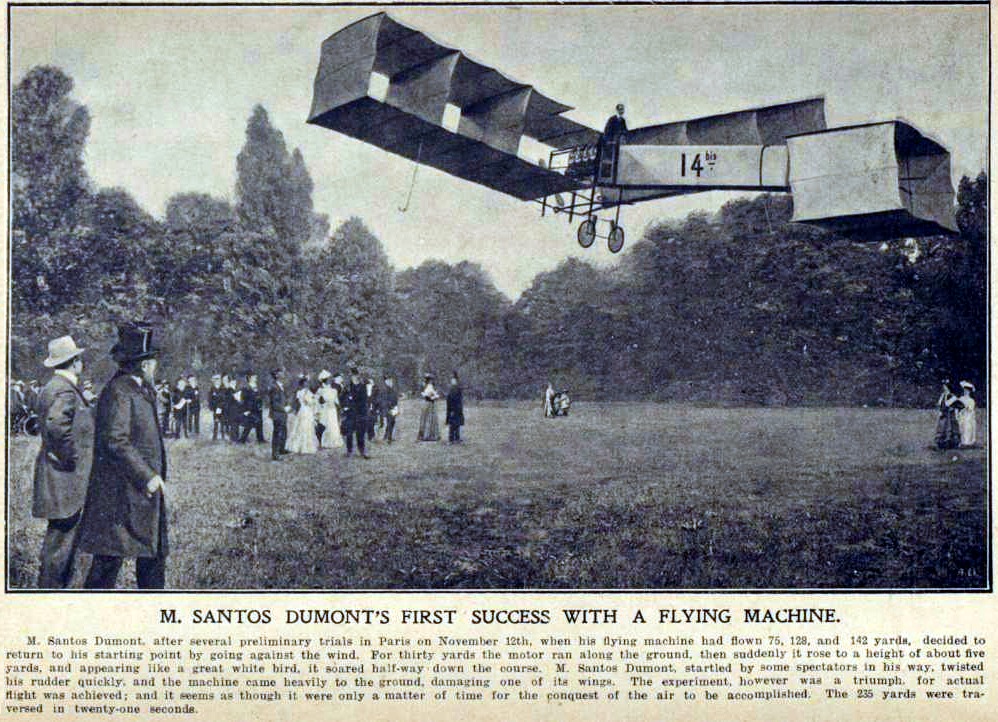
Santos-Dumont then progressed to powered heavier-than-air machines and on 23 October 1906 flew about 60 metres at a height of two to three metres with the fixed-wing 14-bis (also dubbed the Oiseau de proie—"bird of prey") at the Bagatelle Gamefield in Paris, taking off unassisted by an external launch system. On 12 November in front of a crowd, he flew 220 metres at a height of six metres. These were the first heavier-than-air flights certified by the Aeroclub of France, the first such flights officially witnessed by an aeronautics recordkeeping body, and the first of their kind recognised by the Fédération Aéronautique Internationale.
Santos-Dumont is a national hero in Brazil, where it is popularly held that he preceded the Wright brothers in demonstrating a practical aeroplane. Numerous roads, plazas, schools, monuments, and airports there are dedicated to him, and his name is inscribed on the Tancredo Neves Pantheon of the Fatherland and Freedom. He was a member of the Brazilian Academy of Letters from 1931 until his suicide in 1932.
Childhood
Alberto Santos-Dumont was the sixth child of Henrique Dumont, an engineer who graduated from the Central School of Arts and Manufactures in Paris, and Francisca de Paula Santos. The couple had eight children, three sons and five daughters: Henrique dos Santos-Dumont, Maria Rosalina Dumont Vilares, Virgínia Dumont Vilares, , Gabriela, Alberto Santos-Dumont, Sofia, and Francisca. In 1873, the family moved to the small town of Cabangu, in the municipality of João Aires, for Henrique Dumont to work on the construction of the D. Pedro II railroad. The construction work finished when Alberto was 6, and the family moved to São Paulo.}} Here he began to show signs of his aeronautical interest; according to his parents, at the age of one he used to puncture rubber balloons to see what was inside. He was baptised in Valença at the on 20 February 1877, by Teodoro Teotônio da Silva Carolina.


.png)
In 1879, the Dumonts sold their farm in Valença, Rio de Janeiro, and settled in Sítio do Cascavel, in Ribeirão Preto, where they bought the Arindeúva Farm,{{efn|It was later called Dumont Farm and was bought by an English syndicate. When they bought the farm, the family had 300 million réis and 80 slaves. to 96 kilometres of track and seven locomotives. From 10 to 12 years old he studied at Colégio Culto à Ciência. A newspaper of the time stated that Santos-Dumont would only accept if "...that amount was intended for an aircraft contest prize."
Santos-Dumont would remember with nostalgia the times spent on his father's farm, where he enjoyed the greatest freedom:
At the age of seven Santos-Dumont was already driving the farm's trains, and at twelve he could operate a locomotive on his own, but the speed achievable on land was not enough for him. By observing coffee machines he deduced that oscillatory machines wore out more, while those with circular motion were more efficient.
By reading the works of Jules Verne, with whose fictional heroes he was later compared and who he would meet in adulthood, Santos-Dumont got the desire to conquer the air. The submarines, balloons, ocean liners, and vehicles that the novelist envisioned in his works made a deep impression on the boy's mind. Years later, as an adult, he still remembered the adventures lived in imagination:
Technology fascinated him. He began building kites and small aeroplanes powered by a propeller driven by twisted rubber springs, Every year, on 24 June he would fill whole fleets of tiny silk balloons over the bonfires of St. John, to watch them climbing into the sky.
Career
Main article: List of Santos-Dumont aircraft
Mountaineering, motorsports and ballooning
In 1891, when he was 18, Santos-Dumont visited Europe. In England he spent a few months practising his English, and in France he climbed Mont Blanc. This adventure, at an altitude of almost 5,000 metres, gave him a taste for heights. The following year, his father had a serious accident, and released Alberto from parental care on 12 February 1892, advising him to focus on learning mechanics, chemistry, and electricity.}} With that, Alberto left the Ouro Preto Mining Engineering School and returned to France where he took part in motor racing and cycling. Santos-Dumont and other inventors studied the works of Lilienthal and Cayley. He relied on self-education, with Garcia guiding him in his studies. Peter Wykeham describes Garcia as an advisor in his studies. Around this time he went on to study at Merchant Venturers' Technical College, but never graduated. Agenor Barbosa described Santos-Dumont in this period as a "student of little diligence, or rather, not at all studious for 'theories', but of admirable practical and mechanical talent and, since then, revealing himself in everything, of inventive genius", but who was later described by Agnor as someone focused on aviation from when "...'explosion engines' began to succeed."
In 1897, independent and heir to an immense fortune At 24 years of age, Santos-Dumont left for France, where he hired professional aeronauts to teach him ballooning after reading the book Andrée – Au Pôle Nord en ballon.
On 30 May 1898 he made his first night ascent, By 1900 he had created nine balloons, of which two became famous: the Brazil and the Amérique. Brazil first flew on 4 July 1898, In his first experiments he was awarded a prize by the French Aeroclub for his study of atmospheric currents; he reached high altitudes and stayed airborne for more than 22 hours. Santos-Dumont advocated for government investment in aviation development and the importance of public opinion, something previously noted by .
Airships
Airships, powered aerostats, were first demonstrated and patented by the colonial Brazilian priest Bartolomeu de Gusmão in 1709, and were flown by the Montgolfier Brothers in 1783, but until the late 19th century had yet to be mastered, having been attempted by Henri Giffard, Charles Renard and Arthur Constantin Krebs in a flight with an electric motor in a closed circuit in a project abandoned by the French Army, and by the Brazilian , without success. Public demonstrations, such as those performed by Santos-Dumont, were important in the sceptical academic environment.
Due to the weight of electric motors, Santos-Dumont chose the internal combustion engine. In initial tests, he hoisted the tricycle he had used in the Paris-Amsterdam race up a tree to check for vibration, which did not occur. He modified the engine by putting the two cylinders on top of each other, creating a lightweight 3.5 horsepower unit, which was the first internal combustion engine successfully used in aeronautics. An article presented in , claims that the aeronautical movement in France was sparked by Santos-Dumont's experiments and Santos-Dumont said he believed his experiences led to the founding of the Aéro-Club de France.
A detail raised by Santos-Dumont refers to the definition of what would be heavier than air: in June 1902 he published an article in the North American Review arguing that his work on airships was about aviation, because hydrogen gas itself was not capable of taking off, and engine power was also needed. He also wrote: "...the flying-machine will be achieved only by the way of evolution, by making the air-ship pass through a series of transformations analogous to the metamorphoses by which the chrysalis becomes the winged butterfly."
No. 1

.png)
The first airship designed by Santos-Dumont, the No. 1, was 25 metres long with a volume of 186 cubic metres,}} made its first takeoff attempt in February 1898, after being inflated in Henri Lachambre's workshops in Vaugirard. Snowy conditions caused the airship to flex and crash. "At a height of five or six metres, over Longchamp, the apparatus suddenly bent and the crash began. Of my entire career, this is the most abominable memory I have in store."
No. 1 was inflated again in the Aclimation Garden in Paris on 18 September 1898, but was damaged before it could fly, due to a misjudgement by the ground crew holding the ropes. Repaired two days later, the aircraft took off and flew. The air pump for the internal balloon, which kept the envelope rigid, did not work properly, and the airship, at a height of 400 metres, began to flex and descend rapidly. In an interview, Santos-Dumont told how he escaped death:
No. 2
In 1899, Santos-Dumont built a new aircraft, No. 2, with the same length and similar shape, but a larger diameter of 3.8 metres, increasing the volume to 200 cubic metres. To address the unreliability of the air pump which had almost killed him, he added a small aluminium fan to maintain pressure and rigidity.
The first test was scheduled for 11 May 1899. At the time of the flight, rain made the balloon heavy. The demonstration consisted of simple manoeuvres with the aircraft attached by a rope, but ended in the adjacent trees. The airship had folded under the combined action of the contraction of the hydrogen and the force of the wind.
No. 3
In September 1899 Santos-Dumont started the construction of a new elongated airship, the No. 3, inflated with lighting gas, 20 metres long and 7.5 metres in diameter, with a capacity of 500 cubic metres. The basket was the same one used in the two other aircraft.
.png)
At 3:30 pm on 13 November Santos-Dumont took off in No. 3 from Vaugirard Aerostation Park and went around the Eiffel Tower for the first time. From the monument he went to the Parc des Princes then to the Bagatelle Gamefield in the Bois de Boulogne (near the Hippodrome of Longchamp). He landed at the exact spot where No. 1 had crashed, this time under control.
Santos-Dumont had a large hangar built at the Saint-Cloud site, large enough to hold No. 3 when completely filled, as well as the equipment to make the hydrogen gas.}} It was no longer intended to house No. 3, which had been abandoned, but No. 4, completed on 1 August 1900. With No. 3 he broke the record of 23 hours in the air. He tried to fly almost every day, demonstrating the reliability and usefulness of his aircraft.
No. 4
On 24 March 1900, the millionaire oil magnate Henri Deutsch de la Meurthe sent the President of the Aéro-Club de France, which had been founded two years earlier, a letter in which he promised 100,000 francs to anyone who could invent an efficient flying machine:
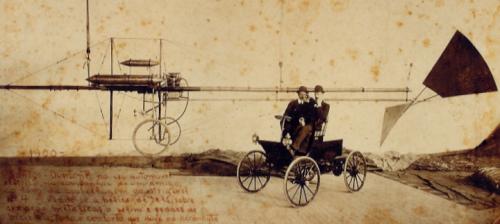
The challenge became known as the Deutsch Prize. The regulations stipulated that an aircraft must be able to fly to the Eiffel Tower, round the monument, and return to the place of ascent in no more than thirty minutes, without stops, a total of 11 kilometres, under the eyes of a commission from the Aeroclub de France convened at least one day in advance. This required a minimum average speed of 22 km/h.
The award encouraged Alberto Santos-Dumont to try faster flights with No. 4. The aircraft was 420 cubic metres in volume, 29 metres long, and 5.6 metres in diameter. Underneath was a 9.4-metre bamboo keel, in the middle of which were the saddle and pedals of an ordinary bicycle. Astride the saddle, the pilot had under his feet the starting pedals of a 7 hp engine, which powered a front propeller with two 4-metre long silk blades. Next to the pilot were ropes with which he could control the carburettor and valve settings, the rudder, ballast, and displacement weights. Santos-Dumont made almost daily flights in No. 4 from Saint Cloud during August. On 19 September, before members of the International Congress of Aeronauts, he proved the effectiveness of an aerial propeller driven by an oil engine by flying repeatedly against the wind, even with a broken rudder, impressing the scientists present. The general impression was that he would win the Deutsch Prize, and upon going to Nice after falling ill, he began designing No. 5.
No. 5 and No. 6

No. 5 was built to compete for the Henry Deutsch de la Meurthe award}} made of pine was suspended. Other innovations included the use of piano wire to suspend the gondola, reducing drag, and the use of water ballast tanks. It was powered by a 12 hp, 4-cylinder air-cooled engine driving a propeller,
On 13 April the Santos-Dumont Prize was created. It was similar to the Deutsch Prize, but had no time limit.}} On 13 July 1901, After some experimental outings, Santos-Dumont competed with No. 5 in the Deutsch Award for the first time. It completed the required course, but exceeded the time limit for the race by ten minutes. At that time, he met Princess Imperial Isabel, after an accident. On 29 July he aborted a flight when he cut his fingers on the guide-rope; around that time French aeronauts started a smear campaign against Santos-Dumont.
On 8 May, trying for the prize again, he crashed his aircraft into the Hotel Trocadero;}} The accident was caused by one of the automatic valves having a weakened spring, which allowed the escape of gas.
After offering his own 21 cubic metre balloon which was under construction – and being politely refused – Henri Deutsch said, "I'm afraid the experiments will not be conclusive. Mr Santos-Dumont's balloon will always be at the mercy of the wind, and is therefore not the kind of aircraft we dream of." Santos-Dumont crashed his No. 6 at the Longchamps racetrack on 19 September 1901.
On 19 October 1901, with the 622-cubic-metre No. 6 balloon powered by a 20 hp engine, he executed the test in 29 minutes and 30 seconds, and workers in Paris who for some reason had "pawned their tools of labor" with help from the City Hall of Paris. A month before the event, by announcing this intention, he had obtained "unrestricted support from public opinion". The money was released on 4 November after a vote in which nine members of the Aeroclub opposed and fifteen supported. This delay served to put public opinion further in Santos-Dumont's favour. The same afternoon, he sent a letter of resignation to the Aeroclub. Mauricio Pazini Brandão, in The Santos-Dumont legacy to aeronautics, says that this event should be considered as the certification of the airship.
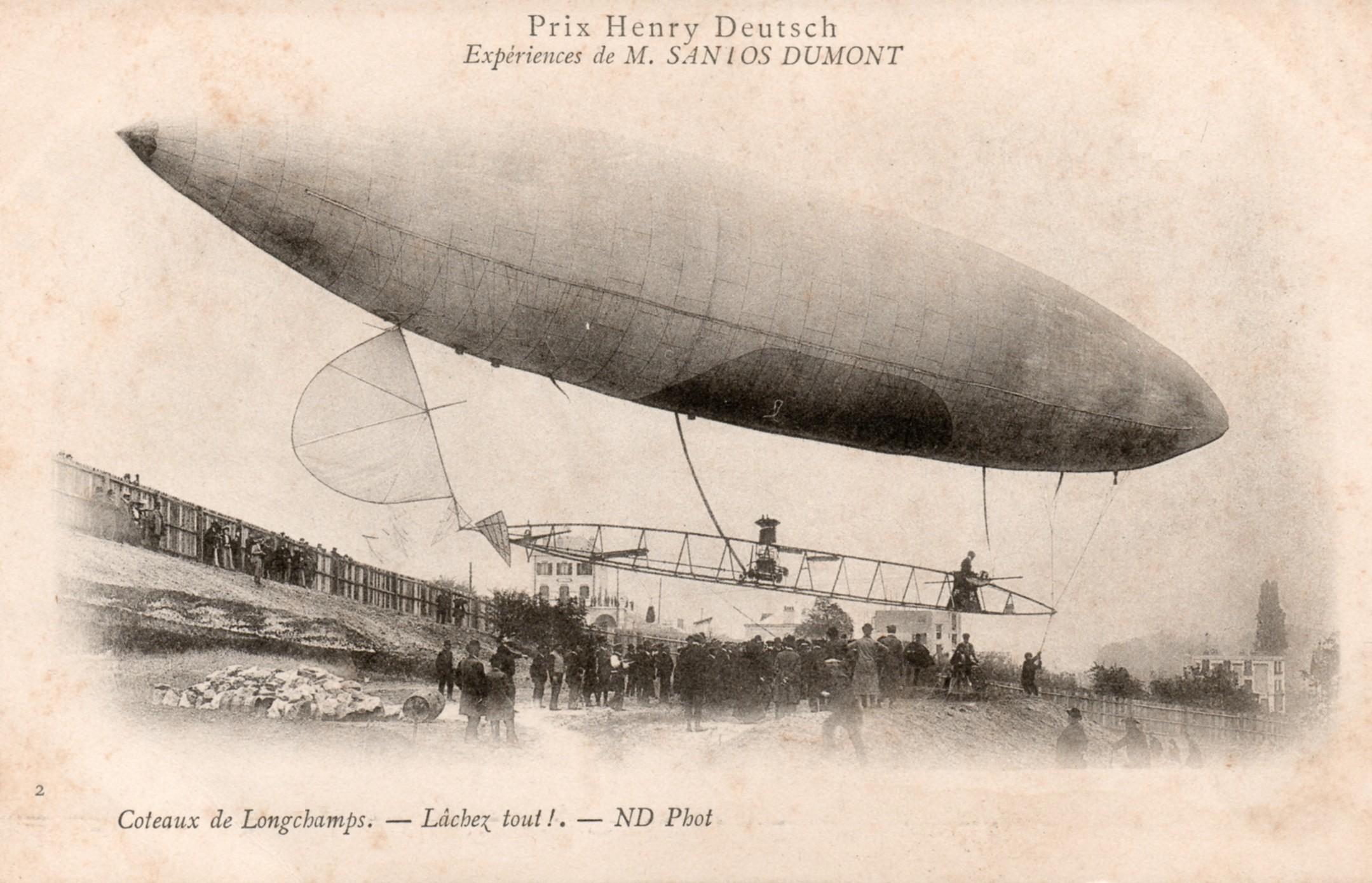
After winning the Deutsch Prize, Santos-Dumont received letters from several countries, congratulating him;}} following the proposal of Augusto Severo, They discussed patents. The American asked Santos-Dumont to create the Aero Club of the US; when justifying not charging for demonstration flights in St Louis, Santos-Dumont said: "I am an amateur". After the meeting with Edison, Santos-Dumont told the American press that he did not intend to patent his aircraft. He was received at the White House in Washington, DC, by President Theodore Roosevelt and talked to U.S. Navy and Army officials about the possibility of using airships as a defence tool against submarines. In July 1902, after the creation of the Aeroclub of the US, Santos-Dumont announced a series of flights in American territory. These did not take place, confusing the media and American public opinion. He left New York in late 1902, without having made any flights, and the American public did not consider his inventions to be practical.
At the beginning of the 20th century, Santos-Dumont was the only person in the world capable of controlled flight. After his time in the US, he learned of the fatal accident of Augusto Severo and the suicide of his mother; he returned to England, where he had left No. 6 being prepared for an exhibition at the Crystal Palace, as well as planning to fly into London. The fabric of the airship was punctured, as confirmed by the balloonist Stanley Spencer. The initial view was that the balloon had been cut with a knife, with Santos-Dumont stating that "...whole sections were cut and removed" and that he had previously experienced similar.
Monaco
Main article: Santos-Dumont's experiments in Monaco
In Monaco, after accepting Prince Albert's invitation, Santos-Dumont guided the construction of a 55 metre long, 10 metre wide and 15 metre high hangar, with doors he designed which weighed 10 tons, on the Boulevard de La Condamine by the sea. On testing the guide wire over the sea, he found that it stabilised the aircraft in low-level flight. Santos-Dumont also demonstrated that overall the aircraft behaved well over water, reaching up to 42 km/h (26 mph). Its success made clear the potential military use of the aircraft, especially for anti-submarine warfare, but its flights in the principality were interrupted by a crash in the Bay of Monaco on 14 February 1902. The crash was due to the balloon being "imperfectly filled when leaving the garage". After the accident he began to perform a check list before each take-off, but No. 6 was badly damaged.
Nos. 7, 8, 9 and 10
.png)
Santos-Dumont started to dedicate himself to the construction of new airship models, two years after he left Paris, No. 8 was a copy of No. 6 ordered by Edward Boyce, vice president of the Aeroclub of America, Boyce also bought No. 9.}} having made a single flight in New York; No. 9, with 261 cubic metres and 3 hp, was a travel airship, in which Santos-Dumont made several flights throughout 1903, including the first night flight of an airship on 24 June, and the last of these came on 14 July, when it took part in a military parade in commemoration of the 114th anniversary of the Storming of the Bastille. As he passed the President of the Republic, he fired 21 revolver shots into the air. The military considered the balloon to be a practical instrument for wartime. Santos-Dumont placed himself and his flotilla of three aircraft at the disposal of the government in the event of war, provided it was not against the nations of the Americas and that, "in the impossible event of war between France and Brazil," he considered himself obliged to support his motherland. The French military encouraged several industries to develop the technology proposed by Santos-Dumont.

The first woman to fly an aircraft was Aida de Acosta, on 29 June 1903, in No. 9. The 11 August 1905 issue of La Vie au Grand Air describes the organisation of the second Coupe des Femmes Aéronautes and in the second half of 1906, the magazine Le Sport Universel Illustré reported that three years after the start of the Grand Prix of the Aéro-Club de France, seven countries were already participating in the competition.
No. 10, a 2,010 cubic metre airship with a 60 hp engine, was large enough to carry several people and serve as public transport. It made a few flights in October 1903, but was never completely finished; No. 11 was an unmanned monoplane. No. 12 was a helicopter never completed due to the technological limitations of the time and finally, No. 13, a luxurious double hot air and hydrogen balloon.
On his first return to Rio de Janeiro in 1903, a group of climbers put up a banner on Sugarloaf Mountain, beside Guanabara Bay, greeting the aviator on his return by ship from Europe. On 7 September 1903, he returned as a hero and met the President of Brazil, Rodrigues Alves, at the Catete Palace. When asked why he did not fly in Brazil, Santos-Dumont justified himself that it was because he could not "...count on the help of his mechanics, and much less on a hydrogen production plant like he had in France." He returned to Paris on 12 October. In 1904 he was nominated as a Knight of the Legion of Honour of France, and published the work Dans L'Air, whose translation into Portuguese, Os Meus Balões (My Balloons), was published in Brazil in 1938.
Heavier-than-air flight
In October 1904, three aviation prizes were founded in France: the , the , and the . The first, promoted by millionaire Ernest Archdeacon, would award 3,500 francs to anyone who flew 25 metres; the second, instituted by the French aeroclub, would award 1,500 francs ($300) to anyone who flew 100 metres; and the third, sponsored by Henri Deutsch de la Meurthe and Ernest Archdeacon, would award 1,500 francs to anyone who flew 1,000 metres.
With the exception of the Deutsch-Archdeacon Award, which prohibited the competing aircraft from using a balloon for launch, the other awards left the question of takeoff open. The flight could take place on flat or uneven terrain, in calm weather or wind – the French Aeroclub's Award required the flight to be into the wind – and the use of an engine was not mandatory. This allowed human-powered gliders and ornithopters to compete. It was required for all prizes that the race took place in France and under the supervision of an aeronautical commission convened no later than the evening of the previous day.
Very little of what was required was new. Inventors in other countries had already met or exceeded some of the required goals including 2-axis (pitch and roll) control of gliders.{{efn|Henrique Lins de Barros' article says that the FAI did not consider that the claims of earlier flights (Ader, Lilienthal, Whitehead and Wrights) satisfied its criteria and that until 1905 there had been "...no actual flight of a heavier-than-air aircraft...". Lilienthal's death due to a stall led the Wright brothers to place the elevator in front, which helped prevent stalls but made stable flight difficult until the Wrights modified the design; the 3-axis surface control (pitch, yaw and roll) pioneered by the Wrights was also adopted by other inventors including Santos-Dumont and remains the standard airplane control configuration.
Glider and helicopter
Having already accumulated technical knowledge, mainly concerning engines, in early 1905, Santos-Dumont built a model glider, No. 11, inspired by a self-stabilising prototype made 100 years earlier by English scientist George Cayley, considered to be the first aeroplane in history: the model, 1.5 metres long by 1.2 metres wide, had fixed wings, a cruciform tail and a movable weight to adjust the centre of gravity. Santos-Dumont's glider differed from Cayley's in size, wing profile, and the fact that it had no movable weight. The project was abandoned due to poor stability. An article by Georges Blanchet published in April 1904 diverges from the description of the No. 11 as a model aeroplane by presenting it as a dirigible balloon capable of carrying five people and a 34-metre-long envelope, being purchased by an American.

The first experiment, conducted on 13 May at the Aeroclub de France, was made by the Dufaux brothers with a prototype helicopter. The model, weighing 17 kilograms and with a 3 hp engine, repeatedly soared to the roof of the air club's porch, raising clouds of dust. It had been demonstrated that heavier, larger aircraft could be lifted by their own means. The second experiment was made on 8 June on the Seine: Gabriel Voisin went up in the hydroplane Archdeacon, towed by a speedboat piloted by , La Rapière. The device barely rose out of the water and the project was abandoned due to poor stability. Watching tests like this, Santos-Dumont realised that the Antoinette engine from the tugboat could be used in an aeroplane, giving the concept of the 14-bis.
He began to study the two solutions for heavier-than-air flight. On 3 January 1906, he entered the Deutsch-Archdeacon Prize, and before that he had begun building a helicopter, the No. 12, but gave up on it on 1 June because it was impossible to create a light, powerful engine. Between June 12 and August 25, 1905, he tested the No. 14 airship, which flew in two versions (14-a and 14-b): the first was 41 metres long, 3.4 in diameter and 186 cubic metres, with a 14 hp engine, and the second was 20 metres long, 6 in diameter and with a 16 hp engine.
Olympic diploma, 1905
On 13 June 1905, represented by the Italian Count Eugenio Brunetta d'Usseaux, Baron Pierre de Coubertin awarded Santos-Dumont the Olympic Diploma No. 3 for "...representing the Olympic ideal..." according to Coubertin, who was also received by Theodore Roosevelt, Fridtjof Nansen and William-Hippolyte Grenfell. The FAI was created on 14 October 1905, along the lines of the International Olympic Committee.
''14-bis''
Main article: Santos-Dumont 14-bis
In 1906 Santos-Dumont built a hybrid machine, the 14-bis or Oiseau de Proie, consolidating his studies of what had been done in aviation until then, and the same newspaper even announced that Santos Dumont had entered the new prize with the "Santos-Helicopter," aiming to experiment with both aircraft.}} without having had experience with gliders.
''Oiseau de Proie I''
Santos-Dumont decided not to compete for the prizes with the hybrid, but on 20 July signed up for the tests and over the next three days continued to test the plane tethered to the balloon, to practise steering. Throughout the tests he realised that, although the balloon helped take-off, it made flight difficult as the drag generated was too great.
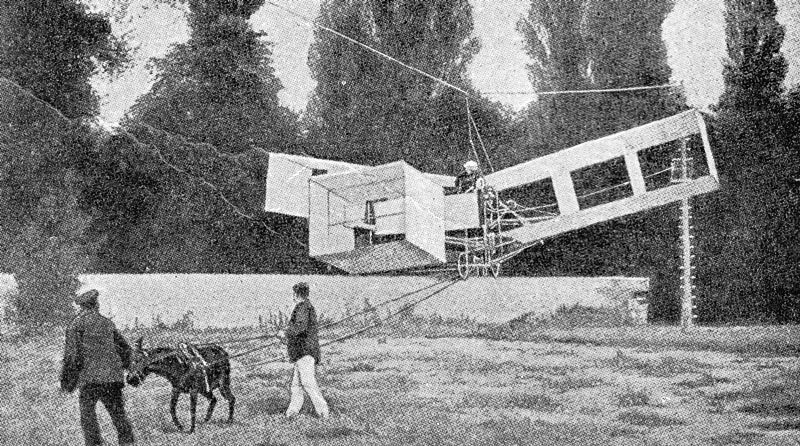
On 29 July, using a donkey and a system of cables, Santos-Dumont hoisted the Oiseau de Proie to the top of a tower
''Oiseau de Proie II''
On 23 October, Santos-Dumont presented himself at Bagatelle with the Oiseau de Proie II, a modification of the original model. The plane had been varnished to reduce the porosity of the fabric and increase lift. The rear wheel had been removed. In the morning he limited himself to manoeuvring the aircraft across the field, until the propeller shaft broke. It was repaired in the afternoon, and the plane was moved into position for an official attempt. An expectant crowd was present. At 4:45 pm, Santos-Dumont started the engine. The plane lifted off and flew for 60 metres,
The crowd celebrated, ran up to the pilot and carried him off in triumph. The judges had been overcome with emotion and forgot to time and track the flight, and due to this the record was not made official. says that because the Aeroclub Committee was partially present, a new test was scheduled for 12 November.
''Oiseau de Proie III''

The aeroplane was still experimental. To compete for the French Aeroclub's prize, Santos-Dumont inserted two octagonal surfaces (rudimentary ailerons) between the wings for better steering control and created the Oiseau de Proie III. Santos-Dumont was a pioneer in implementing ailerons in his aircraft.


Santos-Dumont competed for the award on 12 November 1906, The Wright brothers, after learning of the 12 November experiment, sent a letter to Captain Ferdinand Ferber asking for "exact news of the Bagatelle experiments," including "a faithful report of the trials and a description of the flying machine, accompanied by a schematic". Santos-Dumont even adopted the configuration proposed by the Wright brothers and placed the rudder at the front of the 14-bis, which he described as "the same as trying to shoot an arrow forward with the tail...". To test the idea that the rudder at the rear increased the angle of incidence of the wings, Santos-Dumont built a new aircraft, without abandoning the 14-bis, and tested it in March 1907, without taking off as the primitive landing gear did not allow it.
''Oiseau de Proie IV''
He returned to the 14-bis having made other changes to the aircraft after 12 November, and on 4 April 1907, at Saint-Cyr, the aircraft flew for 50 metres, oscillated, crashed, and was torn to pieces. The project was abandoned.
New aeroplanes

He also made the No. 15, a biplane with a rear-mounted rudder, as opposed to the canard format, the No. 16, a mix of airship and aeroplane, No. 17 and No. 18, a waterslide used to test the wing shape underwater.
Dissatisfied with numbers 15 to 18, he made a new series, smaller in size and more refined, like the Demoiselle, that was capable of reaching up to 90 kilometres per hour. It was first tested in November 1907, returning on an abandoned idea from 1905, but soon realised that it "... had serious structural problems" according to Henrique Lins de Barros. However, on November 17, 1907, he competed for the Deutsch-Archdeacon award, crossing 200 meters at a height of 6 meters, but abandoning before the required 1000 meters due to a breakdown in the aircraft.
In 1909 he presented the Demoiselle No. 20, improved and considered "the first ultralight in history". The Demoiselle could reach over 100 km/h, with which he made the first crossing in the country, between Saint Cyr of the Buc, with stops every 8 kilometres.}} Because of the aircraft's low cost and high safety, it was used for pilot training during World War I.
The aircraft is on permanent display at the Musée de l'air et de l'espace near Paris.}} and his colleagues were already being rewarded, he already seemed to have moved away from the events.
Last years
Santos-Dumont began to show symptoms of multiple sclerosis. he closed down his workshop and withdrew from social life. He continued to work on popularising aviation. On 12 November 1910 a monument was unveiled in Bagatelle, and on 4 October 1913, the Icarus monument was unveiled, celebrating his winning the Deutsch Prize, made by sculptor Georges Colin. On the same day he was promoted to Commander of the Legion of Honour and soon after these events he returned to Brazil after a 10-year absence, returning to France the following year. He ordered a new Demoiselle in 1913, but there is no evidence that he ever flew it.
In August 1914, World War I began, and Santos-Dumont offered his services to the French Ministry of War.

Santos-Dumont now devoted himself to the study of astronomy, residing in Trouville, near the sea. For this he used several observation devices, with which his neighbours thought he was spying for the Germans. He was arrested on this charge. After the incident was cleared up, the French government apologised. This made him feel depressed, considering that he had offered his help to the military, and he destroyed all his aeronautical documents.
In 1915, his health worsened and he decided to return to Brazil. That year, he took part in the 11th Pan-American Scientific Congress in the United States, dealing with the theme of the use of aeroplanes to improve relationships between the countries of the Americas.}} In his speech he showed concern about the efficiency of the aeroplane as a weapon of war, but advocated the creation of a squadron for coastal defence with the words, "Who knows when a European power will threaten an American state?" In 1916, he was the Honorary President of the 1st Pan-American Aronautics Conference in Chile, which aimed to create an Aeronautical Federation with all the Americas, where, while representing the Aeroclub of America, he advocated the peaceful use of the aeroplane. When he returned to Brazil, passing through Paraná, he suggested the creation of the Iguaçu National Park.}
In the book O Que Eu Vi, O Que Nós Veremos, Santos-Dumont transcribed his letters of 1917 to the President of the Republic of Brazil, stressing the need to build military airfields for the Army and the Navy. He also pointed out that Brazil was falling behind Europe, the United States and even Argentina and Chile. The book also argues for the need to train people in aeronautics, and to make the country technologically independent.


In 1918 Santos-Dumont bought a small plot of land on the side of a hill in Petrópolis in the Serra Fluminense mountains, and built a small house there filled with mechanical devices, including an alcohol-heated shower of his own design. The hill was chosen because of its steep slope, as proof that ingenuity could make it possible to build a comfortable home in that unlikely location. After he built it in land given by the government, he spent summers there to escape the heat of Rio de Janeiro, calling it "The Enchanted" because of the Rua do Encanto. The steps of the outside stairs are dug alternately to the right and left, to allow people to climb up comfortably. The house is now a museum. In 1918 he wrote his second work, O que eu vi, o que nós veremos in this house. In 1919 he got the United States Minister in Brazil to contact the Assistant Secretary of the Navy Franklin D. Roosevelt, as a way to "lobby" for more aeronautical cooperation between Brazil and the US.
In 1920, Santos-Dumont had a tomb erected for his parents and himself in the São João Batista Cemetery in Rio de Janeiro. The tomb is a replica of Saint-Cloud's Icarus. Also in 1920, he began an international campaign against the warlike use of aircraft, but without success.
In 1922, he decorated Anésia Pinheiro Machado, who, during the commemorations of the centenary of Brazil's independence, made the trip from Rio de Janeiro to São Paulo in an aeroplane. On 14 May he made his last balloon ascent. Also in 1922 he visited friends in France. He spent time in Paris, Petrópolis and Cabangu Farm, in his home town.
On 23 April 1923 he went to Portugal to collect his mother's remains. On 21 August, he started the construction of his parents' tomb, where a replica of the Icarus of Saint Cloud offered by the French Government was placed, and he carried out the transfer of his parents' remains on 23 October. Beside his parents' graves, Santos-Dumont personally dug his own.
On 6 November 1924, he was elected Grand Officer of the Order of Leopold II. In July, he was hospitalised in Switzerland.
In January 1926, he appealed to the League of Nations, through his friend and ambassador , to stop the use of aeroplanes as weapons of war. He offered ten thousand francs to whoever wrote the best piece against the military use of aeroplanes. Santos-Dumont was the first aeronaut to speak out against the warlike use of the aeroplane. In the same year he wrote to Senator refusing a third-party proposal to make him a general.
In May 1927, he was invited by the Aeroclub of France to preside over the banquet in honour of Charles Lindbergh for his crossing of the Atlantic Ocean, but he declined due to his health. He spent some time convalescing in Glion, Switzerland, and then returned to France. Researcher Henrique Lins de Barros describes that "around 1925, he gradually enters a state of almost permanent depression."
On 3 December 1928 he returned to Brazil on the ship Capitão Arcona. The city of Rio de Janeiro received him with honour. A seaplane carrying several professors from the Escola Politécnica, from the Condor Syndikat company, baptised with his name, crashed, with no survivors, while flying over Santos-Dumont's ship. After this event, he locked himself in the Copacabana Palace and only came out to attend the funerals. On 10 June 1930, he was decorated by the Aeroclub of France with the title of Grand Officer of the French Legion of Honour. His speech was recorded on a sound film.
Death

On 28 October 1930, Santos-Dumont was hospitalised in France, and on 14 April 1931 he wrote his first will. He would never return to France.
In July 1932, the state of São Paulo rose up in the Constitutionalist revolution against the revolutionary government of Getúlio Vargas. On the 14th, Santos-Dumont wrote a letter in favour of "...constitutional order in the country..." to Governor Pedro de Toledo. When talking to professor and friend José de Oliveira Orlandi by phone, Santos-Dumont said: "My God! My God! Is there no way to avoid the bloodshed of brothers? Why did I make this invention which, instead of contributing to the love between men, turns into a cursed weapon of war? I am horrified by these airplanes that are constantly passing over Santos".
The conflict continued, and aeroplanes attacked the Campo de Marte in São Paulo on 23 July. Coroners Roberto Catunda and Angelo Esmolari, who signed his death certificate, recorded the death as a heart attack. The chambermaids who found his body reported that he had hanged himself with his tie. According to Henrique Lins de Barros, for a long time it was forbidden to say that he had killed himself and that the idea that he committed suicide due to the military use of the aeroplane would be a legend of the getulista period, as the government sought to mythologise him; the suicide could weaken this. The real cause may have been depression and bipolar disorder. The order of the governor Pedro de Toledo, following Santos-Dumont's death, was: "There will be no investigation, Santos Dumont did not commit suicide".
Santos-Dumont left no suicide note and had no descendants. His body was buried in São João Batista Cemetery, in Rio de Janeiro, on 21 December 1932, during a storm, After keeping this a secret for twelve years, he wanted to return it to the Santos-Dumont family, who refused it. The doctor then donated the heart to the Brazilian government after a request from Panair do Brasil. The heart is on display at the Air Force Museum in Campo dos Afonsos, Rio de Janeiro, inside a sphere carried by Icarus, designed by Paulo da Rocha Gomide.
Legacy and tributes

On 25 July 1909, Louis Blériot crossed the English Channel, becoming a hero in France. In a letter, Santos-Dumont congratulated Blériot, his friend, with the following words: "This transformation of geography is a victory of air navigation over sea navigation. One day, perhaps, thanks to you, the airplane will cross the Atlantic". Blériot then replied, "I have done nothing but follow and imitate you. Your name to the aviators is a flag. You are our leader." Blériot's last project was named Santos-Dumont. says that the inventor's influence was both in his aeronautical development and in advocating the public and personal use of aeronautics, whether through lighter or heavier-than-air.
During his career, Santos-Dumont's image was printed on products, his Panama hat and collar were copied, his balloons were modelled as toys, and confectioners made cakes shaped like airships. The European and American media reappropriated him as a French, presenting him as a "French aeronaut" or emphasizing his French ancestry, while the Brazilian media emphasized his Brazilian roots and nationality.
In 1904, renowned French jeweller Louis Cartier debuted the Santos-Dumont, a watch designed for the aviator himself. It was the first wristwatch the Maison made, and the collection retails to this day.
The Aéro-Club de France honoured him with two monuments: the first, in 1910, erected on the Bagatelle Gamefield, where he had flown with the Oiseau de Proie, and the second, in 1913, in Saint-Cloud, to commemorate the flight of airship No. 6 in 1901. On the unveiling of the Saint-Cloud monument – a statue of Icarus – one of his long-time friends, the cartoonist Georges Goursat (aka "Sem"), wrote the following for the magazine L'Illustration:

On 31 July 1932 state decree No. 10,447 changed the name of the town of Palmira, in Minas Gerais, to Santos-Dumont.
Law No. 165, dated 5 December 1947, granted him the honorary rank of lieutenant brigadier. Santos-Dumont's birthplace in Cabangu, Minas Gerais, was made into the Cabangu Museum by state decree (MG) No. 5,057, on 18 July 1956. Law No. 3636, of 22 September 1959, made him an honorary air marshal.
In 1976, the International Astronomical Union gave Santos-Dumont's name to a lunar crater (). He is the only South American to be so honoured.
On 18 October 2005, the Brazilian Space Agency (AEB) and the Russian Federal Space Agency (Roscosmos) signed an agreement to carry out the Missão Centenário, which took Brazilian astronaut Marcos César Pontes to the International Space Station. The mission is a tribute to the centennial of Santos-Dumont's flight on the 14-bis, on 23 October 1906. The Soyuz TMA-8 spacecraft launched on 30 March 2006, from the Baikonur Launch Centre (Kazakhstan). On 26 July 2006 his name was included in the Steel Book of National Heroes in the Panteão da Pátria, in Brasília, granting him the status of National Hero.
Cultural representations

In 1902 the poet composed the song "A Conquista do Ar" in honour of Santos-Dumont's achievements, described by Thomas Skidmore as 'a conspicuous example of "ufanism" during the [Brazilian] belle époque', while for the song was "...an effort to insert Afro-Brazilians into cosmopolitan visions of flight." In 1924 Tarsila do Amaral painted "Carnaval em Madureira", which showed the replica of the Eiffel Tower and the airship built in Madureira for the Carnaval celebrations of that year, alongside Afro-Brazilians attending the event. During the 2004 carnival, the Unidos da Tijuca remembered the aviator, with several scientists – among them Nobel Prize winner Roald Hoffmann – dressed as Santos Dumont.
Santos-Dumont's friend Louis Cartier created a wristwatch for him in 1904. Up to that point, only women had wristwatches as they were considered a jewelry or fashion item only suitable for women; men only carried pocket watches. But Santos-Dumont needed both hands for flying and so Cartier created a wristwatch with a leather strap for him and called it the Cartier-Santos-Dumont. After his 1906 exploits, Santos-Dumont's picture was everywhere wearing the watch, and soon after, wristwatches became popular among men, possibly due to the publicity involving the watch Cartier made for his friend.
Over a century later, Cartier produced a series of watches named after him, celebrating the partnership between him and the brand. As a publicity piece, an award-winning film was made by France's Quad Productions entitled "L'Odyssée de Cartier".
In 1956, the Brazilian Post Office released a series of stamps commemorating the fiftieth anniversary of the first flight of a heavier-than-air aircraft. In 1973, they released a series of stamps to celebrate Santos-Dumont's centenary. On 23 October 2006, they launched a commemorative stamp for the centenary of the flight of the 14-bis. In the same month, the Brazilian Central Bank issued a coin commemorating Santos-Dumont's invention. He was depicted on the cruzeiro and cruzeiro novo banknotes.
In 2015, author Arthur Japin published the historical novel De gevleugelde (O Homem com Asas, in Brazil), about the aviator's life and death, and the extraction of his heart.
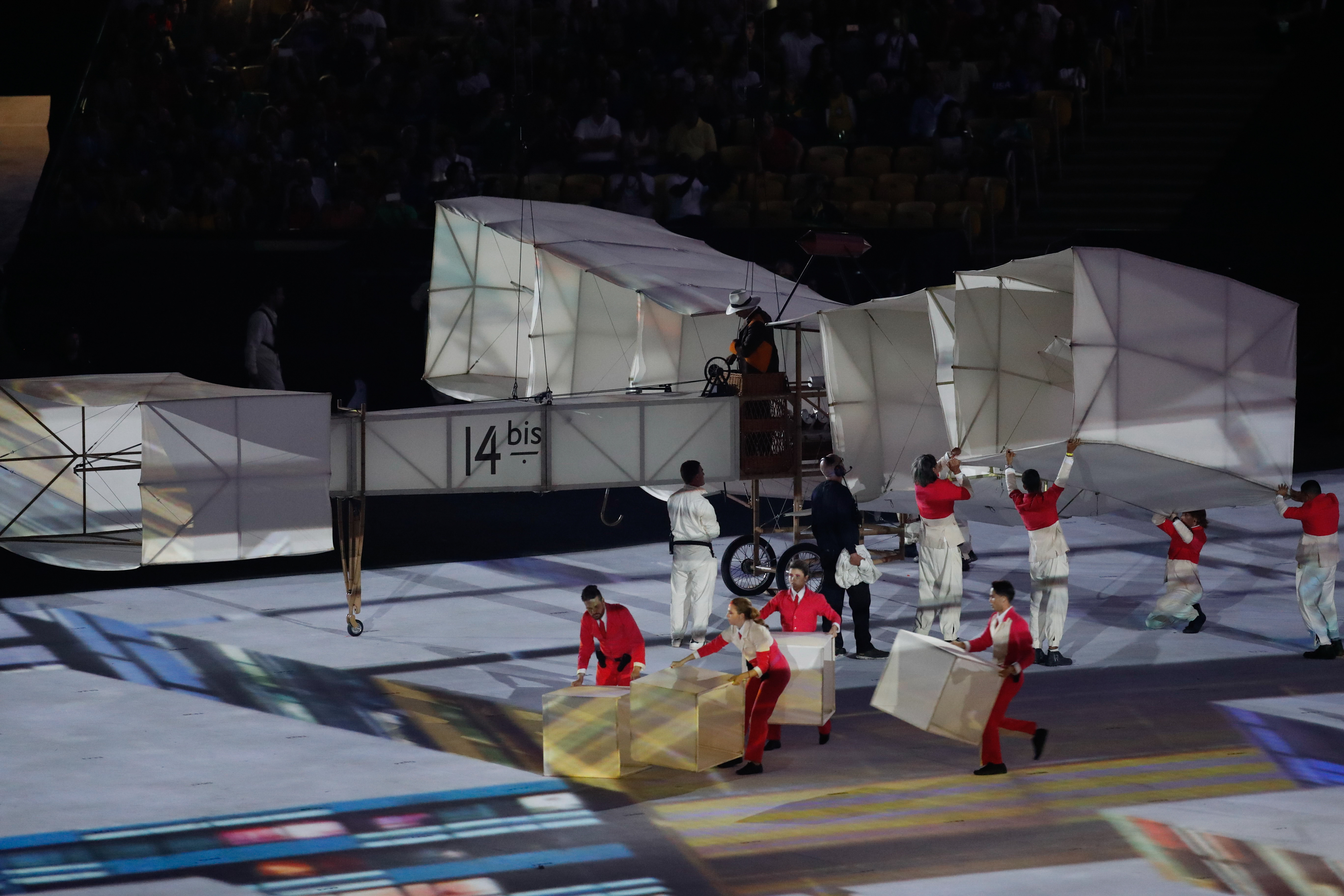
During the opening ceremony of the 2016 Summer Olympic Games at the Maracanã Stadium, a replica of Santos-Dumont's 14-bis, was built in the stadium and, with the help of steel cables, flew over the runway, "taking off" for a flight over the city of Rio de Janeiro.
Santos-Dumont has been portrayed as a character in film, television, and theatre, played by in Marcel Camus' Les faucheurs de marguerites (1974); by in the miniseries Um Só Coração (2004); by Daniel de Oliveira in the short film (2006); by Ricardo Napoleão in Denise Stoklos' play "Mais Pesado que o Ar – Santos Dumont" (1996); and by Henri Lalli in the play Santos-Dumont (since 2003). Fernanda Montenegro played a transsexual descendant of Santos-Dumont in the soap opera Zazá (1997). TV Brasil produced the programme , with a character named Betinho, depicting Santos-Dumont as a child.
On 10 November 2019, HBO released the miniseries Santos-Dumont across Latin America. The production follows the aviator's steps from childhood in his family's coffee fields Minas Gerais and São Paulo (where the family settled), to the sophisticated salons and aeroclubs in Paris, where Santos-Dumont made his historic flight in the 14-bis in 1906. Actor João Pedro Zappa played the inventor.
Personal life
Mental health
Santos-Dumont is traditionally described as having developed multiple sclerosis. However, this diagnosis is disputed by other researchers:
Henrique Lins de Barros questions this diagnosis: "I think it difficult to believe in this hypothesis of multiple sclerosis... How could anyone suffering from a degenerative disease like multiple sclerosis ski in Saint Moritz in the 1910s and play tennis in the 1920s, as he did?" Marcos Villares Filho, great-grandnephew of Santos-Dumont, says that he probably had a profound depression.
The original diagnosis came after consulting a doctor due to symptoms such as dizziness and double vision. Later, this diagnosis was challenged by other doctors, who believed that the aviator was already suffering from psychiatric manifestations. The symptoms reported for the original diagnosis would be only two related to multiple sclerosis.
From biographies of Santos-Dumont, Elie Cheniaux of the Federal University of Rio de Janeiro concludes that Santos-Dumont likely suffered from bipolar disorder or manic syndrome, with his latest bizarre inventions being able to demonstrate the "loss of critical ability", and notes several episodes showing bursts of energy outside of his depressive episodes. Santos-Dumont reportedly developed depression in 1910, predating the use of the aeroplane in the war, which, according to Cheniaux, would indicate that his feeling of guilt was a symptom rather than the cause. A letter written in 1931 by a doctor at the Orthez sanatorium to a friend of Santos-Dumont describes him as 'suffering from anxious melancholy with delusions of self-blame, from imaginary guilt, and awaiting punishment', also identified as neurasthenia, an exhaustion of the central nervous system.
Bipolar disorder is one of the disorders most connected with suicide and Santos-Dumont already had precedents in his family, with his mother having taken her own life in 1902 and that the aviator already demonstrated at the end of his life a number of epidemiological risk factors for suicide. It is hard to determine any diagnosis due to the lack of medical documentation.
Publications
;Books
- {{Cite book
- {{Cite book
;Articles
- {{Cite journal
- {{Cite journal
- {{Cite journal |jstor-access=free
- {{Cite journal
- {{Cite journal
- {{Cite journal
- {{Cite journal
- {{Cite journal
- {{Cite journal
;Translations of his works
- {{Cite book
- {{Cite book
- I. R. Belopolsky, ed. (1911). "Как я выиграл приз Дейча де-Ламетра". Въ мірѣ новыхъ ощущеній. pp. 31–46.
- "Os Meus Balões" (1938). Translated to Portuguese by Arthur de Miranda Bastos.
- {{Cite book |archive-url=https://web.archive.org/web/20071118101006/http://www.dominiopublico.gov.br/download/texto/vo000004.pdf |archive-date=2007-11-18 |url-status=live
- {{Cite book
- {{Cite book
- "O Homem Mecânico": published in Portuguese in the work "Os Balões de Santos-Dumont", 2010.
;Non published
- "L'Homme Mécanique", typescript from 1929.
- A book of 13 chapters, untitled, addressing aeronautical events of the 18th to 20th centuries.
Notes
References
Works cited
References
- Gray, Carroll F. (November 2006). "The 1906 Santos=Dumont No. 14bis". World War I Aeroplanes. 194: 4.
- Dória, Luiz Antônio. (2013-01-14). "João Gomes, Palmyra...Santos Dumont, a terra do pai do aviação.". Relatos de Viagem Etc..
- "História". SantosDumont.gov.
- Neves, Daniel. "Alberto Santos Dumont". Brasil Escola.
- "Les vols du 14bis relatés au fil des éditions du journal l'illustration de 1906".
- "Asas da liberdade: A vida e a morte de Santos Dumont".
- "A Century of Sporting Achievements".
- "Santos-Dumont: Pionnier de l'aviation, dandy de la Belle Epoque.".
- "Faster, Higher, Farther".
- "Alberto Santos-Dumont, Brazil". [[Smithsonian Institution]].
- "Cronologia".
- Barros, Henrique Lins de. (2003). "Santos Dumont: o vôo que mudou a história da aviação". Parcerias Estratégicas.
- (2 February 2019). "A memória de Santos Dumont pede socorro".
- Hoffman, Paul. (2010). "Asas da Loucura: A extraordinária vida de Santos-Dumont". Ponto de Leitura.
- Morel, Edmar. (1974-09-25). "Vida e Morte do Pai da Aviação (I)".
- LaFitte, Pierre. ''Une lettre du vainqueur'', ''La vie au grand air''. Paris: Pierre Laffite et Cie., 1901, p. 2.
- Archive from Igreja da Matriz de Santa Teresa. ''Livro de batismos da Matriz de Santa Teresa'', 1877, vol. 1, fol. 41.
- "Família, Infância, e Adolescência".
- Barros, Henrique Lins de. (2006). "Santos-Dumont and the Invention of the Airplane". CBPF.
- CENDOC. (2021). "E o mundo falava de Santos-Dumont". Centro de Documentação da Aeronáutica.
- "Lembranças do 'Tio Alberto'".
- Jorge, Fernando. (2018). "As lutas, a glória e o martírio de Santos Dumont". HarperCollins Brasil.
- Studart, Nelson. (2006). "Cronologia de Santos Dumont". Física na Escola.
- Reichel, Frantz. (January 1914). "Notre interview de Santos Dumont". Lecture Pour Tous.
- Dumont, Alberto Santos. (1986). "Os Meus Balões". Fundação Rondon.
- "Nossa Entrevista com Santos-Dumont".
- Barros, Henrique Lins. (2006a). "Alberto Santos-Dumont: pioneiro da aviação". Exacta.
- (2016). "Santos-Dumont, Aviador Esportista: O Primeiro Herói Olímpico do Brasil". Engenho Arte e Cultura.
- Morel, Edmar. (1974-10-02). "Vida e Morte do Pai da Aviação (II)".
- Dumont, Alberto Santos. (1904). "My Airships". Grant Richards.
- Dumont, Alberto Santos. ''Os meus balões''. Brasília: Alhambra, 3a edição, s/d, p. 23.
- "Santos Dumont". Revista Brasileira de Educação.
- Medeiros, Alexandre. (2006a). "Santos Dumont e o seu Professor de Física". Física na Escola.
- (2019). "Henrique Dumont: how a traumatic brain injury contributed to the development of the airplane". FapUNIFESP (SciELO).
- Dumont, Alberto Santos. (1918). "O que eu vi, o que nós veremos".
- Dias, Adriano Batista. (2006). "Santos Dumont: O Inovador". Vieira Lent.
- Mattos, Bento Silva de. (2012). "Open Source Philosophy and the Dawn of Aviation". J. Aerosp. Technol. Manag..
- {{rp
- Morel, Edmar. (1974-10-09). "Vida e Morte do Pai da Aviação (III)".
- Santos Dumont, A.. (June 1902). "Air-Ships and Flying-Machines". [[The North American Review]].
- (2006). "Mudanças no conceito de vôo na primeira década do século XX: O trabalho pioneiro de Santos-Dumont". Física na Escola.
- Aimé, Emmanuel. ''L'Aérophile. '' Paris: Aéroclub de France, 9o ano, no 4, apr. 1901, p. 76.
- (2006). "Santos Dumont".
- ''Aeronáutica'', ''Jornal do Commercio''. Rio de Janeiro: Propriedade de Rodrigues & Comp., n. 287, segunda-feira, 15 out. 1900, p. 2.
- "Alberto Santos Dumont". UOL – Educação.
- Blanchet, Georges. (1904). "Le retour et les préparatifs de Santos Dumont". Aéroclub de France.
- "Aida de Acosta—The First Woman to Fly a Powered Airship".
- "ANAC".
- ''Les concours d'aviation''. ''L'Aérophile.'' Paris: Aéroclub de France, 12o ano, no 10, out. 1904, pp. 224–225.
- (28 May 2015). "trecho do livro '''Imortais''' de ''Cláudia Barbosa''... desde 1903 voos cada vez mais longos em planadores motorizados".
- "Aeroplano Número 11".
- "History of Santos-Dumont's Inventions". [[University of Perugia]].
- ''Mais pesado que o ar'', ''Jornal do Commercio''. Rio de Janeiro: Propriedade de Rodrigues & Comp., no 161, domingo, 11 jun. 105, p. 3.
- "Olympic Diploma of Merit".
- (1906-02-09). "O Brasil e os Brasileiros na Europa". [[Jornal do Commercio]].
- {{rp. {{harvnb. Mattos. {{harvnb. Barros. Barros. Barros
- (November 1906). "International Balloon Race". Hearst Magazines.
- "Santos Dumont: As Asas do Homem".
- Morel, Edmar. (1974-10-16). "Vida e Morte de Santos Dumont (final)".
- He aged in appearance and felt too tired to continue competing with new inventors in races. On 22 August 1909 he attended the [[Grande Semaine d'Aviation de la Champagne. Flight]]'', 8 January 1910, p. 28.
- "Santos Dumont nos Estados Unidos". agendasantosdumont.com.br.
- (27 June 2016). "Museu Casa de Santos Dumont". Conhecendo Museus.
- "Santos {{sic". O Estado de S. Paulo – Acervo.
- "A Tortura".
- Silvio Cioffi. (2011-09-22). "Agitado, Guarujá é balneário desde 1893". Folha.com.
- "O Reconhecimento".
- (2017-10-25). "Henrique Lins de Barros, do CBPF, é agraciado com a Ordem do Mérito Aeronáutico no grau de Grande-Oficial".
- Francisco Alves Filho. (2007-12-05). "O baú de Santos Dumont".
- (2009). "História Abril – Santos Dumont: vida e morte de um bon vivant".
- Negrão, Daniele Rodrigues Barros Nunes. (February 2021). "Santos Dumont: Um Coração no Museu". Ideias Em Destaque.
- Gisele Machado. "O voo do João de Barros".
- GQ. (2023-06-05). "The High-Flying Origin Story of the Santos de Cartier Watch".
- Maurício Torres Assumpção. (2014). "A história do Brasil pelas ruas de Paris". Casa da Palavra.
- SEM, ''Santos Dumont, L'Illustration''. Paris: no 3.687, sábado, 25 out. 1913, p. 306.
- "Decreto nº 10447, de 31 de julho de 1932 – 10447/32 :: Legislação::Decreto 10447/1932 (Estadual – Minas Gerais) ::". www.lexml.gov.br.
- "23 de outubro DIA DO AVIADOR (A) E DA FORÇA AÉREA BRASILEIRA".
- (1947-12-05). "LEI Nº 165".
- (1956-07-18). "DECRETO ESTADUAL Nº 5.057".
- (1959-09-22). "LEI No 3.636".
- ""Santos-Dumont (crater)"".
- Pontes, Marcos. (2011). "Missão Cumprida: A História completa da primeira missão espacial brasileira". McHilliard.
- (2005-10-04). "Brazil, Russia Agree To Send Brazilian Cosmonaut To Space".
- (2006-07-26). "Santos Dumont é inscrito no Livro dos Heróis da Pátria". Jornal Diário do Grande ABC.
- (2003). "A Conquista do Ar".
- Hranek, Matthew. (2017). "A Man and His Watch: 76 of the World's Most Iconic Watches and Stories from the Men Who Wore Them". Artisan.
- Peter Dehn. (2013-09-23). ""L'Odysée de Cartier" by Quad Productions France". Animago.
- Institucional. "Santos Dumont". Cartier.
- (1956-10-16). "Página 58 da Seção 1 do Diário Oficial da União (DOU) de 16 de Outubro de 1956".
- "Um tributo a Santos Dumont".
- (2006-10-23). "Correios lançam selo comemorativo do 14 bis".
- (2006-10-20). "BC lança moeda comemorativa ao centenário do 14-bis". [[G1 (website).
- (2018-03-05). "Do cruzeiro ao real: relembre notas que desapareceram no Brasil". R7.
- "O Homem com Asas".
- "De gevleugelde".
- Vinicius Lisboa. (2016-08-05). "Abertura da Rio 2016 exalta diversidade, mistura ritmos e tem voo do 14 Bis". [[Agência Brasil]].
- "FAUCHEURS DE MARGUERITES .LES".
- (2004-01-06). "Conheça os personagens da minissérie "Um Só Coração", da Globo". Folha Ilustrada.
- Amin, Tatiana. (2006-10-24). "Daniel Oliveira confere a estréia do curta-metragem 14 Bis, em SP". O Fuxico.
- (2012-09-10). "'Caminhos do Sesc Sorocaba' apresenta novo prédio ao público". Jornal Cruzeiro do Sul.
- "Apresentação".
- Memória Globo. "Zazá".
- (2013-10-07). "TV Brasil leva ao ar três novos programas voltados às crianças". Folha de S.Paulo.
- (2019-11-06). "Saga de Santos Dumont estreia no dia 10 na HBO".
- Maia Barros, Régis Eric. (2013). "Did the "Father of Aviation" have his wings clipped by depression?". Rev. Bras. Psiquiatr..
- Cheniaux, Elie. (2022). "The bipolarity of Alberto Santos-Dumont: flights and falls of the 'Father of Aviation'". J. Bras. Psiquiatr..
- Ramalho, Valdir. (2013). "As biografias históricas de Santos Dumont". Scientiae Studia.
- "Nos 110 anos do 14-Bis".
This article was imported from Wikipedia and is available under the Creative Commons Attribution-ShareAlike 4.0 License. Content has been adapted to SurfDoc format. Original contributors can be found on the article history page.
Ask Mako anything about Alberto Santos-Dumont — get instant answers, deeper analysis, and related topics.
Research with MakoFree with your Surf account
Create a free account to save articles, ask Mako questions, and organize your research.
Sign up freeThis content may have been generated or modified by AI. CloudSurf Software LLC is not responsible for the accuracy, completeness, or reliability of AI-generated content. Always verify important information from primary sources.
Report