From Surf Wiki (app.surf) — the open knowledge base
Albany, New York
Capital city of New York, United States
Capital city of New York, United States
| Field | Value | |
|---|---|---|
| name | Albany | |
| settlement_type | State capital | |
| etymology | Named for the Scottish Duke of Albany, whose title comes from the Gaelic name for Scotland: Alba | |
| motto | Assiduity | |
| nicknames | ||
| image_skyline | {{multiple image | |
| border | infobox | |
| total_width | 280 | |
| perrow | 1/2/2/1 | |
| caption_align | center | |
| image1 | AlbanyNewYorkfromRensselaer.jpg | |
| alt1 | Downtown Albany skyline | |
| caption1 | Downtown Albany skyline from Rensselaer | |
| image2 | UAlbanyStateQuad.jpg | |
| alt2 | UAlbany | |
| caption2 | State Quad at SUNY Albany | |
| image3 | Albany Houses.jpg | |
| alt3 | Helderberg Neighborhood | |
| caption3 | Helderberg neighborhood | |
| image4 | North Pearl Street Albany.jpg | |
| alt4 | North Pearl Street | |
| caption4 | North Pearl Street | |
| image5 | PalaceTheater.JPG | |
| alt5 | Palace Theater | |
| caption5 | Palace Theatre | |
| image6 | EmpireStatePlazaPanorama.jpg | |
| alt6 | Dr. Martin Luther King Jr. Memorial Bridge | |
| caption6 | Empire State Plaza from the Cultural Education Center | |
| image_alt | A medley of different scenes to represent the diversity of the city. At top is a photo of the city's skyline, juxtaposing modern towers from the 1960s with older buildings dating back to the 19th century. Above center, right shows cookie-cutter, single-family houses, all two-stories with porches. Below center, right shows the marquee of a buff- and red-brick theater; marquee reads "PALACE". Bottom is a panoramic view of an open courtyard split by reflecting pools and surrounded by four modern, glass and concrete towers on left and one taller tower on right; in center is a Romanesque, granite, five-story capitol building. Below center, left shows a city street populated with old brick buildings. Above center, left shows a modern, glass and concrete tower surrounded by a shorter building of the same style. | |
| image_flag | Flag of Albany, New York.svg | |
| flag_alt | A flag with three equal horizontal stripes colored orange, white, and blue from top to bottom. In the center is the city seal (except for text and circular outline). | |
| image_seal | Seal of Albany, New York.svg | |
| seal_alt | Circular seal with central images of a shield at center and sailing ship above it, with a European man to the left and a Native American to the right. The seal's edge reads "THE SEAL OF THE CITY OF ALBANY" with "ASSIDUITY" in a banner above the bottom. | |
| image_shield | Coat of arms of Albany, New York.svg | |
| image_blank_emblem | Albany, NY wordmark.png | |
| blank_emblem_type | Wordmark | |
| mapframe | yes | |
| pushpin_map | USA New York#USA | |
| pushpin_map_caption | Location within the state of New York##Location within the Contiguous United States | |
| pushpin_label | Albany | |
| pushpin_relief | yes | |
| subdivision_type | Country | |
| subdivision_name | United States | |
| subdivision_type1 | State | |
| subdivision_name1 | New York | |
| subdivision_type2 | Metropolitan area | |
| subdivision_name2 | Capital District | |
| subdivision_type3 | County | |
| subdivision_name3 | Albany | |
| coordinates | ||
| elevation_footnotes | ||
| elevation_max_point | Loudonville | |
| elevation_max_ft | 378 | |
| elevation_min_point | Hudson River | |
| elevation_min_ft | 2 | |
| elevation_ft | 148 | |
| area_total_sq_mi | 21.94 | |
| area_land_sq_mi | 21.40 | |
| area_water_sq_mi | 0.53 | |
| area_metro_sq_mi | 2811.6 | |
| unit_pref | Imperial | |
| area_footnotes | ||
| area_total_km2 | 56.81 | |
| area_land_km2 | 55.44 | |
| area_water_km2 | 1.38 | |
| population_total | 99224 (US: 331st) | |
| population_as_of | 2020 | |
| pop_est_as_of | 2024 | |
| population_est | 101317 | |
| pop_est_footnotes | ||
| population_urban | 593142 (US: 73rd) | |
| population_density_urban_km2 | 844.1 | |
| population_density_urban_sq_mi | 2,186.3 | |
| population_metro | 913485 (US: 65th) | |
| population_density_sq_mi | 4730.28 | |
| population_density_metro_sq_mi | 416.3 | |
| population_density_km2 | 1825.9 | |
| <!-- * History & management * --> | established_title | Settled |
| established_date | ||
| established_title1 | Incorporated | |
| established_date1 | ||
| government_type | Strong mayor-council | |
| leader_title | Mayor | |
| leader_party | D | |
| leader_name | Dorcey Applyrs | |
| timezone1 | EST | |
| utc_offset1 | −5 | |
| timezone1_DST | EDT | |
| utc_offset1_DST | −4 | |
| postal_code | 12201–12212, 12214, 12220, 12222–12232 | |
| postal_code_type | ZIP Codes | |
| area_code_type | Area codes | |
| area_code | 518, 838 | |
| iso_code | ||
| geocode | , | |
| blank_name | FIPS code | |
| blank_info | 36-01000 | |
| blank1_name | GNIS feature ID | |
| blank1_info | 977310 | |
| population_demonym | Albanian | |
| website |
Albany ( ) is the capital city of the U.S. state of New York. It is also the county seat of, and the most populous city in, Albany County. Albany is located on the west bank of the Hudson River, approximately 10 mi south of its confluence with the Mohawk River. Its population was 99,224 at the time of the 2020 census and was estimated at 101,317 in 2024.
The oldest city in New York, the City of Albany is the economic and cultural core of New York State's Capital District. The Capital District is a metropolitan area including the nearby cities and suburbs of Colonie, Troy, Schenectady, and Saratoga Springs. With an estimated 1.3 million residents, the Capital District is one of the most populous metropolitan areas and the fastest-growing region in Upstate New York.
The area that ultimately became Albany was originally inhabited by Algonquian-speaking Mohican. The area was settled by Dutch colonists, who built Fort Nassau in 1614 for fur trading and Fort Orange in 1624. In 1664, the English took over the Dutch settlements, renaming the city Albany in honor of the Scottish title of the Duke of York (later James II of England and Ireland and James VII of Scotland): the Duke of Albany. The city was officially chartered in 1686 under English rule. It became the capital of New York in 1797 after the formation of the United States. Albany is the oldest surviving settlement of the original British Thirteen Colonies north of Virginia.
In the late 18th century and throughout most of the 19th, Albany was a center of trade and transportation. The city lies toward the north end of the navigable Hudson River. It was the original eastern terminus of the Erie Canal and was home to some of the earliest railroads in the world. In the 1920s, a powerful political machine controlled by the Democratic Party emerged in Albany. Albany's population shrank because of urban sprawl and suburbanization in the latter part of the 20th century. In the 1990s, the New York State Legislature approved for the city a US$234 million building and renovation plan, which spurred downtown redevelopment. Since 2020, the economy of Albany and the surrounding Capital District has been directed toward artificial intelligence, computer hardware, nanotechnology, and digital electronics.
History
Main article: History of Albany, New York
Mohican, Mohawk, and Dutch before 1660
The Hudson River area was originally inhabited by Algonquian-speaking Mohican (Mahican), who called it Pempotowwuthut-Muhhcanneuw, meaning "the fireplace of the Mohican nation". Based to the west along the Mohawk River, the Iroquoian-speaking Mohawk called it Sche-negh-ta-da, "through the pine woods", referring to the path they took there.
According to Hendrick Aupaumut, the Mohicans came to the area from the north and the west. They settled along the Mahicannituck River, which is now called the Hudson River, and called themselves the Muh-he-con-neok, the "People of the Waters That Are Never Still".
The Mohawks, one of the Five Nations of the Iroquois Confederacy, were based in the Mohawk valley and noted for their fur trading and their access to trade between the Iroquois and other nations. The Mohawk became strong trading partners with the Dutch and English. It is likely that the area was visited by European fur traders perhaps as early as 1540, but the extent and duration of those visits are unclear.
Permanent European claims began when Englishman Henry Hudson, exploring for the Dutch East India Company on the Half Moon (), reached the area in 1609, claiming it for the United Netherlands. In 1614, Hendrick Christiaensen built Fort Nassau on Castle Island (now called Port of Albany), in the Hudson River. The fort acted as a fur-trading post and was the first documented European structure in present-day Albany. Commencement of the fur trade provoked hostility from the French colony in Canada and among the natives, all of whom vied to control the trade. In 1618, a flood ruined Fort Nassau, but the Dutch replaced it with Fort Orange on the mainland in 1624. Both forts were named in honor of the leading family of the Dutch Revolt, members of the House of Orange-Nassau. Fort Orange and the surrounding area were incorporated as the village of Beverwijck () in 1652, and the city of Albany in 1686. In these early decades of trade, the Dutch, Mohican, and Mohawk developed relations that reflected differences among their three cultures.
British rule to 1800
Albany is one of the oldest surviving European settlements from the original Thirteen Colonies and the longest continuously chartered city in the United States. When New Netherland was captured by the English in 1664, the name was changed from Beverwijck to Albany in honor of the Duke of Albany (later James II).{{efn|James Stuart (1633–1701), brother and successor of Charles II, was both the Duke of York and Duke of Albany before being crowned king in 1685. His title of Duke of York is the source of the name of the province of New York. The name is ultimately derived from Alba, the Gaelic name for Scotland. The Dutch briefly regained Albany in August 1673 and renamed the city Willemstadt; the English took permanent possession in 1674 with the Treaty of Westminster. On November 1, 1683, the Province of New York was split into counties, with Albany County being the largest: it included all of present New York State north of Dutchess and Ulster Counties in addition to present-day Bennington County, Vermont, theoretically stretching west to the Pacific Ocean; Albany became the county seat. Albany was formally chartered as a municipality by provincial Governor Thomas Dongan on July 22, 1686. The Dongan Charter was virtually identical in content to the charter awarded to the city of New York three months earlier. Dongan created Albany as a strip of land 1 mi wide and 16 mi long. Over the years Albany would lose much of the land to the west and annex land to the north and south. At this point, Albany had a population of about 500 people.
Plan of Union
In 1754, representatives of seven British North American colonies met in the Stadt Huys, Albany's city hall, for the Albany Congress; Benjamin Franklin of Pennsylvania presented the Albany Plan of Union there, which was the first formal proposal to unite the colonies. Although it was never adopted by Parliament, it was an important precursor to the United States Constitution.{{efn|The Plan of Union's original intention was to unite the colonies in defense against aggressions of the French to the north; it was not an attempt to become independent from the British crown.
Revolutionary War and real estate
In 1775, with the colonies in the midst of the Revolutionary War, the Stadt Huys became home to the Albany Committee of Correspondence (the political arm of the local revolutionary movement), which took over operation of Albany's government and eventually expanded its power to control all of Albany County. Tories and prisoners of war were often jailed in the Stadt Huys alongside common criminals. In 1776, Albany native Philip Livingston signed the Declaration of Independence at Independence Hall in Philadelphia.
During and after the Revolutionary War, Albany County saw a great increase in real estate transactions. After Horatio Gates defeated John Burgoyne at Saratoga in 1777, the upper Hudson Valley was generally at peace as the war raged on elsewhere. Prosperity was soon seen all over Upstate New York. Migrants from Vermont and Connecticut began flowing in, noting the advantages of living on the Hudson and trading at Albany, while being only a few days' sail from New York City. Albany reported a population of 3,498 in the first national census in 1790, an increase of almost 700% since its chartering.
Early decades of American independence
On November 17, 1793, fire broke out at a stable belonging to Leonard Gansevoort, destroying 26 homes on Broadway, Maiden Lane, James Street, and State Street. Three were arrested and charged with arson: Pompey, a man belonging to Matthew Visscher; Dinah, a 14-year-old girl belonging to Volkert P. Douw; and Bet, a 12-year-old girl belonging to Philip S. Van Rensselaer. On January 6, 1794, the three were sentenced to death. Governor George Clinton issued a temporary stay of execution, but Dinah and Bet were executed by hanging on March 14, and Pompey on April 11, 1794.
In 1797, the state capital was moved permanently to Albany. From statehood to this date, the Legislature had frequently moved the state capital between Albany, Kingston, Poughkeepsie, and the city of New York. Albany is the tenth-oldest state capital in the United States and the second-oldest city that is a state capital, after Santa Fe, New Mexico.
1800 to 1942
Albany has been a center of transportation for much of its history. In the late 18th and early 19th centuries, Albany saw development of the turnpike and by 1815, Albany was the turnpike center of the state. The development of Simeon De Witt's gridded block system in 1794—which renamed streets that had originally named after the British royal family with names of birds and mammals instead—was intersected by these major arterials coming out of Albany, cutting through the city at unexpected angles. The construction of the turnpike, in conjunction with canal and railroad systems, made Albany the hub of transportation for pioneers going to Buffalo and the Michigan Territory in the early and mid-19th century.
In 1807, Robert Fulton initiated a steamboat line from New York City to Albany, the first successful enterprise of its kind anywhere in the world. The town and village north of Albany known as "the Colonie" was annexed in 1815. In 1825 the Erie Canal was completed, forming a continuous water route from the Great Lakes to New York City. Unlike the current Barge Canal, which ends at nearby Waterford, the original Erie Canal ended at Albany; Lock 1 was north of Colonie Street. The Canal emptied into a 32 acre man-made lagoon called the Albany Basin, which was Albany's main port from 1825 until the Port of Albany-Rensselaer opened in 1932. In 1829, while working as a professor at the Albany Academy, Joseph Henry, widely regarded as "the foremost American scientist of the 19th century", built the first electric motor. Three years later, he discovered electromagnetic self-induction (the SI unit for which is now the henry). He went on to be the first Secretary of the Smithsonian Institution. In the 1830 and 1840 censuses, Albany was ranked as the ninth-largest urban place in the nation; it dropped back to tenth in 1850. This was the last time the city was one of the top ten largest urban places in the nation.
Albany also has significant history with rail transport, as the location of two major regional railroad headquarters. The Delaware and Hudson Railway was headquartered in Albany at what is now the SUNY System Administration Building. In 1853, Erastus Corning, a noted industrialist and Albany's mayor from 1834 to 1837, consolidated ten railroads stretching from Albany to Buffalo into the New York Central Railroad (NYCRR), headquartered in Albany until Cornelius Vanderbilt moved it to New York City in 1867. One of the ten companies that formed the NYCRR was the Mohawk and Hudson Railroad, which was the first railroad in the state and the first successful steam railroad running regularly scheduled service in the country.
Albany's other major exports during the 18th and 19th centuries were furs, wheat, meat, and lumber. By 1865, there were almost 4,000 saw mills in the Albany area The city was also home to a number of banks. The Bank of Albany (1792–1861) was the second chartered bank in New York. The city was the original home of the Albank (founded in 1820 as the Albany Savings Bank), KeyBank (founded in 1825 as the Commercial Bank of Albany), and Norstar Bank (founded as the State Bank of Albany in 1803). American Express was founded in Albany in 1850 as an express mail business. In 1871, the northwestern portion of Albany—west from Magazine Street—was annexed to the neighboring town of Guilderland after the town of Watervliet refused annexation of the territory. In return for this loss, portions of Bethlehem and Watervliet were added to Albany. Part of the land annexed to Guilderland was ceded back to Albany in 1910, setting up the current western border.
The train carrying the body of slain President Abraham Lincoln came through Albany on the way to Illinois and the ghostly image of that train remains.
Albany opened one of the first commercial airports in the world, and the first municipal airport in the United States, in 1908. Originally on a polo field on Loudon Road, it moved to Westerlo Island in 1909 and remained there until 1928. The Albany Municipal Airport—jointly owned by the city and county—was moved to its current location in Colonie in 1928. By 1916 Albany's northern and southern borders reached their modern courses;
1942 to present day

Erastus Corning 2nd, arguably Albany's most notable mayor (and great-grandson of the former mayor of the same name), was elected in 1941. Although he was one of the longest-serving mayors of any city in United States history (1942 until his death in 1983), one historian describes Corning's tenure as "long on years, short on accomplishments," citing Corning's preference for maintaining the status quo as a factor that held back potential progress during his tenure. While Corning brought stability to the office of mayor, it is said even those who admire him greatly cannot come up with a sizable list of "major concrete Corning achievements." Corning is given credit for saving—albeit somewhat unintentionally—much of Albany's historic architecture.
During the 1950s and 1960s, a time when federal aid for urban renewal was plentiful, While cities across the country grappled with similar issues, the problems were magnified in Albany: interference from the Democratic political machine hindered progress considerably. which remains overseen by the Albany County Airport Authority.}}
Governor Nelson Rockefeller (1959–1973) (R) tried to stimulate the city with new monumental architecture and large, government-sponsored building projects; he drove construction of the Empire State Plaza, SUNY Albany's uptown campus, and much of the W. Averell Harriman State Office Building Campus. Albany County Republican Chairman Joseph C. Frangella once quipped, "Governor Rockefeller was the best mayor Albany ever had." Corning, although opposed to the project, was responsible for negotiating the payment plan for the Empire State Plaza. Rockefeller did not want to be limited by the Legislature's power of the purse, so Corning devised a plan to have the county pay for the construction and have the state sign a lease-ownership agreement. The state paid off the bonds until 2004. It was Rockefeller's only viable option, and he agreed. Due to the clout Corning gained from the situation, he gained inclusion of the State Museum, a convention center, and a restaurant, back in the plans—ideas which Rockefeller had originally vetoed. The county gained $35 million in fees and the city received $13 million for lost tax revenue. Having the state offices in the city enabled it to keep good jobs and retain middle-class residents.
Another major project of the 1960s and 1970s was the construction of Interstate 787 and the South Mall Arterial. Construction began in the early 1960s. A proposed Mid-Crosstown Arterial never came to fruition. One of the project's main results was separating the city from the Hudson River. Historian Paul Grondahl has described Corning as shortsighted with respect to use of the waterfront, saying the mayor could have used his influence to change the location of I-787, which now cuts the city off from "its whole raison d'être" In 1967, the hamlet of Karlsfeld was the last annexation by the city, sourced from the Town of Bethlehem.
When Corning died in 1983, Thomas Whalen assumed the mayorship and was reelected twice. He encouraged redevelopment of historic structures and helped attract federal dollars earmarked for that purpose. What Corning had saved from destruction, Whalen refurbished for continued and new uses. The Mayor's Office of Special Events was created in an effort to increase the number of festivals and artistic events in the city, including a year-long Dongan Charter tricentennial celebration in 1986. Whalen is credited for an "unparalleled cycle of commercial investment and development" in Albany due to his "aggressive business development programs".
Prior to the recession of the 1990s, downtown Albany was home to four Fortune 500 companies. After the death of Corning and the retirement of Congressman Sam Stratton, the political environment changed. Long-term office holders became rare in the 1980s. Local media began following the drama surrounding county politics (specifically that of the newly created county executive position); the loss of Corning (and eventually the machine) led to a lack of interest in city politics. The election of Gerald Jennings was a surprise, and he served as mayor from 1994 until his retirement at the end of 2013. His tenure essentially ended the political machine that had been in place since the 1920s.
During the 1990s, the State Legislature approved the $234 million "Albany Plan", "a building and renovation project [that] was the most ambitious building project to affect the area since the Rockefeller era." Under the Albany Plan, renovation and new building projects were initiated around the downtown area. Many state workers were relocated from the Harriman State Office Campus to downtown, helping its retail businesses and vitality.
Albany remains an important location for business presence, given its role as de facto seat of Tech Valley and being home to the state capitol. Fortune 500 companies with offices in Albany include American Express, J.P. Morgan and Chase, Merrill Lynch, General Electric, Verizon, Goldman Sachs, International Paper, and Key Bank.
Albany won the All-America City Award in both 1991 and 2009.
Geography
Albany is about 135 mi north of New York City on the Hudson River. It has a total area of 21.8 sqmi, of which 21.4 sqmi is land and 0.4 sqmi (1.8%) is water. The city is bordered on the north by the town of Colonie (along with the village of Menands), on the west by the town of Guilderland, and on the south by the town of Bethlehem. The former Foxes Creek, Beaver Kill, and Rutten Kill were diverted underground in the 19th century. There are four lakes within city limits: Buckingham Lake; Rensselaer Lake at the mouth of the Patroon Creek; Tivoli Lake, which was formed as a reservoir and once connected to the Patroon Creek; and Washington Park Lake, which was formed by damming the Beaver Kill.
The highest natural point in Albany is a USGS benchmark near the Loudonville Reservoir off Birch Hill Road, at 378 ft above sea level. The lowest point is at the Hudson River—which is still technically an estuary at Albany and is affected by the Atlantic tide—at an average of 2 ft above sea level at low tide and 4 ft at high tide. The interior of Albany consists of rolling hills which were once part of the Albany Pine Bush, an area of pitch pine and scrub oak, and has arid, sandy soil that is a remnant of the ancient Lake Albany. Due to development, the Pine Bush has shrunk from an original 25000 to today. A preserve was set up by the State Legislature in 1988 and is on the city's western edge, spilling into Guilderland and Colonie; it is the only sizable inland pine barrens sand dune ecosystem in the United States, and is home to many endangered species, including the Karner Blue butterfly.
Climate
Albany is in the humid continental climate zone (Köppen climate classification: Dfa),{{cite journal |display-authors=2
Cityscape
Neighborhoods
Main article: Neighborhoods of Albany, New York
Due to the variety of its communities, Albany is often called a "city of neighborhoods." The neighborhoods of Albany include Arbor Hill; Center Square, "[an] eclectic mix of residential and commercial [buildings], including bars, night clubs, restaurants, and stores"; Pine Hills; and the South End.
Demographics
City of immigrants
1960–1980, 1990–2000
2010–2020

Historically, Albany's population has been mixed. First dominated by Mohican and Mohawk people, then Dutch and Germans, it was overtaken by the British in the early 19th century. Irish immigrants soon outnumbered most other ethnicities by the mid-19th century, and were followed by Italians and Poles. In the mid-to-late 20th century, the African-American population increased with thousands of people from the rural South, as part of the Great Migration. As historian (and Albany Assemblyman) John McEneny puts it,
Until after the Revolution, Albany's population consisted mostly of ethnic Dutch descendants. Settlers migrating from New England tipped the balance toward British ethnicity in the early 19th century. Jobs on the turnpikes, canals, and railroads attracted floods of Irish immigrants in the early 19th century, especially in the 1840s during the Great Famine, solidifying the city's Irish base. Michael Nolan became Albany's first Irish Catholic mayor in 1878, two years before Boston. Polish and Italian immigrants began arriving in Albany in the wave of immigration in the latter part of the 19th century. Their numbers were smaller than in many other eastern cities mainly because most had found manufacturing jobs at General Electric in Schenectady. The Jewish community had been established early, with Sephardic Jewish members as part of the Beverwijck community. Its population rose during the late 19th century, when many Ashkenazi Jews immigrated from eastern Europe. In that period, there was also an influx of Chinese and east Asian immigrants, who settled in the downtown section of the city. Many of their descendants have since moved to suburban areas. Asian immigration all but halted after the Immigration Act of 1924.
Albany saw its last large immigration pattern as part of the Great Migration when many African Americans moved there from the American South before and after World War I to fill industrial positions and find other opportunities. In the early years, African-Americans lived together with Italians, Jews, and other immigrants in the South End, where housing was older and less expensive. The black community has grown as a proportion of the population since then; African Americans made up three percent of the city's population in 1950, six percent in 1960, 12 percent in 1970, and 30 percent in 2010. The change in proportion is related mostly to middle-class white families moving to the suburbs and black families remaining within city limits during the same time period.
Since 2007, the number of Burmese refugees to Albany has increased. The Burmese refugee community consists mostly of people of Karen ethnicity. An estimated 5,000 Burmese refugees reside in Albany .
Religious participation
Like most cities of comparable age and size, Albany has well-established Orthodox Christian, Roman Catholic, Protestant, and Jewish communities. Albany is home to the oldest Christian congregation in Upstate New York and the Mother Churches of two Christian dioceses. , eight churches or religious buildings in the city were listed on the National Register of Historic Places, one of which—St. Peter's Episcopal Church on State Street—is a National Historic Landmark. Established in 1642, the congregation of the First Church in Albany (Reformed), also known as the North Dutch Church (on North Pearl Street), is the second-oldest Reformed Church in America. The Cathedral of the Immaculate Conception (Eagle Street and Madison Avenue, built 1852) is the cathedral of the Roman Catholic Diocese of Albany, led by Bishop Edward Scharfenberger, and the Cathedral of All Saints (South Swan Street and Elk Street, built 1888) is the cathedral of the Episcopal Diocese of Albany. As of 2023, the city was home to twelve Catholic churches and four Episcopal churches. Despite its history of Christendom, in 2019 the Albany-Schenectady-Troy MSA was found to be among the most post-Christian cities in the United States in a study by Christian polling firm The Barna Group.
A significant Jewish presence has existed in Albany as early as 1658. As of 2010, Albany is home to two Conservative synagogues, a Chabad-Lubavitch synagogue, an Orthodox synagogue, and two Reform synagogues. Albany is also home to one of the few Karaite synagogues outside Israel. As of 2008, the total membership in Albany's synagogues was estimated at 12,000–13,000, with half the members residing outside the city. Since the early 2000s, there has been an increase in Orthodox Jews moving to Albany from the New York Metro area, largely due to cheaper housing prices and closer walking proximity to synagogues.
The Islamic community in Albany and its surrounding suburbs is represented by at least four major mosques in the region. The Muslim population increased substantially starting in the late 2000s, with the arrival of many refugees from countries such as Iraq, Syria, and Afghanistan.
Exact numbers on religious denominations in Albany are not readily available. Demographic statistics in the United States depend heavily on the United States Census Bureau, which cannot ask about religious affiliation as part of its decennial census. It does compile some national and statewide religious statistics, but these are not representative of a city the size of Albany. One report from 2000 offers religious affiliations for Albany County. According to the data, 59.2% of Albany County residents identified as Christian: 47% are Roman Catholic, 8.4% are mainline Protestants, 2.7% are Evangelical Protestants, and 1.1% are Eastern or Oriental Orthodox Christians. Residents who practice Judaism make up 4.2% of the population and Muslims represent 0.2%.
Modern overview
2020 census
| Race / Ethnicity (NH = Non-Hispanic) | title=P004 Hispanic or Latino, and Not Hispanic or Latino by Race – 2000: DEC Summary File 1 – Albany city, New York | url=https://data.census.gov/table/DECENNIALSF12000.P004?g=160XX00US3601000 | website=United States Census Bureau}} | title=P2 Hispanic or Latino, and Not Hispanic or Latino by Race – 2010: DEC Redistricting Data (PL 94-171) – Albany city, New York | url=https://data.census.gov/table?q=p2&g=160XX00US3601000&tid=DECENNIALPL2010.P2 | website=United States Census Bureau}} | % 2000 | % 2010 |
|---|---|---|---|---|---|---|---|---|
| White alone (NH) | 58,459 | 52,857 | 44,392 | 61.11% | ||||
| Black or African American alone (NH) | 26,042 | 28,479 | 29,222 | 27.22% | ||||
| Native American or Alaska Native alone (NH) | 233 | 191 | 241 | 0.24% | ||||
| Asian alone (NH) | 3,089 | 4,850 | 7,949 | 3.23% | ||||
| Native Hawaiian or Pacific Islander alone (NH) | 27 | 47 | 66 | 0.03% | ||||
| Other race alone (NH) | 217 | 296 | 871 | 0.23% | ||||
| Mixed race or Multiracial (NH) | 2,242 | 2,740 | 4,942 | 2.34% | ||||
| Hispanic or Latino (any race) | 5,349 | 8,396 | 11,541 | 5.59% | ||||
| Total | 95,658 | 97,856 | 99,224 | 100.00% |
As of April 1, 2020, Albany's population was 99,224.
With a 2013 Census-estimated population of 1.1 million, the eight county Capital District, encompassing Albany, Troy, Schenectady and Saratoga, is the third-most populous metropolitan region in the state.
As of the 2010 census, Albany's population density was 4572.7 PD/sqmi. There were 46,362 housing units at an average density of 2166.4 /sqmi; 5,205 of these units (11.2%) were vacant. The racial makeup of the city residents was 52.3% white; 27% Black or African American; 0.06% Native American or Native Alaskan; 7.4% Asian; 0.1% Native Hawaiian or Pacific Islander; .06% from other races; and 3.6% from two or more races. A total of 9.2% of the population were Hispanic or Latino of any race. Non-Hispanic Whites were 52.0% of the population in 2010, compared to 87.0% in 1970.
As of 2010, 20.0% of Albany's population was under the age of 18, 19.3% was aged 18 to 24, 29.2% was aged 25 to 44, 18.1% was aged 45 to 64, and 13.4% was aged 65 years or older. The median age was 31.4 years. For every 100 females, there were 90.6 males. For every 100 females age 18 and over, there were 86.5 males. Some 81.3% of the population had completed high school or earned an equivalency diploma.
As of the 2000 census, the top five ancestry groups in the city were African American (27%), Irish (18.1%), Italian (12.4%), German (10.4%), and English (5.2%); (33.1%) of the population reported "other ancestries". Albany is home to a Triqui language-speaking community of Mexican-Americans.
There were 40,709 households in Albany in 2000, of which 22.0% had children under the age of 18 living with them, 25.3% were married couples living together, 16.1% had a female householder with no husband present, and 54.8% were non-families. 41.9% of all households were made up of individuals, and 11.5% had someone living alone who was 65 years of age or older. The average household size was 2.11 and the average family size was 2.95.
The median income for a household in the city in 2000 was $, and the median income for a family was $ (male, year-round worker) and $ (female, year-round worker). The per capita income for the city was $. About 16.0% of families and 21.7% of the population were below the poverty line, including 28.8% of those under age 18 and 12.5% of those age 65 or over. The rate of reported violent crimes for 2008 (1,095 incidents per 100,000 residents) were more than double the rate for similarly sized US cities. Reported property crimes (4,669 incidents per 100,000 residents) were somewhat lower.
Demographically speaking, the population of Albany and the Capital District mirrors the characteristics of the United States consumer population as a whole better than any other major municipality in the country. According to a 2004 study conducted by the Acxiom Corporation, Albany and its environs are the top-ranked standard test market for new business and retail products. Albany, Rochester, and Syracuse all scored within the top five.
According to the 2020 American Community Survey, the Latino population was: 4.57% Puerto Rican, 1.45% Dominican, .84% Ecuadorian, .77% Mexican, .69% Salvadoran, .22% Cuban.
Crime
Albany's violent crime rate was 10.03 per 1,000 residents in 2023, compared to 7.69 in Buffalo, 7.39 in Rochester, 8.22 in Syracuse, and 7.72 in New York City. New York State had statewide violent crime rate of 3.90 per 1,000 people in 2023.
Economy
Main article: Economy of New York's Capital District
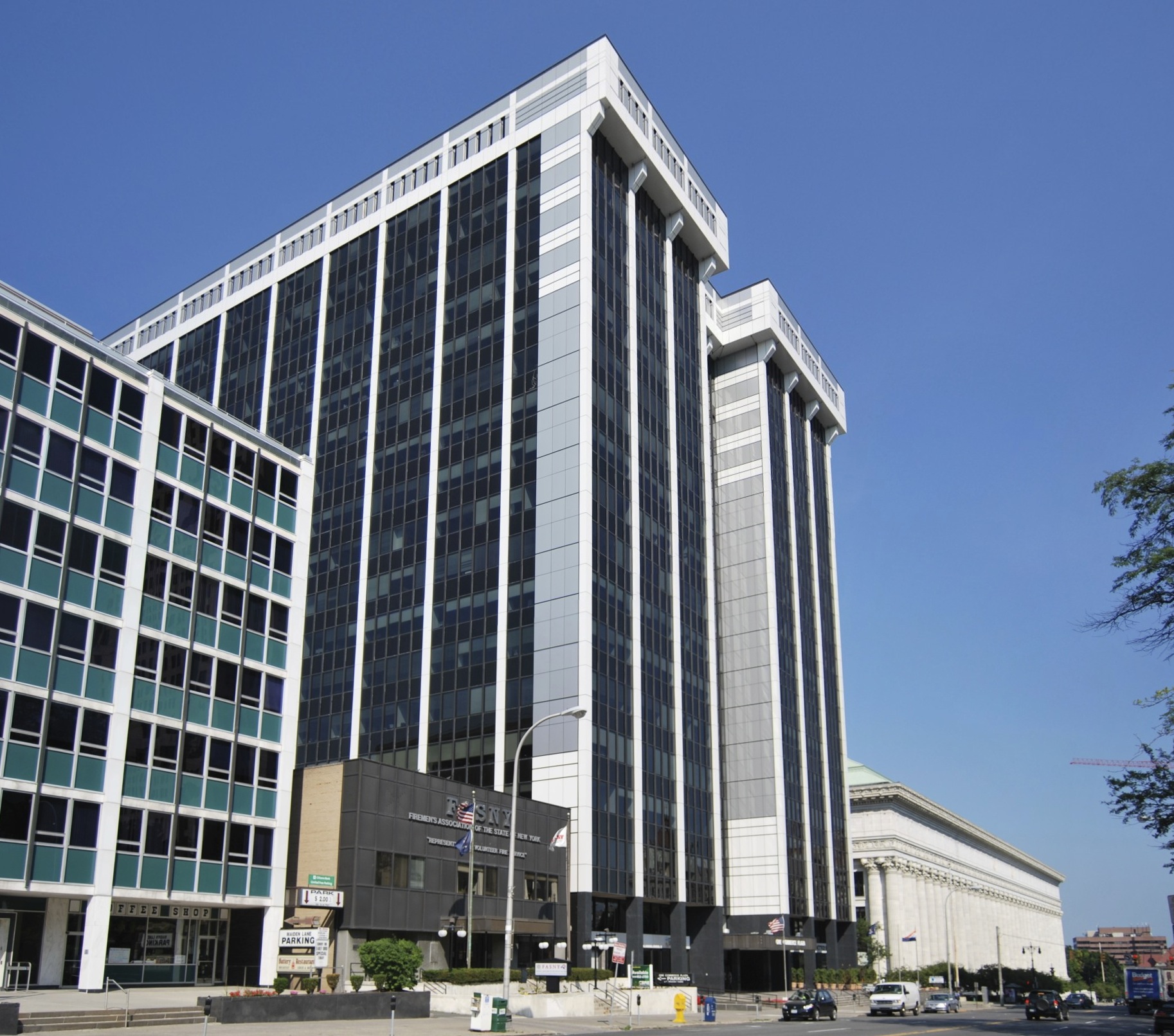
Albany's economy, along with that of the Capital District in general, is heavily dependent on government, health care, education, and more recently, technology. Because of these typically steady economic bases, the local economy has been relatively immune to national economic recessions in the past. In 2009, more than 25 percent of the city's population worked in government-related positions. Albany's estimated daytime population is more than 162,000. Companies based in Albany include Trans World Entertainment, AMRI Global and Clough Harbour. In 2019, Albany had the fourth-highest amount of lawyers in its employment pool (7.5 lawyers per 1,000 jobs) compared to the rest of the nation, behind Washington, D.C., Trenton, New Jersey, and New York City, respectively.
Tech Valley
Main article: Tech Valley
Since the 2000s, the economy of Albany and the surrounding Capital District has been directed toward high technology, a growing fourth sector of the area's economic base. Tech Valley is a marketing name for the eastern part of New York State, encompassing Albany, the Capital District, and the Hudson Valley. Originated in 1998 to promote the greater Albany area as a high-tech competitor to regions such as Silicon Valley and Boston, it has since grown to represent the counties in the Capital District and extending to 19 counties from IBM's Westchester County plants in the south to the Canada–US border in the north.
The area's high technology ecosystem is supported by technologically focused academic institutions including Rensselaer Polytechnic Institute and the State University of New York Polytechnic Institute. Tech Valley encompasses 19 counties straddling both sides of the Adirondack Northway and the New York Thruway, and with heavy state taxpayer subsidy, has experienced significant growth in the computer hardware side of the high-technology industry, with great strides in the nanotechnology sector, digital electronics design, and water- and electricity-dependent integrated microchip circuit manufacturing. A notable video game development cluster has grown in and around Albany starting in the 2010s.
Arts and culture
Main article: Culture in New York's Capital District
Nightlife and entertainment
Albany's geographic situation—roughly equidistant from New York City to the south and Montreal to the north—makes it a convenient stop for nationally touring artists and acts. The Palace Theatre and The Egg are mid-sized forums for music, theater, and spoken-word performances; the Capital Repertory Theatre is smaller. The MVP Arena is the city's largest musical venue for nationally and internationally prominent bands. It also hosts trade shows, sporting events, and other large gatherings. Some people praise the cultural contributions of Albany and the greater Capital District; others suggest that the city has a "cultural identity crisis" due to its widespread geography, which requires a car to reach most of what the area has to offer, a necessity not seen in larger and more densely populated metropolitan areas such as New York and Boston.
In recent years, the city's government has invested resources to cultivate venues and neighborhoods that attract after-hours business. Madison Avenue, Pearl Street, Delaware Avenue and Lark Street are the most active entertainment areas in the city. Many restaurants, clubs, and bars have opened since the mid-1990s, revitalizing areas that had once been abandoned and reclaiming old row houses, businesses, and a pump station. Bars are concentrated in three areas: about two blocks on Park Street, downtown; along Lark Street, home to smaller bars, which fit the neighborhood's artistic and eclectic style; and Western and Madison Avenues, in midtown, centered on the College of Saint Rose and SUNY Albany's downtown campus and drawing younger people. Much of the bar restaurant scene features classic Irish Pubs.
Festivals
Alive at 5 is a free, weekly concert series held downtown during the summer on Thursdays; with 10 concerts in 2010, total attendance was roughly 100,000. The Tulip Festival is set in Washington Park and celebrates the city's Dutch heritage, which began with Pinkster Festival, an African-Dutch Celebration. This traditional Albany event marks the beginning of spring as thousands of tulips bloom in the park in early May; attendance to the Tulip Festival in 2010 was approximately 80,000. Another large festival in Albany is the Capital Pride Parade and Festival, a major gay pride event held each June, attended by an estimated 30,000 spectators annually from across Upstate New York.
The Price Chopper Fabulous Fourth and Fireworks Festival at the Empire State Plaza celebrates Independence Day with musical performances and the region's largest fireworks display. Freihofer's Run for Women is a 5-kilometer run through the city that draws more than 4,000 participants from across the country; it is an annual event that began in 1978.The Albany Chefs' Food & Wine Festival: Wine & Dine for the Arts is an annual Festival that hosts more than 3500 people over 3 days. The Festival showcases more than 70 Regional Chefs & Restaurants, 250 Global Wines & Spirits, a NYS Craft Beer Pavilion, 4 competitions (The Signature Chef Invitational, Rising Star Chef, Barista Albany and Battle of the Bartenders) and one Grand Gala Reception, Dinner & Auction featuring 10 f Albany's Iconic Chefs. The Albany Chefs' Food & Wine Festival donates all net proceeds to deserving Albany Arts Organizations and is held the Thursday-Saturday preceding Martin Luther King Weekend. Smaller events include the African American Family Day Arts Festival each August at the Empire State Plaza; the Latin Fest, held each August at the Corning Preserve; the Albany Jazz Festival, an annual end-of-summer event held at the Corning Preserve; and Lark Fest, a music and art festival held each fall.
Museums and historic sites
Main article: National Register of Historic Places listings in Albany, New York

Because of Albany's historical and political significance, the city has numerous museums, historical buildings, and historic districts. Albany is home to the New York State Museum, the New York State Library and the New York State Archives; all three facilities are in the Cultural Education Center at the south end of Empire State Plaza and are free to the public. The USS Slater (DE-766), a decommissioned World War II destroyer escort that was restored in 1998, is a museum ship docked in the Hudson River at Quay Street. It is the only ship of its kind still afloat. The Albany Heritage Area Visitors Center, at the corner of Clinton Avenue and Broadway at Quackenbush Square, hosts a museum, gift shop, and the Henry Hudson Planetarium. In early 2012, the Irish American Heritage Museum opened in downtown Albany. The museum is home to exhibits highlighting the contributions of the Irish people in America.
The Albany Institute of History and Art, on Washington Avenue near the Center Square Neighborhood and State Capitol, is "dedicated to collecting, preserving, interpreting and promoting interest in the history, art, culture of Albany and the Upper Hudson Valley region." The museum's most notable permanent exhibits include an extensive collection of paintings by the Hudson River School and an exhibit on Ancient Egypt featuring the institute's "Albany Mummies".
Albany is home to 57 listings on the National Register of Historic Places (NRHP) and five National Historic Landmarks. The Ten Broeck Mansion, a 1797 Federal-style mansion (later renovated in the Greek-Revival style) built for Abraham Ten Broeck (mayor of Albany 1779–1783 and 1796–1798) is a historic house museum and the headquarters of the Albany County Historical Association; it was added to the NRHP in 1971. Later known as "Arbor Hill", it gave the current neighborhood its name.
Literature and film
Albany has been the subject, inspiration, or location for many written and cinematic works. Many non-fiction works have been written on the city. One of the city's more notable claims to fame is Ironweed (1983), the 1984 Pulitzer Prize-winning book by Albany native William Kennedy. Ironweed was the third in a series of books by Kennedy known as the "Albany Cycle". The elusive author Trevanian also grew up in Albany and wrote The Crazyladies of Pearl Street (2005), about a North Albany neighborhood along Pearl Street. The book is considered a semi-autobiographical memoir.
In 1987, the film version of Ironweed premiered at the Palace Theatre. The movie starred Jack Nicholson and Meryl Streep, each of whom were nominated for Academy Awards for their performances; much of the filming was done on location in Albany. Most recently the downtown area was the site of filming for the action-thriller Salt, starring Angelina Jolie, and the action-comedy The Other Guys, starring Will Ferrell and Mark Wahlberg.
Authors Herman Melville and Henry James lived with their families in Albany when young, before their careers. James identified his character Isabel Archer, the heroine of his novel The Portrait of a Lady, as being from Albany. Gregory Maguire, author of Wicked: The Life and Times of the Wicked Witch of the West (adapted for the Broadway hit Wicked), grew up in North Albany and graduated from SUNY Albany.
Architecture
Main article: Architecture of Albany, New York


The Empire State Plaza, a collection of state agency office buildings, dominates almost any view of Albany. Built between 1965 and 1978 at the hand of Governor Nelson A. Rockefeller and architect Wallace Harrison, the complex is a powerful example of late American modern architecture and remains a controversial building project both for displacing city residents and for its architectural style. The most recognizable aspect of the complex is the Erastus Corning Tower, the tallest building in New York outside of New York City. Juxtaposed at the north end of the Plaza is the 19th-century New York State Capitol, the seat of the New York State Legislature and the home of the Governor's office.

Albany's initial architecture incorporated many Dutch influences, followed soon after by those of the English. Quackenbush House, a Dutch Colonial brick mansion, was built ; Schuyler Mansion, a Georgian-style mansion, was built in 1765; and the oldest building in Albany is the 1728 Van Ostrande-Radliff House at 48 Hudson Avenue. Albany's housing varies greatly, with mostly row houses in the older sections of town, closer to the river. Housing type quickly changes as one travels westward, beginning with two-family homes of the late 19th century, and one-family homes built after World War II in the western end of the city.
Albany City Hall, designed by Henry Hobson Richardson, was opened in 1883. The New York State Capitol was opened in 1899 (after 32 years of construction) at a cost of $25 million, making it the most expensive government building at the time. Albany's Union Station, a major Beaux-Arts design, was under construction at the same time; it opened in 1900. In 1912, the Beaux-Arts styled New York State Department of Education Building opened on Washington Avenue near the Capitol. It has a classical exterior, which features a block-long white marble colonnade. The 1920s brought the Art Deco movement, which is illustrated by the Home Savings Bank Building (1927) on North Pearl Street and the Alfred E. Smith Building (1930) on South Swan Street, two of Albany's tallest high-rises.
Architecture from the 1960s and 1970s is well represented in the city, especially at the W. Averell Harriman State Office Building Campus (1950s and 1960s) and on the uptown campus of the University at Albany (1962–1971). The state office campus was planned in the 1950s by governor W. Averell Harriman to offer more parking and easier access for state employees. The uptown SUNY campus was built in the 1960s under Governor Rockefeller on the site of the city-owned Albany Country Club. Straying from the popular open campus layout, SUNY Albany has a centralized building layout with administrative and classroom buildings at center surrounded by four student housing towers. The design called for much use of concrete and glass, and the style has slender, round-topped columns and pillars reminiscent of those at Lincoln Center in New York City.
Downtown has seen a revival in recent decades, often considered to have begun with Norstar Bank's renovation of the former Union Station as its corporate headquarters in 1986.{{efn|In 2009, Bank of America (which now owns FleetBank, the bank that eventually bought Norstar) consolidated its operations in an office building on State Street, leaving the former train station vacant. Mayor Corning made great efforts to save the building, which had been owned by his great-grandfather's railroad a hundred years before. He was able to do it when governor Rockefeller brought state money in to purchase the building. but was instead built downtown and opened in 1990. Other development in downtown includes the construction of the State Dormitory Authority headquarters at 515 Broadway (1998); the State Department of Environmental Conservation building, with its iconic green dome, at 625 Broadway (2001); the State Comptroller headquarters on State Street (2001); the Hudson River Way (2002), a pedestrian bridge connecting Broadway to the Corning Preserve; and 677 Broadway (2005), "the first privately owned downtown office building in a generation".
Sports
Main article: Sports in New York's Capital District

Albany has teams in two top-level professional sports leagues in the United States and Canada (New York Atlas, and Albany Firebirds), and several minor-league sports teams with varying levels of support.
The Albany Devils were a minor league ice hockey team that moved to the city for the 2010–11 season. They played in the American Hockey League and were affiliated with the New Jersey Devils of the National Hockey League. The Devils replaced the Albany River Rats, who played in the Capital Region from 1990 to 2010, when they relocated to Charlotte, North Carolina. The Albany Devils moved to Binghamton, New York in 2017.
The Times Union Center has previously hosted arena football teams including the Albany Firebirds in the Arena Football League (AFL) from 1990 to 2000 and then a team originally known as the Albany Conquest and later the Firebirds in the af2, the AFL's developmental league, from 2002 to 2009. The Albany Empire played in the AFL from 2018 through the 2019 season when the league folded. A new Albany Empire was relaunched in the National Arena League for the 2021 season. In 2023, Antonio Brown bought the team; after a series of problems with payments and personnel, the NAL suspended the franchise in the middle of the 2023 season. A relaunched Albany Firebirds franchise began playing in 2024.
The Tri-City ValleyCats short season minor league baseball team have played at the Joseph L. Bruno Stadium on the Hudson Valley Community College campus in North Greenbush since 2002. Prior to the ValleyCats' arrival, the Albany-Colonie Diamond Dogs (1995–2002) played at Heritage Park in Colonie; due to financial pressures, and facing impending competition from the ValleyCats, the franchise folded in 2002.
The Albany Legends (International Basketball League), played in the Washington Avenue Armory from 2010 to 2014 before moving to Schenectady. The Albany Patroons have played at the Armory on and off since 1982 and currently play in The Basketball League.
With the large number of local colleges and universities around Albany, college sports are popular. The University at Albany's Great Danes play at the Division I level in all sports. The football team is a member of the Coastal Athletic Association while all other sports teams play as members of the America East Conference. In 2006, UAlbany became the first SUNY-affiliated school to send a team to the NCAA Division I men's basketball tournament. The Siena Saints saw a rise in popularity after their men's basketball team made it to the NCAA Tournament in 2008, 2009, and 2010. All 18 Saints teams are Division I and play in the Metro Atlantic Athletic Conference. Although Siena's campus is in nearby Colonie, the men's basketball team plays at the Times Union Center.
UAlbany hosted the New York Giants training camp from 1996 to 2012.
On February 23, 2021, it was announced that the National Lacrosse League (NLL) would return to the city with the relocation of the New England Black Wolves. The team was named the Albany FireWolves on April 15, 2021. This is the second NLL team to be based in the area; the first, the Albany Attack, played in the city from 2000 to 2003.
In 2023, the Premier Lacrosse League (PLL) selected cities for their 8 franchises, and Albany was chosen as the primary home for the New York Atlas.
In 2024, the Albany Firebirds began playing in the AFL at the MVP Arena. After one season in the AFL, the team moved to the AF1.
The 518 Ballers (American Basketball Association) have played at Our Savior's Christian School since 2023.
Parks and recreation
Albany has more than 60 public parks and recreation areas. Washington Park was organized as the Middle Public Square in 1806. Its current location has been public property since the Dongan Charter of 1686 gave the city title to all property not privately owned. Washington Park was designed by John Bogart and John Cuyler in 1870, and opened for public use the following year. The original lake house, designed by Frederick W. Brown, was added in 1876. The park had previously been used as a cemetery; its graves were moved to Albany Rural Cemetery. Washington Park is a popular place to exercise and play sports; skate during the winter; people-watch during Tulip Fest; and attend plays at the amphitheater during the summer.

Other parks in Albany include Lincoln Park, Buckingham Park, the Corning Preserve, the Albany Skyway and the Pine Bush. Lincoln Park, southwest of the Empire State Plaza, was organized in 1886 and was originally known as Beaver Park. Today, the park has a pool that is open during the summer months. Buckingham Lake Park is between Manning Boulevard and Route 85 in the Buckingham Pond neighborhood; it contains a pond with fountains, a footpath, a playground, and picnic tables. The Albany Riverfront Park at the Corning Preserve has an 800-seat amphitheatre that hosts events in non-winter months, most notably the Alive at 5 summer concert series. The Preserve's visitors center details the ecology of the Hudson River and the local environment. The park has a bike trail and boat launch and was effectively separated from downtown by Interstate 787 until the opening of the Hudson River Way in 2002.
Other public parks include Westland Hill Park, Hoffman Park, Beverwyck Park, and Liberty Park, today a small circular grassy patch in downtown on Hudson Avenue, which is Albany's oldest park. Ridgefield Park is home to the clay courts of the Albany Tennis Club, one of the oldest tennis clubs in the United States. The municipal golf course, New Course at Albany, was constructed in 1929 as the Albany Municipal Golf Course, later renamed the Capital Hills at Albany, and remodeled in 1991.
Government
Albany has a strong mayor-council government, which functions under the Dongan Charter, granted by colonial governor Thomas Dongan in 1686 when Albany was incorporated. A revised charter was adopted by referendum in 1998, but was legally reckoned as an amendment to the Dongan Charter. This gives Albany the distinction of having the oldest active city charter in the United States and "arguably the longest-running instrument of municipal government in the Western Hemisphere." The mayor, who is elected every four years, heads the executive branch of city government. The current mayor, Kathy Sheehan, was first elected in 2013. The Common Council represents the legislative branch of city government and is made up of fifteen council members (each elected from one ward) and an at-large Common Council President. The current president is Corey Ellis; he began his term in January 2018.
While Albany has its own city government, it has also been the seat of Albany County since the county's formation in 1683 and the capital of New York since 1797. As such, the city is home to all branches of the county and state governments, as well as its own. Albany City Hall sits on Eagle Street, opposite the State Capitol, and the Albany County Office Building is on State Street. The state government has offices scattered throughout the city.
Albany is in the 20th Congressional district, represented by Paul Tonko (D) in the United States House of Representatives. The city is represented by Chuck Schumer (D) and Kirsten Gillibrand (D) in the United States Senate. On the state level, the city is in the 44th district in the New York Senate, represented by Patricia Fahy (D). In the New York Assembly, western Albany is in the 109th district, represented by Gabriella Romero (D) while downtown and eastern Albany are in the 108th district, represented by John T. McDonald III (D). As the seat of Albany County, the city is the location of the county's courts including Family Court, County Court, Surrogate Court, Supreme Court, and New York Court of Appeals. Albany is the site of a federal courthouse that houses the United States District Court for the Northern District of New York.
Politics
Albany's politics have been dominated by the Democratic Party since the 1920s; Daniel (Uncle Dan) O'Connell established a political machine in the city with the election of William Stormont Hackett as mayor in 1922. Prior to that, William Barnes Jr. had set up a Republican machine in the 1890s. Barnes' success is attributed to the fact that he owned two newspapers in Albany and that he was the grandson of Thurlow Weed, the influential newspaper publisher and political boss. O'Connell's organization overcame Barnes' in 1922 and survived well into the 1980s (even after his death). In many instances, votes were outright bought.
Gerald Jennings' upset in the 1993 Democratic mayoral primary over Harold Joyce, who had the Democratic Party's formal endorsement and had only recently been its county chairman, is often cited as the end of the O'Connell era in Albany. In the early 21st century, Albany continued to be dominated by the Democratic Party. Democratic Party enrollment in the city was 38,862 in 2009, while Republican enrollment was 3,487. As of 2022, every elected city position had been held by a Democrat since 1931.
In November 2013, Kathy Sheehan became the first woman to be elected Mayor of Albany.
Education
The City School District of Albany (CSDA) operates the city's public school system, which consists of 17 schools and learning centers; in addition, there are 7 charter schools, including Green Tech Charter High School, and Albany Leadership High School. In the 2015–2016 school year, over 9,000 students were enrolled in the public school system. The district had an average class size of 18, an 81-percent graduation rate,{{efn|The Accountability and Overview Report The district's 2010–11 budget is $202.8 million. Although considered by the state to be one of the lowest-achieving high schools in New York, Albany High was listed as the nation's 976th best high school in a 2010 Newsweek/Washington Post report. Albany also has a number of private schools, including the coed Bishop Maginn High School and Albany Free School; the all-boys Albany Academy; and the all-girls Academy of the Holy Names and Albany Academy for Girls.
The Albany Medical College (private), today part of Albany Medical Center, was founded in 1839. Albany Law School (private) is the oldest law school in New York and the fourth-oldest in the country; it was opened in 1851. President William McKinley was an alumnus. The Albany College of Pharmacy and Health Sciences (private) is the second-oldest pharmacy school in New York and the fifteenth-oldest in the United States.
The New York State Normal School, one of the oldest teachers colleges in the United States, opened in 1844; it was later known as the State Teachers College. It eventually evolved into the University at Albany, also known as SUNY Albany (public), which inherited the Normal School's original downtown campus on Western Avenue. The center of the campus moved to its current Uptown Campus in the west end of the city in 1970. SUNY Albany is a unit of the State University of New York and one of only four university centers in the system. Other colleges and universities in Albany include Empire State College, The College of Saint Rose, Excelsior College, Maria College, Mildred Elley, and Sage College of Albany. Nearby Hudson Valley Community College (HVCC) fills the community college niche in the Albany-Troy area. The effect of the campuses on the city's population is substantial: Combining the student bodies of all the aforementioned campuses (except HVCC) results in 63,149 students, or almost 70 percent of the 2008 estimate of Albany's permanent population.
Media
Main article: Media in New York's Capital District
The Times Union is Albany's primary daily newspaper and the only one based close to the city; its headquarters moved from within city limits to suburban Colonie in the 1960s after a dispute with Mayor Corning over land needed for expansion. Its circulation totals about 73,000 on weekdays and 143,000 on Sundays. Serving Albany to a lesser degree are The Daily Gazette, based in Schenectady, and The Record, of Troy. Metroland is the alternative newsweekly in the area, publishing each Thursday, while The Business Review is a business weekly published each Friday. The Legislative Gazette, another weekly newspaper, focuses exclusively on issues related to the Legislature and the state government.
As of 2010, the Albany-Schenectady-Troy media market is the 63rd-largest in the country in terms of radio and the 57th-largest in terms of television audiences. It is a broadcast market with historical significance. The pioneering influence of General Electric in Schenectady directly contributed to the area emerging as the birthplace of station-based television with WRGB; the station was also the first affiliate of NBC. In 1947, the region was home to the first independently owned and operated commercial FM radio station in the United States: W47A. WGY was the second commercial radio station in New York and the twelfth in the nation.
The sources for the following statements are not good enough. Have a good source? Use it!
In total, there are 16 am/MW stations, 30 full-power FM stations, 14 low-power FM translators, 8 full power analog TV stations, 5 low-power TV translators, and 8 full power digital TV stations licensed in the Albany area.
-- The Capital District is home to ABC affiliate WTEN 10, CBS affiliate WRGB 6 (also operating CW affiliate WCWN 45), Fox affiliate WXXA 23, NBC affiliate WNYT 13 (also operating MyNetworkTV affiliate WNYA 51), and PBS member station WMHT 17. Charter Communications hosts Spectrum News Capital Region, the area's only local 24-hour news channel. The area has numerous radio stations.
Infrastructure
Transportation
Highways
_from_the_overpass_for_the_ramp_to_Empire_Plaza_in_Albany,_Albany_County,_New_York.jpg)
The New York State Thruway is the most prominent highway serving Albany. From Albany westward, it is part of Interstate 90, connecting Albany with major cities such as Syracuse, Rochester and Buffalo. To the south, it becomes part of Interstate 87 and leads to New York City. A short un-tolled section of Interstate 90 extends around the northern and eastern portions of Albany before linking back up with the Berkshire extension of the Thruway, which leads to the Massachusetts Turnpike and ultimately to Boston. North of Albany, Interstate 87 follows the Northway to Canada at Champlain; Autoroute 15 continues into Quebec, linking Albany to Montreal. Interstate 787 links downtown Albany to the southbound I-87/Thruway to the south, while to the north, it links with the free portion of Interstate 90 before continuing to Troy, Watervliet, Colonie, and Menands. By way of Route 7, I-787 connects to the Northway.
Trains
Since the closure of Union Station on Broadway, area passenger-rail service is provided by Amtrak at the Albany-Rensselaer station across the river in Rensselaer. In 2009, the station saw more than 720,000 passengers, making it Amtrak's second-busiest in New York, behind Manhattan's Penn Station. Amtrak provides service south to New York City; north to Montreal, and Burlington (Vermont); west to Niagara Falls, Toronto and Chicago; and east to Boston.
Airport
Albany's major airport is Albany International Airport in Colonie. Major airline service to Albany includes service by: American Airlines, Delta Air Lines, Southwest Airlines, JetBlue Airways, and United Airlines; Million Air is the local fixed-base operator. In 2010, Albany had the highest average airfare in New York, though the per-mile cost on its busiest routes was second-lowest in the state.
Bus
The Capital District Transportation Authority (CDTA) provides bus service throughout Albany and the surrounding area, including Schenectady, Troy, and Saratoga Springs. The city was once served by an urban streetcar service maintained by the United Traction Company. As in many American cities, after the advent of the automobile, light rail services declined in Albany and were replaced by bus and taxi services. Greyhound Lines, Trailways, Peter Pan, Short Line, Vermont Translines, and Yankee Trails buses all serve a downtown terminal. Brown Coach provides commuter service. Low-cost curbside bus service from the SUNY Albany campus and the Rensselaer station is also provided by Megabus, with direct service to New York City.

Boat
Albany, long an important Hudson River port, today serves domestic and international ships and barges through the Port of Albany-Rensselaer, on both sides of the river. The port has the largest mobile harbor crane in the state of New York. The New York State Barge Canal, the ultimate successor of the Erie Canal, is in use today, largely by tourist and private boats.
Sister cities
The city of Nijmegen, Netherlands connected with Albany following World War II. With the help of the Catholic university in Albany, the Catholic University of Nijmegen (Radboud University Nijmegen) rebuilt its partly destroyed library, with over 50,000 books being donated to the Dutch university. To show its gratitude for post-war assistance, the city sent Albany 50,000 tulip bulbs in 1948; this act led to the establishment of the annual Tulip Festival. Most of the other connections were made in the 1980s during Mayor Whalen's term in office as part of his cultural expansion program.
Albany's sister cities are:
- UKR Bucha, Ukraine
- BHS Nassau, Bahamas
- NED Nijmegen, Netherlands
- RUS Tula, Russia
- ITA Verona, Italy
- IDN South Tangerang, Indonesia
Notable people
Notes
References
Bibliography
References
- Nearing, Brian. (November 30, 2004). "Three Cheers for the Orange, White, and Blue". Hearst Newspapers.
- Churchill, Chris. (August 9, 2022). "Churchill: Kaloyeros was a Smalbany antidote". State University of New York Press.
- (March 11, 2014). "Insider's Guide: Albany isn't Smallbany".
- [http://encarta.msn.com/encyclopedia_761562236/albany.html "Albany"] {{Webarchive. link. (October 29, 2009. Archived October 31, 2009.)
- "Geographic Names Information System".
- "NATIONAL WATER QUALITY ASSESSMENT PROGRAM – The Hudson River Basin". [[USGS]].
- "ArcGIS REST Services Directory". United States Census Bureau.
- "Albany city, New York". [[United States Census Bureau]].
- (April 29, 2016). "Peoples of the Hudson Valley {{!}} Weaving Together the Northeast".
- "Why Albany?".
- {{London Gazette. (February 16, 1684)
- Fitzpatrick, Edward. (June 3, 1998). "312-Year-Old Document Shapes City's Government". Hearst Newspapers.
- McEneny (2006), p. 201
- McEneny (2006), p. 6
- (1886). "Bi-centennial History of Albany". W. W. Munsell & Company.
- Schoolcraft, Henry Rowe. (1847). "Notes on the Iroquois; Or, Contributions to American History, Antiquities, and General Ethnology". Erastus H. Pease & Co.
- "Origin and Early History".
- (October 18, 2021). "Culture and History".
- Reynolds, Cuyler. (1906). "Albany Chronicles". J. B. Lyon Company.
- "[https://www.britannica.com/EBchecked/topic/274681/Henry-Hudson Henry Hudson]". (2010). ''Britannica''. Retrieved June 27, 2010.
- (2021). "Thematic Survey of Dutch Heritage Resources in the Greater Hudson Valley".
- (1886). "Bi-centennial History of Albany".
- Venema (2003), p. 13
- Rittner (2002), p. 7
- Venema (2003), p. 12
- [http://www.nysm.nysed.gov/staffpubs/docs/20360.pdf James Wesley Bradley, ''Before Albany: An Archaeology of Native-Dutch Relations in the Capital Region 1660–1664''] {{webarchive. link. (December 23, 2014 , Albany: University of the State of New York, 2007, pp. 2–6)
- Larnard, J.N.. (1922). "The New Larned History for Ready Reference and Research". C.A. Nichols Publishing Company.
- (1896). "Proceedings of the Conference for Good City Government and the Annual ...".
- (1917). "Albany Guide Book".
- (1874). "History of the State of New York". Harper & Brothers.
- Scottish title]] given since 1398, generally to a younger son of the [[List of Scottish monarchs. King of Scots]].{{Cite EB1911
- Leslie, Jhone. (1888). "The Historie of Scotland". William Blackwood and Sons.
- (1906). "Albany Chronicles".
- Thorne, Kathryn Ford, Compiler & Long, John H., Editor: ''New York Atlas of Historical County Boundaries''; The Newbury Library; 1993.
- (1777). "[[:File:A Map of the Provinces of New York and New Jersey, with a part of Pennsylvania and the Province of Quebec. LOC 74692641 (cropped).jpg". Matthew Albert Lotter.
- (1860). "Gazetteer of the State of New York". R. Pearsall Smith.
- "The Dongan Charter". New York State Museum.
- (1906). "Albany Chronicles".
- Rittner (2002), p. 22
- McEneny (2006), p. 12
- series of wars]] dating back to 1689, began. It ended in 1763 with [[Treaty of Paris (1763)
- Bielinski, Stefan. (March 8, 2010). "The Committee of Correspondence". New York State Museum.
- "Livingston, Philip (1716–1778)". United States Congress.
- (1897). "Landmarks of Rensselaer county, New York". Syracuse, New York, D. Mason & company.
- "How a City Worked: Occupations in Colonial Albany". New York State Museum.
- (1977). "Black Arson in Albany, New York: November 1793". Journal of Black Studies.
- Stevens, John Austin. (1886). "The Magazine of American History with Notes and Queries". Historical Publication Co.
- Rittner (2002), back cover
- Waite (1993), p. 185
- McEneny (2006), p. 68
- McEneny (2006), p. 75
- Waite (1993), p. 201
- [http://www.britannica.com/EBchecked/topic/12570/Albany Albany]. (2010). ''Encyclopædia Britannica''. Retrieved June 27, 2010, from Encyclopædia Britannica Online.
- McEneny (2006), p. 92
- (June 15, 1998). "Population of the 46 Urban Places: 1810". U.S. Bureau of the Census.
- (June 19, 2008). "Colonie History: Frequently Asked Questions". Town of Colonie.
- Norder, Akum. (December 27, 2012). "You say RENseler, I say renseLAR". Times Union.
- "Appendix: Annexations 1815–1967". City of Albany Department of Urban Redevelopment.
- Andrews, Horace. (1895). "City of Albany". Julius Bien & Company.
- Novak, William J. (1996). "The People's Welfare: Law and Regulation in Nineteenth-Century America". The University of North Carolina Press.
- New York State Historical Association. (1940). "New York: A Guide to the Empire State". Oxford University Press.
- "Joseph Henry". Distinguished Members Gallery, National Academy of Sciences.
- "[https://www.britannica.com/EBchecked/topic/261387/Joseph-Henry Joseph Henry]". (2010). ''Britannica''. Retrieved September 18, 2010.
- Gibson, Campbell. (June 15, 1998). "Population of the 90 Urban Places: 1830". U.S. Bureau of the Census.
- Gibson, Campbell. (June 15, 1998). "Population of the 100 Urban Places: 1840". U.S. Bureau of the Census.
- Gibson, Campbell. (June 15, 1998). "Population of the 100 Urban Places: 1850". U.S. Bureau of the Census.
- Gibson, Campbell. (June 15, 1998). "Population of the 100 Largest Cities and Other Urban Places in the United States: 1790 to 1990". U.S. Bureau of the Census.
- Baer, Christopher T.. (2005). "Pennsylvania RR Chronology".
- Waite (1993), p. 245
- Moody, John. (1921). "The Railroad Builders, A Chronicle of the Welding of the States". Yale University Press.
- Anderson, Eric. (June 17, 2010). "For a glimpse of the future, backtrack". Hearst Newspapers.
- "History of Railroads in New York State". New York State Department of Transportation.
- {{Shaughnessy-DH
- "Nolan, Michael Nicholas". United States Congress.
- McEneny (2006), pp. 87–88
- McEneny (2006), p. 88
- McEneny (2006), pp. 88 & 92
- McEneny (2006), p. 65
- (1872). "The Albany Lumber Trade: Its History and Extent". The Argus Company.
- (January 6, 2008). "The Bank of Albany". New York State Museum.
- (June 10, 2007). "Trust(Co) Worth Advice?". Hearst Newspapers.
- (November 10, 2008). "KeyCorp". Hearst Newspapers.
- Gordon, Marcy. (March 9, 2004). "Bank Merger Clears Last Hurdle". Hearst Newspapers.
- (1906). "Albany Chronicles".
- (1886). "Bi-centennial History of Albany".
- (1870). "Laws of the State of New York, Passed at the Ninety-Third Session of the Legislature, Begun January Fourth, and Ended April Twenty-Sixth, 1870, in the City of Albany. Volume I". State of New York/Weed, Parsons and Company.
- (1871). "Laws of the State of New York, Passed at the Ninety-Fourth Session of the Legislature, Begun January Third, and Ended April Twenty-first 1871, in the City of Albany. Volume II". State of New York/The Argus Company.
- (October 8, 2021). "Times Union article". Times Union.
- McEneny (2006), p. 157
- Grondahl (2007), p. 490
- Grondahl (2007), p. 500
- Grondahl (2007), p. 494
- Albany did not have growth in its economy or infrastructure. It lost more than 20 percent of its population during the Corning years, as people moved to newer housing in the suburbs, followed by most of the downtown businesses [[Urban sprawl
- "Airport Authority". Albany County Airport Authority.
- Grondahl (2007), p. 501
- Grondahl (2007), p. 502
- Grondahl (2007), pp. 467–469
- Jordan, Christopher. (2006). "Mid-Crosstown Arterial". Capital Highways.
- Grondahl (2007), p. 498
- McEneny (2006), p. 191
- McEneny (2006), p. 192
- Pace, Eric. (March 8, 2002). "Thomas M. Whalen III, 68, Three-Term Mayor of Albany ''(Obituary)''". The New York Times.
- McEneny (2006), p. 193
- McEneny (2006), pp. 193–194
- McEneny (2006), p. 198
- Downen, Robert. (March 1, 2017). "Convention center dream becomes reality". Hearst Media.
- "J.P. Morgan Chase & Co. – Albany, 12 Corporate Woods Boulevard, 4th Floor, Albany, 122112344 {{!}} Search Albany Businesses at Albany.com".
- "Albany, NY – Merrill Lynch Branch Office".
- "CGI offices".
- "Ayco".
- Reynolds, Cuyler. (1906). "Albany Chronicles". J. B. Lyon Company, printers.
- "A Short History of International Paper". Forest History Today.
- (2010). "All America City Awards: AAC Winners by State and City". National Civic League.
- (January 2, 2008). "State & County QuickFacts: Albany (city)". [[United States Census Bureau]].
- (1950). "New York: Albany Quadrangle (15-Minute Series)". [[United States Geological Survey]].
- (October 10, 2007). "Foxes Creek". New York State Museum.
- "Beaverkill". New York State Museum.
- (July 29, 2001). "Ruttenkill". New York State Museum.
- Levinton, Jeffery S.. (2006). "The Hudson River Estuary". Cambridge University Press.
- National Water Quality Assessment Program. (December 16, 2009). "The Hudson River Basin". United States Geological Survey.
- Burger (2006), pp. 27–36
- (January 12, 2008). "Virtual Exhibit". Save the Pine Bush.
- Burger (2006), p. 58
- United States Department of Agriculture. "USDA Plant Hardiness Zone Map". [[United States National Arboretum]].
- Scruton, Bruce A.. (January 18, 2005). "It's Winter, So Warm Up to It". Hearst Newspapers.
- calveric@gmail.com. (2025-03-22). "Albany - NY State Capitol". Discover Upstate NY.
- Board, Times Union Editorial. (2022-03-10). "Editorial: Where to put Albany kids". Times Union.
- "Explore the City of Albany's Neighborhoods".
- "Albany's Neighborhoods". City of Albany.
- "Albany NY Neighborhoods: Mansion, Pine Hills, Center Square & More".
- Grondahl, Paul. (October 1, 2014). "Arbor Hill named one of America's 10 great neighborhoods".
- Diana, Chelsea. (October 13, 2017). "A guide to the coolest places to live, eat and play in the Albany region". Albany Business Review.
- (March 27, 2011). "How can troubles in Albany's student ghetto be fixed?".
- Moench, Mallory. (December 30, 2018). "South End community vigor aims to revive Albany neighborhood".
- (1950). "1950 Census of Population; Volume 1: Characteristics of the Population". United States Census Bureau.
- (1980). "1980 Census of Population; Volume 1: Characteristics of the Population". United States Census Bureau.
- "U.S. Census website". [[United States Census Bureau]].
- "QuickFacts; Albany, New York; Population, Census, 2020 & 2010". United States Census Bureau.
- McEneny (2006), p. 102
- McEneny (2006), p. 103
- "Michael N. Nolan". Biographical Directory of the United States Congress.
- McEneny (2006), p. 104
- McEneny (2006), p. 107
- McEneny (2006), p. 108
- McEneny (2006), p. 111
- [https://www.questia.com/library/p18/afro-americans-in-new-york-life-and-history/i2464161/vol-32-no-1-january Lemak, Jennifer A. "Albany, New York and the Great Migration"] {{Webarchive. link. (March 10, 2018 , ''Afro – Americans in New York Life and History'', Vol. 32, Iss. 1, (Jan 2008): 47–74)
- McKibben, Matthew. (January 12, 2015). "Albany's Karen community celebrates New Year". [[The Daily Gazette]].
- Grondahl, Paul. (March 9, 2013). "They nail the American Dream". [[Times Union (Albany)]].
- (June 18, 2010). "National Register of Historic Places: Weekly List Actions". [[National Park Service]], [[United States Department of the Interior]].
- National Park Service. "National Historic Landmarks Survey: Database". U.S. Department of the Interior.
- (May 1, 2009). "The First Church in Albany". New York State Museum.
- Hoeven, James W. Van. (December 1987). "The First Church in Albany". Faith Alive Christian Resources.
- Waite (1993), pp. 120–121
- "Roman Catholic Diocese of Albany: A Brief History". Roman Catholic Diocese of Albany.
- Waite (1993), pp. 83–84
- "The Diocese of Albany: A Brief History of the Episcopal Diocese of Albany". Episcopal Diocese of Albany.
- "Parish Search". Roman Catholic Diocese of Albany.
- "Find a Church: Albany". Episcopal Diocese of Albany.
- "The Most Post-Christian Cities in America: 2019". The Barna Group.
- (2010). "Synagogues in Albany". MavenSearch (Jewish Web Directory).
- (2010). "Homepage". Karaite Jewish Congregation Oraḥ Ṣaddiqim.
- "Albany (re-published from Encyclopedia Judaica)". The American-Israeli Cooperative Enterprise.
- Edwards, Lynda. (December 15, 2019). "Orthodox Jews recruit city dwellers to Albany". [[Times Union (Albany)]].
- Bump, Bethany. (March 10, 2017). "Albany schools consider closing for Muslim holy days". Hearst Media.
- "Religion". United States Census Bureau.
- (2010). "The 2010 Statistical Abstract (Population: Religion)". United States Census Bureau.
- (2000). "Albany County, New York Denominational Groups, 2000". The Association of Religious Data Archives.
- "P004 Hispanic or Latino, and Not Hispanic or Latino by Race – 2000: DEC Summary File 1 – Albany city, New York".
- "P2 Hispanic or Latino, and Not Hispanic or Latino by Race – 2010: DEC Redistricting Data (PL 94-171) – Albany city, New York".
- "P2 Hispanic or Latino, and Not Hispanic or Latino by Race – 2020: DEC Redistricting Data (PL 94-171) – Albany city, New York".
- "US Census 2020".
- "Inside the Capital".
- "New York – Race and Hispanic Origin for Selected Cities and Other Places: Earliest Census to 1990". U.S. Census Bureau.
- Claudio Torrens. (May 28, 2011). "Some NY immigrants cite lack of Spanish as barrier". UTSanDiego.com.
- Carleo-Evangelist, Jordan. (April 14, 2014). "Keeping a language alive: Dictionary project aims to save native tongue of the Triqui community". [[Times Union (Albany)]].
- "Uniform Crime Reports: Table 6 Crime in the United States by Metropolitan Statistical Area, 2008". Federal Bureau of Investigation.
- "Uniform Crime Reports: Table 6 Crime in the United States by Metropolitan Statistical Area, 2008". Federal Bureau of Investigation.
- "Uniform Crime Reports: Table 16 Crime in the United States by Metropolitan Statistical Area, 2008". Federal Bureau of Investigation.
- Paeth, Greg. (June 3, 2004). "Cincinnati Among Top 20 at Average: N.Y. Cities Head Test Market List". [[E. W. Scripps Company]].
- "Explore Census Data".
- "Albany, NY Crime Rates and Statistics - NeighborhoodScout".
- "Buffalo, NY Crime Rates and Statistics - NeighborhoodScout".
- "Rochester, NY Crime Rates and Statistics - NeighborhoodScout".
- "Syracuse, NY Crime Rates and Statistics - NeighborhoodScout".
- "New York Crime Rates and Statistics - NeighborhoodScout".
- "New York Crime Rates and Statistics - NeighborhoodScout".
- "Senior Management Team". Carrow Real Estate Services, LLC.
- Karlin, Rick. (September 27, 2009). "Headed Toward Recovery". Hearst Newspapers.
- Rittner (2009), p. 13
- Jackson Lewis. (January 11, 2019). "The Present and the future of law in Albany". Albany Business Review.
- "About Tech Valley". Tech Valley Chamber Coalition.
- Rulison, Larry. (July 10, 2015). "Made in Albany: IBM reveals breakthrough chip made at SUNY Poly". Albany Times-Union.
- Clukey, Keshia. (June 27, 2014). "Better than advertised: Chip plant beats expectations". Albany Business Review.
- Rulison, Larry. (January 13, 2022). "CEG study shows growing clout of local video game cluster". Hearst Media.
- Furfaro, Danielle T.. (September 3, 2000). "City Bringing the Fun Downtown". Hearst Newspapers.
- DeMare, Carol. (December 31, 2006). "The New Center of Attention". Hearst Newspapers.
- Janairo, Michael. (June 21, 2010). "Big Picture: The Arts in Our Daily Lives". Hearst Newspapers.
- (January 4, 2011). "Albany New York Nightlife". Best Western Sovereign Hotel.
- (January 17, 2020). "Dining oldies – but goodies! – in and around Albany".
- "Events: Alive at 5". City of Albany Office of Special Events & Volunteer Services.
- (April 26, 2017). "Pinksterfest: Albany's Dutch-African Spring Festival – New York Almanack".
- "Events: Tulip Festival". City of Albany Office of Special Events & Volunteer Services.
- Department of General Services. "Department of General Services 2010 Yearly Message". City of Albany, New York.
- Andrew Collins. (July 7, 2017). "Capital Gay Pride Festival in Albany, NY". tripsavvy.
- (June 17, 2010). "OGS Announces at the Plaza Summer Concert and Festival Dates". New York State Office of General Services.
- "Women's 5K Run". USATF Adirondack Association, Inc.
- O'Brien, Tim. (August 30, 2009). "This Fest Did Not Rest". Hearst Newspapers.
- "Events: Jazz Festival". City of Albany Office of Special Events & Volunteer Services.
- "LarkFEST 2010". Mannix Marketing, Inc.
- "Directions, parking and visitor information for the Cultural Education Center, Albany, NY". nysed.gov.
- (July 9, 2002). "USS Slater History". Destroyer Escort Historical Museum.
- "Albany Heritage Area Visitors Center". Albany County Convention & Visitors Bureau.
- "About the Irish American Heritage Museum". Irish American Heritage Museum.
- "Albany Institute of History and Art".
- Bielinski, Stefan. (December 15, 2008). "Abraham Ten Broeck". New York State Museum.
- "Historic Ten Broeck Mansion". Albany County Historical Association.
- Liebs, Chester H. (August 1970). "National Register of Historic Places Inventory/Nomination: Ten Broeck Mansion". [[New York State Office of Parks, Recreation and Historic Preservation]].
- Keeney, Irene Gardner. (August 3, 1986). "Historic Arbor Hill's Changing Fortunes". Hearst Newspapers.
- Grondahl, Paul. (October 11, 2007). "Kennedy Pleased to Accept Fitzgerald Award". Hearst Newspapers.
- Lehmann-Haupt, Christopher. (January 10, 1983). "Books of the Times". [[The New York Times]].
- "Trevanian Books/The Crazyladies of Pearl Street". Gravity Publishing.
- Grondahl, Paul. (December 18, 1987). "At Last, 'Ironweed' Plays the Palace". Hearst Newspapers.
- "The Official Academy Awards Database". [[Academy of Motion Picture Arts and Sciences]].
- Karlin, Rick. (April 22, 2009). "Lights, Camera, Detour". Hearst Newspapers.
- Churchill, Chris. (October 8, 2009). "Bright Lights, Our City". Hearst Newspapers.
- "Out of the Frame". Condé Nast.
- Barnes, Steve. (April 11, 2010). "Albany Book Festival Showcases Power of Storytelling". Hearst Newspapers.
- (March 3, 2008). "Inspiring Students: Maguire Explores the Creative Life". University at Albany, State University of New York.
- Waite (1993), pp. 81–82
- Waite (1993), pp. 68–70
- Scheltema, Gajus and Westerhuijs, Heleen (eds.), ''Exploring Historic Dutch New York''. Museum of the City of New York/Dover Publications, New York 2011
- Brooke, Cornelia E.. (February 4, 1972). "National Register of Historic Places Inventory/Nomination: Quackenbush House".
- Waite (1993), pp. 48–49
- Grondahl, Paul. (December 23, 2008). "This Old House Under Our Noses". Hearst Newspapers.
- Scruton, Bruce A.. (July 6, 1986). "City's Architectural Heritage Diverse, Extensive". Hearst Newspapers (online publisher).
- (2001). "Building Big: New York State Capitol". [[Public Broadcasting Service]].
- Waite (1993), p. 106
- Waite (1993), pp. 79–80
- Waite (1993), p. 98
- Waite (1993), p. 82
- "Albany: Buildings of the City". [[Emporis]].
- McGuire, Mark. (September 28, 1997). "Dirt, Not Ivy, Covers This Campus". Hearst Newspapers.
- Waite (1993), pp. 241–242
- Churchill, Chris. (October 21, 2009). "A Landmark Soon to Fall Empty". Hearst Newspapers.
- |group=Note}} The Knickerbocker Arena ([[MVP Arena]]) was originally slated for suburban Colonie,McEneny (2006), p. 194
- McKeon, Michael. (February 1, 1990). "The Knick: Post-Debut Review Despite Glitches, Arean Withstands First Night". Hearst Newspapers.
- Benjamin, Elizabeth. (February 4, 1999). "DEC Firms Up Plans for Tower". Hearst Newspapers.
- Cappiello, Dina. (September 2, 2001). "Workers, DEC Tussle Over Office". Hearst Newspapers.
- Woodruff, Cathy. (January 1, 2002). "New Kid on the Block Stands Tall Amid Neighbors". Hearst Newspapers.
- "Hudson River Way". Albany County Convention & Visitors Bureau.
- Barnes, Steve. (October 8, 2006). "Eat, drink, be merry. Now what?". Hearst Newspapers.
- "Completed Projects". BBL Development Group.
- (2010). "2009–2010 Siena Saints Yearbook". Siena College.
- McGuire, Mark. (January 22, 2010). "Streaking Siena". Hearst Newspapers.
- Campbell, Steve. (October 22, 2002). "Area Fans Are Hard to Please". Hearst Newspapers.
- Dougherty, Peter. (June 11, 2010). "AHL Hockey Back in Albany". Hearst Newspapers.
- Dougherty, Peter. (October 10, 2010). "AHL Devils Lose Debut". Hearst Newspapers.
- (January 31, 2017). "It's official: Albany Devils moving to Binghamton". The Daily Gazette.
- (June 15, 2023). "Albany Empire kicked out of National Arena League". [[Times Union (Albany).
- Singelais, Mark. (September 28, 2023). "Firebirds back? Arena football returning to MVP Arena in 2024".
- LeBrun, Fred. (October 25, 2002). "Dogs' Only Sellout Was Political". Hearst Newspapers.
- Duilio, Mikal. (October 27, 2009). "International Basketball League Expands to Albany (NY)". International Basketball League.
- Wilkin, Tim. (June 14, 2010). "Legends See Success". Hearst Corporation.
- (January 31, 2001). "UAlbany & the America East Conference". University at Albany.
- Iorizzo, Pete. (March 12, 2006). "Welcome to the Party". Hearst Newspapers.
- (March 14, 2010). "Saints Heading to Spokane". Siena College.
- "FAQs for Athletics". Siena College.
- (January 4, 2013). "Giants take a pass on keeping camp in Albany". Hearst.
- Singelais, Mark. (June 9, 2010). "Giants Keeping Camp at UAlbany". Hearst Newspapers.
- (February 23, 2021). "NLL relocates New England to Albany". [[Vancouver Warriors]].
- (April 15, 2021). "New Albany NLL name and logo revealed". [[Albany FireWolves]].
- "Albany Attack lacrosse Statistics and Roster on StatsCrew.com".
- "518ballers".
- Waite (1993), pp. 158–159
- "Park Maintenance". City of Albany, New York.
- Waite (1993), p. 155
- (1886). "Bi-centennial History of Albany". W. W. Munsell & Company.
- Brooke, Cornelia E.. (May 1972). "Washington Park Historic District". [[New York State Office of Parks, Recreation and Historic Preservation]].
- "Chronological History of Washington Park". Washington Park Conservancy.
- "Lincoln Park". Washington Park Conservancy.
- Lisi, Michael. (July 22, 2007). "Buckingham Pond, Albany". Hearst Newspapers.
- "Albany Riverfront Park at the Corning Preserve". City of Albany, New York.
- (2010). "Playgrounds and Recreational Facilities". City of Albany Recreation Office.
- Huey, Paul R. (2002). "The Patroon's Garden and Liberty Park, Albany, New York". New York State Office of Parks, Recreation and Historic Preservation.
- (May 6, 2011). "Albany Tennis Club in full swing".
- Bryant, Eric. (2003). "Bogies and Billygoats: A History of the Albany Municipal Golf Course". Writer's Club Press.
- City of Albany. (November 3, 1998). ["The Charter"](http://www.ecode360.com/ecode3-back/getSimple.jsp?custId=AL0934&guid=12064948 }}{{Dead link).
- City of Albany. "Mayor Gerald D. Jennings' Biography".
- City of Albany. "City Charter".
- "President – Hon. Corey Ellis".
- Carleo-Evangelist, Jordan. (January 1, 2010). "'Spirit of the Day' Faces a Tough Road". Hearst Newspapers.
- "Welcome to City Hall". City of Albany, New York.
- "Departments and Offices". County of Albany, New York.
- "Schumer, Charles Ellis (Chuck)". United States Congress.
- "Gillibrand, Kirsten". United States Congress.
- (May 4, 2010). "Albany County Telephone Directory". Albany County, New York.
- "Court Address Information". United States District Court – Northern District of New York.
- Grondahl (2007), p. 48
- Grondahl (2007), p. 165
- Grondahl (2007), p. 458
- Jochnowitz, Jay. (September 15, 1993). "As Joyce Goes Down in Defeat, So Does the Machine". Hearst Newspapers.
- O'Brien, Tim. (January 10, 2009). "Albany contenders". Hearst Newspapers.
- McEneny (2006), pp. 201–202
- "Meet Kathy Sheehan: Albany's first female Mayor". WNYT.com.
- "Our Schools". Albany City School District.
- "Charter Schools in Albany County".
- "green-tech-high".
- "Home".
- Waldman, Scott. (June 20, 2010). "Failed School Offers Lesson". Hearst Newspapers.
- Waldman, Scott. (March 30, 2010). "Again, Board Says Close". Hearst Newspapers.
- Waldman, Scott. (July 8, 2010). "A New Direction Closes a School". Hearst Newspapers.
- (2010). "The New York State District Report Card: Accountability and Overview Report 2008–09". State of New York Education Department Office of Information and Reporting Services.
- (2010). "The New York State District Report Card: Comprehensive Information Report 2008–09". State of New York Education Department Office of Information and Reporting Services.
- (May 20, 2010). "City voters approve $202.8 million spending plan for 2010–11". Albany City School District.
- Waldman, Scott. (June 17, 2010). "Newsweek Says Albany High One of Nation's Best Schools". Hearst Corporation.
- "CBA Homepage". Christian Brothers Academy.
- "Albany County Private Schools". Private School Review.
- {{Cite AMB1920
- Elizabeth K. Allen. (2000). "Albany Law School 1851–2001: A Tradition of change". Albany Law School.
- "About the capital district area in Albany, New York".
- McEneny (2006), pp. 122–124
- Rulison, Larry. (September 22, 2009). "Visit Fuels Tech Talk". Hearst Newspapers.
- "Colleges in Albany, New York". National Center for Educational Statistics.
- Barron, James. (April 15, 1988). "The Media Business; Albany Afternoon Paper Closing After 145 Years". [[The New York Times]].
- (September 30, 2009). "eCirc for US Newspapers". Audit Bureau of Circulations.
- (2010). "dailygazette.com". The Daily Gazette Co.
- (2010). "The Record". [[Journal Register Company]].
- "Metroland". Association of Alternative Newsweeklies.
- "The Business Review subscription page". American City Business Journals, Inc.
- "The Legislative Gazette". Weekly Albany, NY Legislative Gazette Newspaper.
- (April 1, 2010). "Arbitron Market Ratings: Spring 2010". [[Arbitron]].
- (2009). "Local Television Market Universe Estimates: Comparisons of 2008–09 and 2009–10 Market Ranks". [[Nielsen Media Research]].
- Rittner, Don. (July 1, 2009). "Got History? We Do! Schenectady Firsts". Hearst Newspapers.
- "AMQ AM Radio Database Query". Federal Communications Commission.
- "FMQ FM Radio Database Query". Federal Communications Commission.
- "TVQ TV Database Query". Federal Communications Commission.
- "News 10". WorldNow and [[WTEN]].
- "News 6: WRGB". [[Freedom Communications.
- "Fox 23 News". [[Newport Television.
- "News Channel 13". [[WNYT (TV).
- "YNN: Your News Now". TWEAN News Channel of Albany, LLC.
- "Albany, New York, United States".
- "Amtrak Fact Sheet, Fiscal Year 2009 – State of New York". [[Amtrak]].
- "Airlines and Destinations". Albany International Airport.
- Anderson, Eric. (August 2, 2010). "Albany had highest average air fare in state, DOT study finds". Hearst Newspapers.
- "Routes and Schedules". Capital District Transportation Authority.
- Grondahl, Paul. (August 29, 1991). "Trip to Recall the Day the Trolley Died". Hearst Newspapers.
- "Greyhound Terminal Locations (New York)". Greyhound Lines, Inc.
- "Trailways Bus Terminal Locations". Adirondack Transit Lines, Inc.
- "Peter Pan Bus Lines Bus Terminals, Stations, and Stops". Peter Pan Bus Lines.
- "Bus Tours, Cruise Vacations, Casinos, Sports, Travel Agency, Cruise Express".
- "Commuters".
- Anderson, Eric. (November 20, 2008). "Port of Albany 'still thriving'". Hearst Newspapers.
- "I-87 Multimodal Corridor Study.". Parsons-Clough Harbour and [[NYSDOT]].
- "History and Education". [[New York State Canal Corporation]].
- "Sister City US Listings". Sister Cities International.
- (February 6, 2023). "Albany's newest sister city is war-torn Bucha in Ukraine". Times Union.


This article was imported from Wikipedia and is available under the Creative Commons Attribution-ShareAlike 4.0 License. Content has been adapted to SurfDoc format. Original contributors can be found on the article history page.
Ask Mako anything about Albany, New York — get instant answers, deeper analysis, and related topics.
Research with MakoFree with your Surf account
Create a free account to save articles, ask Mako questions, and organize your research.
Sign up freeThis content may have been generated or modified by AI. CloudSurf Software LLC is not responsible for the accuracy, completeness, or reliability of AI-generated content. Always verify important information from primary sources.
Report